

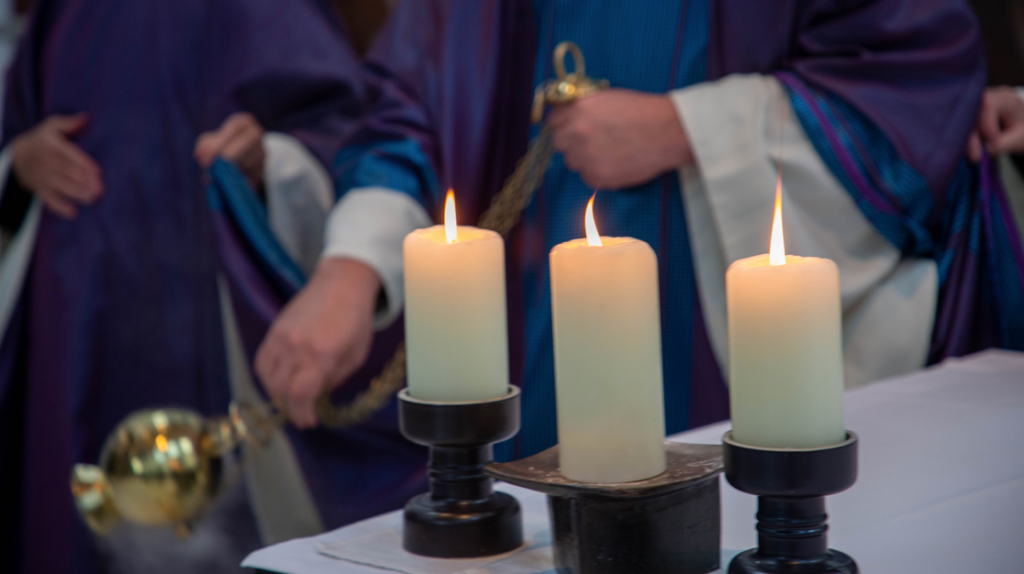
Saint Benedict took Lent seriously. He dedicates Chapter 49 of his Rule for monks to the ‘Observance of Lent.’ He doesn’t mince his words – ‘the lives of monks should be Lenten in character at all times.’ But he quickly acknowledges that most of us are not able for that and urges us at least to make an extra effort ‘in these holy days to atone for what was neglected at other seasons.’ And he says this will be done worthily if we abstain from vice, if we work at prayer with tears, at reading with compunction of heart and abstain from some food, drink and or sleep.
Benedict’s categories of reading, prayer, compunction of heart and abstinence seem like things we easily neglect at other seasons. But they are necessary if we are to live well, to live wisely, in this distracted, restless world. Living within our ‘culture of comfort,’ it is good and even necessary to take a ‘pull’ on ourselves and do something by way of stretching our lives; take aim at areas we have neglected in our daily round.
Benedict ends his chapter warning his monks that they must set off on their own project of reform but submit what they intend doing for Lent to the Abbot to avoid ‘vainglory and presumption.’
When I joined the monastery over fifty years ago, we had a practice that reflected Benedict’s advice. Each monk drew up a list of things he would do for Lent. The list had to include: a book to read, a virtue to practice and some food to abstain from. This list had to be presented to the Abbot before Ash Wednesday for approval.
Of these three spiritual disciplines, the practice of virtue is not something we hear much about these days. A virtue has become the trait of the ‘goody good’ rather than a useful spiritual practice. Unless it comes in just ‘one click’ we are not interested. This is to our detriment. Virtues opted for and practiced are our allies and fortify us to live well as we wade out into the mainstream of life’s many challenges.
Any number of virtues suggest themselves, such as reverence, gratitude, patience. Maybe patience is the one we need to practice more than any other these days. Carlo Carretto, who spent over 20 years in the Sahara desert as a monk, was asked when he emerged if God had asked anything of him during his long silence. His answer was clear and unambiguous: ‘God is asking us to be patient.’
We are no longer used to being patient. We expect things to happen immediately and with ‘one click’ and become irritated or even angry at any delay. It wasn’t always so – throughout most of human history, patience was not a choice – our ancestors waited for light, waited for the harvest, for rain, for news.
The dictionary definition of patience may surprise you: ‘the capacity to accept or tolerate delay, problems, or suffering without becoming annoyed or anxious.’ I was surprised by the tenor of this definition particularly by the inclusion of suffering.
‘The greatest temptation of our time,’ says Eugene Rosenstock Hussey, ‘is impatience in its full original meaning – a refusal to wait, undergo, suffer. We seem unwilling to pay the price of living with our fellow people in creative and profound relationships.’
We are in a hurry and want, even demand, the quickest, the fastest, and are contemptuous of slowness. But human life, especially spiritual life, does not do speed. ‘There are no shortcuts’ says Eugene Peterson, ‘to becoming the person we are created to be.’ Human life is complex and deeply mysterious and requires a ‘deep passion for patience.’
Why not take Benedict’s advice? Select a book that will move you closer to the Lord; abstain from some food (fasting has been shown to be beneficial in so many ways, and not just spiritually!) and practice a virtue… maybe even patience.
Simon Sleeman OSB