

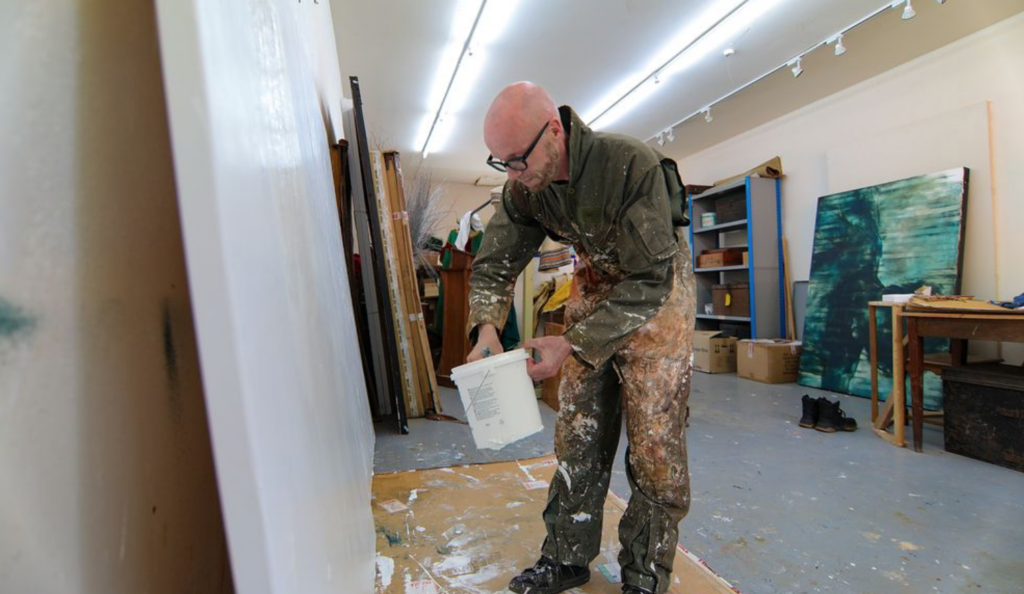
Anyone visiting Glenstal cannot but notice and be struck by the awesome, dramatic contemporary paintings confronting them in the Abbey Church, the Guesthouse and in the Reception area: all works of Brother Emmaus O’Herlihy OSB.
As behoves a monk, Emmaus is very self-effacing – but is an enthusiastic and very eloquently speaker when discussing his paintings (which he describes as an exercise in theology), the artistic choices and the theology behind them.
His academic background is impressive: in addition to a Bachelor of Design from the National College of Art and Design, Dublin, Emmaus obtained a Master of Theological Studies and a Doctorate in Theology from the University of St Michael’s College, University of Toronto, Canada.
Emmaus is also an excellent writer: his doctoral thesis (for which he had been awarded the Governor General’s Gold Medal for Academic Excellence) was published in 2024 as Worship Reshaped by Interruption. It is very much ‘specialised reading’, but as an art historian I found it really absorbing, particularly in its discussion of the role of art within the reform and promotion of the liturgy following Vatican II (Chapter VII of the Constitution on the Sacred Liturgy, promulgated by Paul Vi in 1963).
It is interesting to note how the Church has always relied on art as a mediator to convey its message. In 1557, at the time of the Counterreformation, following the Council of Trent, St Charles Borromeo set out some very explicit Directives on what was appropriate and desirable.
In 2025 Emmaus published a beautifully-illustrated 150 pages book, simply entitled Paintings, in which he presents a selection of his works and discusses the theological points that underpin them. It can be purchased from Glenstal Abbey Shop: https://shop.glenstal.com/collections/all-books/products/paintings
Although it is described as ‘coffee-table book’, it certainly is not just an eye-candy: the texts that accompany each work and their dramatic details are a great exercise in exegesis and an inspiration for meditation. The theme that unifies the works is ‘the flesh is the hinge of salvation’, with much emphasis on physicality and vulnerability.
Earlier this year, in April 2026, building on these ideas, some of Emmaus’ works were exhibited in Limerick Museum. With the title ‘The Mystery and the Mud’, the exhibition explored the idea of humanity in its reality, its embodied experience of both sin and grace, messy and far from perfection, but never far from God, its loving creator and redeemer.
The gallery exhibition space was quite intimate, so only six paintings could be exhibited. Their huge size presupposes large spaces, but we viewers were afforded a close look at the way paint and paintbrush strokes masterly create ‘flesh’ in its texture and drama, and how the background to the figures suggests both an earthly space and infinity, their restricted, sombre palette inviting reflection. I was particularly taken by two works that were new to me, and that also feature in Paintings.
EGO VERITAS SUM (2019; oil on canvas, 183 cmx 244 cm) is a particularly arresting work. It imagines Christ, bound, crowned with thorns and painfully brutalised, standing on trial in front of Pilate. Pilates’ question ‘What is truth?’ elicits no answer from him: it is really the wrong question to Jesus’ statement, which Pilate has not understood at all… In Jesus’ silence and serene facial expression, we can read that ‘his thoughts are not our thoughts’, but that they are turning to his Kingdom. Against the plain background of the canvass, we catch a glimpse of a glorious, ineffable transfiguration, as Christ appears to dissolve in the pure light of ‘being the Truth’. His powerful, body and tightly-clasped hands make a powerful contrast with the evanescent head – we know that, in his love for us, he will stand firm and go through all the pain, agony and horror of the cross to gain our Redemption.
In contrast, the sombre, very beautiful profile of the protagonist of NEITHER DO I CONDEMN YOU (2025; oil on canvas, 183cm x 122 cm) dominates the canvas, which is saturated in hot tones of red-orange and burnt sienna, conveying an oppressive sense of mortal danger under relentless scorching heat. The painting focuses on the very end of the story of the woman caught in adultery, when, after all her accusers, one by one, have left, having been shamed by Jesus, she stands alone to face him. The woman’s expression is composed and tense: she has escaped being stoned to death, but now how harshly will this Teacher berate her? Will she have enough strength and eloquence to defend herself? Jesus, however, is the God of surprises – and merciful love: he knows about her heart and her situation, and he does not condemn her – but tells her that from now on she is to sin no more. As Emmaus notes, this is ‘judgment that doesn’t condemn but liberates’: it allows her to see clearly ahead and start again with courage: it affirms her dignity. This episode carries a lesson for us all: not to hastily and harshly judge and reject people that society condemns as ‘sinners’ – but to consider our common humanity and shared dignity as children of God, and to see how we could help them turn things around and find their true selves.
It is truly wonderful to have such a gifted and inspiring artist as Emmaus working in Glenstal: if you cannot visit and see his art in person, I warmly recommend Paintings as a beautiful book, full of startling new insights, which invites us to look, think and grow our Faith.
Dr Anna Gannon is an Oblate of Glenstal Abbey and Fellow Emerita of St Edmund’s College at the University of Cambridge.