

The times in which we live are among the most challenging, both for the world and for the Church. As Christians, we experience time as marked by the cycle of feasts. In last month’s newsletter, we were introduced to the beautiful tradition of announcing the movable feasts of the newly begun year, which traditionally takes place on 6 January. This month, it may be a good opportunity for us to pay closer attention to the feasts of the saints whom we commemorate throughout the year.
We have just celebrated one of them: a great saint of Ireland, Saint Brigid of Kildare. Brigid, with her distinctive voice and her ways that challenged established patterns of thinking, was part of a period of great religious fervour on this island. This was soon followed by the remarkable missionary zeal of the Irish, who tirelessly carried their enlightened faith to Scotland and Britain, and further onto the European continent. These were turbulent times, yet the contribution of the Irish monks helped to establish a new and lasting identity for the peoples of Europe, particularly in France, Germany, and Italy.
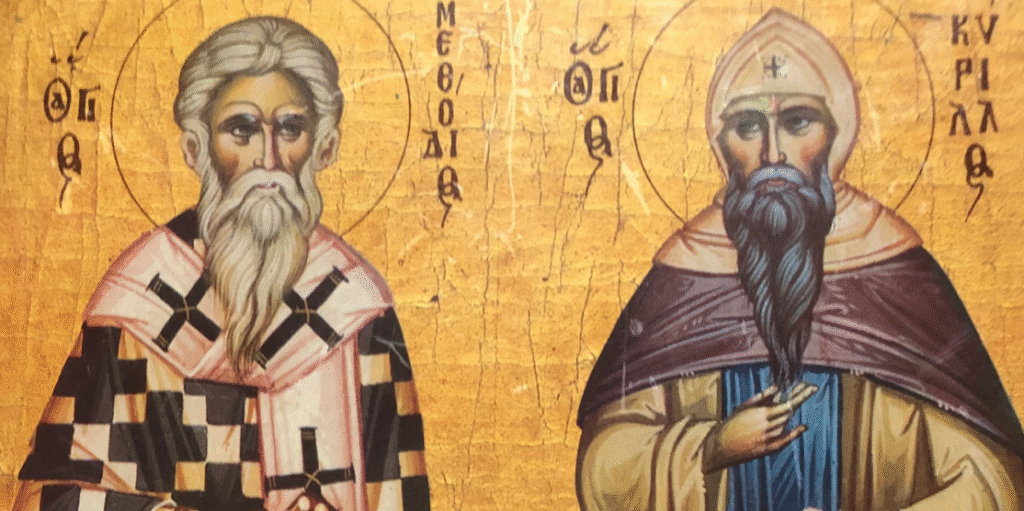
A parallel work was undertaken later by Bulgarian monks in the eastern parts of Europe. On 14 February, we will celebrate the founders of that missionary movement, Saints Cyril and Methodius. Not only did these brothers, together with their companions, evangelise a vast area of the continent, but they also established a new language for that purpose, known as Old Bulgarian, or Old Church Slavonic. They recognised that, in order to reshape the mindset of the peoples they encountered, a new tool of communication was necessary. Through the spread of this language, their mission reached as far north as Great Moravia.
Centuries later, Leoš Janáček, a composer from the land reached by those Bulgarian saints—now known as the Czech Republic—made a remarkable connection with the history of his homeland. Although he described himself as a non-believer, Janáček composed the Glagolitic Mass, a deeply moving work of liturgical music that pointed to the alphabet devised by Cyril and Methodius for the construction of their language. That alphabet would go on to shape the identity of many countries in Central and Eastern Europe.
Less than twenty years ago, Janáček’s compatriot and devoted admirer, the writer Milan Kundera—who had lived in exile in Paris since 1975—attempted to make sense of the composer’s mindset. “Who was he?” Kundera asked in one of the essays in his Encounter. He went on to question Janáček’s stature: “A provincial character under the spell of folk music, as he was persistently described by the arrogant musicologists of Prague? Or one of the great figures of modern music? And in that case, of which modern music? He belonged to no recognised trend, no group, no school. He was different, and alone.”
One of the brothers who established the mysterious Glagolitic alphabet, Saint Cyril—after whom the better-known Cyrillic alphabet is named—went to Rome toward the end of his life. His relics now rest in the church of San Clemente. Remarkably, in our present context, this church has long been cared for by Irish Dominican priests.
The question, then—for Rome and for the Church, for Europe and for the whole world—is this: where are we to look for the new identity so urgently needed today? Is it to be found in established patterns of thinking, in what is already recognised? Or must renewal come from what has so far remained isolated, different, and alone?
For anyone who truly cares about the future of the Church and of the world, the task is to apply themselves to a re-reading of the sources of our cultures. In Greek—the primary language of Cyril and Methodius—this act of re-reading is anagnosis, which literally means “re-cognition.” It is imperative that we re-cognise our own identity, our values and traditions, and ultimately the depths of who we are as Christians, as Europeans, or simply as inhabitants of this world. This may be the only way forward in these most challenging of times.
Jarek Kurek OSB