

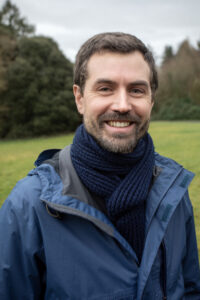
I recently had the chance to spend five weeks in Glenstal Abbey. It was quite a different setting from that of my own community: the Monastic Community of Jerusalem (Fraternité monastique de Jérusalem) whose motto, “In the heart of the city, in the heart of God,” indicates our choice to live a contemplative life in the midst of crowds.
Since I joined the community in 2009, I have lived in vibrant cities as diverse as Paris, Montreal, Cologne, and now in Strasbourg. Our community was founded in 1975 in Paris, in response to the then-Archbishop’s call for the creation of monasteries in the city in order to help city dwellers reconnect with contemplation within the urban rhythm of life.
This led to the creation of two independent communities, one of men and one of women, sharing the same spirituality and celebrating the liturgy together. We lead – or try to lead – a contemplative life whilst remaining close to the people. Our experience of work tends to be unusual for a monastic lifestyle: we look for part-time jobs in the city, usually as employees, both to earn a living and to share something of people’s lives.
Some teach in schools, work in hospitals, are secretaries in enterprises, and we sometimes end up in unexpected positions: I studied tourism and heritage management, but during my religious life I found myself working as an editorial secretary for a religious magazine, as an accountant in a charity organization, as a webmaster for my own community and – closer to my skills – as a tour guide in Cologne’s Cathedral.
It can be quite a struggle to lead a monastic life in the turmoil of the city, especially for somebody who grew up in the countryside like me. But – wisely – we leave the city every now and again for what we call a “desert day” and I can reconnect with nature, go for a hike, listen to the “silence” of the countryside, try to identify the birdsong… Needless to say, I particularly enjoyed the surroundings of Glenstal Abbey in this regard!
As in all monastic communities, the singing of the Liturgy of the Hours plays an important role in our daily routine. This is all the more significant to me because prayer is associated with music. Music is indeed one of my joys. Even though I am not from a musical family I was introduce to it at a very young age, and I started playing the clarinet as a child. As an adult, I learned the flute, which proved to be much easier to play with other musicians or with keyboard accompaniment (thus solving for me all the troubles of sight transposition I had with the clarinet!). It was a skill I could develop in religious life and, moving from one place to another, it gave me the opportunity to discover new repertoires, and meet and play with talented musicians. The most recent experience I made was indeed a great source of shared joy: playing the recessional for the First Sunday of Lent – Sonata in F for Flute and Continuo (Opus 2, No. 1) Adagio; Allegro – accompanied on the organ by Abbot Columba McCann OSB.
I warmly thank the monks for their hospitality and kindness. At a time when my own community is undergoing a period of reform, this stay at Glenstal has given me a great opportunity to take some time for reflection and to rediscover monastic life in a new light.
Frère Marc-Abraham Babski, FMJ.