

Fr Cuthbert Brennan OSB
The great prophet Jeremiah walks into our lives this morning and he is one of those people I’d rather read about than live with. He must have been one incredibly tough truth teller, reminding God’s first Chosen People how they had violated the covenant with their Creator, not only because of their worship of other gods but because of the way they had oppressed the poor.
So love of God and neighbour! It sounds familiar doesn’t it? Jeremiah announces a second chance – a fresh covenant, not one with new content but one with a new geography. From now on, the heart not
stone tablets will be the place where God writes his covenant. The late Stacy Simpson, a Baptist minister, in an attempt to understand what a heart inscribed covenant might look like, offers this reflection entitled Branded by God She writes; The image of God writing on the heart of the people is a compelling one, it also has a frightening aspect to it. Think of a tattoo. Pain, indelibility, identity are the central aspects of what it means to be marked. If it didn’t involve pain, it wouldn’t be indelible; marks that don’t hurt are the ones that wash off. If it were not indelible, what it revealed about a person’s identity wouldn’t be so critical.
Maybe you remember your catechism classes as a child where we learned that baptism left an indelible mark on our souls. At baptism a covenant was inscribed on us, our very hearts were tattooed by God. On the very centre of our being, we are fired with love, that same love which called St Patrick back to this land with the gift of the gospel. That gospel which isn’t simply a story showing us a path to life; it’s an education in what things are worth dying for.
Unless a grain of wheat falls into the earth and dies, it remains a single
grain; but if it dies, it bears much fruit. From Jesus, we learn that divine power is the most subversive force in all of creation. Rather than crush opponents, God’s power undermines evil and the violence it perpetrates. As Mahatma Gandhi explained, “Love is the strongest force the world possesses, yet it is the humblest imaginable.”
Ultimately, the greatest leap of faith Christians are invited to take is to
believe in this entirely counterintuitive and countercultural idea that the
forces of humility, generous love, and tender, nonviolent creativity are the instruments of world change. This is Jesus’ message. He taught that falling into the ground and dying lead to ousting the ruler of this world.
Jesus was planted on Calvary, St Patrick was planted in Ireland, we were
planted deep in a baptismal pool and it is here at our liturgies that we
rehearse transformation, we learn to germinate, we practise dying so that our lives when we leave here, can give seed to justice and care, respect and dignity, love of neighbour equal to a love of God.
Jesus knew what he was living for. And he knew what he was dying for. He was the grain of wheat that died and produced much fruit. That fruit is us. That leaves only one question on this St Patrick’s Day – What are we dying for?
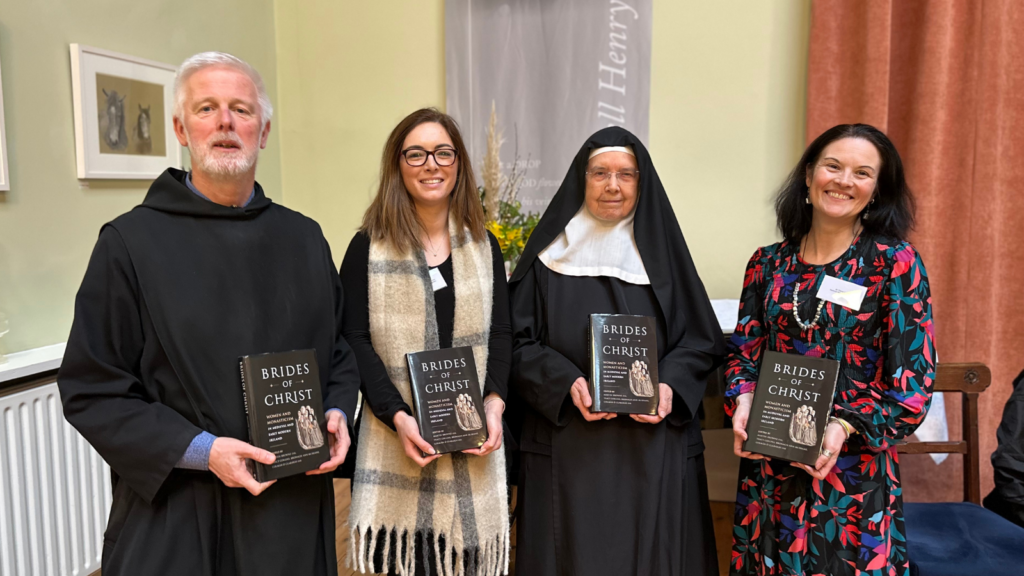
On 6 March 2024, the Benedictine Community at Kylemore Abbey hosted a one-day symposium on the history of nuns and female monasticism, to mark the launch of Brides of Christ: Women and Monasticism in Medieval and Early Modern Ireland (Four Courts Press, 2023).
Organised in association with the University of Notre Dame Kylemore Abbey Global Centre, over 75 guests attended the programme, travelling from all parts of Ireland for this unique gathering.
Throughout the long history of Irish monasticism, the experience of women monastics has, until recently, been relatively sidelined. A desire to redress this inspired the decision to dedicate the fifth Glenstal History Conference in 2021 to exploring the various ways in which women responded to the monastic and ascetic vocation in medieval and early modern Ireland, with the publication Brides of Christ bringing together the contributions made at that conference. This work highlights the extraordinary Irish women who found creative and dynamic ways to pursue their calling as ‘Brides of Christ’ between the fifth and the seventeenth centuries, often in the face of tremendous difficulties and challenges.
Last week’s Symposium, entitled Keepers of the Sacred Flame, drew speakers from Ireland and the US, including Dr Tracy Collins of the National Monuments Service; Sr Faustina Greally of the Poor Clares in Galway, Dr Bronagh Ann McShane of Trinity College Dublin; Professor Amy Mulligan of the University of Notre Dame; Dr Colmán Ó Clabaigh OSB of Glenstal Abbey, and Professor Deirdre Raftery of University College Dublin.
Following the Symposium, M. Máire Hickey OSB, former abbess of Kylemore Abbey launched Brides of Christ: Women and Monasticism in Medieval and Early Modern Ireland. The book’s editors include Glenstal Abbey’s Br Colmán Ó Clabaigh OSB and Fr Martin Browne OSB.
To purchase a copy of the book please visit Glenstal’s online shop here.
Fr Lino Moreira OSB
In his dialogue with Nicodemus, a Pharisee who came to see him during the night, Jesus spoke about the light of faith, and at one point he said: ‘As Moses has lifted up the serpent in the wilderness so must the Son of Man be lifted up, that whoever believes in him may have eternal life’ (Jn 3:14-15). Jesus was referring to chapter 21 of the Book of Numbers, where fiery serpents are said to have been sent among the Israelites in the desert to punish them for speaking against God. Moses interceded for the people, and then God told him what he had to do to save them. So Moses made a bronze serpent and set it on a pole – reports the sacred author. – And if a serpent bit anyone, they would
look at the bronze serpent and live (Nm 21:9).
Nicodemus was very familiar with this story, and Jesus told him that the bronze serpent was an image of himself, and that whoever looked at him with faith would be rescued from the power of Satan and live forever. But what exactly did Jesus mean by saying that the Son of Man must be lifted up? As is often the case in Saint John’s gospel, the assertion has a double meaning. Jesus was not simply predicting that he would be crucified in Jerusalem, he was explaining that his death on the cross would be the moment of his exaltation, the occasion when – having accomplished the task entrusted to him by his Father – he would be glorified with the glory that was his from the beginning
(cf. Jn 17:4-5; 19:30).
Seen in this light, the crucifixion of Jesus was not a humiliation, but
rather a revelation to the world that the Son of Man was also the Son of God, and that the one into whose hands the Father had placed all things (cf. Jn 13:3) was enthroned on the cross as supreme king over the whole creation. That is why Jesus said to Pontius Pilate: ‘You are right in saying that I am a king. For this reason I was born, and for this I came into the world, to testify to the truth. Everyone on the side of truth listens to me’ (Jn 18:37).
As king of all creation Jesus was commissioned by God the Father to
judge the world on his behalf. And again according to Saint John’s gospel, judgement is an on-going event, not just something that will take place at the end of time. As we have heard today, Jesus gives a verdict for the here and now when he says that whoever believes in him is not condemned (cf. Jn 3:18). And then he explains that a genuine believer is someone who does what is true (cf. 3:21) – an idiom which means the exact opposite of doing evil (cf. 3:20). So we should ask ourselves constantly, as we go about our daily life, whether we are doing what is true – that is to say, whether we are living by the
truth and our deeds are good. Conscious of the many times we have fallen short, we may be inclined to think that the standards set by Jesus are simply too high for an ordinary human being – a fact which seems to find confirmation in Saint Paul’s sobering words: I do not do the good I want, but the evil I do not want (Rm 7:19). However, perfection is our goal, not our point of departure. Jesus calls all God’s children, saints and sinners alike, to come to him with full confidence, so that through his divine power they may overcome the darkness of evil and experience the joy of a new life. Let us, then, never lose hope, mindful of what our Redeemer said to some Pharisees who were less sympathetic than Nicodemus: ‘I am the light of the world. Whoever follows me will not walk in darkness, but will have the light of life’ (Jn 8:12).
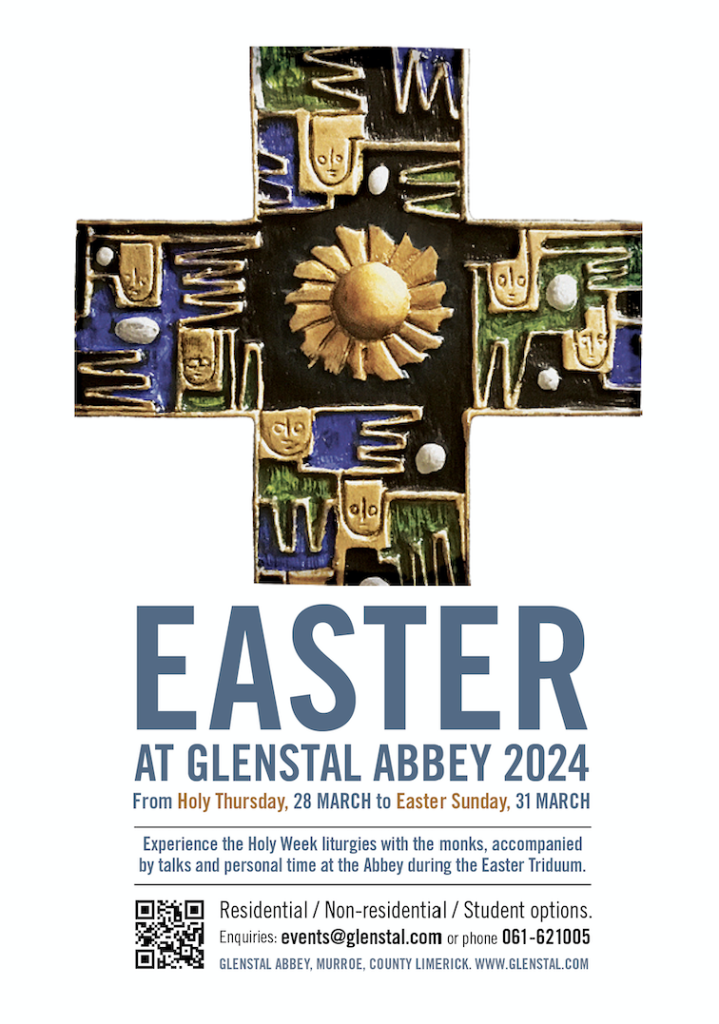
All are invited to join the monks of Glenstal Abbey in celebrating the Easter Triduum: the Mass of the Lord’s Supper on Holy Thursday, the Celebration of the Lord’s Passion on Good Friday and the Easter Vigil on Holy Saturday. The Liturgy of the Hours – Morning, Midday, Evening and Night Prayer – will be celebrated as appropriate each day also.
Participants in our annual retreat will be able to deepen and enrich their experience of these holy days through a number of talks and and personal time. Talks include:
This year’s annual retreat takes place from Thursday 28th March Sunday 31st March with residential (full bed and board), non-residential (meals included) and student options available.
To book please email events@glenstal.com or call 061 621005.
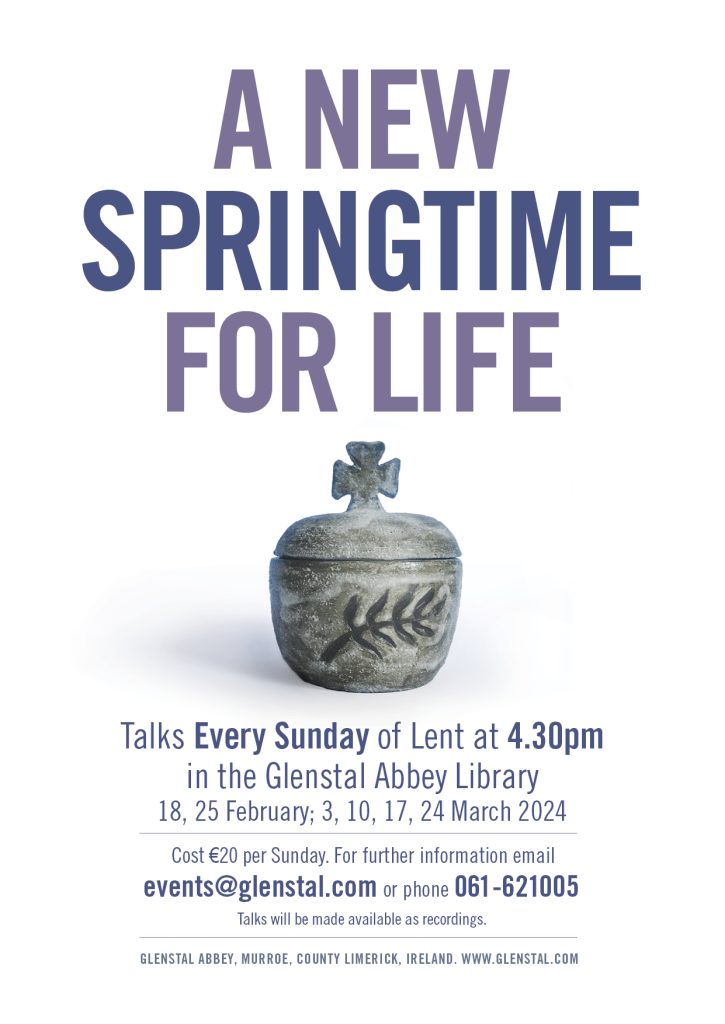
Our journey through Lent – ‘A New Springtime for Life’ – continues with the monks of Glenstal Abbey each Sunday of Lent with a talk at 4.30pm in the Monastery Library.
Cost is €20 per Sunday, with talks made available later on our YouTube page. Each talk will be followed by refreshments and an invitation to join the monastic community for Sunday Vespers in the Abbey Church. For more information please email events@glenstal.com or call 061 621005.
Fr William Fennelly OSB
There is surprisingly little in common between St John’s Gospel and the other three. Apart, of course, from the bare facts of Jesus’s life, notably his crucifixion, there are very few stories from his biography that all four agree on. But today’s tale of the ‘cleansing of the temple’ is such a one, and all four Gospels see this incident as closely related to Jesus’s death. This is not simply because Jesus was only making himself a nuisance and causing a fuss – even a potentially explosive fuss at the
biggest event in the Jewish year – but because by his actions Jesus was seen to be making a claim about himself, one that was absolutely unacceptable to the religious authorities of Jerusalem.
This is very obvious in the account that we read today. ‘What sign do you have to show us for doing this?’, he is asked. In other words, ‘Who do you think you are?, and why should we believe you?’ Now Jesus gives an answer, but it’s a cryptic one, which is naturally enough misunderstood, at least until the resurrection, when the sign is fulfilled. But in fact what he has done is itself the sign that justifies his action, if
we recognise the point of his saying about making the temple a ‘house of trade’.
Naturally we take this to mean that Jesus is against selling things and changing money in the temple. We may ask ourselves whether he would express equal displeasure at copies of Catholic newspapers and related products for sale in the back of so many Churches. But this misses the point. Without the sellers of animals for sacrifice, animals that were guaranteed to be acceptable according to the Law of Moses, there could be no sacrifices. Without the money changers, taking the
unacceptable Roman coins and converting them into the acceptable which was shekels, no-one could offer money to the treasury or pay the temple tax that every Jew took pride in paying. In other words, Jesus is not just trying to get rid of a few corrupt practices that have crept in to stain something he basically approves of; no, he is trying to put a stop to the whole thing.
And this is because Jesus brings, in his own person, the fulfilment of the prophecy of Zechariah – in fact the very last verse of his prophesying, which says that ‘there shall no longer be a trader in the house of the Lord on that day’. On what day? On the day of the Lord, when the Lord shows himself to be King over all the earth, when all the nations of the earth will be gathered into one, and when ‘living waters shall flow out from Jerusalem’. On the day of the Lord, the temple is no longer needed, because the whole world is sanctified by the presence of the Lord.
Jesus claims to be the one who brings in this day of the Lord. Indeed, when he is nailed to the cross, Pilate will truly (though he does not mean to be truthful) proclaim that here is the Lord enthroned as King. From that Crucified King living waters will indeed flow out from Jerusalem to bring life to the whole world, on the day when zeal
for God’s house does indeed consume him.
What is this zeal? On the one hand, it is the misplaced zeal of those trying to protect the status quo, the present arrangements which are working out very nicely. Thank you very much, for the temple authorities, and they’ll not encourage anyone who threatens their fragile authority. Or perhaps they are not so cynical: after all, the temple was a great institution, it was after all the place where God had chosen to make his dwelling among humanity and invite his chosen people to celebrate his mercy by participating in the sacrifices established by Moses. All of that, important though it was, was but a sign pointing towards its fulfilment, the astonishing fulfilment that came in the person of Christ. Perhaps we are all guilty, from time to time, of loving the outward signs more than the inward reality.
But more importantly, the ‘zeal for your house’ that consumed Jesus is also Christ’s love for God’s true house, which is the whole world, and which is every human heart that welcomes his Spirit of truth and love.
On the Cross Jesus died for love of us, as zeal for our hearts consumed him. The challenge is very radical for us. Today, will we decide to accept that life-giving love, and if we do, are we willing to accept the sometimes very inconvenient consequences of such a profound change? This renewed religious consciousness does not just arise out of our own selves; it is simultaneously the call of God addressed to us. And it is the working, the operation, of God welling up from the bottomless depths of our soul. Only if God is alive in us, will he be alive in the church.