Categories


Fr Lino Moreira OSB
Jesus took with him Peter and James and his brother John, and led them up a high mountain by themselves (Mt 17:1). What mountain was this? The evangelist deliberately makes no mention of any specific location – be it Mount Tabor, Mount Carmel or the Hermon – in order to emphasise that Jesus and his disciples climbed to the top of a new Sinai or a new Horeb. And on this holy mountain, Jesus was transfigured before his three chosen witnesses: his face shone like the sun and his garments became as white as light (Mt 17:2).
Six days earlier, at Caesarea Philippi, Peter had confessed that Jesus was the Messiah, the Son of the living God (cf. Mt 16:16); now he and the two sons of Zebedee were able to see what had remained invisible until then, namely, that Jesus being one with his heavenly Father, was himself God from God, and Light from Light (cf. Nicene Creed). We can detect a reference to this experience in the Prologue to Saint John’s gospel, where we read: And the Word became flesh, and dwelt among
us, and we saw his glory, glory as of the only begotten from the Father, full of grace and truth (Jn 1:14). And also in the Second Letter of Peter we find a statement very much in the same vein: we did not follow cleverly devised tales when we made known to you the power and coming of our Lord Jesus Christ, but we were eyewitnesses of his majesty (2 P 1:16).
So the three witnesses of the Transfiguration saw Jesus’ divinity shining out of his humanity. They saw beforehand the glory of the risen Lord, and experienced an anticipation of Jesus’ second coming at the end of time. In fact this may well have been the fulfilment of Jesus’ prophecy, when he declared rather mysteriously: “Truly I say to you, there are some standing here who will not taste death until they see the Son of man coming in his kingdom” (Mt 16:28).
What the disciples saw on the holy mountain was confirmed by the voice of God speaking from the cloud that overshadowed them: “This is my beloved Son, with whom I am well pleased” (Mt 17:5). Here God the Father reaffirms what he had already said to his Anointed in Psalm two, namely: “You are my son, today I have begotten you” (Psalm 2:7). But the second part of God’s declaration is taken from the prophet Isaiah, who opened the first Canticle of the Suffering Servant with the
words: “Behold, my Servant, whom I uphold; my chosen one in whom my soul delights” (Is 42:1). In this way it was revealed on the mountain of the Transfiguration that Jesus was both the Son of God and the Son of Man, and that, as the Son of Man, he had to follow the path marked out for the Suffering Servant, and give his life as a sin offering (cf. Is 53:10). Jesus fulfilled this mission when he laid down his life upon the Cross as a sacrifice of atonement for the sins of the whole world. And
after he had accomplished in Jerusalem all that was required of him as God’s faithful Servant, he entered for ever into his glory (cf. Lc 24:26), opening the way of salvation to all who believe in him.
We can say, then, that Jesus’ garments of light at the Transfiguration also point to the future glory of those who firmly confess that he is the Son of God, and are baptised in his name. Indeed, in a vision of the end times, the author of the Book of Revelation saw the great multitude of the elect from every nation, race, tribe and language standing before the throne and before the Lamb, clothed in white robes and holding palms in their hands (cf. Rev 7:9). And he heard one of the elders say: “These are the ones who come out of the great tribulation; they have washed their robes and made them white in the blood of the Lamb” (Rev 7:14).
That means that, through baptism, the believers are united with Jesus’
Passion, which washes away every stain of sin – and being thus restored to their original innocence, they are clothed with Jesus in light. So we ourselves have become light, when we were baptised in the name of Jesus. And since this mystery of our union with the risen Lord, the Light of the World (cf. Jn 8:12), was made manifest on the mountain of the Transfiguration, we needn’t be afraid to glory in the Cross of Christ (cf. Ga 6:14), and to suffer for the gospel, whenever necessary, relying on the power of God (cf. 2 Tm 1:8) who can make us win the palm of victory.
Fr William Fennelly OSB
This week sees us begin our annual observance of Lent. We may want to consider: ‘Am I willing to allow myself to be changed in this lenten season this year?’ The word ‘Lent’ apparently comes from the Old English word lencten meaning spring-time or ‘the lengthening of days’; it is a time of renewal, of coming back to life in nature; a time for the birth of young animals, and of looking forward. We usually think of lent as about self-discipline but it’s also about growth and these two elements remain in constant tension. In keeping with this season, our Lent can be an invitation to our own renewal in the ways available to us live with and for God; a time to recognise the love of God made visible to us in the creation all about us; it’s a time to notice those ways in which we fall short of the desires that God has for each one of us
and for our world, and to pray for the gift, the grace, to live more fully according to God’s ways.
We are familiar with ‘giving up for Lent’: perhaps this year our ‘giving up’ may be of those things in our lives that are getting in the way of valuing what God has given us, perhaps this year it’s a question of allowing God to deepen God’s life in us. It may help to take time, it may take patience to notice and to speak with our Lord, to pray about what lent means for me, or maybe just be quiet and be with for a bit.
The readings today speak about our choice to listen to the voice of God or to be tempted by evil: Adam and Eve are seen to succumb to the tempting voice, but in the gospel Jesus holds fast in his rejection of temptation. The Psalm today is a prayer of someone who knows their own sinfulness, but that person also knows that God’s love and mercy are more powerful than their weakness. St Paul celebrates the freedom
from sin that Jesus brings us. Jesus’s gift of love overcomes our sin and brings us to life.
Through our Lent, we ask for the grace to become more and more aware of God’s compassion and love for us, ready to journey with Jesus to his death on the cross and to celebrate his resurrection. The first temptation in the gospel temptation for food (like the two temptations that follow it) food does not entice Jesus to do evil things. In the first temptation the Seducer wished to induce the Saviour, instead of trusting in God and patiently enduring hunger, to create bread by His own power, against His Father’s will. He sought, therefore, to make our Lord sin by sensuality and an unlawful desire for food, or in other words by gluttony. All three temptations rather encourage him to do good things, but for the wrong reasons or at the wrong time. Jesus’s answer here is rooted in Scripture: he quotes from Deuteronomy (8: 3; 6: 16; and 6: 13), one of the great law books of the Old Testament. Jesus is not denying the importance of food, but stresses that there is another larger dimension to life.
For the second temptation, the scene is moved to Jerusalem, the Holy City, where Satan invites Jesus to give a convincing sign of his miraculous powers. This time the devil himself uses scripture, quoting Psalm 90 (91): 11–12. The Seducer tried to awaken a spiritual pride in Jesus, saying: “Throw yourself down; God will help you and see that no evil befalls you!” The cunning seducer wished by this clever ruse to
change a humble and submissive confidence in God’s mercy into a proud presumption. The reply Jesus gives, ‘You shall not put the Lord your God to the test’, foreshadows the episode where the Pharisees and the Sadducees will test Jesus by asking him to give them a sign (Matthew 16: 1–4). He resists the temptation to show his power for vain effect.
In the third temptation Jesus is brought up a mountain with a view of all the kingdoms of the world, of course no mountain exists which allows you to see all the kingdoms of the world. There may also be a parallel with Moses standing at the top of Mount Nebo (Deuteronomy 34: 1–3). Jesus doesn’t give into the threat of gaining political power over others. Matthew had an ecclesial purpose in the telling of these
temptations. He tries to explain to the first-century Church the kind of Messiah that Jesus was. By implication, he also showed the kind of society the Church should be, and how it should overcome its own temptations to temporal, political or spiritual power instead of focussing on love of God and the other.
Part of what all these battles against temptations reveal is that one of the main places we can meet God in the very weaknesses that seem to shut us into ourselves and shut us off from each other and from God. Just as our world seems to become ever more emancipated from the presence of God who might judge us paradoxically Pope Francis recently said that the fragility of each one of us, is a theological place of
encounter with the Lord,” Powerlessness, the state of being shipwrecked, is an experience we all share anyway, if we are sincere, but Bill Wilson (1895–1971), co-founder of Alcoholics Anonymous, discovered we are not very good at that either. He called it “denial.” It seems we are not that free to be honest, or even aware, because most of our wounds are buried in the unconscious. So, it is absolutely essential that we find a spirituality that reaches to that hidden level. If not, nothing really changes. It’s as if there is another exile—a "second space"—deeper and more enduring than his
geographic one. We could call this the banished metaphysical dimension in our culture, with its inability to see beyond the little “here” and the little “now.”
Volodymyr Zelensky: yesterday said that “Two things I had luck with – my country and my family. I am immensely thankful to my wife. I love my parents and my children whom I sadly never see now…”. But yep” he said “Ukraine, my country, wins because of two things. One is courage. The other is love”. Courage to understand and stick at the task and love to make sure that it matters at the heart of us and to
those who matter most to us.

The Lord asks us to “come back to me with all your heart” (Joel 2:12) and Lent is a fitting time to begin again.
Confessions are heard each Saturday from 3-4pm in the Abbey Church.
You are welcome!
Abbot Brendan OSB
What are you going to do between the time you get these ashes and the time you actually become them? This is the question posed to each one of us in the rite of blessing and distribution of ashes. “Remember that you are dust and to dust you shall return.”
Year after year, we come to this holy season of Lent and year after year, we are filled with good intentions. We review the ashes of our lives and resolve to do something about them. Somehow, despite all our good intentions, we seem to hold onto our ashes. We don’t give these ashes to God. In Lent, God is waiting to take the ashes of our lives and exchange them for His beauty.
The ashes we bless come from the burned palm branches we used last year on Palm Sunday. The palm branches from the triumphal entry of Jesus into the holy city of Jerusalem, amid acclaim from the crowd, are consumed by fire and become our ashes of repentance. How fitting this is. How many of our great schemes, begun with such fanfare and acclaim, end in ashes. How many of our relationships, hopes, dreams, come crashing down to earth in ruins.
Our ashes are the wounded parts of our lives, because we are dust and we will return to the dust, but God is waiting to take the ashes of our lives and exchange them for His beauty. He knows that they have come from the palm branches of our good intentions, as well as the mistakes and missteps we have taken along the road. So it is that the Prophet Joel speaks, “come back to me with all your heart, fasting, weeping, mourning. Let you hearts be broken not your garments torn, turn to the Lord your God again, for he is all tenderness and compassion, slow to anger, rich in graciousness and ready to relent.”
Ashes are everywhere in our lives; give them to God this Lent. I think the hardest wounds to turn to the Lord are the ones we wounded ourselves with when we did stupid things. Take courage in the ointment of fasting, the power of prayer and the zeal of almsgiving and open your hands to release those ashes in particular.
Easter is on the horizon, so no gloomy faces, no hypocrisy, insincerity, or half measures. For we are Christians, made from the dust of the earth in the image and likeness of God and reborn in the waters of baptism. What are you going to do between the time you get these ashes and the time you actually become them?
Subscribe to our YouTube channel for talks, prayer, chant, music and more coming soon from Glenstal:
Fr Anthony Keane OSB
Hearing the words of Jesus in today’s gospel, when struck on the right
cheek, turn the other, when forced to go one mile go two, when one’s
coat is demanded, give also ones cloak…some might wonder if the
cost of discipleship is not way to high. How can we let our enemies
strike us with impunity, take our possessions as they will and force us
to walk miles with them when we have better things to do. And this
is not all: we are to do all this with cheerfulness, happiness and love.
Not only must we avoid any grumbling, but we must go further still:
We are to be perfect as our Heavenly Father is perfect.
Are we here being press ganged into giving service way beyond our
strength? Perhaps. More adequately it might be said that we are here
receiving a pressing invitation to share in God’s glory, to receive not
only His gifts, but also the very generosity that inspires them. We are
indeed being pressed to accept this life giving offer. And there is a
great gang, a cloud of witnesses and of holy helpers, persuading us to
accept. Taste and see that the Lord is good. A friend of mine,
wandering in Brazil, came upon a little village clearing where a
woman sat making cakes and little loaves for baking. Beside her sat a
little child with a stick in his hand who kept on beating the cakes into
the dust as they were made. In response to his outrage the woman
responded that she like making cakes and the child liked breaking
them. The bin of four in that village was not emptied; the cruise of oil
did not fail; the chickens were delighted with their cupcakes filled with
grit and the divinity and delight of the child was honoured.
For those who might turn back in alarm at the prospect of going along
with every fool who comes the way, of putting up no resistance to the
violent, or of making no effort to protect property or the ability to
function fruitfully on earth, it must be understood that these words
are true and inspirational. They are not burdensome. They are
liberating. They are to be taken literally and applied as the Spirit
commands. They are not to be slavishly or stupidly and mechanically
applied. So, as the poet said, when necessary, plunge into battle,
plunge into battle but with freedom in your heart. The readiness to
give and to keep on giving may be seen in the presence of God’s
abundant love and mercy, of which it may be said: It is twice blest: it
blesses him that gives and him that takes. We are like profligate
children of an infinitely wealthy father. We earn no money ourselves
but enjoy life by giving away to our friends our father’s treasures. He
is rich in mercy. Let us give unstintingly then not from the limited
store of our limited selves but from God’s infinite abundance.
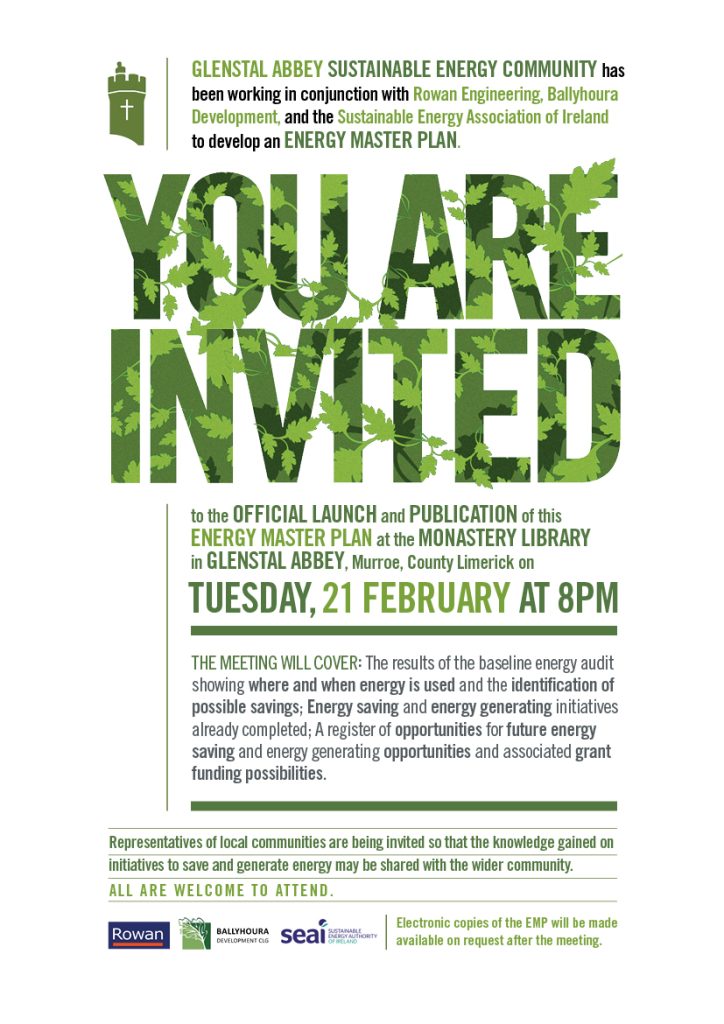
Glenstal’s Energy Master Plan will be published and launched by the monastic community on Tuesday 21st February at 8pm in the Monastery Library, and all are welcome to attend.
To coincide with the fifth anniversary of the publication of Laudato Si’ – Pope Francis’ groundbreaking encyclical on care for our common home – the monks of Glenstal Abbey began to look at ways of caring for our environment and reducing our ecological footprint as part of a series of community meetings called ‘Greener Glenstal’ during the summer of 2020.
This Energy Master Plan is the culmination of work by monks, staff, students, friends and partners of the monastery to see where energy is used, can be saved and even generated at Glenstal.
Representatives of local communities are invited to attend so that knowledge gained on initiatives to save and generate energy may be shared with the wider community.
A digital copy can be obtained here. For more information, please contact monks@glenstal.com