Categories
Abbey | Latest News abbeynews

Homily – Fourth Sunday of Lent (Year A)

Fr Columba McCann OSB

My sister worked for most of her life as a psychotherapist. I always had the sense that, in addition to her professional training, she had an innate gift in this area. She could walk into a room and see the
dynamics at work between people in the way they related to one another. She could see things no one else could see. It was unnerving at times, because she seemed to have x-ray eyes! It goes to show that seeing is more than just the colours and shapes that your eyes pick up. It’s about what you perceive. It’s about being in touch with reality.
We have just heard the story of the prophet Samul who is sent by God to find a new king for Israel among the sons of Jesse. When Jesse parades his sons before him, one finer and stronger than the
next, Samuel is not satisfied. Initially he was taken in by superficial appearances, but the Lord helped him to see. God looks at the heart, he is told; we tend to look only at appearances. It was the little guy who hadn’t even been included in the beauty pageant who got the crown, David the shepherd boy, a little nobody in his family. God saw in him the future king of Israel who would shepherd his people. No-one else saw it. They were blind.

All over the world right now there are thousands of people who are preparing to be baptised as adult Christians this Easter. Following an ancient tradition, today’s gospel is chosen specially for them. During these weeks they are coming to see ever more clearly who Jesus really is, and so the story of the healing of the blind man is ideal for them. But it’s also read for us who are already baptised.

When most people looked at the blind man they were thinking about sin: was he blind because he was a sinner or because his parents had sinned? Jesus sees him in a completely different way: this blind man will reveal God’s glory. Jesus puts mud on his eyes and tells him to wash in the pool of Siloam, the name of which means ‘the one sent’. But Jesus himself is the one sent from the Father. People preparing for baptism are being given a hint that in the waters of the baptismal pool, they are going to be plunged into Jesus himself.

The blind man begins to see with his eyes. But a deeper vision begins to dawn slowly on him. When questioned by the authorities he refers initially to ‘the man Jesus’. Later, under the pressure of argument, he says that Jesus is a prophet. Net he is able to see that Jesus must be from God. Finally, when he meets Jesus again, Jesus reveals himself as the Son of Man – a person wielding great authority given by God. But a deeper intuition, not even spoken by Jesus, takes him even further: he calls Jesus ‘Lord. This can simply mean ‘master’ but here it is also the respectful name ‘Lord’ given by Jews to God himself. We know this because when he calls Jesus ‘Lord he worships him. He has really begun to see!

Sadly the authorities are becoming more and more blind to Jesus because of their religious certainty. Their thoughts are boxed in by a narrow view of what God allows on the Sabbath day. We might say, ‘That’s well and good for people who are about to be baptised; they come to new insight about Jesus. But what about us? We are already baptised!’ This reminds me of a medical fact when it comes to ophthalmic surgery. Sometimes people who have been blind for a long time undergo a successful eye operation where everything functions
perfectly. The eye is now working exactly as it should, but they still cannot see. This is because it takes their brain some time to adjust to the new information it is receiving from the optic nerve. I think it may be like that for many of us and our baptism. We have received the Holy Spirit, we have been given the vision and insight, the light of Christ shone into our depths in baptism. But we still can’t see it, we seem unable to access it. Lent is a time for post-operative therapy, not
physiotherapy but therapy of the spirit.

Prayer, fasting and almsgiving are the traditional therapies to awaken our spiritual sight. Prayer puts us into close contact with Jesus, just like the blind. Jesus might as well be touching us. In fact he is even closer than that. Acts of kindness – almsgiving- activate the love that has been poured into us in Baptism so that it becomes an active energy in our lives, releasing joy and light. The search for immediate comfort and convenience often blinds us to the things that really matter, the things that give us life, and so some restraint in following all our attractions tunes up our spiritual awareness – fasting from food, from drink, from the internet, from gossip, or whatever it is that diverts us from bathing in the joyful light of Christ.

You don’t need to be a psychotherapist to have x-ray eyes. Our baptism has given us the capacity for a way of seeing that can keep growing from now into eternity. Lent is the time to open our eyes.
Awake, O sleeper!
Rise from the dead,
And Christ will shine upon you!

Categories
Abbey | Latest News abbeynews

Homily – St Patrick (Year A)

Fr Patrick Hederman OSB

Patrick: My dear Sisters and Brothers, we really need to update our sometimes pathetic notions about Saint Patrick. Nowadays, for instance, we could think about Patrick who was trafficked to Ireland as a slave; or Patrick the immigrant, shunned by many; or Patrick who said he was rescued by God like a stone pulled out of the mud. He was a man with a chequered past who relied on God’s kindness and preached it to others.

Spokesperson: Okay, Patrick, we get all that, but tell us about this Trinity thing. But remember that we’re simple people without your fancy education and books and learning and things, and we’re hearing all this for the first time. Try to keep it simple, okay Patrick?

Patrick: Very well, here goes: There are three persons, Father, Son, and Holy Spirit, but only one God.

1 st S: We’re not pickin’ up what you’re saying here, Patrick, could you make it more simple? Could you give us an illustration?

Patrick: Sure, sure, well let’s say that God is like water: God can appear in three forms: liquid, ice, vapour.

1 st S: Ah come on Patrick, is that not modalism . . .

Patrick: What?

1 st S:Modalism – an ancient heresy taught by such people as Noetus and Sabellius, which holds that God is not three distinct persons but that he reveals himself in three different forms. This heresy was clearly condemned in Canon One of the First Council of Constantinople in 381 AD and anyone confessing it cannot possibly claim to be a Christian. Come on Patrick!

Patrick: Okay, then, the Trinity is like the sun in the sky, where you have a star radiating both light and heat.

1 st S: Come on, Patrick, that’s Arianism!

Patrick: Arianism?

1 st S: Yes, Arianism, a heresy claiming that Christ and the Holy Spirit are created by the Father and are not one in nature with him, like how light and heat are not one with the star but merely creations of the star.

Patrick: Alright so, sorry about that. Well, you’ll have to love this one:
God is like this three leafed shamrock . . .

1 st S: I’m going to stop you right there, Patrick, that’s too corny for words. We need to move beyond the Patrick of the shamrocks and the snakes. And as well as that it’s what we call ‘partialism’ Patrick
Patrick: Partialism?

1 st S: Yes, a heresy which asserts that the Father, Son, and Holy Spirit are not distinct persons in the Godhead but are different parts of God, each forming one third of the divinity.

Patrick: Okay, fine, you smart alec bosthoon. The Trinity is a mystery which cannot be understood by human reason but can only be confessed by faith and which has been best expressed in the words of
the Athanasian Creed which says that we worship one God in trinity, and trinity in unity, neither confusing the persons nor dividing the substance. We are compelled by the Christian truth to confess that each distinct person is God and Lord and that the deity of the Father, the Son, and the Holy Spirit, is one: equal in Glory and co-equal in majesty. Have you got it?

1 st S: Well, why didn’t you just say that in the first place, Patrick ? You’re always beating around the bush – you must stop beating round the bush, Patrick.

Patrick: Fine. That’s enough to go on with for now; so: In the name of the Father, the Son and the Holy Spirit. Amen


Categories
Abbey | Latest News abbeynews

‘Draw Water from the Well of Salvation’ talk


Luke Macnamara OSB presents the third talk in our series for Lent 2023 – ‘Draw Water from the Well of Salvation.’

Listen to an audio-only version here.

 
Categories
Abbey | Latest News abbeynews

Homily – Third Sunday of Lent (Year A)

Fr John O’Callaghan OSB

Today’s gospel of the Samaritan woman at the well is presented to us in this season of Lent because it is an example of conversion to faith in Christ, something we are all supposed to be doing or deepening.
It is midday at the well of Jacob and Jesus is resting there. The woman comes along at an hour when the sun burns hottest – doubtless to avoid meeting anyone, because she was sensitive about her ill-repute. She sees someone sitting there but she takes little notice because he is a Jew, and Jews disdain Samaritans, and vice versa, since they fell out with each other centuries earlier over idol worship and defilement. A not altogether friendly question and answer session follows on Jesus’ request for a drink, with the Samaritan woman not understanding the deeper meaning of Jesus’ words “anyone who drinks the water I shall give will never be thirsty again.” Her reply is merely that he needs a bucket! But what is this ‘living water’? It is not eternal life itself but something that leads to it, namely the teaching of Jesus. The OT often used the symbolism of water for God’s wisdom; ‘the teaching of the wise is a life-giving fountain’ (Prov 13:14). But the Samaritan woman was not understanding.

She then twists the repartee in the direction of places of worship, Jerusalem or Mt Gezerim, where her break-away Jewish movement worships. We see that she is beginning to think spiritually although she misses out on the fullness of what Jesus is really saying – that he himself replaces religious institutions like the Temple. For Jesus real worship does not involve ritual purity or attending at one or other temple; our way to God is through him. The conversation moves on
two different plains: one material and practical whilst Jesus’ questionning and replying is always at a deeper, metaphysical, level.
The Samaritan woman’s defense is finally breached when reference is made to her ‘five husbands’. Jesus knows that her life has been marked by sadness and rejection. So he gently suggests, ‘Go and call your husband’. This gives her the opportunity to open out the story of her fragile heart just a little, and within a few sentences the whole truth is out. He, for his part, reveals himself to her when she mentions the Messiah: ‘I who am speaking to you, I am he.’ No words of rejection from him! Mutual self-revelation. Now the Samaritan woman indeed thirsts for living water, and tells her townspeople about ‘the man who
has told me everything I have ever done’, What we have witnessed is the drama of a person struggling as she rises from the things of this world to belief in Jesus. This challenges us too, puts the questions to each one of us, of ‘Who is Christ? Who is God? Who am I? Youth
in particular asks these questions as it is a time par excellence for self-
reflection, for big dreams and idealism. One option is to try to forget God. It is quite easy these days; to live out a banal, mediocre life-plan and think no further. But that can turn to disaster, especially in times of stress. The option given us of faith in Christ, is “to come to know God – the true God – [and this] means to receive hope”. And that hope draws the future into the present and giving us the possibility of living the present well no matter what the circumstances. The fact that a great future exists changes the present; the present is changed by the future reality, and thus the things of the future spill over into those of the present and those of the present into those of the future.

The people in the desert, in the first reading, were terrorised by the possibility of having no physical water, of thirsting to death. So too is our need for meaning in our lives, and for love, so as to persevere without loosing direction and drive. Christ is the rock gushing forth in such life-giving water. Faith in him shows us the way to God who alone guarantees us the possibility of a great life, of fullness of life!

Categories
Abbey | Latest News abbeynews

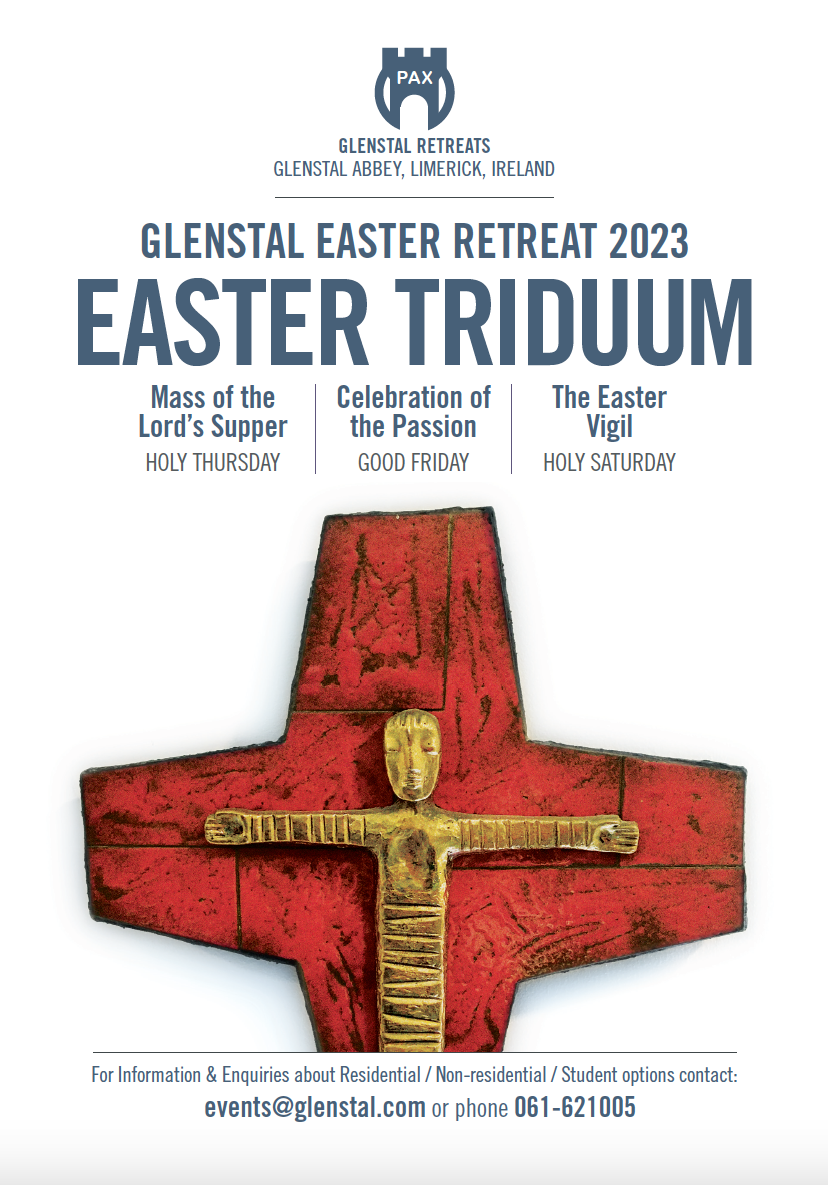
Easter Retreat 2023

You’re invited to journey through Holy Week with the monks of Glenstal Abbey at our Easter Retreat 2023, between 6th – 9th April.

The ceremonies of the Easter Triduum – the Mass of the Lord’s Supper, Celebration of the Lord’s Passion and the Easter Vigil – will be accompanied by a series of talks and times for prayer, reflection and table fellowship.

Speakers include Dympna Mallon (Director of the Margaret Aylward Center for Faith and Dialogue) with Columba McCann OSB, Colmán Ó Clabaigh OSB and Patrick Hederman OSB.

Residential participants will be lodged in rooms and dormitories at Glenstal Abbey School, with meals and refreshments provided. Please contact us for more information and for booking at: events@glenstal.com or call 061 621005.

Categories
Abbey | Latest News abbeynews

‘Transfiguration’ talk


The second in our series of talks for Lent 2023 can be viewed here, and an audio-only version is available here.

Categories
Abbey | Latest News abbeynews

Homily – Second Sunday of Lent (Year A)

Fr Lino Moreira OSB

Jesus took with him Peter and James and his brother John, and led them up a high mountain by themselves (Mt 17:1). What mountain was this? The evangelist deliberately makes no mention of any specific location – be it Mount Tabor, Mount Carmel or the Hermon – in order to emphasise that Jesus and his disciples climbed to the top of a new Sinai or a new Horeb. And on this holy mountain, Jesus was transfigured before his three chosen witnesses: his face shone like the sun and his garments became as white as light (Mt 17:2).

Six days earlier, at Caesarea Philippi, Peter had confessed that Jesus was the Messiah, the Son of the living God (cf. Mt 16:16); now he and the two sons of Zebedee were able to see what had remained invisible until then, namely, that Jesus being one with his heavenly Father, was himself God from God, and Light from Light (cf. Nicene Creed). We can detect a reference to this experience in the Prologue to Saint John’s gospel, where we read: And the Word became flesh, and dwelt among
us, and we saw his glory, glory as of the only begotten from the Father, full of grace and truth (Jn 1:14). And also in the Second Letter of Peter we find a statement very much in the same vein: we did not follow cleverly devised tales when we made known to you the power and coming of our Lord Jesus Christ, but we were eyewitnesses of his majesty (2 P 1:16).

So the three witnesses of the Transfiguration saw Jesus’ divinity shining out of his humanity. They saw beforehand the glory of the risen Lord, and experienced an anticipation of Jesus’ second coming at the end of time. In fact this may well have been the fulfilment of Jesus’ prophecy, when he declared rather mysteriously: “Truly I say to you, there are some standing here who will not taste death until they see the Son of man coming in his kingdom” (Mt 16:28).

What the disciples saw on the holy mountain was confirmed by the voice of God speaking from the cloud that overshadowed them: “This is my beloved Son, with whom I am well pleased” (Mt 17:5). Here God the Father reaffirms what he had already said to his Anointed in Psalm two, namely: “You are my son, today I have begotten you” (Psalm 2:7). But the second part of God’s declaration is taken from the prophet Isaiah, who opened the first Canticle of the Suffering Servant with the
words: “Behold, my Servant, whom I uphold; my chosen one in whom my soul delights” (Is 42:1). In this way it was revealed on the mountain of the Transfiguration that Jesus was both the Son of God and the Son of Man, and that, as the Son of Man, he had to follow the path marked out for the Suffering Servant, and give his life as a sin offering (cf. Is 53:10). Jesus fulfilled this mission when he laid down his life upon the Cross as a sacrifice of atonement for the sins of the whole world. And
after he had accomplished in Jerusalem all that was required of him as God’s faithful Servant, he entered for ever into his glory (cf. Lc 24:26), opening the way of salvation to all who believe in him.

We can say, then, that Jesus’ garments of light at the Transfiguration also point to the future glory of those who firmly confess that he is the Son of God, and are baptised in his name. Indeed, in a vision of the end times, the author of the Book of Revelation saw the great multitude of the elect from every nation, race, tribe and language standing before the throne and before the Lamb, clothed in white robes and holding palms in their hands (cf. Rev 7:9). And he heard one of the elders say: “These are the ones who come out of the great tribulation; they have washed their robes and made them white in the blood of the Lamb” (Rev 7:14).

That means that, through baptism, the believers are united with Jesus’
Passion, which washes away every stain of sin – and being thus restored to their original innocence, they are clothed with Jesus in light. So we ourselves have become light, when we were baptised in the name of Jesus. And since this mystery of our union with the risen Lord, the Light of the World (cf. Jn 8:12), was made manifest on the mountain of the Transfiguration, we needn’t be afraid to glory in the Cross of Christ (cf. Ga 6:14), and to suffer for the gospel, whenever necessary, relying on the power of God (cf. 2 Tm 1:8) who can make us win the palm of victory.

Categories
Abbey | Latest News abbeynews Uncategorized

‘Find Life in the Desert’ talk


Abbot Brendan Coffey OSB begins our Lent 2023 programme with his talk ‘Find Life in the Desert.’ 

An audio-only version of this talk is available here.

Talks take place each Sunday at 4.30pm in the Monastery Library and are live-streamed on the webcam.  For more information visit our events page.

Categories
Abbey | Latest News abbeynews

Homily – First Sunday of Lent (Year A)

Fr William Fennelly OSB

This week sees us begin our annual observance of Lent. We may want to consider: ‘Am I willing to allow myself to be changed in this lenten season this year?’ The word ‘Lent’ apparently comes from the Old English word lencten meaning spring-time or ‘the lengthening of days’; it is a time of renewal, of coming back to life in nature; a time for the birth of young animals, and of looking forward. We usually think of lent as about self-discipline but it’s also about growth and these two elements remain in constant tension. In keeping with this season, our Lent can be an invitation to our own renewal in the ways available to us live with and for God; a time to recognise the love of God made visible to us in the creation all about us; it’s a time to notice those ways in which we fall short of the desires that God has for each one of us
and for our world, and to pray for the gift, the grace, to live more fully according to God’s ways.

We are familiar with ‘giving up for Lent’: perhaps this year our ‘giving up’ may be of those things in our lives that are getting in the way of valuing what God has given us, perhaps this year it’s a question of allowing God to deepen God’s life in us. It may help to take time, it may take patience to notice and to speak with our Lord, to pray about what lent means for me, or maybe just be quiet and be with for a bit.
The readings today speak about our choice to listen to the voice of God or to be tempted by evil: Adam and Eve are seen to succumb to the tempting voice, but in the gospel Jesus holds fast in his rejection of temptation. The Psalm today is a prayer of someone who knows their own sinfulness, but that person also knows that God’s love and mercy are more powerful than their weakness. St Paul celebrates the freedom
from sin that Jesus brings us. Jesus’s gift of love overcomes our sin and brings us to life.

Through our Lent, we ask for the grace to become more and more aware of God’s compassion and love for us, ready to journey with Jesus to his death on the cross and to celebrate his resurrection. The first temptation in the gospel temptation for food (like the two temptations that follow it) food does not entice Jesus to do evil things. In the first temptation the Seducer wished to induce the Saviour, instead of trusting in God and patiently enduring hunger, to create bread by His own power, against His Father’s will. He sought, therefore, to make our Lord sin by sensuality and an unlawful desire for food, or in other words by gluttony. All three temptations rather encourage him to do good things, but for the wrong reasons or at the wrong time. Jesus’s answer here is rooted in Scripture: he quotes from Deuteronomy (8: 3; 6: 16; and 6: 13), one of the great law books of the Old Testament. Jesus is not denying the importance of food, but stresses that there is another larger dimension to life.

For the second temptation, the scene is moved to Jerusalem, the Holy City, where Satan invites Jesus to give a convincing sign of his miraculous powers. This time the devil himself uses scripture, quoting Psalm 90 (91): 11–12. The Seducer tried to awaken a spiritual pride in Jesus, saying: “Throw yourself down; God will help you and see that no evil befalls you!” The cunning seducer wished by this clever ruse to
change a humble and submissive confidence in God’s mercy into a proud presumption. The reply Jesus gives, ‘You shall not put the Lord your God to the test’, foreshadows the episode where the Pharisees and the Sadducees will test Jesus by asking him to give them a sign (Matthew 16: 1–4). He resists the temptation to show his power for vain effect.

In the third temptation Jesus is brought up a mountain with a view of all the kingdoms of the world, of course no mountain exists which allows you to see all the kingdoms of the world. There may also be a parallel with Moses standing at the top of Mount Nebo (Deuteronomy 34: 1–3). Jesus doesn’t give into the threat of gaining political power over others. Matthew had an ecclesial purpose in the telling of these
temptations. He tries to explain to the first-century Church the kind of Messiah that Jesus was. By implication, he also showed the kind of society the Church should be, and how it should overcome its own temptations to temporal, political or spiritual power instead of focussing on love of God and the other.

Part of what all these battles against temptations reveal is that one of the main places we can meet God in the very weaknesses that seem to shut us into ourselves and shut us off from each other and from God. Just as our world seems to become ever more emancipated from the presence of God who might judge us paradoxically Pope Francis recently said that the fragility of each one of us, is a theological place of
encounter with the Lord,” Powerlessness, the state of being shipwrecked, is an experience we all share anyway, if we are sincere, but Bill Wilson (1895–1971), co-founder of Alcoholics Anonymous, discovered we are not very good at that either. He called it “denial.” It seems we are not that free to be honest, or even aware, because most of our wounds are buried in the unconscious. So, it is absolutely essential that we find a spirituality that reaches to that hidden level. If not, nothing really changes. It’s as if there is another exile—a "second space"—deeper and more enduring than his
geographic one. We could call this the banished metaphysical dimension in our culture, with its inability to see beyond the little “here” and the little “now.”

Volodymyr  Zelensky: yesterday said that “Two things I had luck with – my country and my family. I am immensely thankful to my wife. I love my parents and my children whom I sadly never see now…”. But yep” he said “Ukraine, my country, wins because of two things. One is courage. The other is love”. Courage to understand and stick at the task and love to make sure that it matters at the heart of us and to
those who matter most to us.

Categories
Abbey | Latest News abbeynews

Confession times

The Lord asks us to “come back to me with all your heart” (Joel 2:12) and Lent is a fitting time to begin again.

Confessions are heard each Saturday from 3-4pm in the Abbey Church.

You are welcome!


Subscribe To Our Newsletter To Receive Updates

[hubspot type=form portal=6886884 id=9e1d6d0d-c51e-4e35-929d-3a916798de64]