Categories
Abbey | Latest News abbeynews

Taste and See retreat day

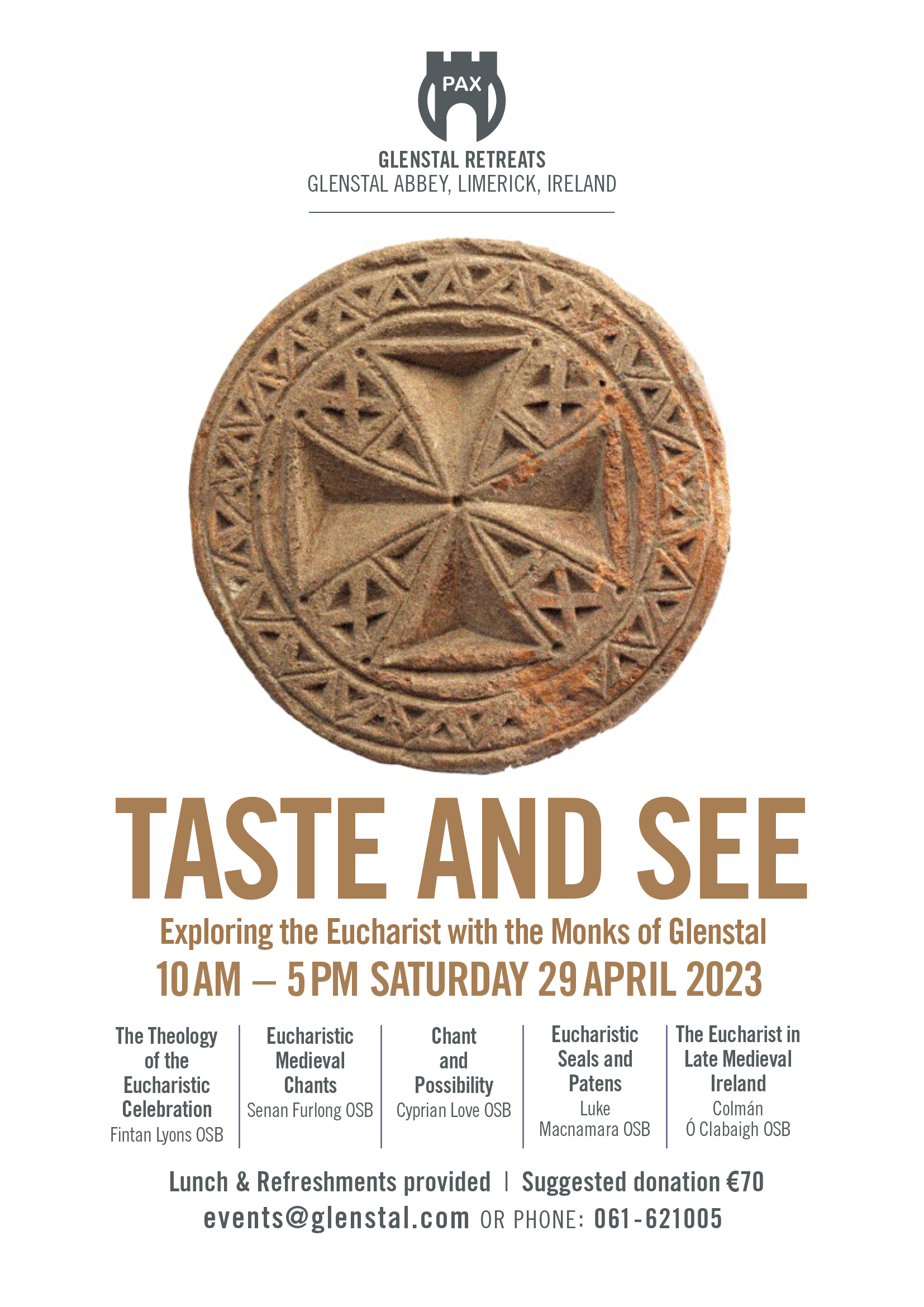
The Eucharist is the source and summit of our entire Christian life. You are invited to explore the theology, history and liturgy of the Eucharistic celebration with the monks of Glenstal Abbey on Saturday 29th April 2023 from 10am – 5pm.

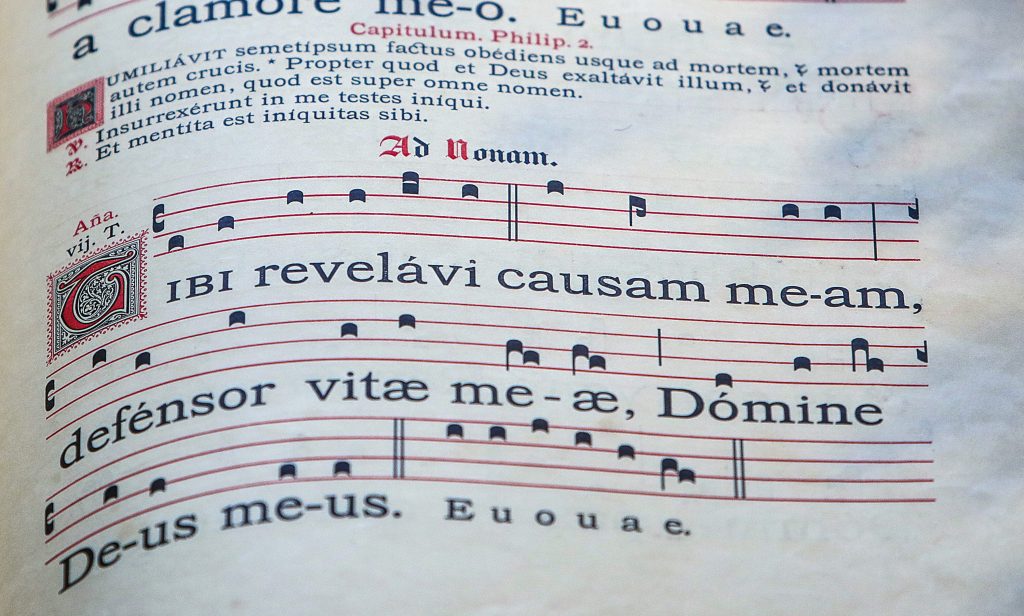
Fintan Lyons OSB will speak on ‘The Theology of the Eucharistic Celebration’ and Senan Furlong OSB will speak on ‘Eucharistic Medieval Chants.’ A talk by Cyprian Love OSB will explore ‘Chant and Possibility’ and the day will be concluded with Luke Macnamara OSB on ‘Eucharistic Seals and Patens’ and ‘The Eucharist in Late Medieval Ireland’ by Colmán Ó Clabaigh OSB.

Suggested donation for the day is €70 with lunch and refreshments provided. Please contact us for more information and for booking at: events@glenstal.com or call 061 621005.

Categories
Abbey | Latest News abbeynews

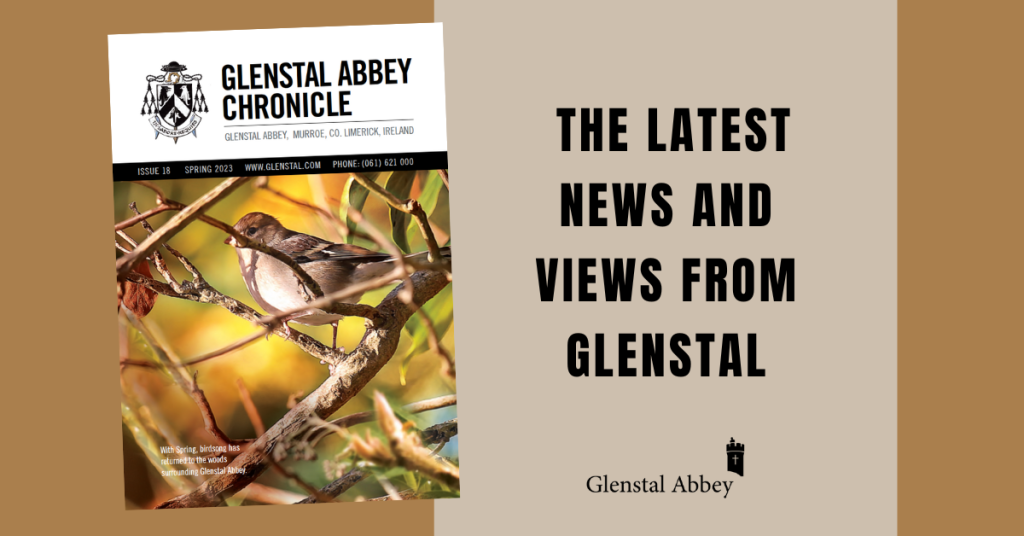
Spring 2023 Chronicle

Find some springtime reading from the monks of Glenstal Abbey in the latest edition of our Chronicle here.

Categories
Abbey | Latest News abbeynews

Homily – Easter Day

Fr Senan Furlong OSB

“I saw a hyacinth bulb being planted in a bowl. I thought, there is a wonderful fragrance locked up in that bulb; I knew of course that there is no place in the bulb a fragrance is locked up… Nevertheless there is in the bulb a potential which eventually will become the characteristic
fragrance as the flower opens…”

Unless a grain of wheat falls into the earth and dies, it remains alone; but if it dies, it bears much fruit. Christ has been raised from the dead, the first fruits of those who have fallen asleep in death. Alleluia!
Today we immerse ourselves in the mystery of Christ and his resurrection—Christ the very mystery of God, prepared before the beginning of the world, hidden in God, concealed from previous generations and now revealed to the saints. It is a mystery that unfolds every day; spreading its fragrance and opening up a new future for us all.

Easter is a promise, a gift. It is also a work, a mission to be carried out in the midst of the joys and sorrows, the beauty and chaos of our broken world. Yes, Christ has conquered death and given us the promise of eternal life. But the struggle between death and life, darkness and light, is ongoing and inescapable, and Good Friday continues to be daily re-enacted in the lives of so many. We live in a world longing for and in need of resurrection—a world ravaged by war and violence, inequality and injustice, hatred and self-destruction. In our own lives too, we long for resurrection, when it feels the powers of darkness and death have the last word.

But they don’t have the final say. For Christ’s resurrection is the true hope of the world. It is the power of the grain of wheat, the power of that love which humbles itself and gives itself to the very end, and thus truly renews the world. Christ not only laboured and struggled against death in the dramatic final days that ended in crucifixion; he laboured for life throughout his earthly existence, cultivating the gift of resurrection everywhere he went. The whole of his life was, as it
were, an unfolding Easter, bringing light where there was darkness, healing where there was pain, acceptance where there was abandonment. And this work of Easter—the task of being
heralds of resurrection, propagators of life, diffusers of hope—has been bequeathed to all of us who invoke his name.

The hyacinth bulb remains just a bulb unless it awakens and the flower opens. Resurrection is awakening the potential so that we become a fragrance of Christ to God and to one another. Therefore, we are encouraged to be imitators of God; and walk in love just as Christ loved us, giving himself up for us, a fragrant offering and sacrifice to God.

Mahatma Gandhi once remarked: A rose does not need to preach. It simply spreads its fragrance. As with the rose, so too with the hyacinth, and so too may it be in our lives. Draw us after you, O Risen Christ; we shall make haste to follow you, in the fragrance of your garments, to breathe the fragrance of resurrection.

Christ is risen. Alleluia!

Categories
Abbey | Latest News abbeynews

Homily – Easter Vigil

Abbot Brendan OSB

Easter is early this year. I won’t bore you with the complicated calculations that produce the date of Easter, but as you probably know it’s all to do with the Paschal moon which has been shining so brightly these nights.

There is a sense, however, in which Easter is early every year. It’s forever taking us by surprise. The women, moved by affection, went to the tomb early in the day, while it was still dark, to anoint the body. They did not give in to the gloom of sorrow and regret or flee from reality. In the darkness of their hearts, they lit a flame of mercy. Going to the grave of a loved one is something we often do. People are drawn to graveyards because it makes us feel closer to the one who has died. Graveyards are usually peaceful places, the last place in the world you would expect to find high drama. The tomb is the place where no one who enters ever leaves.

Imagine then how surprised the women were when they experienced a violent earthquake and saw an angel sitting on the great stone with the tomb lying open and empty. This was not someone breaking in; this was someone breaking out. The resurrection had already happened. Easter was early!

The first message of Easter is this: He is not here. He is risen! Everyone was afraid. No surprise there. The soldiers, we’re told, were shaken, like dead men, terrified of the angel. But the angel ignores the soldiers and speaks directly to the women, “There is no need for you to be afraid.” Tonight we acquire a fundamental right that can never be taken away from us: the right to hope.

The resurrection accounts are full of people getting it wrong. The simple fact is that our minds and our imaginations are far too small to contain the vastness of this mystery. This is why we still descend into jealousy, war and vengeance two thousand years later, when in reality what we need in the world today is bread, not more guns.

Did you ever wonder what it was like for those first few hours after the empty tomb was discovered by Mary of Magdala and the other Mary? Which of us would really rejoice at the prospect of a miracle that would make us rethink most of what we had taken for granted? Then into that chaos steps a figure before whose face ‘the questions fade away’. The future is now quite unimaginable; but there is nothing that can alter the sheer effect of his presence. That same presence is here among us right now. Tonight, humanity has for the second time in history, discovered fire. For this reason, we began our liturgy with fire, celebrating the light in darkness. For it was God who said, ‘Let there be light! We then made memorial of the history of salvation: the creation of the world, the faith of Abraham, the exodus from Egypt. Everything in history has a meaning and that meaning is fulfilled in the Resurrection.

Everything in history converges on that moment when the women arrive at the tomb; but the tomb was empty; they did not find the Lord there. They were on their way home when they met the Risen Lord. This is also how we meet him, in times of trouble, in times of joy, along the road of life. And so it is that this is the loveliest of all nights. The angel’s message was to go to Galilee. Galilee was the farthest region from Jerusalem; the farthest place from the sacredness of the Temple, an area where people of different religions lived. The message of hope should not be confined to our sacred places.

Many have seen in this white robed angel, a symbol for all the baptised – for you and me. Standing before the empty tomb the angel announces, “He has risen from the dead”, because this is what a Christian does – announces the resurrection!

Χριστὸς ἀνέστη! Ἀληθῶς ἀνέστη! (Khristós Anésti! Alithós Anésti!) Christ is Risen! He is Risen Indeed!

Categories
Abbey | Latest News abbeynews

Homily – Holy Thursday

Abbot Brendan OSB

“On the night he was betrayed”, this is how St Paul names this night in his first letter to the Corinthians and it is a phrase repeated in all the Eucharistic Prayers of the Church. This is the night of betrayal, the night of non-recognition, the night of abandonment by the disciples. It is in this context of our betrayal that Jesus gives us the gift of the Eucharist, his everlasting covenant of fidelity and love. We should embrace in all its scandalous truth the context in which the gift of the Eucharist was bestowed upon us.

On the night he was betrayed, on the night when the covenant is broken, Jesus celebrates the new and eternal covenant. The Eucharist was gifted on this night not because it was the last night before his arrest, but because it was the night when Jesus underwent exactly what we human beings are capable of: betrayal, denial and abandonment.

It is clear from all the gospels that Jesus wanted to share this final meal with his disciples. He planned it carefully, sent his disciples ahead to prepare it, and when the hour came, he declared: “I have longed to eat this Passover with you”. Jesus wanted his disciples not only to eat and drink, in a context of prayer and liturgy, but he wanted above all, through this bread and wine, to celebrate the new covenant.

The Eucharistic table, our altar, is not defined by our being righteous or unrighteous: there were no worthy people with Jesus at the Last Supper. However, Jesus in that very context took bread saying: ‘This is my body given up for you’. At the Last Supper Jesus broke the bread for the apostles who abandoned him, denied him and even betrayed him.

During his life on earth, he had broken bread with his friends in Bethany; he had broken bread in the homes of public sinners; he had broken bread with the crowds who came to him and understood little of what he said and did. The truth is that Jesus broke bread with all sorts of people and all of them were sinners!

St Paul goes on to remind us that there is also a second rite: “In the same way … he took the chalice, saying: ‘This is the new covenant in my blood. Every time you drink from it, do this in memory of me”. That cup, thanks to the word of Jesus, contains his blood, and that blood is the new covenant, the mystery of faith.

The Lord Jesus offered this covenant to everyone: to those who betrayed him, to Peter who denied him, to the disciples who were without the courage of their convictions. These were Jesus’ guests at the Last Supper, just as we are his guests here this evening. We may well ask ourselves, am I one of the disciples who abandoned Jesus. Yet what St Paul asks of us is very different. Paul asks that we ‘recognise the body of Christ’. In his letter to the Corinthians, ‘body’ carries two meanings: the body of the Lord in the bread and wine and the body of the Lord in the community. To help us with this recognition on this unique evening the Church gives us a third ritual, that of the washing of the feet. This too comes with a command, “Do as I have done to you”.

Eucharist means thanksgiving. On this most holy night, let us be thankful that we, though sinners, are numbered among the guests at this Supper of the Lord. Let us be thankful for this new covenant and let us be thankful for the mystery of faith.

Categories
Abbey | Latest News abbeynews

Holy Week and Easter

Liturgy times during Holy Week and Easter:

Holy Thursday

Morning Prayer  7am

Midday Prayer  12.30pm

Solemn Mass of the Lord’s Supper – 7pm

Compline – 9.45pm

Good Friday

Morning Prayer – 7.30am

Midday Prayer – 12.30pm

Solemn Liturgy of the Lord’s Passion – 3pm

Compline – 8.35pm

Holy Saturday

Morning Prayer – 7.30am

Midday Prayer – 12.30pm

Evening Prayer – 6pm

Solemn Vigil of the Lord’s Resurrection – 10pm

Easter Sunday

Solemn Morning Prayer – 8am

Mass (no singing) – 10am

Sung Mass – 12 noon

Solemn Vespers – 6pm

Compline – 8.10pm

Easter Monday

Morning Prayer – 7am 

Mass  12.10pm

Vespers  6pm

Easter Tuesday to Easter Saturday

Morning Prayer – 7am 

Mass  12.10pm

Vespers  6pm

Compline  8.35pm

Confessions

A priest will be available to hear confessions on:

Good Friday at 11am, 4.30pm and 5.30pm

Holy Saturday at 11am, 3pm, 4pm and 5pm

Categories
Abbey | Latest News abbeynews

‘Waving Palms and Singing’ talk


Thanks for joining our weekly series of talks for Lent 2023.

Watch the final contribution made by Br Colmán Ó Clabaigh OSB here bit.ly/3GeT2SR 

or listen to an audio-only version here: bit.ly/3U55DNX

Categories
Abbey | Latest News abbeynews

‘Lent in a Golden Calf Country’ talk


Father Simon Sleeman OSB encourages us to identify our idols and seek instead God in his talk for our Lent 2023 series.

Watch the video here or listen to an audio-only version here.

Categories
Abbey | Latest News abbeynews

Homily – Fifth Sunday of Lent (Year A)

Fr Luke Macnamara OSB

Five years ago I visited a 19 years old prisoner facing a life sentence. He was in the most secure part of a maximum security prison. I passed through so many locked doors that I was unsure I would ever get out. Reflecting back on that day, I wonder about what others prisons I have encountered in my life and the lives of others. There are many forces at work in the world that can imprison us and cut us off. Social media can so engross us that it ends up isolating us from those physically around us. Gambling and pornography can consume us leaving us with no energy to engage with others. Sometimes things beyond our control can imprison us such as physical illnesses or depression. Finally, there is one force that imprisons us all and that is death.

In the Acts of the Apostles, Peter and John in Jerusalem and Paul in Philippi are released from a series of high security prisons, usually with the assistance of an angel. When Jesus stands before the tomb of Lazarus and faces the definitive prison of death, he prays to God: “Father, I thank you for hearing my prayer. I knew indeed that you always hear me, but I speak for the sake of all these who stand round me, so that they may believe it was you who sent me.” It is only after praying to the Father and only after giving the Father thanks that Jesus
calls Lazarus out from the tomb. The restoring to life of Lazarus is the work of the Father and the Son and the result of prayer. Jesus reveals the power of God, Father and Son, to break the bonds of death. So if Jesus through prayer has broken the bonds of death for Lazarus, might we not also imitate him and through prayer ask that he liberate us from our various prisons and our beloved death from theirs, that they may enjoy eternal life. The name Lazarus signifies “one who is helped by God”. We can all be Lazaruses by invoking God’s help that we may have fullness of life wherever we may be.

Categories
Abbey | Latest News abbeynews

‘Turn Towards the Light’ talk


Fr Columba McCann OSB encourages us to ‘Turn Towards the Light’ in the fourth talk of our Lent 2023 series.

Watch the video here or listen to an audio-only recording here.

Details of the final two talks can be found here.

Subscribe To Our Newsletter To Receive Updates

[hubspot type=form portal=6886884 id=9e1d6d0d-c51e-4e35-929d-3a916798de64]