Categories
Abbey | Latest News abbeynews

Homily – Ascension of the Lord – A

Fr Patrick Hederman OSB

There are four gospels, as we know, but Luke alone mentions and describes the Ascension of Our Lord. It happens at the end of his Gospel and is taken up again at the beginning of this second work called The Acts of the Apostles. The Ascension, in his description, takes place as a blessing: the last paragraph of his Gospel reads: ‘lifting up his hands he blessed them, and as he blessed them, he withdrew from them and was carried up to heaven.’ The second book, which
describes what happened later when Christianity began, opens with those words we heard in our first reading this morning: ‘In my earlier work . . . I dealt with everything Jesus had done and taught from the beginning until the day he . . . . was taken up to heaven.’ Luke then quotes Jesus as saying: ‘when the Holy Spirit comes upon you, you will be my witnesses.’ You will be my ambassador; you will be my agent in the world. And ‘after he said this, he was taken up before their very eyes, and a cloud hid him from their sight.’

The scene then changes to the audience who stand dumbfounded,
gawking up into heaven. “ They were looking intently up into the sky as he was going, when suddenly two men dressed in white stood beside them.    “People of Galilee,” they said, “why do you stand here looking into the sky? This same Jesus, who has been taken from you into heaven, will come back in the same way you have seen him go.” He will come back to you, but in a different guise, not out there, but in here.
All this happens between Luke’s two books: his first one on the life of
Jesus, which we call his gospel, and the second one called the ‘The Acts of the Apostles,’ what his agents did when he was gone.

So, the mystery of the Ascension, which we celebrate today, a week
before we celebrate the coming of the Holy Spirit at Pentecost, is described and accomplished as a blessing. Christ’s leaving was a blessing . . . is a blessing . . . the best thing that ever happened; the necessary preliminary to all progress in the spiritual life. Noli me tangere [‘do not touch me’ in Latin] applies to us all: stop holding on to me; free yourselves up and stop swooning over my physical presence, my external reality. Find that all-important presence, that security, that strength inside yourself. Christ’s ascending to the right hand of the Father was the greatest blessing ever bestowed on us. It was the gift of the Holy Spirit which we find inside ourselves when we have stopped weeping and wailing about our various losses. Leaving and separation, painful as they might be at the time, are, in fact, the greatest blessing, because they allow us to find ourselves, and, more importantly, to find and to cherish the Holy Spirit within the depths of our being, the place where we breathe from. It is only when the separation is complete, that ‘the acts of the apostles’ can begin. And those ‘acts’ are our acts, the curriculum of our lives as apostles. ‘Apostle’ in Greek means ‘someone who is sent off to do something.’ We are the apostles; we are being asked here this morning: ‘Why are you still looking up into the sky?’ He is risen and has gone before you. You have to rise up too and walk tall. Wherever you go from now on, God is up there in front of you; the Holy Spirit is planted deep inside you, acting as a permanent guide. You just have to turn on your Sat-Nav., your GPS, your Global Positioning System, and ask the Holy Spirit about your ‘global positioning.’ Your destination will be included in the instructions, with
directions also on how to get there, if you listen carefully and accurately.

The blessing is yours, if you have a mind to access it, nothing is forced or imposed in this idiom, it is always, and forever, up to you. So, Go n-éirí an bóthar libh, as we say in Irish, may the road rise to meet you, especially if you are doing exams or making important decisions in your life at this time. May the Holy Spirit be your first port of call. Remember that between now and next Sunday the hot-line is open. Amen.

Categories
Abbey | Latest News abbeynews

Homily – 6th Sunday of Easter – A (Confirmation)

Fr Abbot Brendan OSB

Most of you sitting up front are not old enough to remember Terry Waite, but those sitting further back probably do. He was frequently in the news in the late ’80’s and early ’90’s. He worked as special envoy to the Archbishop of Canterbury and negotiated the release of hostages in the Middle-East. In 1987, while conducting hostage negotiations, he was kidnapped and held for 1,763 days, nearly 5 years. For 4 of those 5 years he was in solitary confinement and during that time he was frequently blindfolded, beaten, and subjected to mock executions. He lived much of the time chained to a radiator, suffered desperately from asthma, and was transported in a giant refrigerator as his captors moved him about.

After his release, he wrote two best-selling books recounting his experiences and gave countless interviews. He summed up his experience again and again in a single phrase. “At the end of the day, love and compassion will win”. He is just one of many people who having suffered greatly discovered this truth.

If you love me, you will keep my commandments, said Jesus. Those commandments are summed up as love of God and neighbour. It can sound all too easy to love, unless you hear it in a context where it has cost someone dearly. And yet Jesus tells us that this is how the world will know that we are his disciples. Our candidates for Confirmation, this morning, are completing their baptism, receiving the Holy Spirit and becoming his disciples. The point I want to make to you, is that this is a serious business. To really love is not an easy thing. It demands huge sacrifices from the one who loves. It demands patience, it demands wisdom too and it demands mercy and forgiveness.

Sometime in the past, water was poured over you and the words “I baptise you in the name of the Father and of the Son and of the Holy Spirit” were spoken. Most likely, you have no recollection of that day because you were too young. Nevertheless, some very powerful things happened on the day of your baptism. You were anointed with the Chrism of salvation as a member of Christ, Priest, Prophet and King. If you watched the coronation of King Charles recently you would have seen that he was anointed king with the oil of Chrism too. You were also clothed with a white garment at your baptism as a new creation in Christ and you were given a lighted candle, lit from the paschal candle, which burns here behind me. You were told to keep this flame of faith alive in your heart. Finally, the priest touched your ears and mouth so that you might proclaim your faith.

So here you are today, before the altar of God to complete your baptism and be sealed with the gift of the Holy Spirit by the laying on of hands and anointing once more with the oil of Chrism.

When Jesus gave the Spirit to the apostles, he breathed upon them. He breathed into them his own breath of life, his “spirit’ and the Church was born. For the Church is all of those people into whom the Risen Jesus has breathed the breath of his own risen life.

This is the good news we carry. If this is our newfound dignity as human beings, then how should we treat each other? How can it be possible for us who claim to be Christian not to be moved to compassion when we see a brother or sister in need? We are not left as orphans; we are those who love the Lord and are loved by him.

This is what it means to be a Christian and this, my young friends, is the challenge placed before you today. “At the end of the day, love and compassion will win”.


Categories
Abbey | Latest News abbeynews

Homily – Funeral Fr Anselm Barry OSB

Fr Abbot Brendan OSB

John Francis Barry was born on 24th day of March 1928 into a family of three boys and three girls. He entered the monastery of Glenstal on 11th March 1947 taking the name Anselm and became a member of this fledgling community. Fr Anselm spent much of his long monastic life in Wald, Germany, as chaplain to the nuns and to the school. Here he made lifelong friends and put down very deep roots. Anselm was at home in Wald and Wald was very good to Anselm.

As it happens, Fr Anselm was very aptly named. St Anselm his patron was born in Aosta, in Italy, became a monk at Bec in Normandy and ended up being Archbishop of Canterbury. Was he Italian, French or English? I’m not sure the question ever really bothered him. Our Fr Anselm was the same. He was truly international and he too spent some years of his later life in Italy, at St Paul’s in Rome. Many a bemused civil servant has struggled over the years to comprehend this Irish monk with German health insurance and pension. However, wherever Fr Anselm was, he lived a similar daily routine.

The daily rhythm of the monk has two pivotal moments, sunrise and sunset. For a monk the day begins and ends in the church and Anselm was always present. As the day moves on and the sun makes its way across the sky shedding its warm light and heat upon us, it is easy to take it all for granted. However, at the rising and the setting of the sun, we take note and we look up.

Fr Anselm was particularly fond of the early mornings. He was often the first to rise; he would make the coffee and while he was still able set off for a short early morning stroll, the first of several during the day. He saw many dawns in his long life and he admired the beauty and wonder of this daily miracle.

Once the sun rises, it gets on with its business. For Fr Anselm here in this monastery that meant work in the library, in Wald it was the school and chaplaincy and in Rome hearing confessions and giving tours of the basilica. We thank him for all of his work on earth. All that we do is done under the light of the sun, yet we hardly notice her presence because we are all so busy with our tasks. The same could be said of the course of a human life. We are largely unaware of the gift that each living soul is until their sun begins to set and their light starts to fade. The odd thing about the setting sun is that, as it sets and its heat and light begin to fail, it seems somehow to grow in size. The same was true of Fr Anselm. An unassuming presence, in these last years, his presence somehow seemed to grow in size.

Our life is such a mystery, a gift of God that comes upon us unawares, filling us with wonder. All we really know is that one day this gift of life will return to its source, the Giver of Life. Living to a ripe old age is in itself no assurance or mark of success. For any one of us, of any age, real success is understanding truth, living with God in love and sharing that love with others. The call from God to a monastic vocation in the Church is a great grace and a solemn responsibility. It is a lifelong vocation, regardless of what happens along the way. Fidelity and perseverance are very monastic virtues. Fr Anselm understood this and remained faithful as a monk to the end.

The sun went down for the last time on the life of Fr Anselm on the evening before the sixth day of May and he was ready and waiting. He passed from this world in the loving care of the staff of St Anthony’s, Pallasgreen, for which we thank them. It is from God that we come when we enter life, and it is to him we return when we leave it. May God guard our Brother Anselm’s going, on this his final walk into paradise, just as he guarded his coming.

Go, in the name of Patriarchs and Prophets;

Of Apostles and Evangelists,

Of Martyrs and Confessors; in the name

Of holy Monks and Hermits; in the name

Of Holy Virgins; and all Saints of God,

Both men and women, go! Go on your course;

And may your place today be found in peace,

And may your dwelling be the Holy Mount

Of Sion.

Categories
Abbey | Latest News abbeynews

Homily – 5th Sunday of Easter – A

Fr Lino Moreira OSB

We have heard in today’s gospel that God the Father acts and speaks through his only Son, Jesus Christ. Being one with his Father (cf. Jn 10:30), Jesus said to the twelve sitting at table with him on the eve of his Passion: “The words I say to you I do not speak on my own initiative, but the Father who dwells in me does his works” (Jn
14:10).

The disciples who heard this statement could not understand its full import at the time. But later, after they had received the Holy Spirit from the risen Lord (cf. Jn 20:20), they realised that Jesus was the divine Word through whom all things came into being (cf. Jn 1:2), and that by his Son’s incarnation, death on the Cross and resurrection, God the Father had redeemed the whole universe. It should be noted, however, that the work of creation through the agency of God’s eternal Word is still an ongoing event, and that the redemption of the world,
accomplished by Jesus when he laid down his life on the Cross, is to be made effective in the course of human history through the words and deeds of the Church. That is why Jesus said to his disciples: “Believe in God, believe also in me (Jn 14:1). Very truly, I tell you, the one who believes in me will also do the works that I do; and in fact will do greater works than these, because I am going to the Father (Jn 14:12)”.
We can see the fulfilment of this prophecy, first of all, in the Acts of the Apostles. There we are told that the community of believers, under the leadership of the twelve, not only preached Jesus’ message and performed the same kind of miracles as he did, but made disciples of Jews and gentiles alike, baptising them with the Holy Spirit. That first generation of disciples, of which Paul was such a prominent figure, preached the Gospel of the kingdom far beyond the confines of Palestine, and wherever they went they celebrated the sacraments – especially the Eucharist, the living Memorial of Jesus’ Passover meal – and gave witness to Christ by their works of charity.

In fact the ministry of charity has always been an essential part of the Church’s mission. We heard in today’s first reading how a daily serving of food (cf. Acts 6:1) was a very well established practice in the early community of disciples at Jerusalem. And this service, this ‘diaconia’, was so important that seven men of good standing, full of the Spirit and of wisdom (cf. Acts 6:2), were chosen to minister at the tables (cf. Acts 6:2). As Pope Benedict says in his encyclical Deus caritas est (God is love): “With the formation of this group of seven, ‘diaconia’ – the ministry of charity exercised in a communitarian, orderly way – became part of the fundamental structure of the Church. As the years went by and the Church spread ever further, the exercise of charity became established as one of her essential activities, along with the administration of the sacraments and the proclamation of the word: love for widows and orphans, prisoners, and the sick and needy of every kind, is as essential to the Church as the ministry of the sacraments and preaching of the Gospel” (Deus Caritas est, 21-22).
So Jesus continues to speak and act in the world on behalf of God the Father by means of the threefold mission of the Church, namely: the proclamation of the word of God, the celebration of the sacraments and the ministry of charity, whereby the community of believers seeks to fulfil God’s commandment – love your neighbour as yourself (cf. Lv 19:18). These are the spiritual sacrifices spoken of in the First Letter of
Peter, where we read: you also, as living stones, let yourselves be built up as a spiritual house for a holy priesthood, to offer up spiritual sacrifices acceptable to God through Jesus Christ (1 P 2:5).

Every day, then, we need to rediscover anew our own individual place within God’s house, of which the Lord Jesus is the cornerstone (cf. 1 P 2:5). But at the same time we should be keenly aware that, whatever our specific vocation may be, we are all meant to play an active role in attending to the spiritual and material needs of others. Jesus asks us all to follow the example of the Good Samaritan, and we know for sure that when he comes in his glory, he will welcome into his kingdom all those who were able to recognise him in the least of his brothers and sisters (cf. Mt 25:34. 40).

Categories
Abbey | Latest News abbeynews

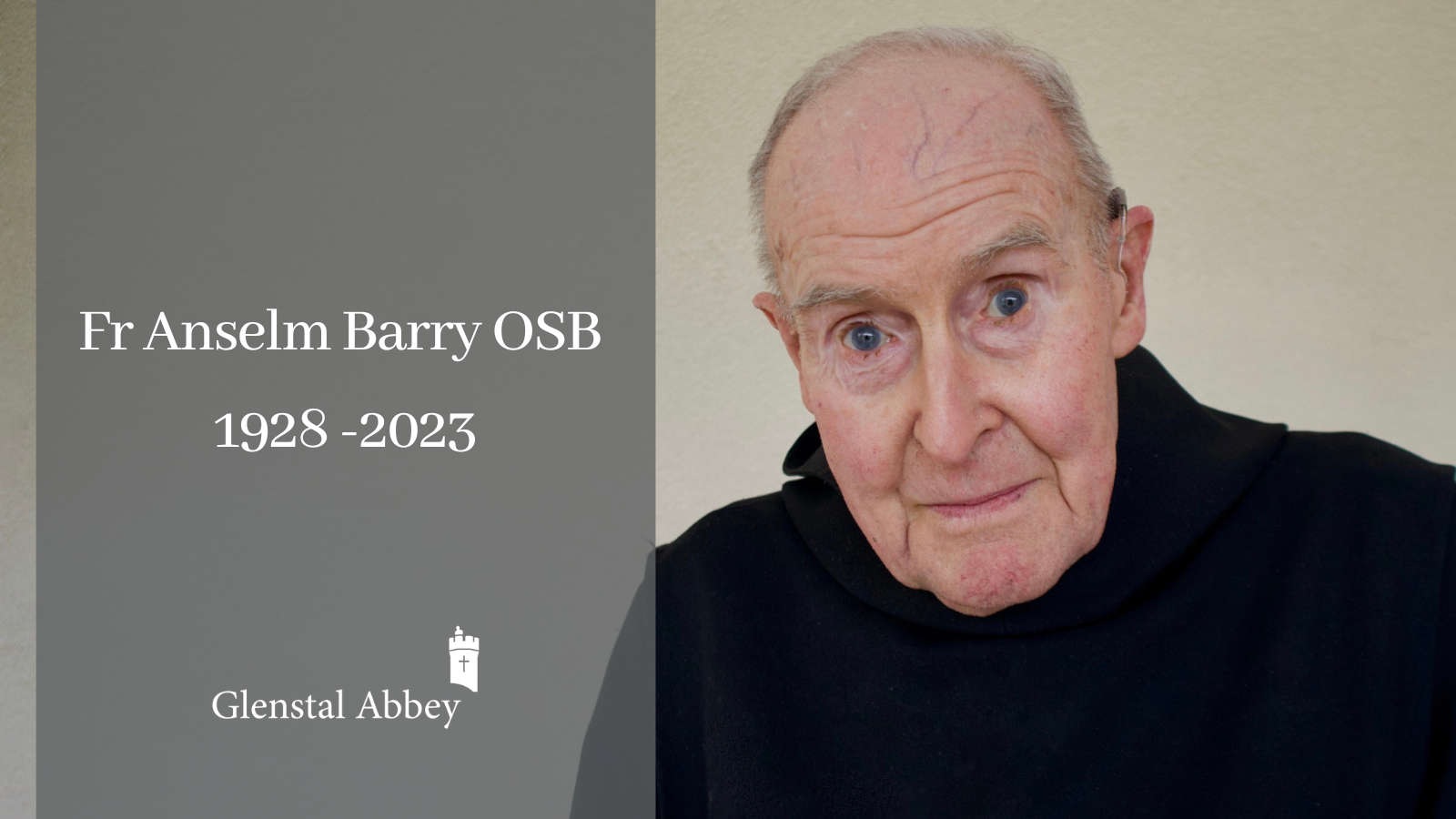
Anselm Barry RIP

Anselm Barry OSB

MONK OF GLENSTAL

died, Saturday 6th May 2023

aged 95

John Francis Barry was born in Roscrea, Co. Tipperary on 24th of March 1928. Because of his father’s position as a bank-manager, he spent his childhood in several Irish towns. After school with the Jesuits at Clongowes College, he entered the monastery of Glenstal on 11th March, 1947 receiving the name Anselm. He was professed on 2nd February, 1949.

Following studies in Maredsous and in Sant’Anselmo in Rome and specialising in philosophy, he was ordained priest on 31st July, 1953. During the following years he taught in Glenstal Abbey School, acting also for a time as assistant to the Novice Master.

In 1966, at the invitation of the Catholic Bishop of Stockholm, he moved to Upsalla in Sweden where it was planned to open a Catholic faculty of theology in which Fr Anselm was to teach philosophy. This plan was not realised and Fr Anselm spent three years teaching English and Religion in a Catholic high school. During this period he learned Swedish.

In 1970, Fr Anselm moved to Wald-Sigmaringen in southern Germany. He remained there for forty-four years as chaplain to the Benedictine Sisters of St Lioba and the girls of their school in a former Cisterian women’ monastery. From the mid-70s, he also acted as curate in the parish, the church of which was also the monastery church. During this period he became a German citizen.

In 2004, Fr Anselm moved to Rome to the Benedicitine community at the Basilica of St Paul’s Outside the Walls. Here he had an active ministry as confessor, his ability to hear confessions in English, German and even Swedish being greatly appreciated.

When his health began to decline, he returned to Glenstal in 2014. In the monastery he acted as assistant librarian until, some months ago, his health made this impossible.

On 24th March of this year he fell and broke a hip. Following and operation in Limerick Regional Hospital, he was transferred to St Anthony’s Nursing Home in Pallas Green, Co Tipperary. After only a few weeks there he died in the early morning of 6th May, 2023.

Funeral arrangements: reposing at Monastery Reception on the afternoon of Tuesday 9th May with removal to the Abbey Church at 5pm for the Office of the Dead. Funeral Mass at 11.30am on Wednesday 10th May.

Ar dheis Dé go raibh a anam dílis.

Categories
Abbey | Latest News abbeynews

Fr Columba in Rome

Father Columba McCann OSB was a speaker at a colloquium organised to mark the 100th anniversary of the death of Bl. Columba Marmion at Sant’Anselmo in Rome last week.

Fr Columba’s talk was titled ‘A Book of Light, Inspiration and Power: Blessed Columba Marmion and the Bible.’

The event – hosted jointly by the Pontifical Atheneum of Saint Anselm and the Pontifical Irish College – brought together monastics, clergy, academics, diplomats and interested guests to examine Bl. Columba Marmion’s relevance today.

The gathering commenced with a letter of greetings sent by Pope Francis which was read by Cork-born Monsignor Joseph Murphy, Head of Protocol at the Vatican’s Secretariat of State.

A recording of Fr Columba’s talk can be watched here.

Categories
Abbey | Latest News abbeynews

Opus 96 Chamber Choir at Glenstal

Opus 96 Chamber Choir will perform ‘From Byrd to Beethoven’ in Glenstal Abbey Church on Sunday 7th May at 4pm.

Including: The Byrd Mass for Four Voices and Beethoven Melodies arranged for Choir.

Choral Director: Martina Ryan Murphy / Accompanist: Bogumila Sokirko

There will be a retiring collection at the door, and all donations will be gratefully received.

We look forward to seeing you!

Categories
Abbey | Latest News abbeynews

Homily – 4th Sunday of Easter – A

Fr Anthony Keane OSB

IN TODAY’S GOSPEL, JESUS IS REVEALED AS OUR
GOOD AND TRUE SHEPHERD.

Some may draw back in alarm at the thought of WE LIKE
SHEEP, WE LIKE SHEEP HAVE ALL GONE ASTRAY,
EACH AND EVERYONE TO HIS OWN WAY, who with
sticks and shouts and dogs need to be chased and rounded up
and driven on to something close to the right path.
Our divine Lord, who, deep within our being, has implanted
his Law, is not like that. Indeed nor are the good shepherds
who deal with actual sheep in the Middle East or on the Aran
Islands and elsewhere: these do not drive their sheep. Rather
they knowingly lead them. Our Lord, the Good Shepherd,
calls his own sheep by name and leads them out
Our Lord and shepherd of our souls is no stranger; within our
very being we know his voice. He has other sheep too, not of
this flock. It is He who leads out the flocks of stars to graze
on the velvet black panoply of the Heavens, releasing the
Pleiades and showing the Bear and its cubs which way to
go,as Job would have it. Or Baruch: He sends the light and it
goes, He recalls it and trembling it obeys. The stars shine
joyfully at their posts; when He calls them they answer “Here
we are”; they shine to delight their creator.
May all of us know the thrill of the Lords playful wisdom
within us to our own delight as well as to that of of our
Creator.

Categories
Abbey | Latest News abbeynews

Homily – 3rd Sunday of Easter – A

Fr Denis Hooper OSB

For the Classical Studies buffs out there, the Roman Empire at the time of Christ was at its peak. By then they had built over 300,000 kilometres of roads. 75,000 kilometres of those roads were paved. Many of the ancient Roman roads can be seen today and some are still even in use. In ancient times – just like in modern times – roads were hugely important. Roads connected people, they connected cities, they connected civilizations. Goods were transported on roads. Armies travelled in roads. Travelling on these roads was very dangerous for most people. You could be robbed or even killed. Only the wealthy and powerful could afford the cost of having armed protection against this danger. The Glenstal Senior rugby team if they were around in those days would have been enough to scare away most robbers. In those days, anyone with a brain in their head travelled in a group – which was about as much protection as most people could hope for against the baddies.

It was on one of these paved Roman roads – the road from Jerusalem to Emmaus – that in today’s gospel Jesus appeared to two of his disciples. Unfortunately, this road no longer survives. It was about ten kilometres from Jerusalem to Emmaus – the same distance from here to Annacotty. It is probable that the two thieves who were crucified alongside Jesus had stolen from people travelling on one of these roads. Perhaps even this same road from Jerusalem to Emmaus. The Romans had no mercy on robbers and crucifixion was seen as an appropriate deterrent to robbers. Crucifixion was always carried on public roads – to make sure that as many people as possible could witness them.

The Gospel we have just listened to – St. Luke’s account of the two disciples meeting Jesus on the road to Emmaus – is probably my favourite story in the entire bible. It is perfectly written. It has a beginning, a middle and an end. It starts with sadness and despondency and ends with joy and elation. It is such a perfect account that there is no point in my trying to explain it. The story speaks for itself. Fr. John tells me that at the very centre of the narrative are the words: “he is alive”. There is the story up to those words; and the story after those words: “He is alive”.

The two disciples on the Road from Jerusalem to Emmaus met the risen Christ. I’d like you to listen to a report that circulated widely on Social media a number years ago. It was later proven to be what we now call “fake news”. But just take a listen to the report:
“On the eve of the annual celebration of the Resurrection of Jesus of Nazareth, many Christians were shocked by the announcement that a body identified as that of Jesus was found in a long-neglected tomb just outside the boundary of Jerusalem. Rumours had already been circulating that a very important discovery was about to be announced. The initial reaction of Christians around the world was that of astonishment, bewilderment and defensive disbelief. We will have to wait and see just what effect this discovery will have on the 2,000 year-old religion. Evidently, the 2,000 year-old lie has come to an end.”

As I told you, this article was many times over proven as “fake news”.
Because if this article was true – then our faith would be worthless and all this celebration of the resurrection at Easter would be absolutely absurd. It is interesting that this same “fake news story” is something which is not new. In the Gospel of Matthew, we are told that when the soldiers who were ordered to guard the tomb discovered that Jesus’ body was gone they – the Jewish authorities paid them in gold to spread the “fake news” that some of the disciples of Jesus’ had stolen his body.

In the Acts of the Apostles – which we have also read today – we hear Peter say: “God raised Jesus – and we are all witnesses to this”. The two disciples on the road to Emmaus were not the first to meet with the
risen Jesus. They were not the last. Each day we meet Jesus in our own
everyday lives:
 in each other
 in the Eucharist
 In the liturgy
 in prayer
 in love
 in beauty
 and in so much more that is good, loving and beautiful in our world
Christianity is an empty religion if the story of Jesus ends with his death. The Resurrection of Jesus is what gives meaning to what we believe in. It also gives us hope that someday we too, will be like Jesus – raised from the dead into eternal life.

Categories
Abbey | Latest News abbeynews

Homily – 2nd Sunday of Easter – A

Fr Jarek Kurek OSB

Gathered as the community of the church here this morning, we resemble the community of the early church, described for us in the Acts of the Apostles. By coming together, we are devoting ourselves to the apostles’ teaching, to fellowship, to the breaking of bread and to prayer.

Today, on the eight day after Jesus’ resurrection from the dead, we celebrate once more our symbolic regeneration. For this reason, therefore, it is for us to assume the attitude of a newborn child, to take a fresh look at our spiritual life and with new eyes reshape the quality of our life of faith.

We began this Mass by chanting a text from the Letter of St Peter: ‘Like newborn infants, you must long for the pure, spiritual milk, that in him you may grow to salvation’.

Nowadays, there is an overwhelming choice of milk on the shelves of our supermarkets. But St Peter tells us who are Christian that there is only one, true, life-giving milk, which is the Word of God and that Word remains for ever. It is for us to rekindle within a longing for this spiritual nourishment, our source of life in God.

The milk we were talking about has, as we sang in Latin, a rationabile character about it. That is to say, this milk is the divine Word of God and its ingredients are God’s inner thoughts. These words and thoughts cannot be perceived by just anyone, it requires a finely tuned ear to notice them.

How can we truly hear and discern these life-giving words and thoughts? When someone plays a two-note chord on a violin, everyone hears the sound of these two notes, but only the person with a very well trained ear will hear the hidden third note, which is not played, but which creates the most amazing harmony within the sound. To hear this note is a skill, but without it, there is always something beautiful missing from the chord. The divine spark is missing.

The same dynamic occurs when we listen to the Word of God. A well-trained ear will hear what is hidden, hardly audible and so subtle. A well-trained ear allows us to recover our inner seeing and our inner hearing. This recovery can be summed up as the ‘salvation of one’s soul’.

St Peter tells us to use the power of the mind, our inner faculties. That is to say, while we are here on earth we don’t see Jesus, the Word of God, with our eyes, but we can still see him with the eyes of our minds by learning how to listen to his words whenever they are read to us in scripture, our spiritual milk.

On this day of resurrection, as we become newborn once more, we can make a fresh start together. Today is the day we grow to salvation. Don’t be afraid to assume the condition of a newborn infant in your soul. Let the ear of your heart long for this divine milk. Let us look for it fervently and in due course delight in the wonderful harmony of the divine words and thoughts, so that we will come at last to the salvation of our souls.

Subscribe To Our Newsletter To Receive Updates

[hubspot type=form portal=6886884 id=9e1d6d0d-c51e-4e35-929d-3a916798de64]