
Categories
Abbey | Latest News abbeynews

Homily – 14th Sunday in Ordinary Time (Year A)

Fr Luke Macnamara OSB

Today we get a rare chance in the Gospel of Matthew to overhear Jesus’ intimate prayer to his Father, whom he addresses as Lord of heaven and earth. The Father’s majesty extends over the whole universe and appears far beyond human reach. In his prayer, Jesus doesn’t thank his Father for his majesty. Instead he thanks him for revealing these things not to the learned and clever but to mere children. The Father has come down to our human level and even
further to the level of children. What are these things that he reveals to us? If we look to the preceding context, we observe that it refers to the deeds of power in Chorazin and Bethsaida to which the cities do not respond, unlike the other Galilean towns. These deeds of power are Jesus’ healings, exorcisms, and proclamations, which manifest God’s saving presence. God makes known in Jesus his saving presence to all humanity whose calling is to become his children and enjoy the fullness of life.

God goes further to reach humanity, for his Son, Jesus, gentle and humble in heart, assumes a yoke of burden. The Son of the Most High lowers himself not only to our human level, but to the level of the lowest grade of slave, whose status is equated with a pack animal. The Son will ultimately go further and carry the yoke of his crossbeam to Golgotha, where he will then be crucified and die for us. He carries our yoke imposed because of sin that through his death and resurrection we might have life.

Our lives are marked by sin which weighs us down and its effects stick to us like muck. The burdens of sin become heavy and make us weary. The yoke of maintaining the illusions of power, position, and prestige over others comes at a great cost. This is not Jesus’ yoke. Jesus points the way to free ourselves. By becoming gentle and humble in heart, towards ourselves, others, and God, we can fit under Jesus’ yoke. Since Jesus carries this yoke, it becomes easy for us and our burdens light. Let us learn to walk humbly with our Lord.

Categories
Abbey | Latest News abbeynews

Homily – 13th Sunday in Ordinary Time (Year A)

Fr Patrick Hederman OSB

I am sure some of you have had the experience of returned emigrants coming back to their old homes, explaining to you just how much they have made good since they left the old sod so long ago. ‘The corn is as high as a elephant’s eye, and it looks like its climbing clear up to
the sky!’ Tell me now, says the visitor: ‘How many acres have you here on this little farm of yours?’ ‘About 35 acres I’d say, not counting the garden at the front, the paddock on the left or the haggard at the back.’
‘Oh, my goodness me,’ says your man, ‘I only wish you could see the
magnificent prairies, the tracts of land that I own back where I come from . . .

I could get up on my tractor in the morning, drive around the headlands for a day and a half and I wouldn’t see a quarter of the property I own.’ ‘Oh, I know well what you’re sayin’ ‘ says my friend, ‘we had a tractor like that one time . . . the divil and all to start it up, and then spluttering and stuttering along the ways . . . an age to get you anywhere . . . a fright to the world.’

To understand the Gospel we have just been reading, we have to know the meaning of hyperbole: hyperbole means telling it as it is, but multiplying by a thousand to get your point across; in other words, exaggerating to tell the truth. And to know how that works, you have to come and live in Ireland for a while. The postman said to me the day before yesterday: ‘I have a mountain of post for you this morning [ now that meant two letters, one small parcel and a bill] After a few weeks of beautiful sunshine that we’ve all been enjoying you could
hear: ‘I’m roasting, I’m biling, . . . my head is like a pat of butter; I can’t eat, I can’t sleep, I’m walking around stark naked.

Then we had a day and a night of much welcome rain: so you’d hear: it was ‘raining cats and dogs, I tell you, It’s been raining now for 40 days and 40 nights. Then with everyone home from school you’ll hear throughout the land: He never cut the grass, it’s a jungle out there!
I’ve told you a million times, pick up your dirty socks. A teacher who’s correcting exams will have ‘a ton’ of papers to grade. So, when we hear our Lord Jesus Christ saying: “Anyone who loves their father or mother more than me is not worthy of me; [or] anyone who loves their son or daughter more than me is not worthy of me” At least here in Ireland, we know where he’s coming from, what he’s getting at. I mean we’re not all fools down our part of the country!

St Paul uses similar language, making the very same point: Here’s what he says to the people of Philippi: ‘ I once thought these things were valuable, but now I consider them worthless because of what Christ has done. Yes, everything else is worthless when compared with the infinite value of knowing Christ Jesus my Lord. For his sake I have discarded everything else, counting it all as garbage, so that I could gain
Christ.’ [Epistle to the Philippians 3: 7-8] The message is clear: the only thing that really matters in this life and in the next, is knowing Christ Jesus and putting our trust in him.

Categories
Abbey | Latest News abbeynews

Homily – 11th Sunday in Ordinary Time (Year A)

Fr Jaroslaw Kurek OSB

We often seem to have a peculiar fascination with Royalty. Many enjoy following ‘the royals’. All that excitement about the lives of royal families, the pomp and ceremony, family dramas, fashion, wealth……. The births, weddings and funerals.
The words we heard in the 1st reading, from the times of Moses and Aaron, point to a royal invitation from God! ‘If you obey my voice and keep my covenant […] you shall be for me a priestly kingdom’.
This overwhelming perspective may sound though somewhat enigmatic as the logic and meaning of the Old Testament often remains unclear for many of us. Also, there is an important ‘if’ there, ‘if you obey my voice and keep my covenant’, in other words, if you genuinely listen to me and keep my words.
Now, was the message about our potential royal destination a matter of consideration for our ancestors in faith only? No, it became a principle of our Christian vocation. In the Book of Revelation John gives thanks to Jesus Christ ‘who loves us and freed us from our sins by his blood, and made us to be a kingdom, priests serving his God and Father’.
Jesus prompts the apostles to proclaim this good news: ‘The kingdom of heaven has come near’.
Now St Matthew to whom we listened this morning and will listen over the next weeks, every day, doesn’t seem to grow tired of delivering this message, a message about the kingdom of heaven. Shall I say that his gospel is actually ‘a book of future royals’, or, to put it differently, ‘a book for future royals’.
Why such a statement? Because through the teaching of Jesus Matthew keeps explaining what this ‘kingdom of heaven’ is about. He truly wants his readers to understand their royal vocation and become the partakers of this regal, spiritual space.
He doesn’t want anyone to be a mere spectator, just watching from outside; no, he wants you and I to become an ‘insider’, to fully partake, to enter the royal palace.
Isn’t that a wonderful, incredible calling?
You and I are invited to become royal!
To join a royal family!
To enter the palace!
To become royalty!
Do you hear and understand your invitation?
Now, two thousand years ago many who listened to Jesus couldn’t understand the meaning of his words.
And often, we do not either.
The problem is that we often hear, ‘There is no need for you to understand; this is a mystery’.
But Jesus said to his disciples: ‘To you, it has been given to know the mysteries of the kingdom of heaven’.
When explaining the parable of the sower, he described the one who will truly blossom and bear fruit: ‘The one who hears the word and understands it’?
We need to listen, but crucially we need to understand. Through understanding, we can fully exploit the privilege granted to us, the disciples of Jesus, to gain knowledge of the secrets of the heavenly kingdom.
Dear fellow Christian, recognise your royal nobility. You might never be granted access to Buckingham Palace in this life, but you are invited to access somewhere incomparably greater.
Take this ‘book for royals’, explore its secrets, and fulfilling its commandments enter the infinitely more splendid palace, the royal palace of God.
However narrow and challenging the door, once you’ve entered and experienced its wonder, you will be able to exclaim as this early Christian author did:
I am a priest of the Lord,
And Him I serve as a priest;
And to Him I offer the offering of His thought.
For His thought is not like the world,
Nor like the flesh,
Nor like them who worship according to the flesh.
The offering of the Lord is justice,
And purity of the heart and lips.
And you come into His Paradise,
And make for yourself a crown from His tree.
Then put it on your head and be joyful,
For His glory will go before you, amen.
Categories
Abbey | Latest News abbeynews

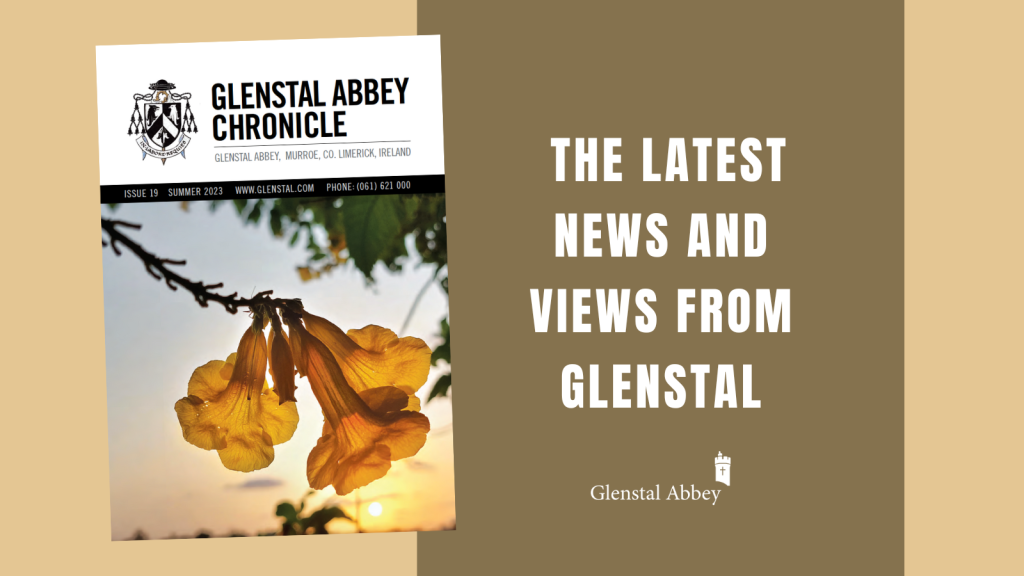
Glenstal Chronicle Summer 2023


Lessons from the monastery garden, our renewable energy plans and news from the brethren can all be found in the latest Glenstal Abbey Chronicle here: http://bitly.ws/IKnJ

Categories
Abbey | Latest News abbeynews

Homily – Sacred Heart – A

Fr Christopher Dillon OSB

Those words of St John in the second reading sum it all up, “God is love”. Unpacking that simple statement is not so briefly done; and I don’t pretend to be able to do it satisfactorily. Again, it is in the Gospel of John that we read the words ascribed to Jesus, when he is speaking to Philip, “to have seen me is to have seen the Father”, which gives us a hint of how the God mystery is binatarian, until with love dynamic of the Holy Spirit, it becomes trinitarian…and increasingly complicated.

So much of what we have picked up in our religious instruction, over the years, is as wrong-headed as it was well intentioned. Most of us, Christians, have the notion that God loves us and will continue to love us, on condition that we keep the rules, as laid down by the Covenant. But love is gratuitous, that is to say, freely given and unconditional; and that is what we have to take on board, in God’s regard. God loves us because he loves us; there are no ifs or buts; and it is only in response to that unconditional love that we can truly love God.

Christian revelation allows us to speculate that God the Father being God, being love, gives himself in and to the Son. The Son being God and therefore love, gives himself reciprocally to the Father. This giving back to the Father involves the whole drama of the Incarnation and the passion with all that follows from it, all of it the expression of divine love. This is what we celebrate, when we speak about the Sacred Heart of Jesus, the self-giving love of the Father to the Son and the self-giving love of the Son to the Father, which, by virtue of our individual baptism into the body of Christ, includes our efforts at self-giving love. So it is that everything which we address to the Father we do through the Son, by the strength and light of the Holy Spirit.

Let me conclude these most inadequate observations by remarking that, to the extent that we manage to exercise self giving love in our relationship with others, we are being God- like, we are being Christ to others, we are being the kindness of God in the world. In a word, we are fulfilling our calling as children of God.

Categories
Abbey | Latest News abbeynews

Homily – Corpus Christi – A

Fr Luke Macnamara OSB

Today we celebrate the Solemnity of the most Holy Body and Blood of our Lord Jesus Christ, known as Corpus Christi. The focus is on the great gift of the Eucharist. The image that probably first springs to mind for most of us is an intact host in a monstrance. This leads us to associate the Eucharist with perfection. The rounded host has no rough edges. All is harmonious, all is whole. This perfection and harmony contrasts strongly with our world and our experience. We recognise our sins at the beginning of every Mass. We come as
a community of the broken.

Saint Paul speaks of the cup which we bless as being a communion with the blood of Christ and the bread that we break as being a communion with the body of Christ. At this celebration of the Mass, the bread will be broken for us. Christ gives himself up to be broken on the Cross, and this complete gift of self is signalled in the sacrifice of the Mass, the breaking of the bread, and the pouring of the cup. Christ is broken for us because we are broken. He comes to
us as we are, broken individuals, broken families, broken communities. He has accepted to be broken up for us so that we might be made whole through communion with him.

The rounded host in the monstrance is in fact a broken fragment of Christ’s body. The perfection is an illusion. There are many hosts but only one body of Christ. St Paul puts it this way: “The fact that there is only one loaf means that, though there are many of us, we form a single body because we all have a share in this one loaf.” So there is at this Mass only one loaf broken into many pieces, which we will receive. We are many but through ingesting the fragments of the one loaf we are incorporated into Christ and become one body in him. The broken relationships which separate us are as nothing compared to the presence of Christ within us to draw us together into communion with Christ and with each other. Let us not be afraid to acknowledge our brokenness as we approach the Eucharist. It is for this that Christ became broken for us, that we might be made whole.

Categories
Abbey | Latest News abbeynews

Homily – Most Holy Trinity – A

Fr Columba McCann OSB

A few weeks ago I looked at our notice board and saw that I was down to preach on Trinity Sunday. I said, ‘Just my luck! I get to preach on the most mysterious aspect of our Christian faith – the Holy Trinity!’ Because the mystery of God is totally beyond our comprehension. Trying to comprehend God is like trying to fit the entire ocean into a little bucket. And St Augustine said that, if you think you have an understanding of God, then it’s not God. Nonetheless, God does want to be known, very much so!

Moses pleaded with God: ‘Let me see your face!’. God’s response was: no, you won’t be able for it, but I will give you something – I will give you an intuition of who I really am. And so, as we have in today’s reading, the Lord passed before Moses and proclaimed, ‘The Lord, the Lord, a God merciful and gracious, slow to anger, and abounding in steadfast love and faithfulness.’ Another translation of the same Hebrew words speaks of ‘a God of tenderness and compassion’. When we look at the vast mystery of the universe, the amazing wonder of biology, the mystery of reality at a sub-atomic level, isn’t it extraordinary to think that, pulsating at the heart of it all, is tenderness, compassion, steadfast love and faithfulness…

Moses however moves this beautiful language into very concrete territory: we are a headstrong people, he says. We have complained and bickered and refused to believe, but if your tenderness, compassion, steadfast love and faithfulness towards us are real, please be with us and adopt us as your own. Maybe each of us could issue a similar plea to God; each of us knows the ways in which we seem undeserving of such special treatment, but we can invite God’s love in nonetheless, with the absolute certainty that we will get a positive response.

Moses’ request was answered by God, centuries later, in a way that went beyond his wildest imaginings. God decided to be with his people by becoming one of them, and here the Trinitarian life of God begins to spill out openly into the world. The only-begotten Son becomes human. The tenderness, compassion, steadfast love and faithfulness of God become flesh in our world. God adopts us as his own by becoming one of us!

In the life of Jesus we see tenderness towards the sick; compassion towards all the sinners who flocked to him; love so steadfast that he would rather die than withdraw it; faithfulness even towards those who killed him, as he forgave them. Jesus the only begotten Son of God reflects the one who begot him, referred to as the ‘Father’ in Christian tradition, even though this one is beyond male or female. ‘Whoever has seen me sees the Father’ Jesus says; whoever sees me sees the mysterious one who begot me from before the beginning of time. I come from him; I am his image.

The tenderness, compassion, steadfast love and faithfulness that came into the world are a divine life that cannot be killed or contained, and so the risen Jesus breathes his Spirit upon his disciples; divine love spreads like wildfire across the Roman empire and has continued spreading ever since. Jesus proclaims himself the vine, and we the branches, and we could say that the Holy Spirit is the sap that flows from him to us, so that we in turn bear fruit of tenderness, compassion, steadfast love and faithfulness.

I remember the story of a man, a number of decades ago, who was really grappling with this idea of the Holy Spirit. For him it was just an idea and he wanted to have a more real sense of what it meant to speak of the Holy Spirit. One day, on a bus, he pleaded with God to give him some sense of what the Holy Spirit was all about. Suddenly, without warning, he was filled with an overwhelming feeling of love for everyone on the bus, even though they were total strangers. A God
of tenderness, compassion, steadfast love and faithfulness. Today’s feast of the Holy Trinity is not about trying to squeeze our brains to understand how you get three into one, or one into three. It’s an invitation to enter into God’s love, which is the Holy Spirit, breathed out upon us by Christ the only begotten Son of God, God from God, light from light, true God from true God. And the best way to enter into that feast of love, a way that surpasses all others, is to do what we are just about to do, to celebrate the Holy Eucharist at this altar.

At this altar we will pray to God the Father, asking him to send the Holy Spirit to transform the bread and wine, so that sharing in them, we become one body, one spirit in Christ his Son. We can actually receive God’s tenderness, compassion, steadfast love and faithfulness into our hands and our bodies so that we may live in turn the life of the Holy Trinity.

Categories
Abbey | Latest News abbeynews

One Day Summer Retreat

Come away for a day to refresh your spirit at Glenstal Abbey!

A one-day retreat is being offered on Wednesday 28th June and Thursday 29th June from 10am – 5pm.

The day begins with tea and coffee on registration followed by talks, Mass, lunch, a Holy Hour (with the option of Confession) and afternoon tea.

Cost for the day is €50 with lunch and refreshments provided. Please contact us for more information and for booking at: events@glenstal.com or call 061 621005.

Categories
Abbey | Latest News abbeynews

Homily – Pentecost – A

Fr Abbot Brendan OSB

Did you know that over 1 billion people worldwide drink coffee every day? After water and tea, it’s our favourite beverage. Almost everyone can tell the difference between the real thing and the decaffeinated variety. It may look like coffee and smell like coffee and even taste like coffee, but it lacks that all-important caffeine kick. Decaffeination removes about 97% of the caffeine.

Christianity without Pentecost is a decaffeinated Christianity. We go through the motions of what it means to be a Christian but we’re a little afraid to get too involved, so we cut down the edges, smooth off the places where it has touched our lives and then we wonder why there is no power left in it.

The disciples in the gospel were decaffeinated, locked away in their little room in Jerusalem, afraid that they too will be accused and imprisoned like Jesus their Master. They feel paralysed and lack courage. Literally, they are a team with no spirit! The Spirit, however, has slowly started to work in them. It didn’t all happen with a bang, the groundwork was laid first. Mary of Magdala, a very brave woman, brought her message: “I have seen the Lord”, while at the tomb itself, the beloved disciple “saw and believed”. These promptings begin to infect this frightened remnant.

On Pentecost the Lord himself came and stood among them in that room sealed off from the world by fear and the very first thing the Risen Lord does is give peace. This is important. When the Lord is present in a situation in my life, peace descends. Then Jesus blows his breath upon them, which is no longer a human breath, but the Holy Spirit. You remember the story of creation, God had blown into Adam the breath of life. In the new creation, God blows another breath, the breath of eternal life and every time he is present in the community of Christians, the Spirit continues to breathe.

With the breath of the Spirit comes real communication. When we fail to properly communicate the results can be disastrous. Language is a wonderful gift and we must use it well. The power to communicate, for Christians, has always been connected with the Holy Spirit and held in the greatest esteem. In the early sixteenth century a Benedictine monk called Pedro Ponce de Leon adapted the hand signs the monks used in his monastery to communicate with deaf children in the locality and so sign language was born. Real communication can change lives. It can heal rifts in families and communities, bring wars to an end and enable genuine progress in society. To communicate is to do something essentially human and divine. To communicate with God is to touch my freedom, my deliverance.

Pentecost is the feast of deliverance, the completion of the mystery of Easter, a deliverance that reaches out to our daily lives with their struggles, their downfalls and the evil that imprisons them. Deliverance from our own darkness, our homemade dungeons. Deliverance from war and oppression. Deliverance from our painful histories, our mistakes and our litany of bad choices. The Christian breathes the Spirit of Christ, the Holy Spirit of God, and through this Spirit, we are sanctified. From what do you need deliverance? Ask the Holy Spirit for this now, in the silent communication of your heart…

Categories
Abbey | Latest News abbeynews School | Latest News

Talk & Film Screening

You’re invited to join us for a film screening and illustrated presentation on the daily play of shadow and light at the Benedictine Abbey of Vézelay in France, where art and stone enter into the dynamic of life and the 12th century speaks to the 21st century.

Taking place in Glenstal Abbey Library on Saturday 10th June from 3pm – 5pm (registration at 2.45pm).

Glenstal Abbey School is pleased to be hosting this event on behalf of the monastic community. Please contact us for more information and for booking at: events@glenstal.com or call 061 621005.

Subscribe To Our Newsletter To Receive Updates

[hubspot type=form portal=6886884 id=9e1d6d0d-c51e-4e35-929d-3a916798de64]