
Fr Jarek Kurek OSB
Fr Luke Macnamara OSB
Elijah goes to meet God at the mountain of Horeb. He does not meet God in the wind, earthquake or fire, but hears a voice in the silence. While God’s power is manifest in wind, earthquake, and fire, God’s very own presence is in a still voice of silence. This seems puzzling. How can one hear silence, not to mention a fine or still silence? Yet this sheer silence has a voice, and the key characteristic of a voice is that it speaks. God is closest not through great works of power, which we can observe in the wonders of his creation, but in the most gentle manner possible, a whisper, in which he speaks to us. This reveals
something of how God relates to us.
God’s presence requires careful listening. The voice from the still silence cannot be heard in a noisy or busy environment. Elijah travelled 40 days to get to Horeb, and waited alone until after the wind, earthquake, and fire passed by, until he heard the voice of silence. Jesus at the beginning of the Gospel story sends away his disciples and afterwards the crowds, before climbing a mountain so that he can be alone to pray to the Father. It is striking that the Gospel text twice refers to Jesus being alone by himself while he prayed. Earlier in the
Sermon on the Mount, Jesus advises disciples: “go into your inner room, close the door and there pray to the your Father in secret, and your Father who sees in secret will reward you.” (Matt 6:6) What Jesus teaches his disciples to do, he now models for us by going up the mountain. Private personal prayer is a central pillar of a disciple’s relationship with God.
Prayer is not confined in secret to our inner rooms. There are very public moments where we are motivated to pray, when we like Peter, find ourselves sinking. There may be many causes, loss of health, loss of relationship, loss of personal standing or reputation, loss of job or money. In such situations we may make the prayer of Peter to Jesus our own – “Lord save me.” We do this together in a very public way at the beginning of every Mass with the invocation, “Lord have mercy.” Peter makes his prayer in doubt but through the encounter with Jesus this doubting prayer ends in salvation and worship. So we may feel that our prayer of the “Lord have mercy” has been half hearted, but through the encounter with Jesus through word and sacrament, it too ends in our salvation and our worship.

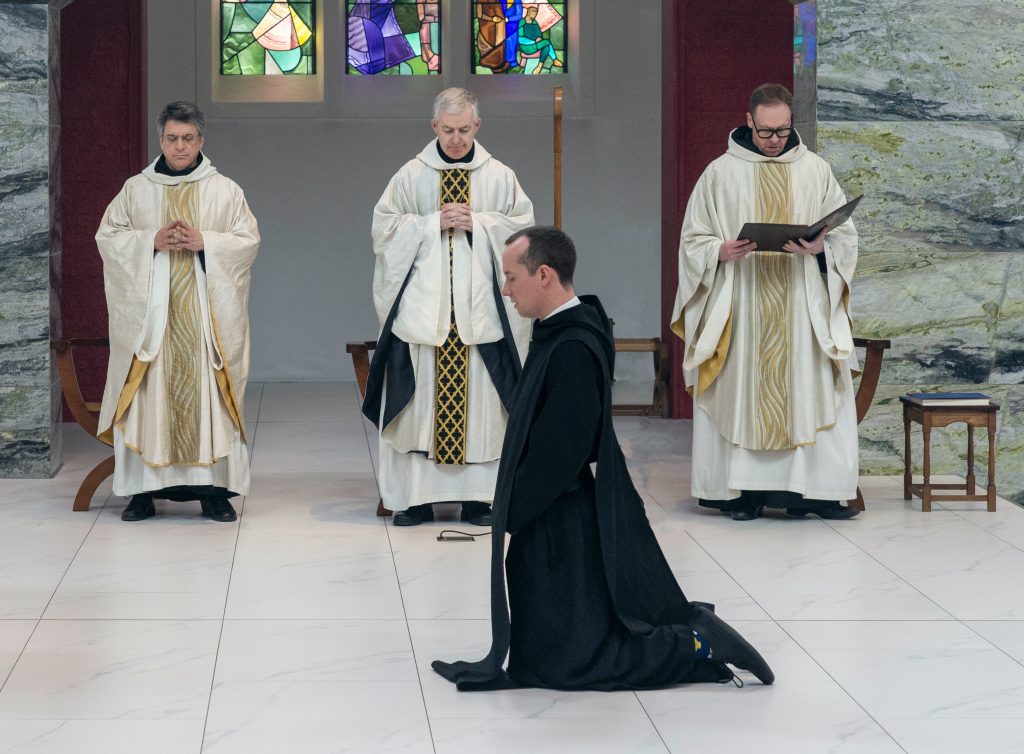
The monastic community rejoiced today, Sunday 6th August 2023, on the occasion of the solemn monastic profession of Br Oscar McDermott OSB during Mass for the Feast of the Transfiguration of the Lord.
Br Oscar, a native of Lifford in County Donegal, made his lifetime commitment to monastic life at Glenstal Abbey before his brethren and a wide circle of family and friends. Deo gratias!
Homily of Abbot Brendan Coffey OSB:
Dear Oscar, here we are on the mountaintop with Jesus and those three disciples. The Lord is transfigured and it is as if the holy Scriptures are transfigured with him; Moses and Elijah, the law and the prophets.
Mark, Matthew and Luke all give an account of the transfiguration. This year we have listened to Matthew’s telling of events. These accounts are remarkably similar, but Luke adds a small detail missing from the others: he tells us that the disciples were heavy with sleep, but they kept awake and saw his glory. Oscar, this line is so important for us today as we gather with you to receive your solemn monastic profession – keep awake, stay vigilant all your days.
A monk is a son of the day, a son of light. This is what the monks of Qumran called themselves, ‘sons of light’. St Jerome says to us: “Monk, you are lyre and harp, you have undertaken to sing psalms to God. Wake up and sing psalms, why do you sleep? Monk you watch only with your body, why do you sleep with your mind and not sing psalms to the Lord?” St Benedict says the same thing, does he not? ‘The mind must accord with the voice’. And in case you still don’t get the point the desert Fathers tell us, ‘It is better to sing the psalms, even with little skill, than not to sing them and hear them sung by others’.
Oscar, the monk must be vigilant because our task is to be a sentinel, a watcher, in the Church, like the watcher on the tower of our castle here in Glenstal. We are the watchers of the prophet Isaiah: “On your walls, Jerusalem, I have set watchmen. All the day and all the night they shall never be silent. You, sentinels, awaken the remembrance of the Lord, do not rest, but do not give the Lord rest either, until the Lord comes”. This is our diakonia, our service, as monks in the church today: day and night to remain in dialogue with him, to give him no rest, until he comes. And so you will sing et non confundas me ab expectatione mea – and do not disappoint me in my hope.
This watching is an affirmation of our freedom – as is your monastic profession. I do not believe there is a greater exercise than waking each day to express our freedom. Every morning when we awake the Lord says to us, ‘awake lyre and harp, I will awake the dawn!’ St Basil asks, “What is specific to the Christian?”, “To watch every day and every hour and be ready to do God’s will fully, knowing that in an hour we do not expect the Lord comes”.
Oscar, in monastic life it is not enough to have lived a good life, it is not enough to remain faithful to the end, it is not enough to do the things we have to do every day well. It is necessary, in the long run, to remain awake, because the great temptation on the monastic journey is to sit back and relax. To let things, overwhelm us, without us noticing. To become the foolish virgins, who lacked oil for lack of wisdom and vigilance. God’s today must always be welcomed: to begin again and begin again “for beginnings that never end”.
On this beautiful feast of the Transfiguration, so dear to monks down the centuries, we recall the creating and transforming power of God. God made this beautiful world of ours in six days; the disobedience of our first parents managed to ruin it in less than six minutes. In his risen life the Lord has transfigured our world into a new creation. He stands on that mountain between Moses and Elijah. Moses whom he transfigured at the burning bush and Elijah, whom he transfigured in a fiery chariot and brought to his side. Now he comes to transfigure you Oscar, as you make this gift of self to him. By your obedience, stability and conversatio morum, you will become all fire, a lyre and harp, singing the praises of God.

This week the monastic community remembers Fathers Bede Lebbe, Cornelius Doherty and Kevin Healy, three of our confrères whose anniversaries occur at this time.
Today we remember in particular Father Bede on the 75th anniversary of his death. Born in Belgium on 10th January 1879, he made profession in Mardesous on 20th March 1898 and was ordained on 30th August 1903.
Father Bede came from a devout Catholic family. His brother Frédéric–Vincent was a renowned missionary priest in China who was eventually arrested by the Communists and died in captivity in 1940.
Arriving at Glenstal in 1934, Father Bede became the second Prior of Glenstal in succession to the founding Prior, Father Gérard François, who returned to Belgium. In addition to assuming the office of Prior, Father Bede became Headmaster of Glenstal School, an office he held until May 1937 when this responsibility was assumed by Father Matthew Dillon, the uncle of our present-day guest master and former Abbot, Father Christopher Dillon.
During Father Bede’s leadership of Glenstal Priory, the monks transferred from the castle buildings – now needed for the expanding school – to what had been the stable-bock. This was made possible by the building of a guesthouse (now incorporated into today’s reception and shop) and the provision of rooms for monks over the present-day refectory in what is still called ‘the Father’s Wing.’
Father Bede was a classical scholar and philologist, the latter quality inspiring an interest in all things Irish. He was particularly interested in providing texts for the offices of the main Irish saints, Patrick, Bridget and Columba. In addition to occasional scholarly contributions to learned journals, he published some books which were more accessible to the non-specialist reader such as The Mass: an historical commentary in 1947.
He was instrumental in facilitating the reception at Glenstal of Miss Mary Martin and her future Medical Missionaries of Mary and their grounding in Benedictine spirituality. In October 1938, having been plagued through his time in Ireland by asthma, Father Bede was succeeded as Prior by Father Idesbald Ryelandt.
Unable to return to Belgium because of the Second World War, Father Bede finally returned to Mardesous in 1946. He died there on 2nd August 1948.
May his soul and the souls of all the faithful departed, through the mercy of God, rest in peace. Amen.
Fr Lino Moreira OSB
Solomon had just been made king in place of his father David. He was very young and inexperienced, and felt that the burden of kingship was far too heavy for him. But he was also aware that God had showed great lovingkindness to his father on account of his uprightness of heart (cf. 1 K 3:6). So Solomon asked the Lord: “Give your servant an understanding heart to judge your people, a heart able to discern
between good and evil” (1 K 3:6).
The heart is the seat of a person’s thoughts and intentions, and literally,
according the Hebrew Bible, Solomon asked to be given a listening heart. The young king was already wise enough to realise that, unless he had a heart that listened to the word of God with sufficient understanding, his thoughts would not be attuned to God’s thoughts and his decisions would not be in accordance with God’s designs; in
short, he would not be able to lead the people of God on the path of justice and peace.
We are told that the Lord was pleased with Solomon’s request and said to him: “I will give you a wise and discerning heart, so that there will never have been anyone like you, nor will there ever be” (cf. 1 K 3:12). And as evidence that God did bestow such an extraordinary gift on his servant, the sacred author then tells the well-known story of Solomon’s judgement. Two women claimed to be the mother of the same baby, and the king said: Cut the living child in two and give half to one and half to the other” (1 K 3:25). Horrified at this order, one of the women begged that the child be given to her rival, and Solomon declared that she was the real mother, because she did not want the baby to be killed. When all Israel heard the verdict the king had given – says the biblical author –, they held the king in awe, because they saw that he had wisdom from God to administer justice (1 K 3:28 N).
The exceptional character of these events, however, should not mislead us into thinking that Solomon became the wisest man on earth overnight, almost by a stroke of magic. The Vulgate, the Latin translation of the Bible, says that Solomon asked for a cor docile, a docile heart – or, even more literally, a heart that can be taught. That
means that divine wisdom is something that has to be learned all through life, a rule of our human existence which applied even to Jesus, our Lord and Master. Indeed, Saint Luke writes that, as a child, Jesus grew in wisdom (cf. Lk 2:52), and in the Letter to the Hebrews we read: Although he was a son, he learned obedience through what he suffered (Heb 5:8).
So to follow in Jesus’ footsteps is essentially to strive to grow in wisdom. And if we want to commit our entire lives to learning the ways of the Lord, the first step we need to take is to pray most earnestly to be given a listening heart. All the time God speaks to us not only through the words of Scripture, but through all that goes on around us, wherever we may be. But if we fail to listen to the voice of the Lord – to the voice of truth speaking in our conscience –, from what other source can we learn to distinguish between right and wrong? And if our thoughts happen to be false, and our intentions in any way warped, how can we still hope to succeed in responding positively to God’s calling to work for his kingdom?
Yes, Solomon was right in thinking that a wise and discerning heart is by far the most precious gift anyone can receive from God. And that same message is imparted to us in today’s gospel, where the treasure hidden in the field and the pearl of great value represent the fullness of divine wisdom, which lies in Jesus of Nazareth, as God’s servant and Son. We are all invited to sell everything we possess in order to buy this wisdom that comes from God, and was made accessible to us by the power of Jesus’ death on the Cross. So we shall do well to listen to our Master’s encouraging words: “Take my yoke upon you and learn from me, for I am gentle and lowly of heart, and you will find rest for your souls” (M 11:29).

The monastic community begins its annual retreat on Monday 31st July.
The guesthouse is closed during this period and there will be changes to the opening hours of Monastery Reception and to the times of some liturgies. Please refer to the times listed below for any changes to the normal schedule.
We ask your prayers for us during this time of retreat, and we assure you of our continued prayers for all of the friends and benefactors of Glenstal Abbey.
<><><><><>
CHANGES TO MONASTERY RECEPTION OPENING HOURS
Sunday 30th July
Monastery Reception open immediately after Mass only (shop closed).
Monday 31st July to Friday 4th August
Monastery Reception open from 11.40am to 12 noon only (shop closed).
Saturday 5th August
Monastery Reception open from 9.30am to 5pm (shop open).
Monday 7th August
Monastery Reception and Shop closed for Bank Holiday.
<><><><><>
CHANGES TO LITURGY TIMETABLE
Monday 31st July
No public celebration of Compline.
Tuesday 1st August
Matins and Lauds at 7am
No public celebration of Compline.
Wednesday 2nd August
Matins and Lauds at 7am
No public celebration of Compline.
Thursday 3rd August
Matins and Lauds at 7am.
Friday 4th August
Matins and Lauds at 7am.
No public celebration of Compline.
Saturday 5th August
Matins and Lauds at 7am.
Fr Columba McCann OSB
Jesus didn’t fit the mould. A normal rabbi would be surrounded by people who were clearly religious and of good moral standing. But the circle around Jesus included quite a few shady characters, including those whose finances were corrupt and others who weren’t exactly
paragons of purity. A very mixed bag indeed, and it got Jesus into a lot of hot water. A good rabbi doesn’t have people like that in his circle. A good Catholic Church is not supposed to have bigots, climbers, cheats and hypocrites; it should be full of people who are good, loving,
just and compassionate.
Today’s parable of the wheat and the weeds would have helped Jesus’ contemporaries to see that things are not so simple. It’s not our job to be sorting out the good people from the bad; that’s God’s job, and he will do all of that in good time. Meanwhile he is working gently and
patiently with all of us. God doesn’t want us to panic about what seems like a mass of weeds in our society, our church, our neighbourhood, our family. God is confident that the wheat will survive.
The mixture of weeds and wheat seems to extend even into Jesus’ inner circle. Among the twelve apostles is a terrorist, a traitor and a man who promises the sun, moon and stars, only to disown Jesus when things get too hot. This crowd are so slow to get Jesus’ message that
even at the Last Supper they are bickering over who is the greatest; and in fact they all run away just when Jesus could do with some support. It seems more like a bunch of weeds with no wheat at all. Yet again, it’s not that simple…
The particular kind of weed mentioned in today’s gospel actually looks a lot like wheat. It’s hard to tell the weeds and wheat apart early on. In fact the apostles turned out to be the finest of wheat in the end, giving their lives for the gospel which they worked to spread across the
Mediterranean. God is the only one who knows what’s really going on in someone’s life and the direction in which they will final grow. God would prefer that people live good lives, but he can even use those who do wrong to achieve his purpose, even the weeds. We can think of the story of Joseph, sold into slavery in Egypt by his brothers, only to become the one who, in the end, becomes powerful enough in Egypt to provide food for his family when they are near starvation. We can think of King David, who committed adultery with Bathsheba and murdered her husband; yet it is from the son of David and Bathsheba that the lineage of Jesus himself is traced. We can think of the early disciples who had to flee Jerusalem because of bitter persecution; but God used their journey of escape to spread the gospel throughout Judea, up to Samaria and beyond. We can think of St Paul who got so much hassle in his preaching that he ended up in Roman custody
facing charges; but God used that to get him safely to Rome itself where he could share the good news unhindered. God knows all about the weeds and can work with them and around them.
The devil, on the other hand, is really happy when we get worked up about the failings of others. When I’m thinking that someone else is weed rather than wheat, then I’m distracted from my proper objective. My focus is supposed to be towards God, not towards blaming others; towards God so that I grow into the kind of person who will bear fruit for others.
Monastic tradition speaks of a kind of religious zeal that is bitter: finding fault always with others, confusing and upsetting them by our judgements; whereas true zeal makes us humble and merciful towards the other, just like God. It says all over the monastic tradition that the
closer we get to God, the less we even notice the faults of others. That’s because the log in our own eye is getting smaller, and we realise that in the eye of the other is only a splinter. St Mother Teresa of Calcutta used to say that if you want to reform the world, reform
yourself. The best way to reform my family, my Church, my society, is to reform myself, by turning constantly to God for help.
As we gather around the table of the Lord, perhaps we are not so different from those who gathered around him long ago, scandalising the upright and the pious. We are a mixed bag. Each of us could say, ‘Thank God we are a mixed bag; that means there is a place for me.’
God is very gentle with those who are not reaching the target. You can’t get a gentler way of coming among us than under the simple signs of bread and wine. God knows only too well what needs fixing, and is constantly at work make things right.
Fr John O’Callaghan OSB
A prominent theme of today’s readings is the Word of God, its presence and power. Who could ever think that anything could be more present and powerful than God’s Word! From a biblical perspective God made the world and everything in it by the power of speech: ‘God said, let there be light and there was light’. Sovereign and majestic power at work in all of creation! And throughout the ages we believe that, as we say in the Creed, God ‘has spoken through the prophets’. The classical prophets typically introduce their teaching
with ‘Thus says the Lord….’ and we believe that the Lord does speak through them, inspires them, though the human element may at times tarnish the impression.
However today’s gospel considers the presence of the Word of God on a different level, on that of our individual experience, even here and now. After scripture readings congregations assent to this when they reply to the phrase ‘The word of the Lord’, with ‘Thanks be to God’. The ‘word’ they are referring to is like a seed. Today Christ teaches us about such seeds. We learn for example that: ‘when anyone hears the word of the kingdom and does not understand it, the evil one comes and snatches away what is sown in the heart.’ It is like a seed that is simply thrown on a path.
The truth is that seeds typically require a resting period after falling to the ground and before they are able to germinate into new plants. Chemical changes take place during this period, making the seed ready for germination. This does not take place unless the seed finds inself in a favourable environment. That means adequate water and oxygen, and a suitable temperature. When these conditions are not present, the seed is prepared to wait… and wait. Indeed seeds found in the excavations of Pompei, dating from 79 AD, grew when they were placed in the right conditions by modern scientists 1 . We understand that if
our hearts are not soft soil, but hard and stony, the word of God, the seed of faith can lie dormant forever.
Today’s parable is particularly interested in these seeds; it is concerned with those who were deaf to Jesus’ teaching. On questioning Jesus explained that such deafness fulfilled a prophecy of Isaiah; it was foreseen by God, and incorporated into the plan of salvation. This sounds ominous. Our first impression may be that Christ is being deeply unfair to some of his listeners – he won’t speak to them except in parables and, on purpose, lets them remain in their dullness of heart and unwillingness to be healed by him! We might wonder: Are the parables meant to be inaccessible to most and their meaning reserved
only for only an elite few for whom he interprets? But this is God’s hidden plan: on Palm Sunday Jesus summarized the many seed parables and unveiled their full meaning: ‘Truly, truly, I say to you, unless a grain of wheat falls into the earth and dies, it remains one; but if it dies, it bears much fruit.(Jn 12:24).
Jesus himself is the grain of wheat. It was precisely because of the blindness of the people that he was put to death and it would be by his death and resurrection that, as he said himself, he would then draw all people to himself.’ This has been God’s way to open the eyes and ears of all people to Him, to this day. It is on the cross that the meaning of the parable of the seeds is brought to full extension.
In conclusion, Jesus is not only the sower who scatters the seed of God’s word in his preaching; he is also the seed that falls into the earth in order to die and thus make salvation available for all. The mystery of the cross is inscribed right at the heart of the parables. It is true, as St Augustine says, ‘God writes straight with the crooked lines of our lives!’
Fr Abbot Brendan OSB
A Spanish Athlete, Beatriz Flamini, recently emerged from a cave in southern Spain after spending 500 days alone exploring the effects of isolation on the human mind and body. This rather unusual feat was part of a scientific experiment. As she appeared from her cave, Flamini embraced supporters, met with her doctors and spent nearly an hour talking to the media. She spent her days reading, drawing, exercising, knitting woolly hats and recording herself on video. Dokumalia, a Spanish production company, plans to turn her experiences into a movie.
St Benedict, whom we celebrate today, spent three years, 1,095 days, in his cave. He was not conducting a scientific experiment and only left the cave because he was discovered by the outside world and people started visiting him. Benedict went into his cave for one reason only, to search for God, to be alone with God.
There is something special about human beings and caves. Plato, in the Republic, compared the human condition to being imprisoned in a cave where we never see the light, but only shadows. Philosophers are those who make their way out of the cave and see the real world – but they have to be careful how they talk about their experience, because people in the dark don’t like the light. That analogy has rung true with many a seeker of truth down the centuries.
Let’s not forget the two most important caves in history, the cave at Bethlehem and the cave outside Jerusalem. Here, God himself did something very strange: He entered our caves to save us. In the manger and in the empty tomb, the Light of the World shone out from the cave. He reversed Plato’s image and brought the light into the cave. There is definitely something very special about people, caves and God.
It was Pope John Paul II who remarked, “The small, obscure grotto of Subiaco, became the cradle of the Benedictine Order. From it a bright beacon of faith and civilization shone out which, through the example and work of the holy Patriarch’s spiritual sons and daughters flooded the West and East of Europe and the other continents.”
We all need to be rescued from our caves. Like St Benedict, each of us needs to let God enter the darkest corners of our heart and mind. We need to allow God to rescue us from the stagnant airless deeps and lead us out by the hand into the light of the world. From his time alone with God in the cave Benedict demonstrates a profound understanding of human nature, and his Rule looks on human weakness with a compassionate eye while making it clear that life in the school of the Lord’s service is not always easy. Rather than being self-absorbed, putting myself in the centre of everything, I need to seek God at the centre. This is the path leading out of my cave.
Each one of us who have chosen a monastic vocation have been called personally by God to enter this school of the Lord’s service. I need to persevere in this school until my death. And so my final word on today’s feast of St Benedict is to those of us in monastic vows. Keep always within your heart and mind those words we recited on the day of our profession: Receive me, O Lord, according to your word and I shall live; and do not disappoint me in my hope.