Categories
Abbey | Latest News abbeynews

Homily – 24th Sunday of the Year A

Fr William Fennelly OSB

The gospel we’ve just heard urges us to cultivate a readiness to forgive. It’s among the most the difficult goals we could aspire to. We all struggle with the idea of forgiving people who have done us serious harm. Popular culture endorses the idea that some offences are ‘beyond forgiveness’, media controversies in recent months give many examples of this. The Christian story, however, encourages us to realise that this is just not true.  Our faith teaches us about an all-merciful Father. In the list of moral priorities there is probably nothing higher for a Christian, than the duty to be merciful as Our heavenly Father is merciful. Our ultimate fate depends on this.

Hannah Arendt a jewish woman, who is recognised as one of great 20th century German philosophers, wrote that, “Forgiving is certainly one of the greatest human capacities and perhaps the boldest of human actions insofar as it tries the seemingly impossible, to undo what has been done, and it succeeds in making a new beginning where everything seemed to have come to an end”. Surely such forgiveness is excessive and yet for us this is precisely what is at the heart of the Christian call. When the woman with a bad reputation fell on her knees before Jesus in the house of Simon the Leper, bathing Jesus’s feet with her tears and wiping them with her hair, Simon was disgusted by her. Jesus rebuked him, reminding him that ‘her sins, her many sins must have been forgiven her, or she would not have shown such great love. It’s the person who is forgiven little, who shows little love’.

What it comes down to, in the end, then is love. Jesus himself makes a direct correlation between being forgiven and developing the capacity to love and to be loving. If we can be harsh with others, we can be harsher still with ourselves, acting as judge, jury and executioner at our own trial. It’s only by praying daily for God’s forgiveness as we forgive others, that we can hope to receive the grace to forgive ourselves. That capacity depends on our willingness to encounter not only one another but to also forgive ourselves. The challenge Jesus places before us is to recognise our need for a depth of forgiveness. This could be the beginning of a great revolution of tenderness that puts the human heart at the very centre of how we live in the world.

Categories
Abbey | Latest News abbeynews

Humility in Benedict’s Rule


Genuine humility is not about acts of great theatre: this is humiliation. It’s rather a daily sharing in the sufferings of Christ, explains Fr Henry: bit.ly/3sPCWLB (🎙️ audio-only: bit.ly/48l3uoi)

Categories
Abbey | Latest News abbeynews

Homily – 23rd Sunday in Ordinary Time (Year A)

Fr Henry O’Shea OSB

“When I use a word,’ Humpty Dumpty said in rather a scornful tone, ‘it means just what I choose it to mean — neither more nor less.”
“The question is,” said Alice, “whether you can make words mean so many different things.”
“The question is,” said Humpty Dumpty, “which is to be master— that’s all.”

It is, I think, true to say that most of us like to imagine that we are in control of our own knowing and behaving. That is, if we ever really reflect on this matter at all serioulsy. On examination, we can recognise, if we don’t’ find it too uncomfortable, that when we read anything, see anything, play anything, do anything, we bring with us a baggage of experience, of pre-conceptions, of ways of looking at things, of ways of deciding what interests or affects us or not.

This baggage, these realities, can be likened to a set of lenses or prisms that filter our perceptions. With that filtering, they influence what we know, or think we know, influence what we think is relevant or irrelevant, important or unimportant to us. These lenses or prisms influence how we behave, what we desire, what we imagine we can hope for. We like to think that our spectacles are our own, constructed or appropriated, made part of us, by ourselves. But are they?

Most of us, most of the time, simply go with the flow. Most of us, most of the time, accept the consensus in our group or society. Just look at the changing consenses in the last hundred years of our country’s history. Most of us go along with what ‘everyone knows’. George Orwell described this reality very eloquently in his presentation of the four-footed animals caught up in the revolution on the farm – a revolution against their human owners. The cycle of – ‘two legs bad, four legs good’, morphs back into ‘four legs bad, two legs good’. This brainlessness is most evident in any society, in a culture that is superficial, ephemeral, throw-away, virtual rather than real. Does this sound familiar in a digital age?

Returning to lenses or prisms: the readings at Mass – along with all the other prayers, chants and actions – are intended to help us to acquire a certain way of seeing, of understanding and of being. The filter through which what we read and hear is presented by the gospel-message in general. This message is most usually presented in the actual gospel-reading of the day. Often, too, though, it is spelled out in the second reading, which is nearly always from the New Testament. The gospel-reading is intended to put the first and second readings into context. And the context is that of the gathered, listening, worshipping community that is the Body of Christ, that is us, the Church. We, the community of the baptised, are constantly learning, constantly trying to learn, the heart- and body-language of love.

The gospel-message and the gospel-text filters out whatever in an Old Testament reading that is conditioned by the, time, place and context at and in which that reading was composed. The gospel filter constantly attempts to extract the core message.

The Old Testament prophets were not and did not attempt to be, fun persons. Today’s first reading from the prophet Ezekiel is an example. What Ezekiel presents us is a balance between the responsibility of the community to help and admonish but also of the freedom of the individual to refuse to heed that warning, to refuse to accept responsibility.

The New Testament reading usually presents the attempts by the early Christian community to put into words and deeds what it was experiencing in its living of the expanding mystery, or showing-forth, of the risen Christ.  In three short verses, today’s second reading from Paul’s letter to the Romans, provides what was at the time, and what still is, a revolutionary, overcoming or surpassing of a legalistic box-ticking of attitudinal and behavioural norms. It is not that Paul is telling us that the Ten Commandments are no longer relevant or binding. What he is telling us is that if our keeping of these commandments is not inspired by, not permeated with and held together by love of one another, then this keeping, however commendable, is merely an exercise in ethical box-ticking, societal propriety.

Today’s gospel-reading from Matthew is a fairly typical example of this writer’s style. All verses deal with the role of the believing community, the Church. The first three verses deal with how to cope with disputes among the faithful. This begins with a one-to-one meeting, progresses to a group-mediation and ends, if necessary, with the involvement of the whole community. This can even lead to expulsion form that community.

Again, like what we heard from St Paul, we, the community are responsible for one another. Responsible in love, but not in dictatorial power. But it also remains true that the individual can avail her- or himself of right to reject this love. Matthew goes on to assert that the Christ has given the community of the Church the competence to articulate and channel this love. Christ himself has given the community of the baptised the capacity to provide lenses and prisms to recognise reality and let hearts expand in the loving living of that vision.  Matthew tells us that our praying and asking are not just a whistling in the wind, but are listened to because Christ, the Master, himself is present in his body, the Church, even when only two or three of his lovers are gathered in his name.

Scorn, cynical dismissive and mocking conformity, ‘everyone knows’ gets one only so far.

“The question is,” said Alice, “whether you can make words mean so many different things.

“The question is,” said Humpty Dumpty, “which is to be master— that’s all.”

 

Categories
Abbey | Latest News abbeynews

A new school year begins at Glenstal

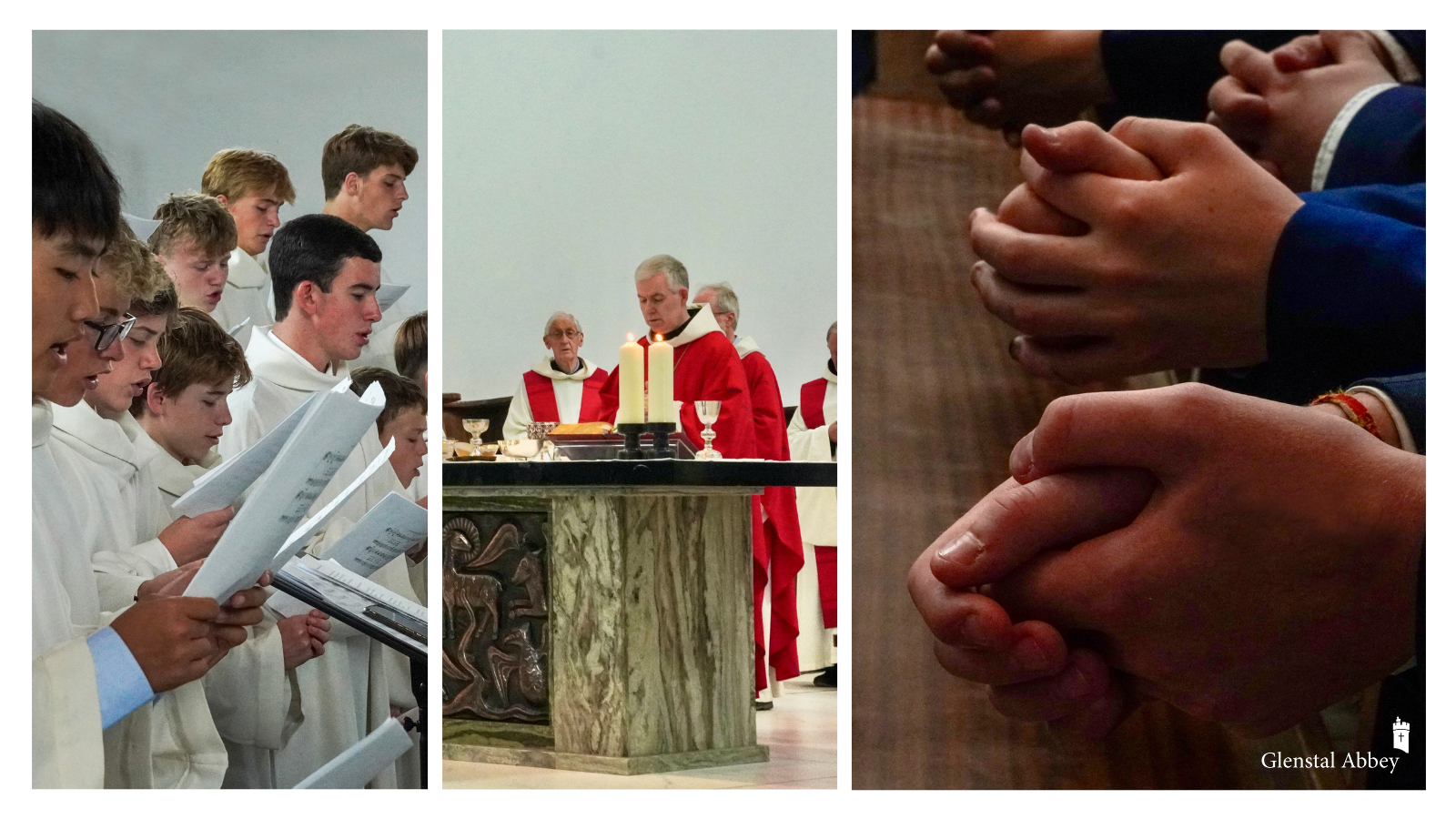
The Glenstal community – monks, students, colleagues and guests – gathered in the Abbey Church to celebrate a Mass of the Holy Spirit for the start of the academic year 2023/24 on Wednesday 6th September.

Invoking the gifts and guidance of the Holy Spirit as the new school year began, Abbot Brendan Coffey reflected on the healing words of Jesus to the mother-in-law of Peter and reminded those gathered to ‘look to the example of Jesus. Be prepared to use words carefully and well. Use them for building up, for healing… the possibility of giving the gift of the right word, a healing word, lies within the power of each one of us.’

In addition to looking forward to the coming year, the Mass was also an opportunity to look back and to give thanks to God for the previous year: for our academic, sporting,  extra-curricular and personal achievements.

We are particularly proud of our 2023 Leaving Certificate class, who together achieved an average point score of 517. An amazing 19% of the class achieved over 600 points, whilst 10% achieved full marks of 625 points. One student achieved a straight run of eight Higher 1’s.

We heartily celebrate the hard-work and dedication of our students and colleagues in the school and we give God thanks for these spectacular achievements.

As another school year gets underway once again at Glenstal, we pray that these coming months in this ‘School of the Lord’s Service’ may be fruitful for all.

Categories
Abbey | Latest News abbeynews

The Abbot in Benedict’s Rule


Ensuring everyone in the monastery is fully alive: Mark Patrick Hederman takes a look at the role of the Abbot and the lessons for Christian leadership – https://shorturl.at/csvCZ (🎙️ audio-only: https://shorturl.at/gvFRU)

Categories
Abbey | Latest News abbeynews

Homily – 22nd Sunday in Ordinary Time (Year A)

Fr Denis Hooper OSB

When I first looked over today’s readings I was struck by the very first line of the first reading from Jeremiah: “you enticed me Lord, and I let myself be enticed” whilst in another version of this reading I saw that it says, “you duped me Lord, and I let myself be duped.” To be duped is to be deceived. To be enticed is to be tempted. Two different meanings. Jeremiah felt duped and even enticed because God did not fit into the vision of what Jeremiah thought God should be.

The disgraced American financier Bernie Madhoff duped and enticed many wealthy people out of their money – he persuaded millionaires and billionaires who should have known better to put their millions into his ponzy schemes. By the time he was caught it was too late for his victims and he had cheated them out of hundreds of millions!

Words change their meaning over time and in a short number of years many words in our past vocabulary mean exactly the opposite to what they mean now: I heard a golfer recently describe a Big Bertha golf club as “this bad boy” – bad used to mean evil – now bad means good. “Sick” used to mean being ill – now it means great – “these are sick boots.” “Friend” used to mean just that – now it means a list in your contacts. Gay was once short for the name, Gabriel. The warden in the movie Cool Hand Luke used a line that sums up well the
issues we have with the changing of the meanings of words when he said: “what we have here is a failure to communicate.”

You can feel Jesus’ frustration with Peter in today’s Gospel – a case of failing to communicate – when after all they have been through together, three years of it – Peter still doesn’t understand the ultimate purpose of Jesus’ mission. Last week’s Gospel has Peter filled with the Holy Spirit saying to Jesus “you are the Christ” and Jesus telling Peter that he will be the rock on which his Church will be built.

This week we can see Peter as a sort of mouthpiece for the devil. Up to now in Saint Matthew’s Gospel, Jesus has been travelling around with his disciples teaching and healing and for the most part it has been a very pleasant experience for all concerned. What’s not to like about following someone with the powers Jesus has? Healing the sick; changing water into wine. His celebrity sort of rubs off on you and you can bask in the shadow of his glory. But now the story is about to change and Jesus now knows that he must go to Jerusalem to face his death and resurrection. Peter will have none of this and says he won’t let it happen. Peter’s attitude is “if it’s not broken, why fix it?” So, Jesus must rebuke him and tell him this must happen and that no one, especially Peter, should get in the way of it.

We are all like Peter – we can blow hot and cold. We are heading into the Rugby World Cup. It is just pure coincidence that I am wearing green today. Come on the boys in green! Rugby and many team sports if let get out of hand can be extremely dangerous. In rugby there is a conflict between both teams. One team is trying to move towards the goal line in one direction and the other team is trying to do exactly the same but in the opposite direction both teams bump, collide and tackle each other trying to stop each other’s progress. In the middle of these two teams is another team – the officials – men and women assigned to regulate what happens during the games. Each official must have an intimate knowledge of the laws of the game. And Glenstal has a connection with the laws of rugby: the laws of rugby were first written down by Sir Charles Barrington of Glenstal castle when he was a student in Trinity College Dublin in the 1880’s.

Now Jesus chose his apostles as sort of officials. He needs them more than ever now that he faces towards Jerusalem and the certainty of a horrible death. Our world is pretty chaotic. Words change meaning at the drop of a hat and we find it hard to negotiate our way through our lives – and we can easily interpret things wrongly. We don’t know yet what the consequences artificial intelligence might bring into our lives. Like sporting officials – like Jesus’s disciples – we must stick to the playbook as best we can.

Let us pray that when the time comes for us we will not get it wrong and will “stand up and fight until we hear the bell” against any and all evil – according to the Way, the Truth and the Life.

Categories
Abbey | Latest News abbeynews

The Prologue of Benedict’s Rule

Fr Columba begins our podcast series on the Rule of Saint Benedict by looking at its Prologue: shorturl.at/xEHTV (🎙️ audio-only version: shorturl.at/dovS9)

Categories
Abbey | Latest News abbeynews

Homily – 21st Sunday in Ordinary Time (Year A)

Fr Cuthbert Brennan OSB

The question of identity is an overarching theme in the gospel of Matthew. Not only the identity of Jesus but also deep in the background of Matthew’s gospel is the real the question of identity for the early Jewish Christian community. Were they no longer faithful Jews? Were they wrong to accept Jesus as the Anointed One, the messianic King?

Last week you will remember we had the confrontation with the Canaanite woman, the outsider who challenged Jesus’ narrow understanding of his mission and this week we have the master asking his students to clarify his career path and identity. Each of these encounters is a dialogue of self-discovery, a reflection about identity and mission. But of course Jesus is not having some divine identity crisis but instead has been consistently pigeon-holed by his contemporaries. He is known as Jesus of Nazareth and we all know
that nothing good can come from Nazareth. He is labelled as the carpenter’s son and we are all familiar with the dismissive maxim like father like son. And so Jesus asks what are others saying about him? And the replies are; John the Baptist, Elijah, Jeremiah – all very honourable if mistaken perceptions. And it is Peter inspired by God who makes the profession of faith. And for that he is rewarded with the keys to the kingdom of heaven.

What a useful set of keys to have these days of greed, intolerance and
animosity, where there seems to be at times a deficit of charity and human decency. If we are to live out our call to discipleship, then we cannot insulate ourselves from the issues of our times, but instead we must have the courage to be seen clearly and reflected honestly in the mirror of the other, in their needs, their dignity, their humanity so that they can unlock the potential of their own selves and in doing so our true identity and potential is also unlocked.

Dr. Frank Mayfield was touring Tewksbury Institute when he collided with an elderly floor maid. To cover the awkward moment he asked, "How long have you worked here? Almost since the place opened; the maid replied. What can you tell me about this place?" he asked. I’ll show you; She led him to the basement. She pointed to small prison cells, their bars rusted with age. She said, "That’s where they kept Annie; Who’s Annie? he asked. A young girl brought here because she was incorrigible. Nobody could do anything with her. She’d bite and scream and throw her food at
people. The doctors and nurses couldn’t get near her. I’d see them trying, with her spitting and scratching. I was only a few years younger, and I used to think, I sure would hate to be locked up in a cage. I wanted to help her, but if the doctors and nurses couldn’t help her, what could someone like me do? so I baked her brownies. I walked carefully to her cage and said, Annie I baked brownies just for you.’ I’ll put them down and then I got out of there as fast as I could. I was afraid she might throw them at me. But she took the brownies and ate them. After that, she was nice to me. Sometimes I’d talk to her. Once, I got her laughing. A nurse noticed and told the doctor. They asked me if I’d help them with Annie. I said I’d try. So every time they wanted to see or examine her, I went into the cage and calmed her down and held her hand. They discovered Annie was almost blind. After they worked with her a year, Perkins Institute for the Blind opened. They helped her and she went on to study and become a teacher.

Years later Annie came back to the Tewksbury to visit and asked what she might do to help. The Director had just received a letter from a man about his daughter. She was unruly, blind and deaf, deranged and animalistic … but He didn’t want to put her in an asylum. So he wrote to ask if we knew a teacher who would work with his daughter. That is how Annie Sullivan became the lifelong companion of Helen Keller. Years later, when Keller received the Nobel Prize, she was asked who had the greatest impact on her life. She said, Annie Sullivan. But Annie said, No Helen. The woman with the greatest influence on both our lives was a floor maid at the Tewksbury Institute.”

A scrub maid who chose the power of the keys. Identity is performative. In birth and baptism we were created and recreated in the image of God and were given our own set of keys. We can use those keys to bind ourselves and others or unlock the doors of dignity and affirmation.

Categories
Abbey | Latest News abbeynews

New Podcast on Rule of Saint Benedict

When a novice monk enters the monastery, the Abbot presents him with a copy of the Rule of Saint Benedict and tells him:

‘This is the Rule under which we strive to serve Christ the true king. If you feel able to follow it, come in; if not, freely depart.’

For nearly a millennium and a half, monks and nuns have followed the Gospel of Jesus Christ in the manner and example laid down by Saint Benedict in his Rule.

This sixth-century document has a relevance and wisdom for the twenty-first century, and not just for monks and nuns: it can be a practical guide, a spiritual teacher and a useful toolbox for all of us. The Rule has so much to offer that is has even been offered as a tool for parents, teachers, politicians, corporate leaders and more.

The Rule famously begins with the word Ausculta, “Listen!”, and we invite you to listen to the wisdom of Saint Benedict from his Rule with a 10-episode podcast released each Sunday by the monks of Glenstal Abbey on our social media channels.

Buy a copy of the Rule at our online shop here.

Subscribe to our YouTube page here, or visit our SoundCloud page for audio-only episodes here.

Categories
Abbey | Latest News abbeynews

Homily – 20th Sunday in Ordinary Time (Year A)

Fr Christopher Dillon OSB

For once it is the words of the Old Testament which sound kinder than
those of the New. “My house will be called a house of prayer for all the
peoples” is a much more generous sounding statement from the prophet Isaiah than those words ascribed to Jesus, “I was sent only to the lost sheep of the house of Israel”. But, while universalism is proposed there in place of the more familiar exclusivity of the Jewish people, the real issue is to be found in Jesus’ concluding words to the foreigner, “Woman, you have great faith.”

Indeed, it is the case that we hear Jesus praising the faith only of foreigners, while he is more likely to be represented as saying to one of his own, even Peter, “Oh you of little faith!” That God should have an interest in and command of the whole world is nothing surprising to us; God is after all infinite and unique. It is relatively easy, then, to subscribe to his achingly mother-love for us all, in his mercy. It is the
way God is. But our having great faith; that is another matter. In general, the instances of great faith to which our attention is called are ascribed to outsiders as opposed to what St Benedict would call “the domestics of the faith”, those who are familiar with it all; that is, those who should know better.

St Paul refers to them as “disobedient”, even, “imprisoned in disobedience”. Probably, a better description of those so-called faithful would be lazy, dulled by entitlement, smug or self-assured. Would any of those epithets rest easily on any of us? I have to admit to a twinge of misgiving. Our times are increasingly familiar with popular disappointment with traditional authorities, fading trust in certainties and growing cynicism with regard to the truth, so that faith of any kind is at a premium. Religious believers who cling grimly to the literal truth of the scriptures are derided for their simplicity, so how are we to read this woman’s faith? Certainly, she is desperate for help, any help, and clearly she has heard about Jesus. At the very least, we are in the same boat; we too have heard about Jesus. But is our faith in him as great as hers? Jesus has spoken of himself as embodying the Truth. Is he our Truth? And, if so, what does that mean?

We are being invited by these readings, I think, to reconsider what it means for us to believe in God, to believe in Jesus, to belong to the Church as the community of believers. To what extent does any of it shape the way I live my life, if I allow it to shape my life? These are important questions, because they contribute to the maintenance of
a perspective for the reality in which each of us lives. What matters more or less? To be able to assert in all sincerity that God is; that God loves me in and through Jesus Christ and that God has made me to live with God for eternity, is already enormous. It is material for lengthy consideration and endless gratitude, very much, as it happens, in the terms expressed by the Collect Prayer for this Mass,

“O God, who have prepared for those who love you
good things which no eye can see,
fill our hearts, we pray, with the warmth of your love,
so that, loving you in all things and above all things,
we may attain your promises which surpass every human desire.”

In a time of cynicism and fractured trust, we have cause to be grateful to this anonymous Canaanite woman whose faith and perspective so impressed Jesus, as it prompts us to consider the nature of our own attachment to the person of Jesus and to his teaching. So, by way of conclusion, may I put a question to you? How often do you read
the Gospels, in order to hear Jesus for yourself speaking directly to you, rather than hearing only the snippets which are offered to you at Mass? It is something, I suggest, to which we could all give better effort and attention. It is something which would richly inform our consideration of what it is that we actually believe, in the religious dimension of our life.

Subscribe To Our Newsletter To Receive Updates

[hubspot type=form portal=6886884 id=9e1d6d0d-c51e-4e35-929d-3a916798de64]