
Categories
Abbey | Latest News abbeynews

Homily – 29th Sunday of the Year A

Fr Lino Moreira OSB

In the sixth year of the Christian era, Rome introduced in Palestine a poll tax of one denarius per adult person. Many argued that to pay such a tax was to acknowledge a foreign pagan sovereignty over Israel, which was forbidden by the Law of Moses. However, when Jesus was consulted about this matter, the aim was not to settle the question, but rather, as Saint Matthew puts it, to ensnare him in his words (cf. Mt 22:15).

If Jesus said that it was lawful to pay taxes to the Emperor, he would incur the wrath of nationalists and lose his credibility before those who regarded him as a prophet. But if he said the opposite, he would be denounced as a revolutionary, who was inciting the people to rebel against Roman rule.

One cannot but admire the skill with which the trap was laid. Jesus was confronted with a yes or no question which was prefaced by very flattering words: “Teacher, we know that you are true, and teach the way of God truthfully, and you do not care about anyone’s opinion, for you are not swayed by appearances” (Mt 22:16). This statement was meant as a ploy but, ironically, it was a perfect description of Jesus, who said of himself: “I am the way, the truth and the life” (Jn 14:6). As the embodiment of truth, Jesus could not be deceived or influenced by any form of outward show, and being in awe of none, he said: “Why are you putting me to the test, you hypocrites? Show me the coin for the tax” (Mt 22: 18-19).

At this point we need to remember that Jesus was speaking in the Temple at Jerusalem, and that the denarius brought to him was a powerful symbol of a pagan cult, for it showed the head of the Emperor Tiberius over an inscription which read: “Caesar Augustus Tiberius, son of the divine Augustus, great High Priest.” The claim here was that, after his death, Octavius Augustus had been deified, and therefore his heir, Tiberius, the ruling Emperor, was to be honoured as the son of a god.

“Whose image and inscription is this?” – Jesus asked. – They said: “Caesar’s”. Then he said to them: “Therefore give to Caesar what is Caesar’s and to God what is God’s” (Mt 22: 18-19). By drawing such a sharp distinction between Caesar on the one hand and God on the other, Jesus was pointing out, first of all, that the Roman Emperors were no more than perishable men, according to the words spoken by God through the prophet Isaiah: “I am the Lord, and there is no other; besides me there is no god” (Is 45:5). And in Psalm 46 it is also said: The rulers of the earth belong to God, to God who reigns over all. That means that the course of human history is in the hands of our Maker, and all kinds of worship of a worldly leader are to be rejected as a form of idolatry. However, there is an obligation to give to Caesar what is Caesar’s. The taxes legitimately imposed by the civil authorities must be paid in line with Saint Paul’s teaching in the Epistle to the Romans: Pay to all what is owed to them: taxes to whom taxes are owed, revenue to whom revenue is owed, respect to whom respect is owed, honour to whom honour is owed (Rm 13:7). And the basis for doing all this, Saint Paul tells us, is that the governing authorities have been instituted by God to serve the common good (cf. Rm 13:1.4).

As Christians, therefore, we are urged to fulfil our civic duties and contribute generously to the welfare of society. But that should be a consequence and an expression of a much greater and more important commitment – namely, the commitment to love and serve the one true God. That is why, in the Temple at Jerusalem, Jesus gave the commandment to pay back to God what is God’s. Caesar had a right to claim a denarius, on which his image had been imprinted, but to God belong the lives of all his children, created in his own image and likeness (cf. Gn 1:26). So to worship God, our Father, in spirit and truth (cf. Jn 4:23) is essentially to return the gift of our very existence to the one from whom we have received it. As Saint Fulgentius of Ruspe said in one of his sermons: “Give God his own image in yourself, an image that must be kept undiminished by prudent care, pure by true faith and shining by good habits and deeds.”

Categories
Abbey | Latest News abbeynews

Food and Drink in Benedict’s Rule


Our podcast returns this week ahead of World Food Day with Abbot Brendan speaking on the place of food and drink in Benedict’s Rule: bit.ly/3QfpLN4 (audio-only: bit.ly/3Qloe8w )

Categories
Abbey | Latest News abbeynews

Homily – 28th Sunday of the Year A

Fr Luke Macnamara OSB

Weddings can be a nightmare. Who do you invite to the meal? Who do you invite to the afters? Who do you place beside one another? Who do you place far apart? Even regular meals can be difficult to negotiate when eating with a crowd. Where do you sit in the school refectory, university canteen, or the family dining table when at home? What dictates where you sit? Do you choose to sit with someone or choose to sit apart from someone? There is no choice in the monastery. St Benedict has his monks take their places by date of entry into the community. So at formal meals at Glenstal, you may end sitting next to the same person for 6 decades! A good reason for eating in silence one might add!

The Kingdom of God is likened to a great wedding banquet on the Lord’s mountain. Isaiah says that all our desires will be fulfilled, with rich food and fine wines. Mourning and death will be no more. This is a wonderful vision. Sadly this vision is very far from our current reality where so many families mourn the loss of loved ones, especially in Ukraine and the Holy Land.

There is a catch to this wonderful future vision of the kingdom as a great banquet. We are there at the Lord’s invitation and we do not get to choose the guests. There is no screening to exclude certain people who we would rather not sit beside. Astonishingly, all are invited to the Lord’s banquet, the good and even the bad! Invitations are not dictated by our notions of merit, and that is probably just as well. We begin to discover that our imaginings of the Lord’s mercy fall far short.

This vision contrasts with the reality of the world where so many cannot site at the same table together. However, the vision points to a way forward for us. The future vision of the kingdom, we make a reality every day in a small way when we gather around the one table at home, or in the monastery and school refectories or university canteens. By sharing the table together with people of different personalities, different nationalities, different politics, etc. we anticipate that universal banquet in the kingdom.

We anticipate the kingdom’s banquet in a particular way here at this Mass, where parents, students and staff from both the school and the university with many nations represented all gathered around the one table. Here, the Lord will offer us his peace, a peace that the world cannot give, and yet a peace that he empowers us to give one another. Here, the Lord will provide his body and blood as the true food for life eternal. As we remember the many dead in Ukraine, Gaza, and Israel, we also remember the Lord’s promise that he will destroy death forever. Perhaps our best response to the senseless round of murder and violence is for our families, our class groups, and our communities to be united around the one table and so be beacons for peace in our world. There are many in the world who are too busy to respond to their invitations. We have all been invited to take our place at the table – let us do so now.

Categories
Abbey | Latest News abbeynews

Homily – 27th Sunday of the Year A

Fr John O’Callaghan OSB

Today’s gospel is a parable about God’s people and their leaders, before and after the coming of Christ. The Old Testament reading depicts a vineyard that has become rundown and unproductive. The scene Isaiah evokes is what you might see at this time of year in France, Italy or Spain – bare hills of ugly stumps and stalks where not long before there were abundant vines of red and green grapes. The dead stumps are crooked, narrow and easily broken, only good to be thrown on the fire. And Isaiah is saying that this is what God’s people have become, that they are like a barren field now. It is a powerful image.

The gospel picks up the same image but focuses exclusively on those
responsible for caring for the vineyard and making it produce fruit. These tenants refuse to pay rent to the owner and instead mistreat, grossly insult and even kill those trying to collect it. The tenants, we know, stand for the chief priests and Pharisees and, in the end, these leaders finally realise that the parable is about them. They are the ones who have not properly cared for God’s people, and it is they who will ultimately hand Jesus over for crucifixion. “They wanted to arrest Jesus [right then] but were afraid of the crowds who looked on him as a prophet.” As you know they had Jesus arrested and killed later!

Our parable condemns those leaders for their corrupt behaviour, saying that “the Kingdom of God will be taken from [them] and given to a people who will produce its fruit’, adding that ‘the stone rejected by the builders became the corner stone’. On Christ’s death and resurrection the church was founded. So our gospel is about regime change, changing the leadership of the people of God from chief priests & pharisees to Christ. We are thus to be made productive, and as delightful as a fertile vineyard. What does that change really involve?

First of all, recognising Christ as God-with-us, as confirmed by the prophecies and especially the resurrection. Christian faith is the great gift that illumines our lives and frees us from unbelief and its substitute, idolatry. Those who do not put their trust in God must hear the din of countless idols crying out: ‘Put your trust in me!’ By faith we know there is always something greater than our own understanding. And Christian faith is trust in a love that holds us all in existence, and even enters into relation with each one of us, and gives our lives ultimate meaning.

Not content with smaller lights, faith is a light capable of illuminating every aspect of human existence. It is by faith that we believers receive a new being and become sons and daughters of the living God, who is our Father. And faith leads on to hope. In the letter to the Ephesians St Paul reminds his readers that before their encounter with Christ they were’ without hope and without God in the world’. Of course he knew they had their pagan gods and religion but those gods had proven doubtful. They were in a dark world, facing a dark future. In a cemetery of the period there is a gravestone engraved with the words: ‘How quickly we fall back from nothing to nothing’. But the distinguishing mark of a Christian is that we know the future is positive, is a victory of life over death. This gives us the courage to rise to the challenges that face us. It is the kind of confidence we all need. And our own individual lives do not end with a shovel full of clay but in the glory of the kingdom of God! Thirdly, love. Christians trust in a perfect, divine love, in its decisive power. We believe in a God who is so close to us that he entered our human history and is constantly guiding us towards Himself. This transforms us to live our lives in
this world with greater intensity, to become loving persons, in his image, ready for renunciation and willing even for sacrifice.

Faith, hope and love. And the greatest of these, says St Paul, is love. It is this we are called to live today, surrounded as we are by so many challenges. The first Christians were known for it; may we also be in our times!

Categories
Abbey | Latest News abbeynews

Saint John in Jerusalem

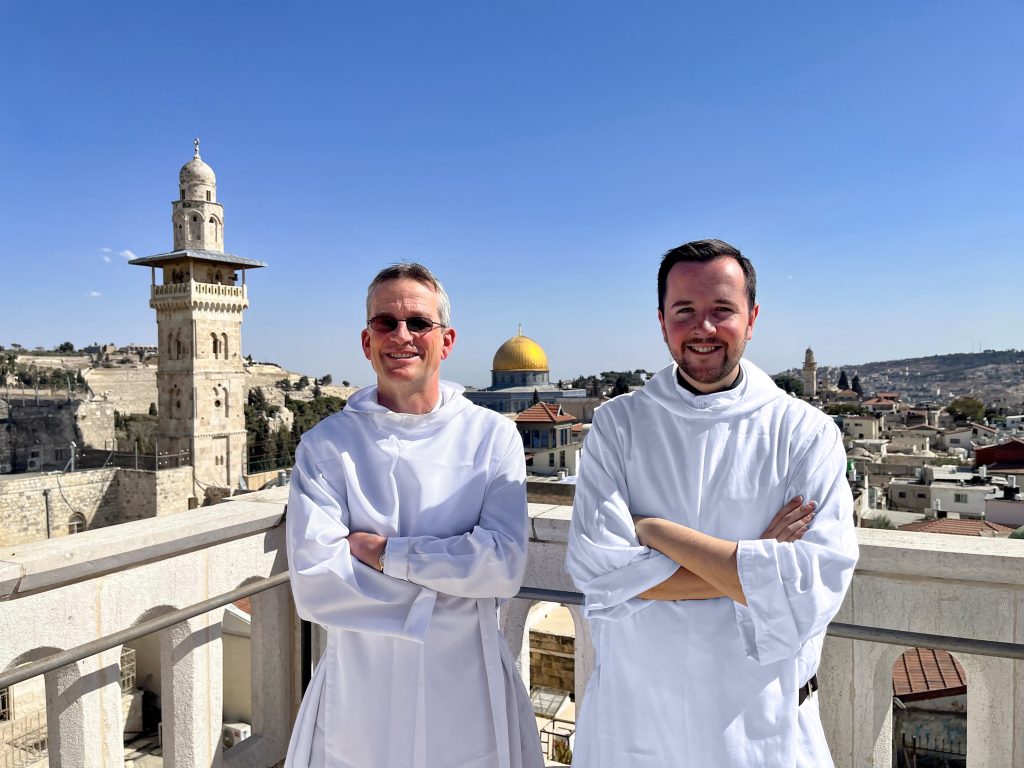
Fr Luke Macnamara OSB recently returned to Glenstal after teaching a two-week course on the Gospel of Saint John at the Notre Dame de Sion Centre for Biblical Formation in Jerusalem’s Old City.

More than two dozen participants from around the world joined Fr Luke for a series of lectures, individual and group study, field trips and excursions focussing on John’s Gospel.

A Glenstal monk for more than twenty years, Fr Luke completed his doctorate in Sacred Scripture at the Pontifical Biblical Institute in Rome and has lectured at Saint Patrick’s Pontifical University in Maynooth for almost a decade.

In addition to lectures on John’s Gospel, the course included some inputs on Judaism and Islam, taking into consideration Jerusalem’s unique position at the heart of the three Abrahamic faiths.

Glenstal’s Br Justin Robinson OSB – who is currently away on studies in the Holy Land – was invited to give two talks on Islam to the participants. He spoke on the subject of ‘Text, Land, People: an exploration of the Qur’an, its People and Holy Land.’

The presence of two Glenstal monks in Jerusalem provided an opportunity for a number of meetings with friends of the monastery and, most importantly, the chance to pray in the holy places for the Abbey’s monks and their relatives, for Glenstal’s friends and benefactors, colleagues, students and their families.

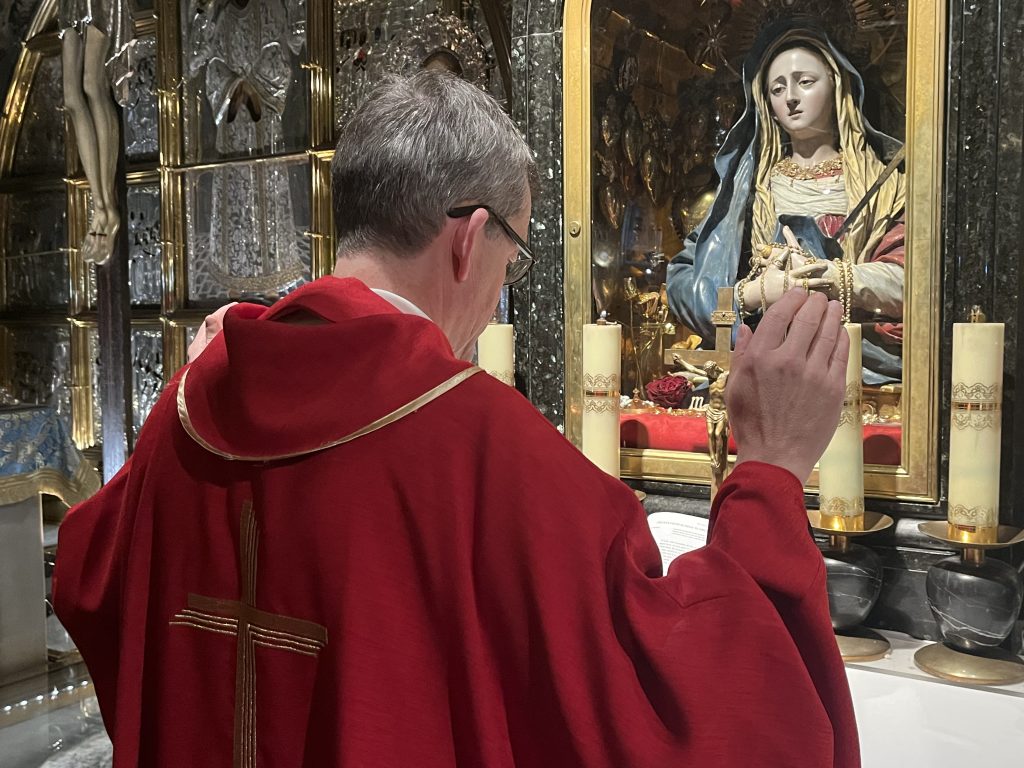
It was a privilege for Fr Luke and Br Justin to pray for these intentions at the Church of the Holy Sepulchre during an early-morning Mass celebrated on Calvary. In a particular way, they remembered the intentions of the students, families and staff of Glenstal Abbey School who recently began a new academic year together.

Most providentially, the pair later had a chance-encounter with Abbess Klara, the superior of our congregation’s foundations in Ukraine, who has visited Glenstal a number of times over the years and was making a pilgrimage to Jerusalem.

This brief meeting was an opportunity to exchange greetings between monastic communities and to hear news of the Benedictine Congregation of the Annunciation’s brothers and sisters in Ukraine.

To learn more about the Benedictine monastic foundation in Lviv, Ukraine, visit the website of our Congregation here.

To find out more about similar talks, retreats and events from monks of Glenstal Abbey, visit our Events page here.


Categories
Abbey | Latest News abbeynews

Homily – 26th Sunday of the Year A

Fr Anthony Keane OSB

We have heard in today’s gospel of a man with two sons. He
tells the first to go and work in the vineyard. This first son
says he will not go, but afterwards thinks the better of it and
goes and works. The man tells his second son to go and work
there too. This second son says ‘certainly I will’ but does not
go to work.

Which of the two do we think did the father’s will? Jesus says elsewhere: It is not those who say Lord, Lord who are saved, but those who do the will of the father. Similarly, we may see that both sons answered superficially: The first who said he wouldn’t but then did and the second who said he would but then failed in the deed. Neither of them knew the great power that could work through them. For the Lord has said: Deep within their beings I will implant my law; I will write it on their hearts.

Indeed it is for this very reason that we have a heart that beats
within us, that hearing it we may rejoice greatly in the great gift of life we have been given, and so attain to the bliss of continuous prayer. And Saint Benedict advises those who do good that they may happily avoid the danger of pride by rejoicing in the power of God who works within them.

This the first son happily discovered, and guided and impelled
by the Holy Spirit, effortlessly fulfilled the command of the
Father. My we too do likewise.

Categories
Abbey | Latest News abbeynews

Good Zeal in Benedict’s Rule

Good zeal in the spiritual life involves a constant turning towards God, Fr Jarek tells us in this week’s podcast on the Rule: bit.ly/48ApECY (audio-only: bit.ly/3tcLAE2)

Categories
Abbey | Latest News abbeynews

Autumn 2023 Chronicle

Read the Autumn 2023 edition of the Glenstal Abbey Chronicle here. This edition features news of this summer’s solemn monastic profession of Br Oscar; tales from a school trip to Togo with Fr John; a sojourn in the Gaza Strip by Br Justin; a centuries-old chalice examined by Br Colmán and much more…

Categories
Abbey | Latest News abbeynews

Homily – 25th Sunday of the Year A

Fr Christopher Dillon OSB

What does justice look like in God’s eyes? And when is it fair? The prophet Isaiah tells us, today, that God is “rich in forgiving”. And then Jesus, who we are told is God in action, in this Gospel passage that we have just heard, poses the question, “Why be envious because I” – God, that is – “am generous?” Well how would you feel, after twelve hours work in the blazing sun, if the fellow next to you, after only one hour, gets the same wage as you? Is this God’s justice? Is it fair that God be so generous to him?

Every so often, we are faced with the enormous truth that God is different, so different. God is absolutely OTHER. Again, Isaiah has God say of himself, “As the heavens are high above the earth, so are my thoughts above your thoughts, my ways above your ways”. For us, God is mystery, utterly beyond our comprehension, which is an essential part of God being God. It is true that Jesus represents God, speaks for God, acts for God. Indeed, in the Gospel of John, Jesus is quoted as saying, “to have seen me is to have seen the Father”; and we
think we have some grasp of what Jesus is about. Yet Jesus too is quite beyond us. Perhaps this is what we are to take from today’s scripture readings, this mysterious otherness of God.

So much of the time, when we think of God at all, we are tempted to think of God as a HIM, as some kind of magnificent chum, to whom we turn for help, when we need it. And so many Gospel stories seem to invite this view of Jesus and so of God. But, no; God is absolutely OTHER…absolutely good, absolutely just, absolutely kind, absolutely humble, absolutely generous, absolutely powerful, absolutely loving. At the same time, God is father to us and mother and sister and brother; and to a degree which is infinite.

It may help our understanding of the tone of this passage if we consider that St Matthew’s Gospel, from which this story is taken, was designed for an audience of Jewish Christians who thought of themselves as members of God’s Chosen People; and many of them will have regarded non-Jewish converts to Christianity as late-comers from the outside world of the un-chosen foreigners. This parable, then, would be explaining to them that all followers of Jesus Christ are on a par, no matter where we come from, no matter who we are; all are equally chosen and infinitely loved by the one God. That takes some
generosity of understanding and some careful consideration, if you are a Jew born and bred. And for us who have been adopted into the family of the Chosen there is a great deal to consider and to understand when you begin to realise that God expects us, chosen as we are now, to develop the same loving concern as God has for all those around us.

The plan is that you and I, taught by Jesus Christ and following him,
increasingly reach out to those around us, as though each of us is Christ. That, we are gradually to understand, is what following Christ, being Christian, actually involves. It is no picnic; in fact, it is very hard work. We heard, last Sunday, about the servant who was forgiven his enormous debt by his master and how we, as fellow servants, must do the same for one another. Today’s story is turning that screw just a bit. The whole point of our lives as Christians is to become increasingly like God in our thinking and behaviour, whatever about his thoughts and ways being above us. We are, in effect, to be the kindness of God to the person next to us. And this, Jesus is telling us, is how we are to set about it, by being increasingly forgiving of one another and increasingly generous to one another. So now you know. It is over to you and me to get on with it.

Categories
Abbey | Latest News abbeynews

Latest podcasts

Due to technical difficulties with the News section of our website over the past week, we share here two instalments from our Benedict’s Rule podcast series:

Sunday 24th September:In this podcast, Fr Martin talks about the place of prayer in the Rule of Saint Benedict: https://bit.ly/3LC3wOO (audio-only: https://bit.ly/3t2vFYR)

Sunday 17th September: Monasteries are never lacking guests, Saint Benedict says. Fr Christopher shares a short reflection on hospitality in our latest podcast here: bit.ly/3LmFMy8 (audio-only: bit.ly/3sUPHV8)

Subscribe To Our Newsletter To Receive Updates

[hubspot type=form portal=6886884 id=9e1d6d0d-c51e-4e35-929d-3a916798de64]