
Categories
Abbey | Latest News abbeynews

Homily – Christ the King – Year A

Fr Columba McCann OSB

A few weeks ago I was with the school choir in London, and as we walked up to the gates of Buckingham palace, the flag was flying. This indicated, I think, that King Charles was in residence. But there was no chance we were going to get near him. The gates were locked and he was well protected from the likes of us. The king we celebrate today is quite different. He died and rose again so that he would be with us always In today’s gospel Jesus describes what it will be like when he sits on his throne of glory, and twice he speaks of himself as King. Yet this king seems to operate more like a shepherd, separating sheep and goats.

This would not have been a huge surprise to Jesus own listeners; in those days kings were often seen as shepherds of their people. The great king David was a young shepherd when he was chosen and set apart to shepherd God’s people. When Jesus himself was born in
Bethlehem the place of David’s origins, it was to shepherds that his birth was first revealed. He is a shepherd king. He knows each of his flock by name and calls them individually. He goes to great lengths to
rescue any of the flock that have gone astray, even one by one. In the end, he gives his life for his flock.

This shepherd king identifies completely with each one of his flock. Mother Teresa of Calcutta, now a canonised saint, was well known for the extraordinary way in which she reached out to the most deprived and the most wounded in here society. She was happy to immerse herself in tragic situations from which most people would run a mile. One day she was asked, ‘What is it that motivates you to go to such extraordinary lengths in your work?’ Her answer was simple. She said that you could it put it down to a few words that you can count on the fingers of one hand: you did it to me.

Christ the shepherd king identifies totally with his flock. And this is not just some clever play of rhetoric in order to get us moving. We see the same visceral connection in a totally different context: We know the story of the conversion of Saul, later St Paul, on the road to Damascus. He had been persecuting Christians. He meets Christ on the road. Christ doesn’t say, ‘Why are you persecuting my brothers and sisters?’ He says, ‘Why are you persecuting me?’

In his monastic rule, St Benedict says that when a monk welcomes a guest, it is Christ whom he welcomes. When a monk looks after a sick brother, it is Christ whom he serves. It is very sobering also not notice that those who are separated from the flock off to the left, like goats, are not murderers, rioters, those who attack children, or perpetrators of fraud. The crime for which they are eternally set aside is simple neglect: neglect of the hungry, the thirsty, the stranger, the naked, the sick, the prisoner. None of us need took too far to see this kind of neediness in our own family, our community, our neighbourhood, our country. The tragic needs of some many people around the world are so great that it can be overwhelming to think of it, and we can end up deciding that it’s all too big for us to handle. But perhaps a first step is to ask for eyes to see what is close at hand. Eyes to see what it is that I can do for the needs of people as they present themselves to me. In what way can I
serve Christ the King as he presents himself in the people around me?

Categories
Abbey | Latest News abbeynews

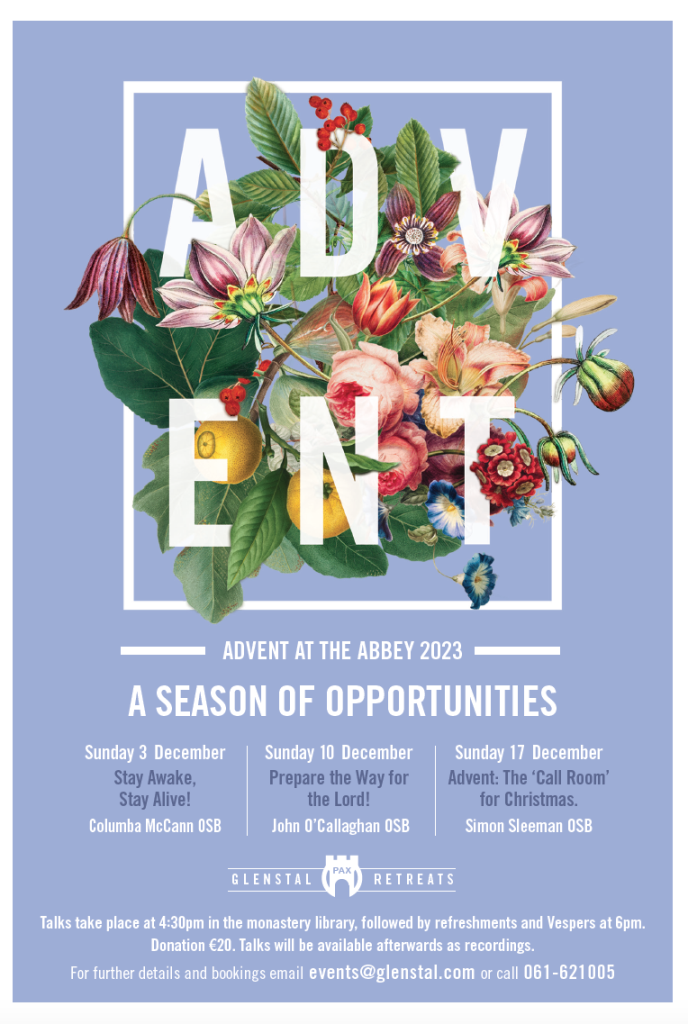
Advent at the Abbey 2023

The famous Benedictine author Sr Maria Boulding once famously asked: “what is the point of Christ’s coming, if Christ does not come to me?”
Advent is an opportune time to welcome Christ into one’s life and to be transformed. It is ‘A Season of Opportunities’, as the title of our Advent 2023 series of talks suggests, to prepare for the central gift at Christmas: the coming of Jesus Christ.
+ Fr Columba McCann begins the series with his talk ‘Stay Awake, Stay Alive!’ on Sunday 3rd December.
+ Fr John O’Callaghan will urge us to ‘Prepare the Way for the Lord!’ on Sunday 10th December.
+ Fr Simon Sleeman will conclude the series with his reflection ‘Advent: The ‘Call Room’ for Christmas’ on Sunday 17th December.
Talks take place at 4.30pm in the Monastery Library, followed by refreshments and Vespers at 6pm. Donation: €20. Talks will be available as recordings online soon afterwards at: www.youtube.com/GlenstalAbbeyMonks
For more information and enquiries please contact events@glenstal.com or call 061 621005.
Categories
Abbey | Latest News abbeynews

Stewardship of Goods with Br Oscar

Br Oscar shares here an interesting perspective on sustainability and the stewardship of goods in the monastery according to Benedict’s Rule: https://bit.ly/47BvLFS  (audio-only: https://bit.ly/46llOLI )

Categories
Abbey | Latest News abbeynews

Homily – 33rd Sunday of the Year A

Fr Patrick Hederman OSB

About three weeks ago, I was walking by the terrace in the school when I saw nine students dressed in all their finery waiting for a bus. They were heading for the first round of the UCC Philosophy Society Schools Debate, and, boy, were they bursting with talent. Five won through to the second round and the other four have the opportunity to join them later. As I stood there admiring them, another student, presumably on his way to the rugby pitches, stood near me, also looking up at them. Suddenly he roared at the top of his voice right into their faces: ‘bunch a nerds! Bunch a nerds’ and he ran off.
I thought to myself: ‘Talent is not always recognized or applauded; in fact, some people can be despised for their talents. If you are Jonny Sexton, Katie Taylor, Rory McIlroy or Leona Maguire, you can hold your head high, walk tall, you’re on top of the pile, but as the first reading says: ‘Charm is deceptive and beauty is fleeting.’ At some point you have to retire.

It is very often the case that what makes you popular and talented at school doesn’t necessarily make you successful in later life. Watch out for the wimps and weaklings when they are young, they’re often the ones who pass you out and make it right to the top. Ugly ducklings do often become swans.

Sometimes, if you’re at school and you’re too clever by half, you need to keep your head down and shine a little less brightly. Otherwise you can be called a geek, a swot, a drip, a square: whatever the fashionable put-down word is for those we envy. Bob Hope, as M.C. for the Oscar awards in Hollywood, for the umpteenth time, looked round the assembly of stunning glitterati and said: ‘Dear friends, the one sentiment that unites us all here together today is sheer jealousy!’

When we speak of talent we generally mean a natural aptitude that someone is born with, such as singing, painting, drawing or athletic abilities. People often have to work to refine these talents, but they’re generally innate and genetic rather than acquired. So, the first two people in this morning’s gospel are not really the point at issue. Whether they double what they got, or multiply it exponentially, they are dealing with gifts they received for which they can’t claim too much credit.

The main point of the parable is the person who got one talent and buried it in the ground. Whether you are a gifted out-half, or a mathematical genius, a beautiful singer or a star on the debating team is not really your doing: it is a gift, or a series of gifts, that you received at birth, and you can improve it depending on how hard you work or how things work out for you in your career. The person, on the other hand, who received only one talent is the model here this morning for each one of us. There are 10 billion people on the planet as we speak, and each one of these ten billion is unique, unique as their finger print. You are unique. Never before in the history of the world has there ever been a person like you. You are the first, and potentially the best ‘you’ that ever existed. So, what are you going to do about it: sit down and complain that everybody else got a better deal? This morning’s parable is encouraging us to get up and get organized. Each one of us has a special talent that we alone can bring to fruition. What matters is to stand up and say, with genuine pride and delight: ‘I am me!’ That is when the Lord and Master who created us in the first place will be able
to say: ‘Well done, good and faithful servant! You have been trustworthy in a few things; I will put you in charge of many things. Enter into the joy of your master!’ God’s joy, God’s glory, is you, as you really are, as you were meant to be, fully alive. So, let’s move ourselves in that direction. Amen.

Categories
Abbey | Latest News abbeynews

Homily – 32nd Sunday of the Year A

Fr Cuthbert Brennan OSB

Lord, lord open to us
And he answered ‘Truly I say to you, I do not know you?’
Does this really have something to do with judgment and salvation? And the answer is yes, these words do. The foolish bridesmaids were not recognised when they came to the wedding banquet because even though they dressed the part and initially carried the right equipment, they indeed had never been bridesmaids at all. We need to begin to recognise how our church and we its members have sometimes been like those foolish bridesmaids. This morning we are invited to stay awake to the Lord, to our calling as Christians, awake to the way of life in Christ. Our response to His person and work determines our
standing on the final day.

So the parable this morning proposes unexpected and even uncomfortable truths.
A superficial reading of today’s parable could give the impression that God’s reign is binary;
That there are only wise and foolish
Saints and sinners
Christians and non-Christians
Glenstallions and those who want to be
One good, the other highly questionable.
We are wired for this problematic kind of thinking.

Mark Twain proposed; “There are basically two types of people: those who accomplish things and those who claim to have accomplished things.” Concluding: “The first group is less crowded”

Robert Benchley summarises: “There are two kinds of people in the world, those who believe there are two kinds of people in the world and those who don’t.”

Jesus is clearly in the second category, for he did not divide people into
redeemable and irredeemable, worthy and unworthy, lovable and despicable. Rather his ministry was like an extended parable that continuously scrambled traditional thinking, upended well established norms and redefined the reign of God. Such disruption is evident in this morning’s parable and it raises more questions than it answers.

Our initial instinct is to side with the wise bridesmaids who must have read up on emergency preparations for wedding feasts but the problem with being a cheerleader for the wise bridesmaids is that they appear to be greedy. To be wise, it would seem, is to refuse to come to the aid of another in need. The wise bridesmaids have enough oil but their vision is limited. If they were so wise why couldn’t the five of them combine their collective wisdom and find a solution. All ten could have walked through the door together. Imagine the celebration that could have been!

One of the central commodities in the parable is oil. Oil has been very much in the news these last years. It is a coveted and weaponised resource. The oil in this parable is not the unreplenishable oil from fossils or fracking or deep sea drilling but rather the oil of the foolish and wise came from fish oil, animal fat but especially from olives. From eminently replenishable animals and trees.

The wisdom of this replenishable oil is a sign of the inexhaustible Christ, the anointed One whose vision is a peaceable kingdom where wisdom is shared, resources support the common good and the lavish graces of an eternal God never run dry.

In baptism we are anointed not with oil extracted from miles down in the earth’s crust but from oil extracted from groves of olives. We are anointed into Christ to collaborate in building a holy kingdom of new wisdom, devoid of rivalry, greed and exclusion especially of the marginalised, rejected and lost.

In baptism we were infused with wisdom from the eternally anointed One, sealed with the oil of healing, the oil of acceptance, the oil of gladness. This is our baptismal birthright and mission and when we accept such an invitation there is simultaneously an expectation placed upon us concerning who we are and what we will do. Will we be open to receiving the gift of wisdom from the margins of our church and society just as Jesus who was wisdom personified, also received wisdom from lepers and the lame, from interactions with the adulterous and tax collectors.

Jesus’ final command to stay awake is not to be taken literally. All the
bridesmaids slept. We are called to be actively engaged in the present which shapes our future. There is no mistake. The parable is a description of the kingdom of God. The kingdom of God is coming and it does not just unify, and synthesise and include. It divides the goats from the sheep, the wise from the foolish. It comes with joy and a demand for conversion of life. And let us beware, lest we, running frantically behind hear the words “too late, too late, I do not know you”.

Categories
Abbey | Latest News abbeynews

Homily – 31st Sunday of the Year A

Fr Jarek Kurek OSB

How fitting today’s readings for church that needs wise guidance, calling for leaders to take on the responsibility of following the teaching of our ‘Instructor’, Jesus Christ.

Now, when I say ‘responsibility’, I think of becoming ‘responsible’, that is, being capable of responding to the needs and challenges of our times, acquiring the ability to read and understand the world and human needs in the light of the instruction that Jesus Christ and all the tradition of the Church have left with us.

But there is also another, somewhat hidden meaning of the term ‘responsibility’, which is to able to set things straight, to guide the way, and ultimately to instruct.

We are just after celebrating the Feast of All Saints, and also, just two days ago, there has been a feast of a rather unappreciated saint, in our times I must add. Because in his own 12th century lifetime, he was a point of reference to many in this country and far beyond. Imagine that one of the most influential saints of all times, Bernard of Clairvaux, chose to write his one and only biography about this man. Such was Bernard’s admiration, that on arrival at his monastery in France, he hailed this man as the ‘true Orient from on high’, a label normally restricted to Jesus himself. Searching for the right modern analogy it’s like getting one’s face on the cover of Time magazine with the headline ‘Man of the Century’.

The man was an Irishman, and his name was Malachy, St. Malachy.

Now, it might be a pure coincidence, but today’s first reading was from the prophet Malachi! The name itself means ‘a messenger of mine’, ‘my messenger’ from God’s perspective, which I think fits quite well into the profile of ‘the one who bears responsibility for the spiritual well-being of people entrusted to him’.

As we have heard, prophet Malachi tried hard to instruct the priests of his times. Actually, he gave out to them for misguiding the people of God. What can we learn from our Irish Malachy about the proper way of instruction? Bernard puts down a striking note: Those who have never been disciples themselves are the blind leading the blind. Malachy, though taught by God, nevertheless sought out a man as a teacher, and he did so cautiously and wisely. A remarkable lesson for everyone who wishes to become more responsible for their own spiritual welfare, and perhaps of the others in the long-term: a prudent looking for someone who deserves to be their teacher and may lead them to Christ.

Our friend Malachy found such one, and after some years, he was ready to go out to the people of Ireland with Christ’s message. As his biographer St. Bernard notes, he was commissioned to give the ‘law of life and instruction to [sorry for this harsh description] an uncultured people living without the law’. What’s striking in what follows in Bernard’s story is that Malachy ‘accepted the command eagerly, fervent in spirit. He did not hide away his talents, but he was gasping for gain…he rejoiced as a giant to run everywhere…he was like a burning fire’. Setting things straight, leading his people toward the light by means of his instruction. Can you hear the intensity of his endeavour? By no means did he take his responsibility lightly. He got it right: to be truly responsible means, in this case, to be fervent in the spirit while spreading the message of the Lord.

But that’s not all when it comes to being truly responsible. St Malachy, according to the testimony of St Bernard, applied to himself one of the main responsibilities of any priest as prescribed by the prophet Malachi. His instruction was successful because his ‘holy lips…guarded knowledge’. Now, knowledge doesn’t get good press in our Christian circles nowadays; it is often seen as some sort of danger to our faith, ‘faith doesn’t go through the head’, we are told. Nothing can be more untrue. Faith and knowledge need to be seen as one; they are needed to form unity. As one of the spiritual masters put it: ‘Faith is a firm and certain knowledge of God’s kindness towards us, founded upon the truth of the promise given in Christ, both revealed to our minds and sealed upon our hearts through the Holy Spirit’. Faith is a knowledge of God’s loving invitation, presented to us through Christ’s instruction and constantly renewed by the Holy Spirit. But it requires our wholehearted response, a daily fervent spiritual quest. If you are happy to seek this knowledge of God and hear God’s plans for you, at some point, you will hear this extraordinary message from God in your heart: ‘messenger of mine, now you are ready’.

Categories
Abbey | Latest News abbeynews

Care for the Brethren with Br Timothy

Br Timothy examines what the Rule has to stay about care for the brethren: nourishing the young and caring for the aged so that all may live, pray, work and die together within the community’s embrace: bit.ly/45Z3hV9 (🎙️ audio-only: bit.ly/470rMCQ)

Categories
Abbey | Latest News abbeynews

Homily – All Saints

Fr Abbot Brendan OSB

What is holiness? This is the question posed to us by today’s feast. We cannot simply read the beatitudes as a nice poetic text. The beatitudes explore the complex relationship between faith and blessedness!

The English word “bless” is derived from an Old English word meaning “blood” and suggests something set aside through sacrifice. God makes holy that which brings about His will. God’s people do not live in a hermetically sealed glasshouse where only good things happen. We live in the real world where there is war, sickness and pain, as well as joy, success and peace. We live in a world where there is war in Ukraine and the Middle East, where terrible hatred and injustice is being acted out before our eyes. The people of God have always lived in the real world and had their share of sufferings. Abraham’s wife, Sarah, was barren. So were Rebekah and Rachel, the wives of the patriarchs. Jacob was cheated over and over by his father-in-law. Joseph was hated by his brothers and sold into slavery. David was attacked and hated by Saul and even by his own son, Absalom. Job, the just man, suffered great pains. John the Baptist was imprisoned and beheaded. Paul was shipwrecked, in dangers, hungry, cold, exhausted and fearful.

A blessed state does not come from external conditions, it does not come from well-being, from pleasure, from success, from wealth; instead, it arises out of precise behaviours.

Being poor in spirit, being able to take on meekness, struggling to renounce violence and war; hungering and thirsting for justice and truth; being pure of heart, practicing mercy and becoming a peacemaker; being persecuted and slandered for love of Jesus. We are blessed with qualities that seem humanly impossible because we have become like the saints, ‘risen from the dead’, partakers in Christ’s resurrection.

Primo Levi, a very famous Italian chemist who died in 1987 spent one year of his life as a prisoner in Auschwitz. While there, he met a man called Lorenzo who gave him part of his ration of bread every day. Levi wrote: “I believe it was really due to Lorenzo that I am alive today; and not so much for his material aid as for his having constantly reminded me by his presence, … (that) it was worth surviving. Thanks to Lorenzo I managed not to forget that I myself was a man.” Every act of kindness and compassion is a witness to the possibility of goodness, which evil can never destroy. The sun shines through even into the darkest corners. To live the life of a saint is to move from a world of black and white into a world of glorious colour.

They give us blessed hope, the peacemakers, the poor in spirit, the merciful, the pure in heart, those who mourn, the persecuted. Because they assure us again and again: no one is born a saint, but every one of us, by the grace of God, can become one.

Categories
Abbey | Latest News abbeynews

Homily – 30th Sunday of the Year A

Fr Senan Furlong OSB

When Jesus was twelve years old, his parents thinking that he was lost went in search of him. They found him in the temple in Jerusalem sitting among the teachers of the Law, listening and asking them questions. I like to imagine, improbable though it is, that one of those teachers was Hillel the great. There is a famous story that a would-be convert approached this wise Rabbi and demanded of him: “Teach me the whole Torah (the Divine Law) while I stand on one foot!” Hillel answered: “What is hateful to you, don’t do to another. That is the whole Law; the rest is commentary. Now go and learn.” Basing the whole Law on one principle, like standing on one foot, Hillel tells the man to go and learn what this principle—the golden rule—requires.

After all, God is in the details. Today’s first reading from the book of Exodus gives a few examples of those details: don’t oppress the stranger, don’t be harsh with the widow or orphan, don’t exploit those in debt or take advantage of someone who has fallen on bad times. For just as God listens to all who cry out to him and is compassionate, so must we, his people, do likewise. The details bring the divine presence down to earth, where we need it most, inviting us to live life as God wishes us to do.

“What is the greatest commandment of the Law?” the Pharisees challenge Jesus in today’s gospel. Jesus replies by quoting the familiar commandment from the book of Deuteronomy: “love the Lord your God with all your heart, with all your soul and all your strength”, or as Matthew puts it, with all your heart, soul and mind. But Jesus does not stop at loving God and sets a second commandment taken from the book of Leviticus beside the first: “love your neighbour as yourself.” Fulfilment of the Law flows from love of God and love of neighbour.

We must stand on these two feet. “Love your neighbour as yourself.” But not all neighbours are lovable. There are neighbours we may dislike, even deeply. Our neighbour may have harmed us and acted in a
way we believe is wrong. If we were angels, it would be easy to love our neighbour. But we are not. For this reason the command in Leviticus is very practical. It sums up a paragraph about dealing fairly and honestly, about talking things through and admonishing, about not taking revenge or bearing a grudge. In effect, it commands us to give our neighbour the consideration we would like to receive in their situation; to give our neighbour’s interests and rights the respect we give our own.

At heart, the command implies, Love your neighbour—who is just like yourself. In other words, my neighbour is profoundly connected with me, and this connection is rooted in the fact that both of us has been created in the image and likeness of God. We share an identity, no
matter how different we may be. In a world that is increasingly divided and polarised, when it becomes difficult to see the person behind the label, it is so easy to get outraged and swept up in hated. Hatred is familiar and easy but it is as destructive of ourselves as of those we hate. What is hateful to you, Hillel reminds us, don’t do to another.
We may be a handful of dust but we are made in the image of God and have been blessed with the gifts of intellect and creativity, empathy and perception. In today’s gospel Jesus invites us to put these gifts to use as we strive to love the Lord our God with all our heart, with all our soul and all our mind, and then love our neighbour as ourselves. Stand on these two feet, for as Jesus says, on these two commandments hang the whole Law and the Prophets.

Categories
Abbey | Latest News abbeynews

Work in Benedict’s Rule

‘Ora et Labora’ is a phrase often associated with Benedictines. Fr John examines here the place of work in the Christian and monastic life according to the Rule: bit.ly/470oCyt (audio-only: bit.ly/3FtV8xk )

Subscribe To Our Newsletter To Receive Updates

[hubspot type=form portal=6886884 id=9e1d6d0d-c51e-4e35-929d-3a916798de64]