
Categories
Abbey | Latest News abbeynews

Homily – Sunday 30 – Year B

Fr Anthony Keane OSB

As Jesus and his disciples left the City of Jericho to go up the
dangerous road to Jerusalem, Bar Timaeus, a blind beggar
sitting on the side of the road, hearing that it was Jesus of
Nazareth that was passing, began to shout and cry out:
Son of David, Jesus, have pity on me.

And many of them scolded him and told him to keep quiet,
But he shouted all the louder: Son of David, have pity on
me… Jesus stopped… Courage they said, get up, He is
calling you…then Jesus said: What do you want me to do for
you? The Blind Man said to Him ‘Rabbuni, let me see
again’. Jesus said to him Go, your faith has saved you.

And at once his sight returned…Now we too, might do well to
ask Jesus, our wisdom and light, that we might see again, for
divine wisdom is indeed more splendid than the sun;
compared with light she takes first place, for light must yield
to night, but against Wisdom, evil cannot prevail.

But who are the jealous spirits that try to prevent us?
It is the enemy, the accuser of our race, which we may, by
God’s grace contemn and ignore, for we read ‘In the
beginning was the Word’.

And who are those who say ‘Courage, get up, He is calling
you’? This is the great gathering of Angels and Saints, whose
feast we celebrate next Friday the First of November. It is the
voice of all those who from our infancy, have looked on us
with love and wished us well. May we listen to their kindly
and beautiful voices.

Categories
Abbey | Latest News abbeynews

Homily – Sunday 29 – Year B

Fr Patrick Hederman OSB

A farmer was saving his hay in the traditional style. None of your combined harvesters for him. He cut the field with a scythe and then began turning the grass with a fork to dry it in the sun. After lunch he turned the whole field again, and at five O’Clock the rain poured down from heaven and ruined his whole day’s work. He looked up into the sky and roared at the top of his voice: ‘Jesus Christ, crucifixion wasn’t good enough for you!’

Now, if you think of it, that man’s theology was quite advanced. He covered most of the items in the creed that we’ll be singing together as Christians in a few minutes time: he believed in God the father Almighty, creator of heaven and earth. He believed in Jesus Christ his only son, Our Lord, who suffered under Pontius Pilate was crucified died and was buried; he believed in the resurrection: that the same Jesus is now seated at the right hand of the Father, in charge of the weather as well as everything else.

The only thing is: he got it all wrong. The trinity, who are trying to lead the universe in the right direction, and who are dependent on each one of us as cooperating partners, have massively big plans for each one of us as for the whole universe, have more to do than make hay while the sun shines.

Take another example nearer to home. On Wednesday 18 th of September last, the Glenstal JCT were playing Crescent in the first round of the Junior Cup. In the dying minutes of the game Glenstal were leading by one point. Crescent were given a free under our posts. Prayers went up from both sides. The kicker missed the kick and Glenstal won the match. Do you think God was responsible for that historic win? And, if so, what were the Crescent team meant to think.

It is consoling, at least to me it is, to hear in today’s Gospel that the very first disciples of Jesus, the Sons of Thunder, James and John, Scrum half and Out-half, you might say, on the first JCT [Jesus Christ Team] were getting it all wrong from the very beginning: ‘When you win the election. Lord, and take charge of your kingdom, can I be the Taoiseach and the brother here has his eye on being Tanaiste?

They didn’t know what they were talking about; they didn’t understand that Jesus Christ came on earth to teach us a whole new notion of politics, a whole new way of doing things, a whole new way of being in charge. And have we learned any better since then?

Listen to the Persian poet, Rumi, who lived in in the 13 th Century in the country we now know of as Iran. He seems to have got the message a bit better and understood his place and his role in the universe:
Then new events said to me,
‘Don’t move.
A sublime generosity is
coming towards you.’
And love said, ‘Stay with me.’
And I said, ‘I will.’
The chess master says nothing,
other than moving the silent chess piece.
That I am part of the ploys
of this great game makes me
amazingly happy.

Categories
Abbey | Latest News abbeynews

Homily – Sunday 28 – Year B

Fr Henry O’Shea OSB

Many people who had the patience to follow the reporting and
comments on the government’s recent budget, will most likely have
been struck by the undercurrent of what can be called the What’s-in-
it-for-me-syndrome. An understandable syndrome, of course. We
have to live. But how? But why?

In today’s gospel reading, Peter shows a certain air of potential
disillusionment when he begins to point out to Jesus that he and the
other disciples have given up everything to follow him: – in some
cases, a successful fishing business, in most cases, a settled family life, a
certain stability, however humdrum And so on. Peter’s reminder cannot hide an expectation of some reward for his and the disciples’ heroic offering. Jesus interrupts him and reassures him that he and they will be amply rewarded – but at a cost.

Regardless of what form this reward will take, it will nearly always
include persecution in its varied forms. This can be persecution
experienced as actual physical violence, as legalized discrimination, as
public or private ridicule, as being ‘othered’. Persecution, even if not
recognized as such, can also take the form of racking doubts, mental
weariness, of temptations to give up.

Among the experiences that can prompt us to leave all, are
disillusionment when our idols let us down, the evaporation of hope
when our idols are shattered. In our relatively affluent society, most of us have the luxury of being able to choose our idols. But, idols remain idols, whether material, psychological, spiritual or some combination of these. And idols cannot save. Idols always disappoint. What has this to do with our gospel? Am I my own idol? What are my idols? How do I recognize them for what they are? How do I name them? Today’s first reading is from the Book of Wisdom and is a poem or song attributed to King Solomon, who reigned in what is now Israel, about 1000 years before the time of Christ. Solomon, having experienced what, by any standards, was enormous worldly success – but also well aware of his own personal flaws – tries to draw up a balance, tries to express where he stands, what he really values. He identifies wisdom as the greatest gift and treasure one could desire.

The fact that he has a full stomach and more, does not invalidate his
insight. Roughly 1000 years later, the write of the Letter to the Hebrews, from which our second reading today is taken, suggests one way of identifying our idols. The writer tells us that the word of God is living and actively effective, sharper than a two-edged sword, that can reach into what we regard as the most secret corners of our innermost being, the radical core of our hearts, the being of the real me.

This word of God is the scalpel that dissects, the spotlight that
exposes, the x-ray that penetrates, all our illusions and phantasies, all
our delusions, all our idols. This word of God exposes our idolatries,
not only of worldly riches as we usually understand them, but also the
idolatries of our smug or imagined securities, our imagined swaggering superiorities, be they intellectual, athletic, social – or even spiritual.
It is clear that the man in today’s Gospel who approaches Jesus is not
an evil person. He keeps all the commandments. He is honest, law-
abiding and respectable, probably respected. We are told that Jesus looked at him and loved him. Jesus does not condemn him, nor does he condemn us, but indicates an attachment that is crippling him and can cripple us; his and our many possessions. Jesus offers him and us an alternative that he is, and we are, free to choose. Jesus tells him to
let go, sell up, give to the poor and risk a life of listening to Jesus’ own
living and effective word.

Jesus invites us also to grow up, to get really real, to let the scalpel, the
searchlight, the x-ray of his word, of himself, the word of God made
flesh. He invites to let this really get into our hearts. Jesus admits to his shocked disciples that this relativisation, this scrapping of accepted social norms, even proprieties, might, and even does, appear impossible to the human person. The eye of a needle will always remain small. But it is not impossible to God. It is not impossible if we let him in to the real heart of ourselves. If we let him in, so that, in the words of today’s responsorial psalm: ‘…we may shout for joy and gladness all our days…’

Categories
Abbey | Latest News abbeynews

Abbatial Blessing

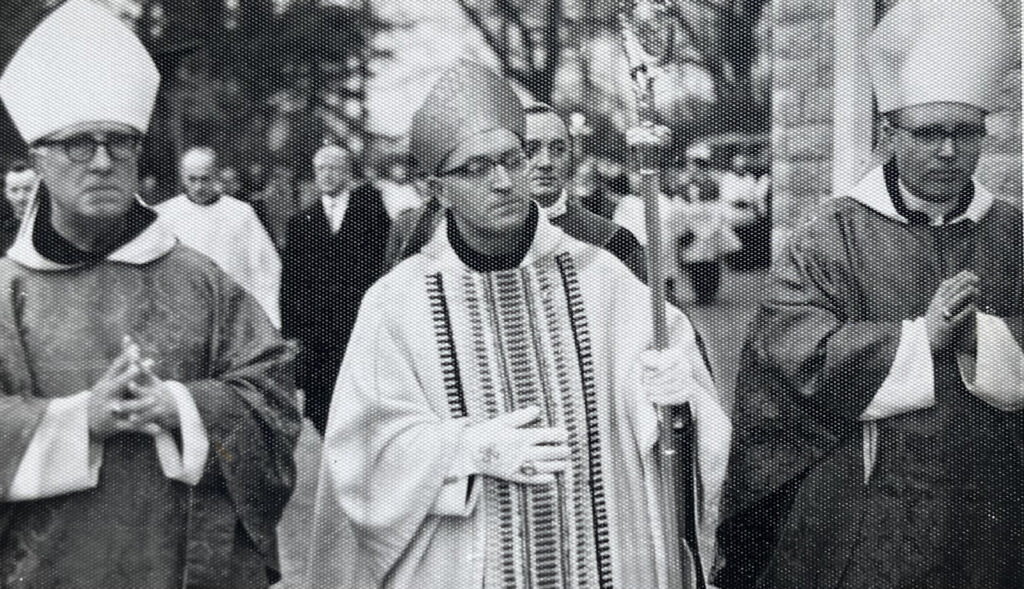
On the solemnity of All Saints the monastic community will present their recently elected abbot Columba McCann OSB to the Archbishop of Cashel and Emly to ask for his blessing.

Archbishop Kieran O’Reilly will ask God to bless and strengthen Abbot Columba as he begins his service as leader of the community of twenty six monks, with the new abbot then receiving a copy of the Rule of Saint Benedict and the symbols of his new office.

The abbatial blessing takes place on Friday 1st November 2024, the solemnity of All Saints, at 3pm in the Abbey Church and may be followed online at www.glenstal.com/abbey/webcam

There will be no 12.10pm Conventual Mass on that day.

Categories
Abbey | Latest News abbeynews

Homily – Sunday 27 – Year B

Fr Brendan Coffey OSB

Today we have the account of Jesus’ famous prohibition on divorce. The temptation is to skip over it, talk about something else and hope nobody notices, because today’s Gospel makes fairly stark reading and we can easily come away from it thinking that Jesus doesn’t have much sympathy with those of us who make mistakes in life. And yet, that just isn’t true, is it?

He understood us very well indeed, as we see from his conversation with the woman at the well, who had five husbands and the man she was with when she met Jesus was not her husband at all; or when he was confronted by the woman taken in adultery. He was the only one who showed her any compassion. The crowd wanted to stone her to death, but he shamed them all into slinking away by writing in the dirt with his finger, just as God wrote the commandments on the tablets of stone which he gave to Moses. The law is there to give life and set us free, not to place heavy burdens upon us. Jesus understood this better than any of us. So don’t tell me that Jesus doesn’t have sympathy with those of us who make mistakes, because that’s utter nonsense; we know perfectly well that he does.

It is we who do not see and it is we who are so unteachable, just as he said. If you need proof of that, look at the wonderful job we have made of managing the world today! It is we who choose to see in part and we who do not open our eyes to the Divine Light. But from the beginning of Creation he made them male and female. And there we have it; the echo of three seemingly insignificant words. Three words that are of vital importance. In the beginning. They are not just any three words, these are the first three words in the Bible. “In the beginning God created heaven and earth.” Jesus is saying to us, go deeper, go back to the beginning. If you really want to understand life’s more difficult questions, go deeper and look at the bigger picture. It’s easier to gloss over everything and find a quick fix. There is no quick fix, some wounds are just too deep. So where do we begin?

What God created was good. Jesus, more than any of us was aware of this, and in seeing that goodness, he also saw the value in marriage and family life which is beyond price, and precisely because he understood this he was also able to respond to the reality of human heartbreak when he confronted it in the woman at the well or the adulterous woman. We can only really do the latter properly, if we can first do the former.

We are very mistaken if we think that life is simple, it is not and neither are Christ’s words about life. To understand him we have to go deeper, we have to go back to the beginning and really try to understand why Jesus so insists on the sanctity and indissolubility of marriage. It is important for each of us to do this and take seriously what he has to say, because unlike most of us, he actually does know what he’s talking about. And so he came and walked among us, as one of us, to show us how to live and how to be alive.

Categories
Abbey | Latest News abbeynews

Abbatial Blessing

On the solemnity of All Saints the monastic community will present their recently elected abbot Columba McCann OSB to the Archbishop of Cashel and Emly to ask for his blessing.

Archbishop Kieran O’Reilly will ask God to bless and strengthen Abbot Columba as he begins his service as leader of the community of twenty six monks, with the new abbot then receiving a copy of the Rule of Saint Benedict and the symbols of his new office.

The abbatial blessing takes place on Friday 1st November 2024, the solemnity of All Saints, at 3pm in the Abbey Church and may be followed online at www.glenstal.com/abbey/webcam

There will be no 12.10pm Conventual Mass on that day.

Categories
Abbey | Latest News abbeynews

Homily – Sunday 24 – Year B

Fr William Fennelly OSB

“Who is the greatest among us?” This question seems petty to us, but for those first followers of Jesus it was a very real question. It can be hard to understand just how deeply ingrained  status was in first century Israel. Your standing affected how you lived your life from day to day, how you related to other people and they to you. Working out the appropriate honour and respect due to an individual was a constant task whether in worship, or in discussions, or in eating family meals, or receiving guests, or seating them, or greeting people in public and so on. The disciples were no different to anyone else in asking such a question. The real difference comes with what Jesus has to say on the subject.

It is understandable that at this point in the narrative the issue has arisen. Shortly, before Jesus had singled out three of them, Peter and James and John, and  led them up a mountain to witness his transfiguration and not long afterwards the brothers James and John asked to sit on his right and his left in his glory.

In this passage Jesus and his disciples are back in Galilee. In the earlier chapters, Mark described how Jesus went through Galilee teaching, healing and casting out demons. The crowds followed him everywhere he went. The crowds were amazed at the authority with which he taught them. Jesus’ status grows from that of someone unknown to that of a great prophet, teacher and healer. Now he is back in the same region and in the very same town of Capernaum, but this time there are no crowds because nobody knows that he’s there. Mark says this is because he is teaching his disciples. Mark singles out his teaching that “the Son of man will be delivered into the hands of men, and they will kill him; and when he is killed, after three days he will rise.” (9.31) The way Jesus puts it, there is no question of it not being true. It will happen. On top of that, Jesus doesn’t just say it once. He keeps saying it. But the disciples can’t understand him. Before this, many times they’d asked him to explain something that they didn’t understand. But now they don’t even bring up the subject. Mark tells us that they are afraid to ask.

And so Jesus speaks to them about status in his kingdom. And he does it in an extraordinary way. First, St Mark says that he sits down. This detail is important because it tells us that here Jesus is teaching them in a very formal way, indicating to them the importance of what he is about to say. Moreover, he calls the twelve to him. It might seem obvious that the twelve men who are named earlier as apostles should be there among his disciples but again this underlines for us that this teaching is being given to those who will be sent to proclaim the gospel. He says, “If any one would be first, he must be last of all and servant of all.” In effect he tells them that in terms of their culture and their thinking they should seek to take the place of lowest status. Of course he himself is the first of them to do so, when he submits to the shame and humiliation of the cross. Here he uses the word “last”. In him, the first becomes the last.

I remember once hearing a French priest, preaching in English on this gospel, and he mistranslated these words from his French bible as ‘they were arguing which of them was the tallest’! Grand means tall as well as great in French. It was a happy mistake because only children argue about who is the tallest and the disciples are in fact acting just like children. Perhaps that is why Jesus uses the example of the child he sets in front of them. Certainly the lesson that Jesus gives them is a gentle one. He understands them, he loves them. They’re his family. But it’s more than that. The key point about being a child at that time was that a child had absolutely no status whatsoever. A child was totally dependent on others and in this sense powerless. If you wanted to select the least important person to make a point then a child was a good choice. Jesus puts the unimportant child in the centre of the room. He gives the child the most important place and then takes the child in his arms. The one of no status is given the position of greatest honour. The last is placed first. It is in receiving such a person notwithstanding his or her total lack of standing or status or importance, that a follower of Christ will receive God the Father. Jesus turns their whole way of looking at themselves and others completely upside down.

If we were to list those in our world to whom effectively we accord no status it would be a very long list. This gospel passage asks of us that we begin to rethink our attitude to many people, and it should lead us to ponder all the more deeply what Jesus is doing when he becomes last of all and servant of all on the cross.

Categories
Abbey | Latest News abbeynews

Homily – Sunday 23 – Year B

Fr John O’Callaghan OSB

Today’s gospel asks a question that we all have to answer, many times
throughout our lives, and it is not by words but by actions that we answer: Christ asks ‘Who do you say I am?’ So, let us consider how relevant is Christ, and discipleship, to ourselves in particular? One might think one’s parents and friends, a rugby coach and a music teacher are all I need. In the future would not a marriage partner, a friendly bank manager and a few golfing buddies be entirely sufficient?
In Jesus’ own time lots of people questioned his relevance: some were
astonished by the authority of his words, but they would nonetheless dismiss him with a sarcastic rhetorical question: ‘Is not this the son of the carpenter?’ Others saw him as religious and indeed political threat to their own position. Some dismissed him completely as deranged, possessed by a devil. And Peter did not do much better! Although he recognised Jesus as a messiah, he had a very different view of messiahship than Jesus. He wanted a social and political one, who would expel the Roman army from Jerusalem. As today’s gospel
reveals, for Peter it was absolutely out of the question that the messiah would endure the physical suffering and public humiliation of crucifixion. Jesus had a different idea: “Get behind me Satan. The way you think, Peter, is not God’s way but man’s!”

But those who dismissed Jesus as irrelevant or a danger did not have the benefit of encountering the Risen Christ! They hadn’t an inkling of his future resurrection. And that changed everything! The resurrection of Christ was not only the indisputable divine seal of approval of Christ but it shows that God has the last say in what survives; and it demonstrates that Christian discipleship opens onto eternity. The followers of Christ are called into a relationship with him that is not only to transform their present life, but also introduces us into a new one. Following Christ calls us actually to be heroes now, not shrinking form suffering, not sinking back from a tough challenge, so that we can claim a final victory. We all know heroes – perhaps in our own entourage, but also elsewhere. The Olympic games were full of a type of hero. We see and admire such people, especially the para-Olympic champions, who overcame particularly demanding odds. We also encounter them in hospitals and cancer wards; people rising to the very best in themselves, surpassing themselves in courage, often upheld by the love of others and faith in God’s love.

Christian heroes are prepared to be generous, to love beyond their comfort zone, to be truthful and thus courageous; they forego the soft options that cowardice can invite us to take. The do not allow suffering to direct their lives. Easier said than done! but it is our Christian way. Young people and adults who rise to it are saints – which we are all called to be. What would a life be if we were only egocentric, selfish and cowardly? Profoundly boring and achieving nothing! If you make yourself the end of all that is the end of you! But the relationship with our brother Jesus Christ fills us with courage and generosity even now and promises a brighter future. We Christians are called to move mountains in society, in our personal lives, to stand up for what is right and true. It is in that struggle that true peace can come into being, in place of an apparent peace, beneath which lie hidden hypocrisy and all kinds of weakness and conflict.

Jesus did not avoid the challenges, and he warned us of them but he added: ‘Come to me, all you who labour and are heavy burdened, and I will give you rest. Shoulder my yoke and learn from me, for I am gentle and humble in heart, and you will find rest for your souls. Yes, my yoke is easy and my burden light’. May he help us all to take up whatever cross we may be carrying and follow him to victory!

Categories
Abbey | Latest News abbeynews

Stepping into the Garden of the Risen Lord

Glenstal Abbey was pleased to welcome and host a large group of guests to the monastery for our day-retreat titled ‘The Garden of the Risen Lord: From Recognition to Action on Saturday 7th September.

The retreat explored  Mary Magdalene’s encounter with Jesus through the Gospel text, art, chant and contemporary ecological and feminist readings, with Dr Margaret Daly Denton as keynote speaker. A biblical scholar who began her career as a church musician, composer and liturgist, Margaret spoke first about the garden where the encounter with the Risen Lord takes place and the many echoes it has for readers familiar with the Biblical and Ancient Near East background on the Garden of Paradise.

In the afternoon, Margaret went on to discuss how the encounter leads to action and ended with a strong ecological reading on how we are to assume our stewardship of God’s creating activity.

Fr Luke Macnamara presented an opening paper titled ‘The Divine Bridegroom in Search of the Spouse’ which gave a scriptural perspective on the spousal motif in John’s Gospel and how the Risen Lord’s encounter with Mary Magdalene is its climax.

Later, Br Cyprian Love and Br Pádraig McIntyre gave a combined organ and chant improvisation session, before Br Emmaus O’Herlihy concluded the retreat day with an exposition and discussion of his newest painting of Mary Magdalene.

To stay up-to-date with our upcoming events, visit: www.glenstal.com/abbey/events

Categories
Abbey | Latest News abbeynews

Opening and Blessing of Tipperary SVP Shop

Fr Luke Macnamara OSB was pleased to join Fr Eugene Everard, parish priest of Tipperary Town, for the opening and blessing of a new Society of Saint Vincent de Paul (SVP) clothes shop in the town on Thursday 8th August.

Glenstal Abbey and School both contributed to the launch of the new shop through fundraising and a collection of clothes prepared and delivered by monks, students, parents and colleagues of monastery and school. As the clothes are being reused, a sustainable circular economy is being promoted which avoids the waste associated with fast fashion.

Fr Luke was joined by fifth year student Peter Purcell, who represented Glenstal Abbey School at the opening event. Other attendees included Eimear Purcell, Manager of the SVP Drop-In Centre in Limerick City, Dermot McGilloway, SVP National Retail Manager, and Paddy Carroll, Volunteer Manager of the SVP Regional Warehouse.

The clothes shop will assist families in need, whilst the funds raised will go to support the local conference of the Society of Saint Vincent de Paul. It is hoped the shop will also become a social hub where people from different backgrounds to come to know one another and have a place of welcome in the town.

The Society of St. Vincent de Paul was founded in Ireland in 1844 and has become the largest voluntary charitable organisation in the country, offering practical support to those experiencing poverty. For more information on the work of the Society of Saint Vincent de Paul visit: www.svp.ie

Subscribe To Our Newsletter To Receive Updates

[hubspot type=form portal=6886884 id=9e1d6d0d-c51e-4e35-929d-3a916798de64]