
A feature by Chai Brady in The Irish Catholic on 19th January 2023 and copied with permission from www.irishcatholic.com
It’s hugely important to bridge the complicated relationship between Christian communities, Fr Martin Browne OSB tells Chai Brady in Rome…
Dialogue between the Christian Churches in Ireland is more important than ever as the population of different religious traditions continue to grow across the country, according to an Irish monk chosen by the Vatican to assist with ecumenism.
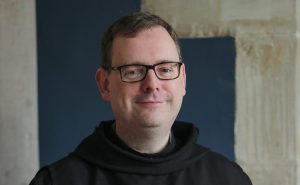
Benedictine monk Fr Martin Browne OSB was recently appointed to the Vatican’s Dicastery for Promoting Christian Unity with responsibility for the Church’s relationship with the worldwide Anglican Communion and the World Methodist Council.
Fr Browne, who is a monk of Glenstal Abbey in Co. Limerick, told the Irish Catholic ahead of the Week of Prayer for Christian Unity which runs from January 18-25 that the celebration must not become “safe and stale.”
It is not enough for Christians to come together just because it’s a date set in the calendar, Fr Browne said, “it’s important because you’re actually praying and we trust that God hears our prayers, and it also punches holes in that wall of ignorance and fear that can exist between people.”
“What may give something like the Week of Prayer a bit more impetus in Ireland now, because it can get a bit sort of safe and stale, no denying that, is the variety of expressions of Christianity that are present in Ireland now,” he said.
“The amount of new Pentecostal and African-led Churches, the huge increase – sadly because of the war in Ukraine – of Eastern Christians, both Orthodox and Eastern Catholic, all of this creates a whole new set of potential relationships, a whole new set of people who need to know more about open another, a whole new set of opportunities to learn from one another and be enriched.”
Due to the changing environment, acting and praying for Christian unity is not something to be done once and ticked off, Fr Browne insisted. “Apart from what might be happening in society, and the need for more credible Christian witness, the Christian make-up of Ireland now would have been unimaginable 20 years ago, so that work and adventure and fun of getting to know one another and having the courage to step out and meet one another, and to pray and witness to Christ together, is all the more urgent,” he said.
One a worldwide scale, the ecumenical work of the Vatican is complex. The Church has connections and relations with a huge variety of other Churches and Christian bodies around the world. The Vatican’s Dicastery for Promoting Christian Unity is organised in two sections, an eastern section and a western section.
In the Eastern section there are the Orthodox Churches, including the Oriental Orthodox Churches, many of which are very old such as the Coptic Orthodox Church, the Armenian Apostolic Church and the Assyrian Church of the East. The Vatican has a different kind of relationship with each group, sometimes there are simple conversations and sometimes there are very formal theological dialogues which have been in place for years.
In the Western section they dialogue with a plethora of Protestant Churches, including the Anglican Communion, the World Methodist Council, the World Communion of Reformed Churches, the Baptist World Alliance, the World Evangelical Alliance, the Salvation Army, the Quakers and some newer Pentecostal and independent non-denominational Churches.
Speaking of the different dialogues between the various Churches, Fr Browne said: “There’s a lot of very different kinds of relationships, a lot of different levels of similarity and dissimilarity depending on the Church and the history. Some are characterised by very complicated histories, mutual condemnation and so on.
“Particularly since Vatican II the effort has been to try and attend to all those relationships and work on them and see what progress can be made and that is done on several different fronts,” he said.
“Some of it is the ecumenism of life, just getting to know one another, or the ecumenism of love, learning to know a bit about one another, meeting one another, praying together. Some are also at a different level where we’re addressing really complicated theological questions.
“Some of the Churches that separated from the Catholic Church first, the Oriental Orthodox Churches, like the Assyrian Church in the East, did so over very serious disagreements on questions like the divinity and humanity of Christ and so on. In most of those cases, thanks to the dialogue, those disagreements have been overcome, or understood, or brought into new context and so there’s a considerable level of new agreement that has been reached.”
In the West, Fr Browne said the situation is a bit more complicated. Regarding his responsibilities, which are the Anglican Communion and the World Methodist Council, the dialogue began shortly after Vatican II in the late 1960s.
ARCIC (Anglican-Roman Catholic International Commission) are currently working on their final report on moral discernment in the Churches and how Churches reach decisions on moral issues, which Fr Browne describes as “a complex and hot topic.”
He said often when the issue of moral discernment is broached, people think it’s only about questions of sexuality, but it’s also about various issues, such as slavery. “Of course the Churches reached the same decision on that [slavery] as part of their discernment,” Fr Browne said, “But they’ll come to different conclusions on other issues. That’s what the dialogue is about, trying to understand how Churches have come to these decisions, what hope there is for convergence. Sometimes people think that theological dialogue sounds very ivory tower and remote but currently we’re looking at very concrete issues.”
Discussion
Asked about the discussion regarding the ordination of women to the priesthood and same-sex marriage, Fr Browne said they “certainly make agreement more difficult”, but the Vatican is not “in the business of breaking off relations”.
He gave the example of the Russian Orthodox Church, which the Church is still very actively engaged with despite major disagreements about their attitude to the war in Ukraine.
Even within the various Anglican Churches there is disagreement, which has led to “huge trauma”, Fr Browne said.
“The hot button issues in the West around women’s ordination and sexuality and so on, undoubtedly there are huge disagreements on some of these issues within the Churches. The Anglican Communion is experiencing huge trauma at the moment around that and there’s a danger of having some very serious division between its global south members and other more liberal Anglican provinces,” he said.
Speaking on the Catholic Church’s position, he said: “We’re unlikely to agree on something like the issues of women’s ordination or same sex marriage any time soon. The Catholic Church has a very firm position. On one level that makes it all the more pressing to do as much as possible together on things we do agree on. That we do bear witness to Christ together, that we don’t let our relationships be defined by what we disagree on.”
“It’s important we continue talking to one another, it’s important that we don’t let those differences define us, that we do continue to pray about them, but certainly with some of those things it’s hard to see how we could ever agree,” he continued. “Unity is God’s gift, it’s something that Jesus prayed for the night before he died so we’ve got to take that imperative very seriously and keep working at it no matter what the obstacles are even if it’s hard to see how we’ll be able to agree on certain things.”
Many of the ‘hot button’ issues came up in the synthesis of Ireland’s national synod. It was clear that there are some within the Church that feel the Church’s position should change on same-sex marriage and female ordination.
Fr Browne said this is one of the reasons some people found the synod difficult, as “everything is being spoken about”.
“We know that we can’t make our doctrine by referendum either, but it would be a strange synod if they were not talked about. If the whole idea of consulting the people of God is to get a sense of what the people of God think you’ve got to be willing to hear what the people of God think even if it isn’t exactly what the official positions of the Church would be,” he said.
“That’s one of the big challenges, and for some, one of the great fears of the next couple of years in the synodal process – where does it all lead? I don’t think anybody knows but we do trust that God is part of that process, it’s not just wait and see, it’s wait and see hopefully.”
A lot can be learned from the experiences of other Christian Churches, according to Fr Browne, who said the Anglican Communion is “suffering greatly around the issue of same-sex marriage.”
“Whereas some provinces have moved to celebrate same-sex marriages, to allow clergy to be in same-sex marriages… huge swathes of the Anglican Communion, particularly in what’s called the global south, see it as an absolute departure from the Biblical truth and they are struggling to know how they are going to continue to be part of the same communion. There are very strongly held positions on both sides and how that tension is resolved is just as big a problem for the Anglican Communion as it is for the relationships with other groups like us,” he said.
As the Catholic Church continues on its synodal journey, Fr Browne said it is important to look at what is happening in other Churches: what they resolve or don’t resolve and how they manage or don’t manage certain tensions.
He added: “I think that’s what this synodal process is probably about and that’s not tidy, it’s messy and it causes a lot of anxiety and in some places suspicion that there’s some strange agenda being played out whereas if we take it on its own terms, that it’s about listening to the people of God and ultimately trying to hear the voice of the Spirit of God, well then you just keep at it and see. I’m inclined to trust God when it comes to these things even if it looks a bit messy.
Ecumenical landscape
Speaking of the ecumenical landscape in Ireland, Fr Browne said there is a tendency to see it through the lens of Irish history, through political and reconciliation issues.
“When it comes to relationships between the Churches, certainly at a leadership level, they’re very good, and I think in most places certainly, in the parts of Ireland I know well, the relationships locally are very strong,” Fr Browne said.
“Again it has to be more than singing Christmas carols together but you do see in places around the country that there is practical cooperation.”
He said that sometimes in Ireland people don’t realise that the need for reconciliation has driven the Churches together because the reality of the need for a common witness is more clearly perceived than it might have been in a place where everything is simpler socially.
Week of Prayer for Christian Unity
However, Fr Browne believes that the Week for Prayer for Christian Unity needs a “kick-start” in Ireland.
“I think in some cases certainly the issue has ceased to be important to people,” he said. “Sometimes it can be that in places the relationships are so strong already and they’re doing things together anyway, they say why would we need to be doing something special for the week of prayer – but I wouldn’t stretch that point.
“In some cases I think it is that the energy has gone out of it and we need leaders to promote it more, to talk about it more and to encourage.”
He said the local events, even if they are not based off the formal materials sent out every year, can be beneficial and parishioners don’t need to depend on clergy to organise something.
“I think nowadays in most parishes and communities there are lots of different people involved in identifying priorities and planning events and certainly I would hope that people would re-tune into that,” he advised.
South Sudan
The Pope will soon be travelling on an ecumenical pilgrimage to South Sudan with Anglican Archbishop Justin Welby of Canterbury, head of the worldwide Anglican Communion, and Rev. Dr Iain Greenshields, moderator of the General Assembly of the Church of Scotland. The pilgrimage will take place from February 3-5 in the capital city of Juba.
For Fr Browne the trip is important for a plethora of reasons, one of which is the political turmoil and general instability in the country.
“The Presbyterian, Catholic and Anglican Churches are the main Christian groups in South Sudan so there’s a logic to the three of them going together. Over the years the Council of Churches in South Sudan was hugely instrumental in working for reconciliation in witnessing to unity together,” he said.
“This isn’t a manufactured intervention, it’s organic. They wanted to go for several years and then between the Pope’s illness and the pandemic it wasn’t possible. This has been long desired by the three Church leaders and it’s been long desired by the Church leaders in South Sudan. It is welcomed and desired by the political leaders in South Sudan too, they’ve recognised the importance of the Christian contribution to any progress that is being made in what is still a very volatile situation.”
Another “incalculable” positive is the ecumenical message it will send to the world, Fr Browne said, a message that is hugely important to all Christian Churches.