Categories


Fr Abbot Brendan Coffee OSB
‘Remember that you are dust, and to dust you shall return.’
There is only one other time we hear these words in the liturgy and that is at the graveside and if we are the one being buried, it is too late at that point to do anything about it. So, ‘now is the favourable time, this is the day of salvation.’
We have heard how the Israelites returned to the Lord with fasting, weeping and mourning to reassert their identity as the people of God. As we begin the holy season of Lent, we prepare to do the same. However, we have to be very careful and very honest, “Beware of practicing your piety before others in order to be seen by them; for then you have no reward from your Father in heaven.” We need to be particularly careful when trying to claim our identity as the people of God that we don’t make a performance out of it. The world is not a theatre and the God who made us won’t be applauding any kind of theatrical performance. Who is our audience in this season of Lent? ‘Our Father in heaven who sees all that is done in secret’.
Jesus tells us that we can easily become caught in the contradiction of audiences. On the outside we can appear to be seeking God, or trying to do what’s right; but on the inside we can be preoccupied with making a certain impression on other people.
It is not a question of whether we have kept the law or not, but whether the law has become so much ourselves that it has grown into the mystery of love. This then, is the point of Lent. ‘Remember that you are dust, and to dust you will return’. Take stock of reality and open your eyes to the mysterious relationship that we call mercy. Come face to face with being human, being dust and accept the love of the Lord.
It is mercy that gathers us here. God came into a broken world because He had mercy on us. We can choose to remain broken and indifferent. We can look at the hungry and say, “Not my problem,” we can look at the terrible conflict in Ukraine and think, “that’s very far away”; or we can view these victims of violence and declare, “There but for the mercy of God go I”. If we know anything about mercy, we know that mercy doesn’t make us any better than anybody else. We are in this together and mercy only makes sense when we share it with others. Who needs our help? The question is not difficult to answer. That is the invitation for us this Lent. We remember that we are dust, nothing more than dust and it is only by the mercy of God that we journey forward in the middle of the mess, which is this world of ours.
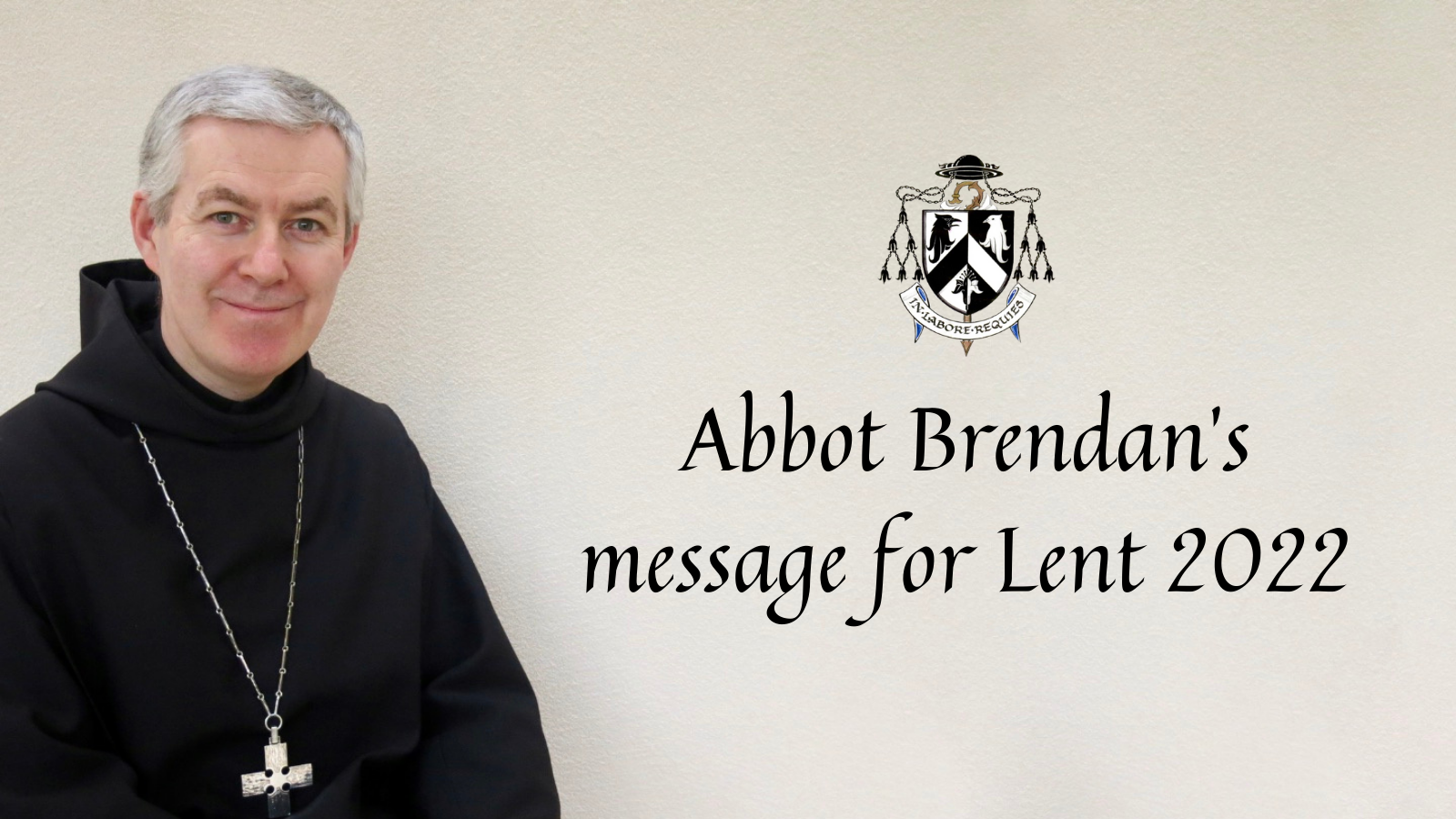
The word ‘Lent’ comes from the old English word for ‘Spring’. Lent is not a time for feeling gloomy or miserable for forty days; it’s not even about giving things up for forty days. Lent is springtime. Lent prepares us for that great climax of springtime which is Easter. And as we prepare ourselves for Easter during these days, by prayer, fasting and works of mercy, what motivates us is not self-denial as an end in itself, but trying to sweep and clean our own minds and hearts so that new life may have room to come in and take over and transform us at Easter. All this clearing and cleaning brings us face to face with the accumulated dust and ashes.
The trouble with dust and ashes is that it’s always in the wrong place. There is no good place for dust to be and even though we know that the ashes we use and bless are made from burning last year’s palm branches and are a sign of the Paschal Mystery, we still can’t wait to wash them off! They are such a nuisance. And that is the whole point. ‘The Lord formed us from the dust of the earth’. It is our beginning and our end.
Lent is a gift from God to us; a gift of the essential. Lent returns to me this essential layer of life. Lent is the time for healing. Realising my own weakness makes me more tolerant of weakness in my neighbour. As St Isaac the Syrian puts it “The one who knows their own sin is higher than the one who resurrects the dead in their prayers. The one who is granted the gift of seeing themselves is superior to the one who has the gift of seeing angels.”
There is no real getting away from it: for we are dust, and to dust we shall return. That is why we must turn from sin and follow Christ, who is not merely a good idea, but the Word who was made flesh to dwell among the children of Adam and Eve, the people of dust.
The spirit of this holy season of Lent is neatly summed up in the much loved prayer of St Ephrem:
O Lord and Master of my life,
Give me not a spirit of sloth, vain curiosity, lust for power, and idle talk.
But give to me your servant, a spirit of soberness, humility, patience and love.
O Lord and King, allow me to see my own faults and not to judge my brother & sister,
For You are blessed to the ages of ages.
Fr Luke Macnamara OSB
In every human eye, there is a natural blind spot. The optic disk conveys the nerve messages from the retina to the brain to be processed and produce images, but the area of the disk itself receives no messages and so there is a gap in the image. However, the brain produces a corrected image which makes up for the blind spot and so we see no black dot in our field of vision.
The natural tendency to hide blind spots is much overused. We all see what is before us in a particular way, noting some things, and not noting others. Some will see children playing in a park as making fun, others will see them as making a nuisance. The world is not observed in a neutral way but from one’s perspective. This perspective can seek to view signs of life and joy or seek evidence to judge and condemn. Jesus’ metaphor of the plank in the eye reflects the latter view, a distorted vision of God’s wonderful creation, that sees only the faults of others and ultimately renders such viewers bitter and resentful.
Jesus’ teaching to the disciples uses several sayings which explore not only how disciples might use their eyes, but also their mouths and ears, their hands and feet, and, most importantly, their heart. Our way of seeing, speaking, hearing, and doing, all flow from the heart. A sound heart is essential for life as a disciple of Jesus. Close examination of the signs of the state of the heart is important and such signs are observed in our speech, deeds and vision.
Jesus invites us to examine ourselves. Sirach uses three images to describe how speech might be tested. The sieve allows true speech to percolate through but leaves behind rough and coarse elements. The kiln tests the potter’s work, and a person’s conversation reveals his or her character. The tree is known by the quality of its fruit and so a person’s feelings are known by the quality of his or her words. Humans are relational beings, and speech is a key element of relationship. It is a powerful tool. To put in a good word – may change the outlook for someone in despair. To put down might provoke despair. Great care is needed in speech and should form a key part of self-examination.
Jesus reuses the metaphor of the tree and the fruit but focuses on action or production of fruit, to reflect on people’s deeds. Jesus has moved from considering eyes, mouth and ears to the practical activities of hands and feet. No part of the potential disciple is exempt from attention. There is to be no blind spot. Instead, the transformation of the whole person is in view. By this transformation, the disciple sees, speaks, hears and acts in accordance with the way of blessedness that Jesus has just exposited in the beatitudes.
Perhaps the greatest danger is self-deception, thinking we are clear-sighted but in fact either blind or having a plank in our eyes obstructing our vision. Too often we seek to judge others for their minor failings while not seeing our own. Jesus invites us to honestly examine ourselves, not to condemn ourselves, but to choose the way of life and happiness for ourselves and offer it to others.
Fr. Lino Moreira OSB
David had been badly wronged by Saul, but he spared the life of his enemy, putting his trust in the Lord who rewards everyone for their righteousness and faithfulness (cf. 1 S 26:23). As we have heard, Abishai had proposed an entirely different course of action, more in keeping with the ordinary notions of retributive justice, but David knew that the Lord shows himself merciful with the merciful (cf. 2 S 22:26) – that is to say, he understood that a compassionate and generous God wants his servants to be like him in returning good for evil.
What we see in David, however, is only a foreshadowing of what we find in Jesus of Nazareth, who revealed the full measure of God’s love for all humanity. Jesus said to his disciples, when they were urging him to eat: My food is to do the will of him who sent me and to accomplish his work (Jn 4:34). And similarly in the Temple of Jerusalem, at the age of twelve, he said to Mary and Joseph: Why did you seek me? Did you not know that I must be about my Father’s business? (Lk 2:49).
These words emphasise that throughout the course of his earthly life Jesus was entirely devoted to the work of reconciliation that had been entrusted to him by his Heavenly Father. And his mission as Mediator between God and the human race was fully accomplished when he died upon the cross. As Saint Paul puts it: when we were enemies we were reconciled to God through the death of his Son (Rm 5:10). Indeed, when Jesus Christ laid down his life for our salvation, he not only restored our friendship with the Creator of world – as the last Adam, who came from Heaven (cf. 1 Co 15:47) – but even made us partakers of his own divine sonship – as the true Son of the living God (cf. Mt 16:16).
To become God’s children is, therefore, the greatest and most wonderful gift we have ever received from Heaven. But every gift from God entails a task, and we can only be acknowledged as sons and daughters of the Most High if we in our turn are willing to reconcile ourselves with one another.
How? – we might ask.
In today’s gospel we are told that the only way to make our peace with all our brothers and sisters – with friend and foe alike – is to take God himself and his only-begotten Son as the model for our dealings with others. In fact what Jesus really means when he exhorts us to do to others as we would have them do to us (cf. Lk 6:31) is that we should follow his example in imitating his Heavenly Father, who is kind even to the ungrateful and the wicked (cf. Lk 6:35).
So we are asked to do good to those who hate us (cf. Lk 6:27), because our Creator showed his love for us when were we were still his enemies (cf. Rm 5:10). We are asked not to resist an evil person (cf. Mt 5:39), because Christ was delivered into the hands of sinful men to be crucified (cf. Lk 24:7). We are asked to lend and give freely, because God the Father did not spare his own Son but delivered him up for us all (cf. Rm 8:32). And above all we are urged not to pass judgement on others, because – as Jesus said to Nicodemus – God did not send his Son into the world to judge the world, but that the world should be saved through him (Jn 3:17).
By acting ever more decisively and perfectly along these lines, we will be helping to build up that true peace that Jesus left as his great legacy, when he said at the Last Supper: Peace I leave you, my peace I give you (Jo 14:27). This messianic statement, which we repeat at Mass every day, reminds us that it is Jesus Christ himself who gives us both the discernment and the strength to bring his work of reconciliation to fruition in our own time. We can have confidence, then, that our task is not an impossible one, and that by loving our neighbour as Jesus loved us we will indeed be acknowledged as his brothers and sisters, in accordance with what he said in the Sermon on the Mount: Blessed are the peacemakers, for they shall be called children of God (Mt 5:9).
Fr. Senan Furlong OSB
In 1912 the American poet, Robert Frost, moved to England for a few years. Among the friends he made there, was another poet, Edward Thomas, with whom he often went for long walks. One day as the two were wandering in the countryside, they came to a fork in the road. Thomas, who was indecisive at the best of times, couldn’t make up his mind which road to take. When eventually they took one road, he lamented that they should have taken the other. After Frost returned home to New Hampshire, he composed what is perhaps his best known and most quoted poem “The Road Not Taken”. Written in jest to his dithering friend, the poem is rich in possible meanings.
Two roads diverged in a yellow wood,
And sorry I could not travel both
And be one traveller, long I stood
And looked down one as far as I could
To where it bent in the undergrowth;
Then took the other …
The readings at Mass today concern a choice between two roads, albeit not equal roads like in Frost’s poem: the path of beatitude and blessing, or the way of curse and woe.
The first reading from the prophet Jeremiah is a short poem about the quest for true happiness. We have a choice to make: do we seek happiness by trusting solely in our own efforts and control, or do we tap into another source by trusting in God? These alternatives are presented in two vivid images: a shrivelled shrub in a dry desert, and a verdant tree whose roots reach down into a flowing stream. One is sterile, the other fruitful.
The psalm also speaks of two ways of life – good and evil – and their consequences – happiness and misery. Whoever hopes in the Lord and takes delight in his word is compared, as in Jeremiah’s poem, to a tree that is planted by a stream of water. In contrast the wicked are like chaff that is blown away by the wind during winnowing.
The gospel passage from St Luke presents Jesus’ teaching on blessings and woes. Looking straight into the eyes of his disciples Jesus pronounces four blessings followed by their mirror opposite, a quartet of woes. The blessings or beatitudes are not just surprising, but shocking. How can Jesus say that you are blessed if you are poor, hungry, reduced to tears, reviled and excluded? It’s outrageous. The woes too sound off-key. Surely it is foolish of Jesus to declare you unfortunate if you happen to be prosperous and well-fed, if you laugh and enjoy a good reputation? Everything is turned on its head. Jesus showers honour on those the world shuns, and shuns those the world is inclined to honour. This is Mary’s Magnificat: He has brought down the powerful from their thrones, and lifted up the lowly; he has filled the hungry with good things, and sent the rich away empty.
Is all this meant to the tell us something fundamental about God and about ourselves? That our way of seeing the world and its people is not God’s way? That what we often hold as dear is not what God cherishes? That what we consider important — the fashionable, the popular, the lucrative, the clever, the witty— is not truly important? That what we regard as a woe may indeed be a blessing and what we deem a blessing may in fact be doing us damage? Perhaps Jesus is provoking us today to take another look, to choose another path, to change our heart?
Tomorrow is St Valentine’s day. The symbol of Valentine’s day is of course the heart, that amazing muscle that pumps blood, life, 24/7 to every part of our body. That is, unless something clogs our arteries. If there’s a risk of obstruction, we know we have to make necessary changes to our life style to keep our arteries open and the blood pumping. Likewise we must make necessary changes to keep our hearts open if the Gospel message is to course through the veins of our lives. The beatitudes and woes prescribed for us today in Luke’s gospel account are like a double dose of medicine that we must take if we are to have an open heart, unclogged and un-shuttered, like the pierced heart of him who poured out his life blood for us.
In the course of a life each of us comes to many a fork in the road and each time we have to choose which direction to take. We can dither and dally, like Frost’s friend, and then regret the choice we made, or we can accept the invitation of today’s gospel to clarify what is truly important and so follow in the steps of him who is the Way, the Truth, and the Life.
And that will make all the difference.
Fr. William Fennelly OSB
Scientists tell us that of all the five senses we possess, sight is the most valuable. It’s our sight that teaches us most about the world. By our nature, human beings are creatures who, above all, want to see and understand. That is why phrases like ‘I see’ mean both that we see in a physical sense and also that understand something. Other phrases like, ‘it finally dawned on me’ use the imagery of light to indicate that we have finally grasped something that had previously eluded us. When cartoon characters like Tom and Jerry or have one of their ‘bright’ ideas, it’s often represented by a light bulb appearing above their heads and being switched on.
Many commentators were so impressed by how the light bulb changed our millennia long relationship to day and night that they feared it was so powerful that the Jewish and Christian imagery so powerful for millennia would be made redundant by it. Whilst we can admire their enthusiasm for the power of technology we also know that they were wrong, of course. The imagery of light and understanding in today’s readings retains its power continues to be meaningful.
Isaiah reminds the people that if they act justly then ‘Your integrity will go before you and the glory of the Lord behind you.’ This is a really attractive allusion to the pillar of fire by night and pillar of cloud by day going before the people of Israel as they we were lead out of Egypt by Moses, of course the pillar and the cloud were the Lord himself, leading the people out of their slavery in Egypt.
The glory of the Lord, which shines throughout the Old Testament, is for Christians finally and fully revealed in the glorious light of the resurrection of Jesus. The gospel sees, Jesus link the idea of the visibility of a city on a hilltop, with a light shining to illuminate a room. In the book of Revelation the seer reports about the heavenly Jerusalem, ‘I saw no temple in the city, for its temple is the Lord God almighty and the Lamb. The city had no need of sun or moon to shine on it, for the glory of God gave it light, and its lamp was the Lamb. The nations will walk by its light, and to it the kings of the earth will bring their treasure. During the day its gates will never be shut, and there will be no night there.’
The invitation of today’s scripture readings is to allow ourselves to be illuminated, to be light up. By this grace we can participate in the light of God, and can become a means of spreading that light to others. Faith enables to be enlightened by his grace, by his gift. God’s gift is what enables so many of us to be gifted in so many wonderfully different ways. Regardless of how clearly we can see or, whether we are academically gifted or not, the gift of faith helps us see and understand saving realities of God’s work active here on earth.
While this sounds optimistic and easy; faith often doesn’t find us in an easy way. Today’s gospel has a moving image of this. Jesus the son of a carpenter comes to Simon Peter the fisherman who has been fishing all night without success. Tired, no doubt disappointed, why start all over again, and perhaps catch nothing, only to have to mend the nets a second time? Why listen to this visiting preacher? That Simon Peter does listen might perhaps already indicate the gift of faith. And we see the virtue of his faith. Against the odds, by trusting in Jesus, the fishermen haul in that huge shoal. Christ’s word holds good, he is afterall trustworthy. What God wants to give each of us isn’t something miserly, small or mean. Cardinal Newman once asked the rhetorical question: ‘What is more elevating and transporting than the generosity of heart which risks everything on God’s word?’ From this perspective, Simon’s fearfulness, and our own awareness of our shortcomings, our struggles, our sin, are themselves part of a graced journey of transformation within an ever deepening life of faith. They prepare us to experience God’s forgiveness with thanksgiving, a joyful recognition of graces given and received.
Br. Jaroslaw Kurek OSB
When a young man decides to become a monk and join our community here in Glenstal, he receives the monastic habit from the abbot. The abbot clothes the young novice in tunic and scapular and then girds him with a belt; a good leather belt, saying: As you wear the habit of our house, learn to bear the yoke of Christ. Keep in mind St Paul’s exhortation, ‘You must put on the new self which is created in God’s likeness and reveals itself in the true life that is upright and holy.’
We learn from the Institutes of John Cassian, a work recommended by St Benedict himself, that ‘it is fitting for a monk to have his loins girt’, since a monk is supposed to be a soldier for Christ who is always armed and ready for spiritual warfare. It is no accident that Cassian mentions this at the very beginning of his famous work.
The inspiration behind this remark of Cassian comes primarily from the prophets Elijah and Elisha, ‘who, according to the monastic tradition, first laid the foundations of this way of life in the Old Testament’. Jesus uses these two prophets as powerful examples in today’s Gospel, demonstrating for all of us how the divine plan was actioned throughout history.
What do these heroes of old have in common with monks and Christians of today? John Cassian tells us: monks, through their obedience, are to be eager for spiritual progress! This should be so for every Christian and this is what we see in Elijah, a prophet like fire, as the Book of Sirach says. His eagerness and zeal for the Lord are unmistakable. This is the good zeal St Benedict speaks about in his Rule: zeal that ‘separates from vices and leads to God and everlasting life’.
Now, the prophet Elijah’s life wasn’t easy, and yet he remained unyielding, carrying out the mission entrusted to him by God. He persevered in his zeal for God because he had his loins girt with a belt. In the same way, the monastic tradition sees in this belt the two-fold dynamic of the life of a monk: it restrains our fleshly inclinations, our attachment to earthly things, and keeps us vigilant in order that we may be strengthened and ready for the challenge of the monastic and Christian vocation.
This is the good zeal of which we speak. However, as Benedict warns us, there is also another kind of zeal, ‘an evil bitter zeal which separates from God and leads to Hell’ and this, sadly, is what characterised the other protagonists in today’s gospel: the inhabitants of Nazareth. Initially they were amazed by Jesus’ words, but ultimately they rejected him. Why? Because what they heard and saw, did not square with their ideas of the Messiah? Perhaps they were too familiar with Jesus, who they simplistically saw as ‘one of them’. This rejection of the Son of God separated them from him, evil thoughts entered their hearts, bitter zeal arose within them and instead of clinging to the one who wanted to save them, they expelled him from their town and from their lives.
This must never happen to us. We must remain open-minded, ready to accept all that comes from God, especially those truths that make us feel uncomfortable.
This belt, a symbol of our enduring zeal, girds the body tightly. In exactly the same way, we need to cling tightly to God. Let the good thoughts of our hearts tightly embrace the one who, in turn, will always be happy to gird us with his help and strength for our spiritual warfare.