
Categories
Abbey | Latest News abbeynews

“What unites Christians is infinitely more significant than what divides us” – Martin Browne OSB talks to the Anglican Communion Office on Christian Unity

During the month of January, Christians around the world unite their prayers together during the Week of Prayer for Christian Unity (18-25 January). Whilst this week is a particularly graced time of seeking unity among Christians, it is a year-round undertaking. Glenstal Abbey’s Father Martin Browne OSB of the Vatican’s Dicastery for Promoting Christian Unity talks here to the Anglican Communion Office about this task:

Can you tell us more about the work of the Dicastery? How would you summarise its purpose?

‘Dicastery for Promoting Christian Unity’ is a long name, and includes a word that is unfamiliar to many, but its meaning is very simple. It is the office in Rome responsible for ecumenism – the quest for unity among Christians. That involves promoting ecumenism and ecumenical initiatives within the Catholic Church, but it also involves engaging in dialogue and cooperation with Christians of other traditions. For example, among the Dicastery’s many relationships, we have two separate commissions working with the Anglican Communion – the Anglican-Roman Catholic International Commission (ARCIC), which has been engaged in formal theological dialogue since the 1960s, and the International Anglican-Roman Catholic Commission for Unity and Mission (IARCCUM), which promotes practical cooperation between bishops of our two communions.

Why is the Week of Prayer for Christian Unity so important in the life of the Church?

In short, because Jesus prayed for it and Christians need to take him seriously! Dialogue and cooperation nurture unity, but ultimately, Christian Unity is God’s gift, and we need to pray for it. Of course, we should pray for this gift throughout the year, but a dedicated Week of Prayer is graced time each year to pray about Christian Unity with particular intensity. The fact that the prayers and reflections come from a different part of the world each year, but are used by Christians in all parts of the globe, is itself a powerful expression and foretaste of the unity for which we pray.

What does it mean to work for Christian Unity? Why do you feel called to this ministry?

One of the fundamental vocations of the Church is to bear witness to and share the Good News of Jesus Christ. To be a Christian, regardless of one’s particular tradition, is to be evangelical – in the sense of being one who believes in and shares the Gospel. Christian disunity is a countersign. It weakens our capacity to be credible witnesses in the world. How can we expect unbelievers to take Christianity seriously if Christians are marked by division and discord? It is as simple as that. The conviction that what unites Christians is infinitely more significant than what divides us has been central to my own believing and belonging for many years. To find even small ways of experiencing and expressing that unity felt like a key part of my vocation even before I found my way to monastic life and ordination. That I now find myself working full-time in Rome on this quest is an extraordinary privilege.

What excites you about the work of IARCCUM?

IARCCUM is unique! It recognises that while Catholics and Anglicans have not been able to establish a full communion relationship, over half a century of dialogue and walking together has caused them to discover how deep – though still incomplete – is the communion we already share. It challenges our two communions to take practical steps to manifest that communion in the way we minister alongside one another. It invites bishops from our two communions to take the lead in bearing witness to that relationship.

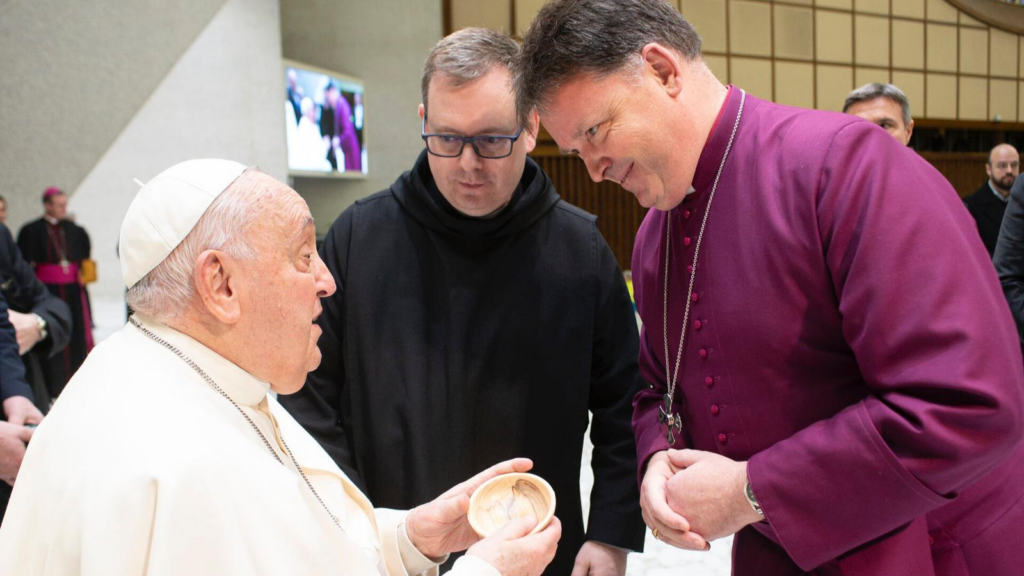
In practical terms, IARCCUM has organised two joint pilgrimages for bishops in the last ten years. I was closely involved in the pilgrimage of January 2024. It gathered over 50 bishops, in pairs, Anglican and Roman Catholic, from throughout the world for a week of walking, talking and praying together, first in Rome and then in Canterbury. During the Vespers at the Basilica of St Paul outside the Walls marking the end of the Week of Prayer for Christian Unity, the Pope and the Archbishop of Canterbury jointly commissioned the bishops to “together bear witness to the hope that does not deceive and the unity for which our Saviour prayed” and to “be for the world a foretaste of the reconciling of all Christians in the unity of the one and only Church of Christ”. It was an immensely moving experience. Their evident respect and affection for one another as co-workers for the Kingdom, along with their impromptu sharing in the ministry of preaching, made the words of commissioning that they spoke to the gathered bishops all the more powerful. It can be done!

What encouragements would you give to Anglicans who are seeking to strengthen church unity and encourage ecumenism in their contexts?

I call to mind some words from Pope Francis when he welcomed the participants in the Anglican Communion Primates’ Meeting to Rome last May. “The Lord calls each of us to be a builder of unity and, even if we are not yet one, our imperfect communion must not prevent us from walking together.” He went on to quote from Pope John Paul II’s great encyclical on Christian Unity, Ut Unum Sint, saying that relations between Christians “presuppose and from now on call for every possible form of practical cooperation at all levels: pastoral, cultural and social, as well as that of witnessing to the Gospel message”. The Pope underlined his belief that our differences do not diminish the importance of the things that unite us. I have a sense that this could be an important intuition for relationships within the Anglican Communion as well as for relationships between Anglicans and other Christians. Pope Francis also reiterated a statement he made with Archbishop Justin in 2016, saying that our differences “cannot prevent us from recognizing one another as brothers and sisters in Christ by reason of our common baptism”.

– Lambeth Conference, “What unites Christians is infinitely more significant than what divides us” – Reverend Martin Browne on Christian Unity,” 16 January 2025, https://shorturl.at/0p7mB.

Categories
Abbey | Latest News abbeynews

Homily – Third Sunday – Year C

Fr. John O’Callaghan.Today’s Mass started with a procession – and pride of place was given to the Gospel book. Encased in silver, it was reverently carried high up and placed on the altar and, later, it was brought to this ambo, honoured with candles and incense. We stood for it and the choir sang alleluia. After its proclamation we acknowledged it as Gospel, the Good News of the Lord, saying “Thanks be to God!”. This speaks volumns!  We recognise Jesus’s word being communicated to us; and as Jesus came from God we understand God has communicated with us. And similarly, after each of the preceding two readings, the reader announced it as “The Word of the Lord” and we acknowledged this with “Thanks be to God!”.  We acknowledge that God reveals himself through through human speech. God breaks the silence and reveals himself in many ways, through the marvels of nature, through marvellous people, but he also reveals Himself through the medium of words. This is the theme of today’s readings. 

In the first one we heard the priest Ezra reading the Law of Moses to people assembled in Jerusalem.  He was reading the Ten Commandments given on Mount Sinai. That was an exceptional  and foundational moment of communication between God and the human race. It is said that God even wrote out the Commandments. It could not have been expressed in a clearer and more profound way that God really did enter into communication with us and taught us how to live. We don’t have to believe that the words were actually chisseled out on stone tablets by God; that was a manner of speaking; it is most likely a simple metaphor but we do believe God to be their ultimate source and that he revealed his teaching through Moses. 

This is actually a very important point about biblical literature and it distinguishes Catholics from, for example, fundamentalists: what we read in the Bible must be interpreted in the same spirit in which it was written. The account of creation, for instance, as happening over six days does not mean that the universe just popped up, after six times twenty-four hours! The serpent in the Garden of Eden did not actually speak to Eve in Hebrew, and nor are we being asked to believe that God got hold of a hammer and chisel. We recognise poetic language can communicate deeper truths than words taken literally. The word of God uses many literary genres, and it doesn’t come flowing unalloyed, like water through a pipe, from the mouth of God, as some people say; no, it comes mediated by human beings! That is what makes interpreting scripture hard: the truth in it is not always easily recognizable

Today’s gospel is also an instance of God communicating with us and we heard a very telling example. Jesus is in the synagogue; he unrolls the scroll of Isaiah and finds the passage which is widely recognised as the summit and quintessence of the prophetic tradition and he applies it to himself, saying: “This text is being fulfilled today, even as you listen”. Jesus is saying that he himself is the one to ‘give freedom to captives and make the blind see’. He did that, in a literal sense to many people, sick in mind or body, but he also did it on a far deeper level for us all. He destroyed the finality of death and opened the way to eternal life, when he rose from the dead. It is in this way that Jesus fulfilled the scriptures, on a deeper level. The whole Bible can be read and interpreted from this perspective and thereby gives convincing testimony to Christ as fulfilment of the scriptures and traditions of Israel, so that we may believe intelligently. 

The word of God is not just understood, as the Jewish scribes saw it, as a guide for living but as a truth test, an authenticity test for Jesus as Messiah and coming from God. God revealed Himself progressively through his words, spoken by Moses and the prophets. These words culminated in the incarnation, the coming into the world, of God’s own self, most appropriatly known as ‘the Word of God’. “The Word became flesh and dwelt amongst us.” Jesus Christ the man is God’s greatest self-expression. It is through him that we can get to know better than ever the truth about God.  

When dealing with such heady matters it is reassuring to know that our own interpretations of the word of God are subject to correction. We are part of a church community where, as the Second Letter of Peter says: “the interpretation of scriptural prophecy is never a matter for the individual. For no prophecy ever came from human initiative. When people spoke for God it was the Holy Spirit that moved them.”  May our listening to the word of the Lord brings us, slowly but surely, to a greater knowledge and love of God!


Categories
Abbey | Latest News abbeynews

Homily – Second Sunday – Year C

Fr. Simon Sleeman. John loved weddings – early in his gospel we have the wedding in Cana and in his last book, the Book of Revelation, he ends talking about the ‘marriage of the lamb.’ There are eighty eight weddings in the bible if you include Adam and Eve.

Today, John gives us a report on the wedding in Cana of Galilee – tells us that Jesus was there with his Mother and a few friends, no sign of Joseph. And he tells us they ran out of wine. Jesus, after some persuasion by his Mother, turns six stone jars of water into the finest wine  – the guests were none the wiser – but Mary, Jesus and the servants knew. No fanfare, no three cheers for the wine maker. Just a line saying – this was Jesus’ first sign, revealing his glory.

I find this account a bit thin – it has none of the details I want.      

Compare to this to the Examiner’s, ‘Wedding of the Week’, on a Saturday. “There was a wedding in Killorglin, Co.Kerry.  Kathleen with a K and Kevin were the bride and groom. The bride looked super elegant in a ‘Prea James’ dress and the groom was stylish, thanks to Massimo menswear. Paradise Flowers created the floral arrangements. The Jugglers, arrived from Galway and set the toes tapping. …The bride said, ‘Our wedding was like something out of a movie, the weather was amazing. The ceremony was very emotional and both mothers were in tears and the wine flowed.”

Now that’s more like it! We get the scene…no shortage of wine here and mothers in tears…

If you were assigned to cover that wedding in Cana and came back with John’s report, I can imagine the editor saying, ‘listen, I have work to do, a paper to produce, people to see. Get real. Give me a report I CAN PUBLISH, that PEOPLE WILL READ.’

And yet John’s version has lasted 2000 years….why? what was John up to? …can we mine some meaning from his report?

You could look it as an interlude between the heady opening to his gospel and the unsavoury business of cleansing the Temple. I don’t think it was a filler.

He was/is trying tell us a truth; something that has existed since the beginning, that we have heard and we have seen, that we have touched with our hands, the Word who is life…but telling it slant – in a miracle – the quiet operations of grace – in the background – in an abundance of wine.

Isaiah, the prophet, told people to watch out for an abundance of wine. It would be a sure sign the Messiah had come..

Grace, miracles, God in action – we are not used to this …we are not used to living by invisibles. ‘Listen, I am busy’ …the editor comes back at you, ‘I have a deadline to meet, photographers to see….I don’t need this. I’ll settle for water. For being my own god. The snake promised I could do it’ – ‘you will be like God’ (Gen 3:5).

The editor didn’t want miracles – we don’t want miracles – they disturb us – they break open the reality we thought we understood, give us a glimpse of the ‘more’ of life – THE WORD –  they disrupt routine, break through the superficial – the dress, the hats, the flowers. We are not in control of things…sometimes it takes a miracle to get in behind – and crush the grapes.

So there is something more. And loads of it…more wine than you could drink…the larger world of God – the world of grace – glimpsed –  a world where the priority is not to get the facts but to obey – follow him. It is hard to believe there is someone greater than me here – even if he can turn water into wine or wine into blood.

Life is probably easier for the editor, go it alone – live in a small, controlled, miracle-less world…where you are god.

For us, who were neither in Cana or Killorglin but are here, in Murroe, this morning, not expecting miracles, the invitation stands… to open ourselves – just a crack – to the quiet operations of grace.

The invitation stands …to fill, maybe, just one stone jar with whatever needs changing in my life – pain, sadness, sin …and ask humbly …that it be changed.

The invitation stands to become the finest of wine – holy and divine…  The key – ‘do whatever he tells you’…

Categories
Abbey | Latest News abbeynews

Irish High Crosses

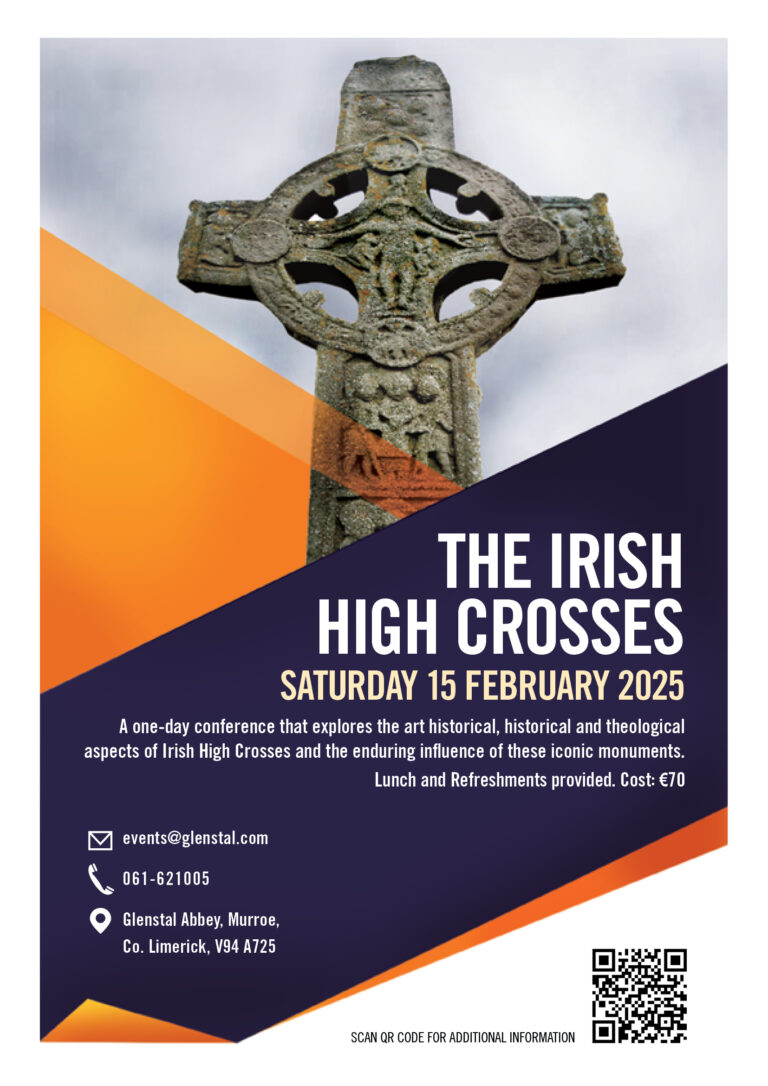
As the central symbol of the Christian faith, the Cross has been depicted in a variety of ways by artists since the early Christian period. This one-day conference taking place on Saturday 15th February 2025 explores how Irish sculptors and artists have portrayed the key instruments of Christ’s passion in the millennium between the seventh and the seventeenth centuries. The contributors will examine the art historical, historical and theological aspects of the Irish High Crosses and will trace the enduring influence of these iconic monuments.

  • Registration: 9.30 to 10am
  • Session 1: 10am –10.45pm
    Form, Contexts and Functions of the Irish High Crosses with Dr Megan Henvey.
  • Session 2: 11.10–12 noon
    The Iconography of Irish High Crosses with Professsor Rachel Moss.
  • 12.10pm Conventual Mass followed by lunch.
  • Session 3: 2.20–3.10pm
    The Cross in Late Medieval Ireland with Br Colmán Ó Clabaigh OSB.
  • Session 4: 3.45–4.30pm
    The Afterlives of Medieval Crosses with Professor Rachel Moss.
More details on the talks and speakers can be found below. For bookings please contact 061 621005 or events@glenstal.com

The iconic form of Ireland’s early medieval, free-standing, stone-carved crosses has long captured the imagination of antiquarians, scholars, and the general public, alike. Through a case-study of what has been considered the earliest high cross – the Carndonagh Cross (Co. Donegal) – this paper will: provide an overview of research methods applied to the crosses to-date; consider some new evidence to better understand the chronology and morphology of the development of this unique monument type; and show how individualised study of these monuments may reveal both their original function, and their important role in the development of Christian belief and theology of the period.

This paper will present an introduction to the often complex iconography of the Irish High Cross. It will examine some of the more popular biblical themes, viewed in the broader context of early Christian art, before turning to some of the more puzzling  figures that present greater challenges in interpretation. 

Irish society and the Irish church experienced radical transformation from the twelfth century onwards. This presentation traces how these developments were reflected in the form and function of the crosses erected during the period from the twelfth to the fifteenth centuries. It will demonstrate how the form and iconography of these crosses reflected contemporary theological and political developments alongside changing expressions of faith and devotion.

The 150 years that followed the Reformation was a turbulent period in Irish religious history. This paper examines the fortunes of medieval crosses in Ireland during the period c. 1540-1690. It looks at how a confessionally divided society regarded the monumental cross on the one hand as an enduring symbol of commerce and civic obedience and on the other as a tangible link to the saints and centuries of Roman Catholic devotion. Examples of crosses that were destroyed, moved or reconstructed during this period will demonstrate the ever changing fortunes of some of Ireland’s best known stone crosses.

Megan Henvey is an Associate Fellow in the Department of History of Art at the University of York, where she also completed her AHRC-funded and Stanford Text Technologies- supported doctorate in 2021. Her multi-disciplinary research employs the historical, literary, liturgical, archaeological, art historical, and geological evidence to explore early medieval Christian communities in Ireland, their pan-geographic networks, and the relationships between regional iconographies and Christian beliefs in the early Middle Ages, with wider research interests including the nature of borders and their function and value in the classification of material heritage.

Rachel Moss is Professor in the History of Art and Architecture at Trinity College Dublin. She specialises in the medieval art and architecture of Ireland. Her current research focusses on the extended biography of medieval objects and buildings, examining how the uses and meanings of medieval material culture has altered over time.

Colmán Ó Clabaigh is a monk of Glenstal and a medievalist specialising in the monastic and religious history of Late Medieval Ireland on which he has published extensively. His current research focusses on the social impact of religion in Ireland between the twelfth and the sixteenth centuries.

Categories
Abbey | Latest News abbeynews

Homily – Baptism of the Lord – Year C

Fr. Mark Patrick Hederman. Today is the feast day of the Baptism of the Lord. What is happening here that is of interest to us? We know relatively little about Jesus Christ until he reaches the age of thirty. The angels, the manger, the straw, the magi, the star, the shepherds, the ox and the ass, these are all images which later generations plastered on the bare walls of fact. We know that he was born in Bethlehem, which still exists and which is now a city in the Israeli-occupied West Bank of Palestine, located about six miles south of Jerusalem; and at a particular time, in human history, ‘the time of Caesar Augustus, to be precise, when Herod was king of Judea.’ These are verifiable facts. At some point in his life, probably during his adolescence, the Gospel suggests at the age of Twelve, this remarkable human person, this boy similar to ourselves, at about the same age as many of you sitting listening to me at this moment; this person, who had been brought up as a Jew, who had his relationship with God filtered through the normal channels of Temple worship, yearly feasts and traditional prayers, experienced a traumatic transformation, a psychic upheaval.  He became aware that his relationship with God was different from anything that had ever been experienced by any other person who ever existed on this planet. 

Something strange had happened when he was twelve years old. He was in Jerusalem with his parents and a whole load of other people who had travelled there, as they did every year for the Festival of Passover. When the whole group, including his parents, left the city to travel home, He somehow knew that he had to stay behind without telling any of them. Three days later after agonising worries about his safety, they found him in the Temple arguing with theologians and experts about the God question. 

Today we are focusing on a later moment in his career. He is out in the desert beside the river Jordan. His cousin, John, is baptising people in acrowd. Suddenly he knows that he must be baptised also. When he goes into the water, something happens to him and something happens to the river. 

He comes up out of the water and he knows that he is the Son of God. This is no longer a hazy intuition, it is a certain conviction. He hears a voice from heaven saying: ‘You are my Son, whom I love; with you I am well pleased.’  

In a few moments from now, during this Mass, one of you will bring a flagon of wine to the altar. One drop of water will be poured into the chalice as these words are said: ‘By the mystery of this water and this wine may we come to share in the divinity of Christ who humbled himself to share in our humanity.’

My dear friends: we are that drop of water, we are the Jordan  river; we are invited to share the same light-bulb moment that Jesus Christ experienced as he came up out of the water. 

One of these mornings
You’re going to wake up singing
going to spread your wings
And  take to the sky


That’s the kind of feeling when the message sinks in: You are being asked to hear these same words we have just had read in the Gospel passage addressed to you personally this morning: ‘you are my beloved, you are the one and only; and I am with you for ever more.’ 

If you are still looking for a New Year resolution: make it to find the switch to that light bulb and turn it on. No one else can do it for you, that is the meaning of free will. It should change your life and it should  make the year 2025 the most significant and the most creative you have yet to live.

Categories
Abbey | Latest News abbeynews

Homily – Epiphany – Year C

Fr. Luke McNamara.  Most of what happens in life we don’t notice. Even if we do notice, the significance of what happens mostly passes us by. Today’s celebration of the Epiphany allows us to look again at the birth of Jesus, and what it signifies for us.

The Epiphany, which celebrates the manifestation of Jesus to the world over 2,000 years ago, is not a historic celebration. The antiphons that we sing repeat the word hodie or “today”. The manifestation of Jesus to the world is happening here and now in 2025. We don’t have to wait until the final coming of Jesus or even until the next visit of a new star or comet.

To avoid missing out on discovering Jesus and the love that he brings, today we have the opportunity to follow the Magi. Tradition says that they are 3 wise kings, Caspar, Melchior, and Balthasar, and that they are from three different continents, Asia, Africa, and Europe. The Gospel is silent on all this. For the early Irish monks, the Magi were a large group of ordinary people, men and women, young and old, who travelled to see Jesus. Our ancestors understood that everyone has the possibility of going to see Jesus.

The Magi look for signs of Jesus’ coming – the star in the sky. They go on a long journey. They find at Bethlehem an ordinary sight, an infant with his mother. Yet, by observing the natural world (the star), by being attentive to those around them (the people of Jerusalem) and to the word of the Lord (the prophecy of Micah), they recognise the Saviour in their midst, as shown by the gifts they bring and by their worship. They are the first in a long line of disciples who come and worship Jesus.

They bring gifts of gold signifying his royal status, frankincense his priestly role and myrrh for his burial. The gifts, especially the myrrh point to the extent of Jesus’ love for us. Jesus will give his life for us that we might live. The Magi recognise the extent of Jesus’ love, as shown by their gifts and their worship.

We all need the power of God’s love in our lives. The question of the Magi, where is the newborn king of the Jews becomes our question. The search of the Magi becomes our search. The presenting of gifts and worship of the Magi becomes our worship, even at this very Mass. The transformation of the Magi who walk the earth in a new way, is also ours as we are sent forth from this Mass renewed with the gift of God’s love manifested to us in Jesus.

I conclude with a traditional Irish prayer for this time of year: 


A Íosa naofa, a Chara caomh, 

A Réalt na maidine, A Ghrian álainn an lánlae, 

A Bhreo ghil na bhfíréan agus na firinne, 

A Thobar bithnua, tabhair dúinn do ghrá.

Holy Jesus, gentle friend, 

Star of the morning, glorious sun of the noonday, 

Bright light of believers and of truth,

Well of everlasting life, grant us your love.

Categories
Abbey | Latest News abbeynews

Second Sunday after Christmas Year C

Fr. Fintan Lyons. This morning shortly after 9, the great double door of St Paul’s Basilica in Rome, was pushed open by the Archpriest of the Basilica, Cardinal Harvey, in the last of the symbolic acts initiating the Holy Year 2025. The Holy Year tradition is based on an Old Testament practice described in the book of  Leviticus 25:10: ‘Thou shalt sanctify the fiftieth year, and shalt proclaim remission to all the inhabitants of thy land: for it is the year of jubilee’. In the Old Testament it was realised that things could come to a breaking point in people’s lives and God in his mercy would intervene. 

The year of jubilee was revived in 1300, and in the course of the centuries the interval was changed to 25 years. In 1300, as now, the Jubilee began with the opening of the door of St Peter’s so that pilgrims could come seeking the mercy of God, it was an era when human misery was seen as the result of universal sinfulness, and hope for the future was grounded in being freed from sin. In addition to the spiritual benefits, the hardships involved in many pilgrimages can have a transformative effect on a pilgrim’s lifestyle. 

Besides Rome, there are many other places of pilgrimage and Ireland has its quota; Jerusalem would be the ideal destination but for many centuries it has been accessible only on an individual basis and the holy places are not accessible at all at present.. 

There is a special significance about today’s ceremony at St Paul’s, because Pope Francis, in the document inaugurating the year, quoted extensively from St Paul – his Letter to the Romans – and used four words from it as the theme for the year: ‘Hope does not disappoint.’  

Overall, this Jubilee year, is meant to encourage us at a time when everywhere, you can say, there is foreboding about what the year holds in store. In the Old Testament the nature of the jubilee was legislated for, it brought remission of debts, the liberation of prisoners. 

Today the pope can only make an appeal regarding prisoners in the world’s overcrowded jails or countries sunk under the weight of debt:

I propose that in this Jubilee Year governments undertake initiatives aimed at restoring hope; forms of amnesty or pardon meant to help individuals regain confidence in themselves and in society; and programmes of reintegration in the community. 

Pope Francis actually and very symbolically pushed open the door of one of Rome’s prisons the day after Christmas.   

How does this opening of the door touch the lives of all of us? For some, life can be experienced as a door closed against fulfilment – the way forward in a career blocked, a relationship aspired to denied, being held in the grip of addiction. Pope Francis acknowledges this when he says: ‘uncertainty about the future may at times give rise to conflicting feelings, ranging from confident trust to apprehensiveness, from serenity to anxiety, from firm conviction to hesitation and doubt.’

Is it really helpful then, to continue the quotation from St Paul, ‘Hope does not disappoint’ to its conclusion – ‘the love of God has been poured into our hearts’, because today many have no sense of this inpouring of God’s love?  Or if the passage in the second reading doesn’t seem to apply: ‘God chose us to belong to Christ before the world was created.’

But in fact, there is hope for all, though many today may not experience the power of the traditional Irish conviction: Is giorra cabhair Dé ná an doras. Instead of our having to knock we have only to open, because in the Book of Revelation Jesus says: ‘I am standing at the door, knocking. If anyone hears me calling and opens the door, I will come in and share a meal with them’. In the gospels this is what Jesus actually did, with the marginalised of society.

The initiative has always come from God, it is for us to open the door of our hearts. The door of the church here is open, encouraging all to enter and open our hearts to an encounter with God’s grace – of forgiveness, of healing, of encouragement, of faith itself, whatever our need is.


Categories
Abbey | Latest News abbeynews

Every moment of the Christian life is an opportunity for renewal

I’m not a fan of New Year’s resolutions, mostly because I don’t keep them for long. Whether I keep them or not, however, the arrival of 2025 is like turning the page into a new chapter, offering a chance for reflection and closure on the past year and providing a clean slate for the year to come.

Looking back at the year gone by can bring a mixed bag of emotions. Gratitude for the blessings we’ve received, the successes we’ve enjoyed, or the new experiences we had. Regret for the missed opportunities, the broken relationships, or the things we’ve failed to do. And sorrow and grief for those we’ve lost along the way.

The dawning of the New Year gives us renewed hope for ourselves, our families, our countries and our world. There’s a feeling of excitement at the possibilities we might grasp, thanks for the fresh start we’re afforded, and not a little bit of trepidation at what might be ahead. It’s as if we have a blank page on which to continue writing the story of our lives, without the baggage of whatever the last chapter contained.

All this is rather secular, to be honest, as we Christians needn’t wait for the New Year to turn things around. Instead, it’s a possibility given to us every moment of our lives. Indeed, I’ve found that here in the Middle East the new calendar year tends to arrive with little fanfare. Rather, more attention is given to the Jewish Rosh Hashana and Islamic al-Hijrīyah, the religious “head of the year” that determines the timing of key festivals and which will impact upon, and be used alongside, the secular calendar. For example, on a recent visit to a Gulf country I noticed my passport was stamped with an arrival date of 15/06/1446… something sure to baffle border officials wherever the Gregorian calendar is used!

The quiet acknowledgment given to the arrival of the New Year in the Middle East contrasts with the lively traditions of my childhood in Northern England, where the start of the year was an occasion steeped in ritual and anticipation. As children we hoped to be the one chosen to step the “first foot” into the house, carrying with us a piece of coal and a silver coin in hope of prosperity for the year to come. I’m not sure what the significance or origin of these rather superstitious practices are, but the coal probably had something to do with the region’s mining heritage and spoke of a time when coal in the hearth was vital for a family’s survival. In those days, hope for prosperity was born of knowledge that destitution was always a terrifying possibility.

When thinking about these practices, I’m reminded of a line somewhere about how we need rituals because “we need to elevate certain parts of life by marking them out in some way.”  For us Christians, it is the Church that recognises, explains and dignifies this human impulse through her own rituals, liturgies and observances. In a less religious upbringing like my own, perhaps the sort of New Year rituals that I described took on more importance as they fulfilled the need to mark turning-points in lives otherwise devoid of Church practice and rituals.

Indeed, as participation in Church life declines nowadays a whole array of secularized rituals now seek to satisfy this human desire, often with hefty price tags attached: gender reveals, naming ceremonies, and even divorce rituals, to name but a few!

I don’t want to sound puritanical, and I do recognise how the New Year gives a very clear sense of transition and many people wish to mark it. So, if we wanted to make resolutions for the New Year we won’t go wrong by committing to something like more time for daily prayer, the reading of the Scriptures, going to Mass more often, or frequenting the Sacrament of Reconciliation. Friends of our monastery might consider taking time for a retreat at Glenstal Abbey, a commitment to regular giving, or living the Benedictine spirituality each day as one of our Oblates.

I’m not sure what, if any, resolutions I’ll be making. But I will mark the arrival of the New Year 2025, and will use it as an opportunity to review the year past and seek signs of God’s action throughout. I’ll take time to reflect on the year ahead too, mindful that every moment of the Christian life is an opportunity for renewal – not just at the start of the year. Thanks be to God!

Justin Robinson OSB

Categories
Abbey | Latest News abbeynews

Homily – Feast of the Holy Family – Year C

Fr. Jarek Kurek  It is rather perplexing that on the feast of the holy family of Mary, Joseph and Jesus we get a picture of their family that is far from perfection. It seems rather like an experience of any of our own families. Jesus leaves his parents, which leads them actually to a desperate search. Jesus who should be a model of human behaviour for us comes across as seemingly unkind, or inconsiderate to put it differently.

Not without reason then Mary asks her son ‘Child, why have you treated us like this?’ 

And Jesus gives her this bewildering response ‘Why were you searching for me? Did you not know that I must be in my Father’s house?’

He leaves his human family to be with his Father, Jesus leaves Mary and Joseph to stay in his heavenly Father’s house. An important step towards manhood, towards his spiritual maturity takes place. And yet, having asserted his independence, Jesus returns obediently to his parents. 

Now this desire to be and stay with the Father is in us also, I believe, perhaps not as clear and compelling as in the twelve-year-old Jesus. We want to be in our Father’s house, but maybe we are not as determined to step out of our human family, and the human conditions we live in. There may be a feeling in us that we are stuck there, we are not moving on…

But… think of what happened in your life four days ago. On the day of Christmas all of us here renewed this very important desire to be with the Father, the Father of Jesus and our Father. It happened in a very solemn way when we reverently knelt at those powerful words of the Creed, while speaking of Jesus: ‘who for us, and for our salvation, came down from heaven, and was incarnate by the Holy Spirit and of the Virgin Mary, and was made man’. 

Something of a tremendous importance took place. On that day once again we were given power by God to become his children. A good reminder that what we perform here is not in vain, it has its far-reaching and wonderful consequences.

That’s how the desire that was in Jesus at the time is aroused also in us, with Jesus we want to stay in his and our Father’s house a little longer, maybe we’ll do so after this celebration of Mass? 

Jesus was also happy to please the Father and to do what he commands. And what is God’s commandment for us today so we can please our Father too? Something we apparently heard so many times before: ‘love one another’. But today, if we truly recognise that Jesus’ story is in fact ours, step by step we may be able to uncover a deeper meaning of that commandment. Slowly but surely, we’ll realise that the story of Jesus’s family is ours and that it is in the God’s house that we can learn the best lessons about love and family.

And my last thought, or rather a sort of wishes for you gathered here and for those who join us through the webcam: today, when we say Our Father together as one family during this Mass, may it have a different, somewhat renewed, and hopefully deeper sense for all of us. 

May everyone find their own way, in the depth of their heart, to address him truly as My Father.

Categories
Abbey | Latest News abbeynews

Homily – Christmas – Year C

Abbot Columba McCann OSB.

Here we are, four years after the appearance of Covid 19, seven weeks after the re-election of Donald Trump, three weeks after the fall of the government of Syria, twenty-six days after the Irish elections. That’s how you might date our gathering, if you didn’t have the numbering system to say ‘the 24th of the 12th, 24’.

In the reign of Caesar Augustus, while Quirinius was governor of Syria, there was a census, not just for fun.  You did it to get the size of a population, the extent of tax you could get off them, especially in order to pay your armies to rule over them.  You can just hear the tramp of soldiers’ feet across the Roman colonies to ensure that Roman rule would be obeyed, and Roman strength displayed.

But Caesar Augustus and governor Quirinius didn’t realise that there was another army, usually invisible to the naked eye, that was far more powerful.  One night it was seen by a group of shepherds in a far-off eastern province.  They saw what the gospel literally calls an army of angels.  

When we think of the great figures of history, perhaps we think of the Roman emperors, of Charlemagne, of Napoleon and of other great movers and shakers.  But all the while, almost under cover, is another power which whispers gently into our world, and only rarely shines out brilliantly, as it did for the shepherds of Bethlehem, as it did on Mount Tabor when Jesus was transfigured, and later at an empty tomb in Jerusalem.

These shepherds were the kind of people you would not generally let into your kitchen, and if you did, you’d keep an eye on them.  The kind of people that Jesus himself would later gather around himself.  Maybe that’s one reason why they saw angels that night.  Maybe it was also a smiling gesture from heaven recalling a little shepherd boy centuries earlier, a little nobody, almost overlooked, by the name of David, who became perhaps their greatest king.  He could have been minding sheep even in the same fields way back then.  And now the Son of David is born, the greatest shepherd of them all.  

He is born to a couple who are really quite poor.  We know that because, when it came to making an offering in the temple forty days after his birth, they couldn’t afford the normal offering and just offered a bird or two.  That’s all they could afford.  They were the kind of people that get pushed around on account of the great Caesar Augustus, and his census, like the people that are still getting pushed around in that part of the world today.  Jesus was born to a couple who didn’t have enough money or pull to get proper lodging for the night, born instead among the animals.  

And yet, when we look at world history, we know that something mighty happened that night, under the cover of darkness, under the cover of poverty, out at the edges, where people wouldn’t take a blind bit of notice of you.  Under the radar, while nobody noticed, except for a few shepherds, divine love sneaked into our world and became flesh.

There is tremendous hope for us and our world in this.  We look at the bewildering changes that are happening around us, wondering where it will all end, saying perhaps to ourselves, ‘Sure what can I do about it?  I’m not one of the big movers and shakers!’  And that’s the point.  It’s because I am not one of them that I am ideally suited for God’s work, the real work, much of which may remain unnoticed.  Pope Francis said recently, ‘Small is not a handicap, it’s a resource.’

That’s how God works.  As undramatic and life-giving as the dewfall.  Dewfall happens so quietly overnight, so subtly that you don’t even realise it is happening, until suddenly you notice the ground is soaking wet with life-giving moisture.

Every time I turn my attention even a tiny amount towards God, the army of angels sings ‘Glory to God in the highest’, because Christ has a new point of entry into our world  Every time I make the smallest move of generosity, of reaching out to another, of being fair and honest, of forgiving and helping, the angels sing, ‘Peace on earth to those favoured by God’ because Christ is coming to birth now in my flesh.   .  What about when we share the Eucharist together, as we will shortly?  When we share the Eucharist, what do they sing? Maybe they are struck dumb with amazement at what is happening between heaven and earth.  Maybe they are reduced to silence. So this night of the 24th of the 12th, ’24, and into 2025, let’s make sure the angels get no rest!  Let’s give them lots to sing about.  And moments to be amazed.

Subscribe To Our Newsletter To Receive Updates

[hubspot type=form portal=6886884 id=9e1d6d0d-c51e-4e35-929d-3a916798de64]