Categories
Abbey | Latest News abbeynews

Homily – Sunday 13 – Year B

Fr William Fennelly OSB

Two women alone in the middle of crowds! The first woman is older. No one else is mentioned in her story except the doctors who were no help. She is isolated because of her flow of blood which would make her ritually impure. She is an anonymous figure in the crowd which is pressing against Jesus, pushing and shoving, to get near to the great man. For them she’s a nobody. But she sees in Jesus someone who can restore her, if she can but touch him. Suddenly there they are, looking at each other, and he speaks the healing word, ‘Daughter’. She is healed not just in her body but from her utter isolation. She has got back her life. She can go in peace.

Then there is the young girl whose isolation is different. She too is in a crowd of people, who are wailing and weeping and making a commotion, but she is the centre of the action. Everything revolves around her, but her isolation is more radical in her seeming death. Movingly, Jesus goes to her with just her own family and his closest disciples. The mob is left behind. She is restored to those who love her.
The first reading tells us that ‘God did not make death, nor does he rejoice in the destruction of the living. For he fashioned all things that they might have being.’ Jesus here is the Lord of Life. He has come so that we ‘may have life and have it abundantly’. (John 10.10) Sickness undermines our lives in many ways. Like the older woman, it can make us disappear from society. Going out to shop can be a laborious challenge. It is easy to lose touch with friends and relatives. They have
their own lives to live and may not have much time for us. Loneliness is a vast affliction for many older people who go days without speaking to anyone. Life seems to leave them behind.

Then there is the more radical loneliness of death, which has cast its shadow over the young girl. As death draws near, we can feel radically alone, even when we are surrounded by those who love us. In this gospel, Jesus heals both, giving the one back to herself and the other to her family. These are two dimensions of the same healing, for it is only in belonging that we can have a life that is our own.

The drama of today’s gospel foreshadows the great battle that lies ahead when he will bear all our loneliness and overcome it. On the cross he will again be surrounded by another mob, baying for his blood and ridiculing him, just as this earlier mob ridiculed him for saying that death had not taken the young girl as its prey. To be mocked is to feel utterly vulnerable and solitary. On the cross he will bear all the isolation of the sick, the depressed, people afflicted with failure or isolated in any way. Because he has done this, we believe that our own moments of loneliness are not final. He is with us as he was with the lonely woman and gave her back her life.

In his dying, he will know the most radical solitude of all, foreshadowed in the girl in the coma. He will lie in the coldness of the tomb until on Easter Morning he will be given back to his closest companions, as she was handed back to her family. In the garden, the women who loved him will be astonished and their mourning will be turned to celebration.

So loneliness need not crush us. We can face illness and death with joy because we share them with the Lord of Life. I recently had the pleasure of welcoming a lady who is dying to pray in the icon chapel here. It was an emotional occasion for her family but she was singularly unperturbed, “I’ve lived a good life and now is my time” she said calmly and then she asked me to pray not for her but for her daughter “she’s a good girl who’s afraid she won’t cope” she said. I was privileged to receive such a powerful teaching (so modesty delivered) about how to live in the face of death.

Categories
Abbey | Latest News abbeynews

Homily – Sunday 12 – Year B

Fr Denis Hooper OSB

“UNFURL THE SAILS, AND LET THE SPIRIT STEER US WHERE HE WILL” – ST. BEDE THE VENERABLE UNLIKE THE BOAT DESCRIBED IN TODAY’S GOSPEL, HERE IS THE TALE OF ANOTHER LARGER, MODERN AND MUCH MORE ELABORATE CRAFT BY FAR.

THE USS AIRCRAFT-CARRIER GERALD FORD IS THE LARGEST AND MOST TECHNICALLY ADVANCED MACHINE EVER MADE. IT COST $14 BILLION TO BUILD AND WHEN IT HAS ALL IT’S AIRCRAFT ON BOARD IT IS WORTH UPWARDS OF $40 BILLION. BY MY RECKONING IT IS MORE THAN TEN TIMES THE LENGTH OF THIS CHURCH; MORE THAN TEN TIMES THE WIDTH AND FIVE TIMES THE
HEIGHT OF THIS BUILDING.

IT HAS A CREW OF OVER 5,000 – A FLOATING TOWN.
THE TOP SPEED OF THE GERALD FORD IS 48 KILOMETERS PER HOUR AND IT TAKES 5KMS TO COME TO A STOP – FROM THE TIME THEY PUT ON THE BRAKES UNTIL THE TIME THE BOAT COMES TO A STANDSTILL. SO, YOU’D BETTER GET OUT OF ITS WAY – IT WOULD MAKE MINCEMEAT OF THE SMALL BOAT JESUS AND HIS DECIPLES WERE IN, AS DESCRIBED IN TODAY’S GOSPEL! YOU DON’T MESS WITH THE USS GERALD FORD!

LEGEND HAS IT THAT WHEN THE GERALD FORD WAS ON MANUVERS IN THE NORTH ATLANTIC, THE CAPTAIN WAS ALERTED BY HIS RADAR TEAM THAT THERE WAS A SHIP
AHEAD WHICH WAS NOT RESPONDING TO THEIR WARNINGS TO MOVE OUT OF THEIR PATH. THE CAPTAIN – A BURLY, NO-NONSENSE TEXAN WENT OVER TO THE RADAR DECK AND ISSUED HIS OWN WARNING:

“THIS IS THE CAPTAIN OF THE USS GERALD FORD. YOU ARE DIRECTLY IN LINE OF OUR SHIP’S COURSE AND WE ADVISE YOU TO MOVE TO AVOID COLLISION.” “NEGATORIAL” CAME THE REPLY, “WE ADVISE YOU TO MOVE YOUR COURSE INSTEAD.” “I’LL GIVE YOU ONE MORE WARNING” THE CAPTAIN MESSAGED – “EITHER YOU MOVE YOUR COURSE… OR ACCEPT THE CONSEQUENCES” “NEGATORIAL” CAME THE REPLY, FOR A SECOND TIME. “THIS IS THE CAPTAIN OF THE USS GERALD FORD AND THIS IS YOUR VERY FINAL WARNING
– EITHER MOVE OR WE WILL PLOUGH STRAIGHT THROUGH YOU” THE REPLY CAME IMMEDIATELY “THIS IS THE VALENTIA ISLAND LIGHTHOUSE. THE DECISION TO MOVE IS YOURS” TODAY’S GOSPEL SEES THE DECIPLES IN A SMALL FISHING BOAT THAT FINDS ITSELF IN THE TEETH OF A SUDDEN AND NASTY STORM. ANYONE WHO HAS BEEN IN A STORM IN A SMALL BOAT KNOWS EXACTLY HOW SCARY THAT CAN BE.

BUT YOU WOULD THINK THAT SINCE THE DECIPLES HAVE JESUS IN THE BOAT AND EVEN IF HE IS ASLEEP EVEN WE KNOW THAT THERE ISN’T A HOPE IN HELL THAT ANYTHING IS GOING TO GO WRONG. THEY HAVE THE SON OF GOD ABOARD! BUT THEY ARE SCARED – AS ONLY PEOPLE CAN BE WHEN THEY ARE IN A NASTY STORM. AND IN THEIR PANIC, THEY WAKE JESUS – TO GET HIM TO DO SOMETHING BEFORE THEY WILL ALL BE DROWNED. NONE OF US LIKES TO BE WOKEN IN THE MIDDLE OF THE NIGHT AND NEITHER DOES JESUS. BUT STILL, NOW THAT THEY HAVE WOKEN HIM, HE LISTENS TO THE FEARFUL PLEAS OF HIS DESCIPLES AND CALMS THE STORM… AND THEIR FEARS. WE PLOUGH AWAY IN OUR OWN SMALL BOATS THROUGH THE CALMS AND THE STORMS OF OUR LIVES.

ST. BEDE THE VENERABLE IN THAT PRAYER I READ TELLS US TO “UNFURL OUR SAILS AND LET THE SPIRIT TAKE US WHEREVER IT WISHES”. IF ONLY WE HAD THE TRUST TO DO THAT! WHEN YOU ARE IN A SMALL FISHING BOAT IN A NASTY STORM YOU WILL DO ANYTHING, PROMISE ANYTHING – IF ONLY IT WILL CALM DOWN. TRUTH BE TOLD THAT WE SO EASILY FORGET THE TERROR AFTER THE STORM – UNTIL OF COURSE THE NEXT TIME IT HAPPENS.

LIKE THE APOSTLES OUR FAITH IS SHAKY TO SAY THE LEAST AND WE FEAR AND DREAD THE STORMY WATERS IN OUR LIVES. WE SOMETIMES FEEL THAT THEY WILL OVERWHELM US. THE SIMPLE MESSAGE OF TODAY’S GOSPEL IS THAT WHEN THE STORMS OF OUR LIVES
ARE TOO MUCH FOR US TO COPE WITH THEN WE ALWAYS HAVE THE OPTION TO TURN TO JESUS AND ASK HIS HELP. EVEN IF WE HAVE TO WAKE HIM – HE WILL HELP US. NEEDLESS TO SAY, BY THE WAY – THE USS GERALD FORD CHANGED ITS COURSE. SOMETIMES YOU ARE BETTER OFF CUTTING YOUR LOSSESS AND GETTING THE HECK OUT OF DODGE!

THE NEW GLENSTAL BOOK OF PRAYER – WHICH I AM TOLD WILL BE ON THE BOOKSHELVES SHORTLY – HAS A BEAUTIFUL PRAYER IN IT BY ST BASIL OF CAESEREA. THIS PRAYER IS ALSO IN THE ORIGINAL GLENSTAL BOOK OF PRAYER – IF YOU ALREADY HAVE A COPY. I PARAPHRASE ST. BASIL’S PRAYER:

“STEER THE SHIP OF MY LIFE GOOD LORD TO YOUR QUIET HARBOUR WHERE I CAN BE SAFE FROM THE STORMS OF SIN AND CONFLICT SHOW ME THE COURSE I SHOULD TAKE…. GIVE ME THE STRENGTH AND COURAGE TO CHOOSE THE RIGHT COURSE EVEN WHEN THE SEA IS ROUGH AND THE WAVES ARE HIGH KNOWING THAT THROUGH ENDURING HARDSHIP AND DANGER
WE SHALL FIND COMFORT AND PEACE”. AMEN

Categories
Abbey | Latest News abbeynews

Homily – Sunday 11 – Year B

Fr John Callaghan osb

One day Jesus was in the temple at Jerusalem and noticed people putting money into the collection box. The rich put in plenty, but they were giving their leftovers. Then a poor widow put in a few cents. It was all she had to live on. It’s a good image of Jesus himself. At the Last Supper Jesus gave his disciples everything he had to give. There, on the table, was his life poured out for them, something which would come to completion the next day on the cross. He was loving them as the Father loved him. He loves us as the Father loves him, and invites us to the same table.

It is easy to forget about that kind of love, partly because it’s so big we can’t even get our minds around it. And sometimes we just forget about it. That is why Jesus says: remain in my love. Don’t get distracted from it; look for signs of it everywhere; bring your mind back to it whenever you get a bit of free mental space. We receive this love in every Eucharist; but it is good to savour the taste of it the rest of the time, especially in moments of prayer.

Nobody talks about the weather the way the Irish do, and when there are even just a day or two of sunshine we go crazy. We are out there in our shorts and t-shirts, working in the garden, walking the beach, having a drink outside the pub instead of inside, having barbecues. We bask in the sun.

Jesus invites us to bask in his love, a love which has no clouds, no sunset. He wants us to do this so that his joy will be in us. He wants us to experience the joy he gets from the Father’s love. Part of his formula is that we love one another has he has loved us. It’s easy to love someone when they give you what you want, or when they love in return. But let’s be honest: loving as Jesus loves is a tall order. It seems just too much. I don’t want to have to give up my little comforts and pleasures and convenience for someone else; I don’t want to let go of my desire for revenge when I fell hurt or put down; I really do want to have the last word when someone disagrees with me. I’ve got a problem with love. And only God can fix that. God is love.

The only way I can love like Jesus is if his love is in me. Which brings us back to his original invitation: remain in my love. Make your home in me as I make mine in you. The more we allow ourselves to receive from Jesus the more we have to give to others.

Categories
Abbey | Latest News abbeynews School | Latest News

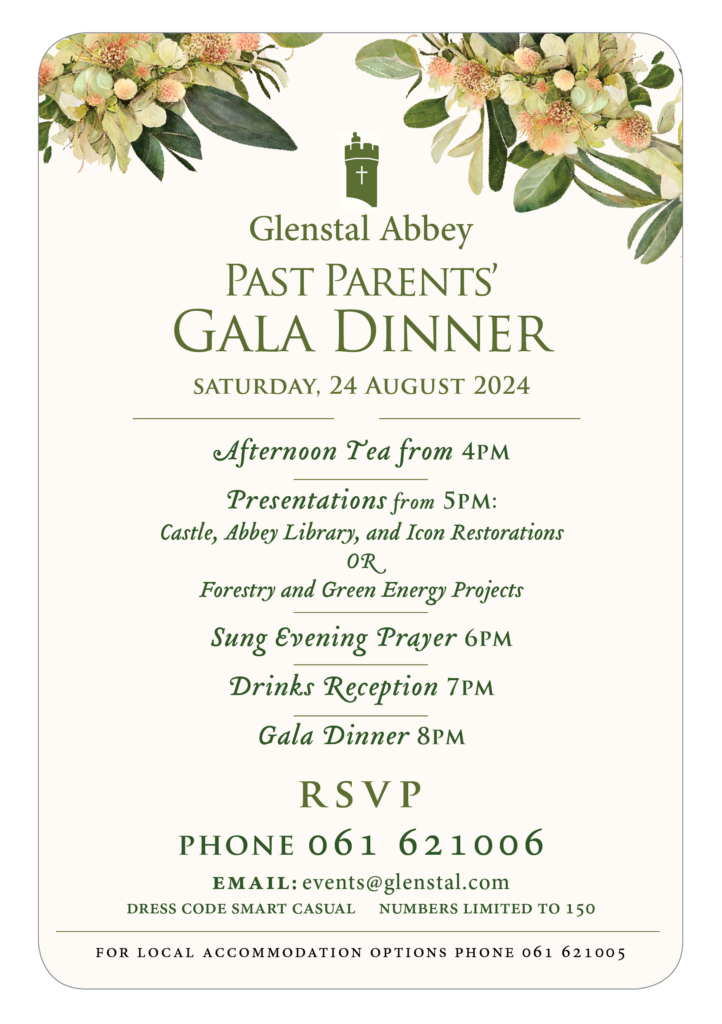
Past Parents’ Gala Dinner

Glenstal Abbey is delighted to invite parents whose sons left our Abbey School ten or more years ago to a Past Parents’ Gala Dinner on Saturday 24th August 2024.

The evening will begin with Afternoon Tea from 4pm and will be followed by Presentations of the Castle, Abbey Library and Icon Restorations, or the Abbey’s Forestry and Green Energy Projects, from 5pm.

Guests are invited to join the monastic community for a service of Sung Evening Prayer at 6pm, after which there will be a Drinks Reception at 7pm before the Gala Dinner begins at 8pm.

The dress code is smart casual and numbers are limited to 150 persons. Local accommodation options can be discussed by telephoning 061 621005.

To RSVP please phone 061 621006 or email events@glenstal.com

Categories
Abbey | Latest News abbeynews

St Columba

Fr Henry O’Shea OSB

At the vigil office last evening we sang: ‘Columba commanded the
winds, restored the dead and put the plague to flight, alleluia.’

At a time when we have become used to the phenomenon of fake
news and so-called alternative facts, no-one is surprised that most of
the early lives of the saints contain much that is fanciful or fictional. At
the same time, a contemporary saying remains valid which claims
that, ‘The fact that it is fiction does not meant that it is not true’. A
novel, for example, can contain many insights that are true and
helpful. While early lives of the saints may contain much gilding of the
lily, many stock images and phrases, they can also contain a reliable
historical core.

And today, were are increasingly aware that every text has a purpose.
Every text is based on intentions and presuppositions, conscious or
unconscious. Lives of the saints were and are intended to nourish and
encourage faith and belonging, to instruct and inspire the language of
love.

This is the case of the saint we celebrate today, St Columba or Colum
Cille, patron of this monastery and one of the three main patrons of
our country. He was born in 521 and died in exile on the island of
Iona in Scotland in 597. Many of the stories about him are contained
in the work of an early biographer, Adomnán, one of his successors as
Abbot of Iona, who wrote around the year 697, a century after his
death.

Every human society, regardless of whether it recognises it or not and
regardless of the yardsticks it uses, is made up of a hierarchy or
pecking-order. Just to mention a few, these yardsticks can be money,

power, inherited status and privilege, elected privilege, celebrity,
online influence, political pull.

Columba’s Ireland was one where caste and clan were of the greatest
importance. He himself was born into the highest aristocracy and
shared many of its assumptions and presumptions. Hierarchy was
taken for granted and, as in every age, the poorer and weaker paid
tribute in goods or services to the richer and more powerful. Slavery
was widespread – as St Patrick experienced some decades earlier on
his first visit to our country. But it is also true that at its best, hierarchy
imposed responsibilities and duties on those further up the ladder.
Columba took it for granted that he was a leader and he led.
The society in which Columba was a vibrant and effective leader
possessed a sophisticated cultural life, a creative and sparkling
literature that we now know was to continue to develop for a further
thousand years, providing one of the first and greatest bodies of
literature the world has seen, both in quality and quantity. And this
literary world is reflected in the stories written by Adamnán about
Columba.

True, there is much violence in these stories. But the stories also
include much tenderness – as in the story of the care for a travel-weary
crane – a bird depicted, by way in the statue of Columba in his chapel
at the back of this church. The crane, the symbol, the embodiment, of
wisdom in Irish pre-Christian tradition, can be seen to represent the
transition from a pagan society to a Christian one, a transition that
was not always smooth, not without controversy and even violence. At
least in this case, it marks a gentle transition, where the best of the old
is refined by the best of the new.

Like Columba himself: prince and warrior by birth, abbot and cleric
by the call of God and by choice, founder of monasteries, lover of
learning and lover and defender of his native culture and its literature
against Christian zealots, lover of the land- and seascape. By all
accounts, he was choleric, impulsive, competitive, bossy but also
merciful, kind, joyful and humble.

But all this leading to the great sacrifice of his actual body by leaving
his beloved land, partly, we are told, in penance for deaths caused by
a battle over the copying of a manuscript, partly as a leaving of what
was most loved for the sake of Christ, joining an already existing and
growing Irish tradition of becoming a pilgrim for Christ, the so-called
white martyrdom which often entailed exile.

Today’s readings, From the prophet Ezechiel, from the Letter to the
Romans and from the Gospel according to St Matthew, are happily
chosen. Happily chosen because, while reflecting characteristics of St
Columba in his life and personality they also provide a map for each
of us in our Christian pilgrimage.

Ezekiel reminds us of the duties of the evangelist or missionary, and of
the rewards opened to, as well as the risks run by, those who spread or
fail to spread the Gospel message and those to whom it is preached.
“If I say to the wicked, ‘You shall surely die’, and you give them no
warning, and do not speak to warn the wicked from their wicked way,
in order to save their life, those wicked persons shall die for their
iniquity; but their blood I will require at your hand.” Cheerful stuff.
And while that preaching can take the dramatic form as exemplified
by Columba’s life as founder and missionary in Scotland as well as in
Ireland. It can also take the form of the example of a Christian life
well lived in vibrant, if tranquil, faith and love. St Paul reminds us, in
his usual trenchant way, that what is demanded of us is nothing less
than the total giving of our bodies, souls and minds, that is, our whole
selves, as a living sacrifice, holy and acceptable to God.

Paul does not demand that, as in the case of Columba, we physically
remove ourselves from a much-loved land and a community that has
given us much, or even all, of our identity, but he does demand the
sacrifice of love, which he tells us is our spiritual worship. And he goes
on to list some of the attitudes and behaviour in which this love
consists: brotherly affection, mutual respect, zeal, radiance in the
Spirit, service of the Lord and one another, joyfulness in hope,
patience in times of difficulty, perseverance in prayer, generosity in
prayer and hospitality. This could be a pen-picture of Columba as it is
of our best, baptised, selves.

The Gospel from Matthew invites us to climb aboard the ship of
Christ. It may not invite us to leave our native land as Columba did,
but it does invite us to take the risk of leaving the dry, even arid, land
of our ordinarinesses, our tepidity, our mediocrity, to acknowledge, to
confess and abandon our sinful deeds and omissions, our smug
certainties and spiritual laziness. We are invited into the storm that a
genuine hearing and living of the Gospel can entail, but always with
the assurance that when we are in the boat with Christ, he will see us
safely to harbour, even if we have a bumpy ride.

As Columba, rightly known as ‘the hope of the Irish’, put it himself in
a poem now accepted by most scholars to be his:
Having thus wherewith to glory,
All the wide world might adore
The high Godhead’s sole-possession
Everywhere and evermore.

And after this, our exile show unto us the fruit of thy womb, Jesus.

Categories
Abbey | Latest News abbeynews

Corpus Christi – Year B

Fr Lino Moreira OSB


At the foot of Mount Sinai, the people of God, who had just been set
free from slavery in Egypt, promised to obey all the commandments given to them by the Lord (cf. Ex 24:3). Then Moses sprinkled the blood of sacrificed animals – first on the altar, which represented God, and then over the people, saying: ‘This is the blood of the covenant that the Lord has made with you in accordance with all these words (Ex 24:8).’

By virtue of this ritual God and Israel became a single family sharing a
common life. But no sooner had the people made their promise than they broke it by committing the sin of idolatry. They fashioned a golden calf and prostrated themselves before it as the god who had brought them out of Egypt (cf. Ex 32: 8). And from then on they never ceased to violate the divine covenant bringing upon themselves a series of disasters.

God, however, remained true to his pledge, and eventually he
announced through the prophet Jeremiah: ‘The time is coming when I will make a new covenant with the house of Israel and the house of Judah. I will put my law within them, and I will write it on their hearts’ (Jr 31:31.33). And about the same time God also addressed his people through the prophet Ezekiel as follows: ‘I will remove from you your heart of stone and give you a heart of flesh. And I will put my Spirit in you and move you to follow my decrees and be careful to keep my laws’ (Ezk 36:26-27).

This promise of a new covenant was fulfilled when, on the eve of his
Passion, Jesus gathered his disciples to eat the Passover with them (cf. Mk 14:12.16). At that moment our Lord anticipated the sacrifice he would be consummating on the cross by giving his followers bread and wine, and saying: ‘Take; this is my body. This is my blood of the covenant, which is poured out for many’ (Mk 14:22.24).

The phrase ‘this is my blood of the covenant’ is almost a quotation of
what Moses said at Sinai, and the words that follow echo what is written about the Suffering Servant in the Book of the prophet Isaiah: he poured out his life unto death, and was numbered with the transgressors; for he bore the sin of many, and made intercession for the transgressors (Is 53:12). So, at the Last Supper, Jesus fulfilled the core expectations formulated in the Scriptures and the worship of Israel in that he offered himself as a sacrifice of atonement for the sins of the whole world (cf. 1 Jn 2:2), and presented his own blood as the
seal of an everlasting covenant with his disciples and the entire human race.

That is why the author of the Letter to the Hebrews calls Jesus Christ the high priest of the good things that have come (cf. Heb 9:11) and the mediator of a new covenant (cf. Heb 9:15), saying as we have heard: He entered once for all into the Holy Place, not with the blood of goats and calves, but with his own blood, thus obtaining eternal redemption (Heb 9:12).

Indeed Moses, the mediator of the old covenant, helped the Israelites to escape from Pharaoh’s tyranny, but Jesus, the one mediator between God and humankind (cf. 1 Tm 2:5), sets us free from slavery to sin in order to live according to the Spirit, which is the new law written by God in our hearts of flesh (cf. Ezk 36:26-27, Jr 31:33): the blood of Christ will purify our conscience from dead works to worship the living God (Heb 9:14) – says again the sacred author. So let us our minds and hearts be cleansed as we receive from the altar of the Lord his own body as our food and his own blood as our drink, for only that can give us the strength to obey the promptings of the Spirit, which calls us to offer our very selves as a sacrifice of praise to the one true God through Jesus Christ, his Servant and Son.

Categories
Abbey | Latest News abbeynews

Meeting the Climate Challenge

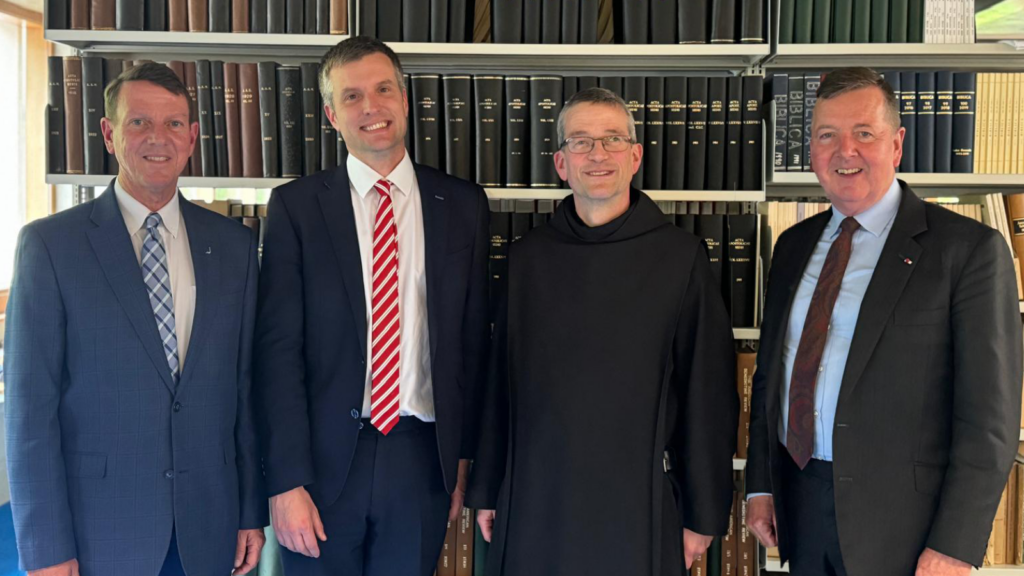
L to R: Tobias Winright, Edward Burke, Luke Macnamara OSB and Mark Mellett.

The monks of Glenstal Abbey were pleased to host a conference titled ‘Resetting the Clock on Climate Change’ on Saturday 18th May 2024 which brought together speakers, guests and representatives from church, academic, military and non-governmental spheres.

The conference’s keynote speaker was Admiral Mark Mellett, former Chief of the Irish Defence Forces. Mark spoke about the importance of the oceans, the story of evolution, our place in and with creation and the challenges of climate change. He concluded by suggesting ways we might meet these challenges through new technologies and outlined the characteristics required for leadership to drive the change needed.

Edward Burke, Professor of the History of War at University College Dublin and an Old Boy of Glenstal Abbey School gave a broad sociopolitical analysis of the climate crisis by outlining its stark challenges, including the security challenges posed by competition for resources and responses to ever increasing natural disasters.

Tobias Winright, Professor of Moral Theology at Saint Patrick’s College Maynooth, gave a reflection on non-violence and just war theories in the church and how these might assist in shaping responses to the climate crisis.

Br Cólman Ó Clabaigh OSB chaired a Q&A session to conclude the day’s proceedings. All three speakers spoke of how climate change disproportionately affects the poor and a question by an attendee asked if the proposed remedies mostly affected the poor – there was general agreement that this was the case and that public policy needs to reflect the needs of the poor when crafting responses.

The conference aimed to facilitate discussion on the issue of climate change and create a space where solutions might be explored together. Monasteries have long been concerned with the natural environment, and most recently the monastic and school communities at Glenstal have worked on a range of projects to reduce our carbon footprint and take steps to care for our common home in response to Pope Francis’ encyclical Laudato Si’. Indeed, earlier this year the monks welcomed the planting of 2,500 native Irish trees on a small plot of the Abbey grounds, part of a much wider project to plant 100 million trees across the country.

The monks of Glenstal Abbey give thanks to God for the gift of creation – a gift so wonderfully on display in the place which we are privileged to call our home – and pray that the challenges of climate change might be met in a timely and effective manner. Our hosting of the conference underlines our commitment to responding to the climate crisis and gives the monastic community new energy as we play our part in the response through the co-operation of one another, of our visitors, guests, students and co-workers.

Saint John Paul II once spoke of how in contemplating “with wonder the universe in all its grandeur and beauty, we must praise the whole Trinity.” May our contemplation of God’s marvellous handiwork lead us to praise Him, and prompt us to care for his gift to us!

Categories
Abbey | Latest News abbeynews

Homily – Pentecost

Abbot Brendan osb

On the evening of 14 November 1940, bombs rained down on the city of Coventry for eleven hours. After the raid, Coventry Cathedral and much of the medieval city had been reduced to ruins. It lost hundreds of shops, public buildings and 43,000 homes; 554 people were killed. The raid was so bad that a new word was coined; to be coventried, meaning to be decimated. In February 1945, and partly in retaliation, bombs were dropped on Dresden, one of the world’s most beautiful cities, for three days. A firestorm developed, killing up to 25,000 people, and six and a half kms2 of the city centre was obliterated.

Today, Dresden and Coventry are twinned cities, but the ruins of Coventry Cathedral are still visible. A new cathedral stands beside the old, but the old remains as a reminder of the senseless destruction and loss of life of which we are capable when madness takes hold. These cathedrals, new and old, side by side, have become symbols of peace and reconciliation.

Eighty four years later and our world is still disfigured by war and violence. People of good will desire to make common cause in the search for a worldwide community of fraternity and understanding under God. Peace is not just the absence of war, like a cathedral, it has to be constructed, patiently and with unshakeable faith.

What does all this have to do with Pentecost and your Confirmation? Everything. The cathedral of peace is built of many small stones. Each one of us has to become a stone in that beautiful edifice. Mistrust and division begin in human hearts. The Acts of the Apostles tells us, “There were devout people living in Jerusalem from every nation under heaven.” Each heard the apostles preaching in their own language. They communicated and understanding was the result. Love, joy, peace, patience, kindness, goodness, faithfulness, gentleness and self-control. These are not just qualities that sound nice in a list, they are necessary if humanity is to survive. They are the fruits of the Spirit. Wisdom, understanding, counsel, fortitude, knowledge, piety, and fear of the Lord, the Spirit’s seven gifts; wise people of integrity are what we need today.

Wherever the strong exploit the weak; wherever the rich take advantage of the poor; wherever great powers seek to dominate and to impose ideologies, there the work of making peace is undone; there the cathedral of peace is again destroyed.

“When the Advocate comes, whom I shall send to you from the Father, the Spirit of truth who issues from the Father, he will be my witness. And you too will be witnesses”. The ruins of the old cathedral constantly remind our society of its capacity to destroy. You are the stones building up the new edifice. You can see from our castle restoration works outside just how difficult it is to replace a broken stone. Be strong, firm and clear. Know for what you stand and why. Know that you are not alone, the Holy Spirit is with you and together we are many. This is the Church, whose birthday we recall with the coming of the Spirit. Find your voice and use it.


Categories
Abbey | Latest News abbeynews

Homily – Ascension of the Lord

Fr Luke Macnamara osb

Some time ago, when on a train, I sat opposite a young woman. She was giving a final farewell through the window to her boyfriend on the platform. As the train pulled away she kept her eyes on him, stretching and squinting until he eventually faded from view. At that precise moment she rested back in her seat and closed her eyes for a good five minutes. She wanted to treasure and savour the memory. When she opened her eyes, she smiled broadly – happy to engage again with the world. Although her boyfriend was no longer present, she was fully conscious of his love for her.

How must the disciples have felt when the Lord was taken up into heaven? They were looking all the time that Jesus was being taken up into heaven and even after he has disappeared from view. Two angels direct their gaze back to earth with the promise that Jesus will return. The angels’ words confirm that their longing will be satisfied – Jesus will be with them again.

The disciples had grown accustomed to Jesus’ physical presence among
them. As we all know when we lose someone dear to us, a spouse or child, a grandparent, parent, or sibling, or a close friend, it is very hard to adjust to their absence. The more we love someone, the more we miss them. The special love shared between Jesus and the disciples must have made his absence all the harder. However, love has a way of bridging the gap.

Jesus, before his ascension, in his final instructions to his disciples sends them out to proclaim the Good News. As a caring parent gives instruction to a child when starting school, university, or perhaps a first job, so Jesus gives instruction to his disciples. Those who believe are to be baptised. Believers will be recognised as they will speak and act with the same power with which Jesus spoke and acted when he was with them.

Jesus reassures the disciples that they do not go out alone but that, wherever they go, he the Lord will be working with them and in them. The Lord is no longer a companion on the road as he was on the way to Emmaus. Through belief and baptism, Jesus is in and with each disciple every moment of every day. The relationship with Jesus is not broken by his ascension. It becomes closer than we could possibly imagine. We need not worry about the booming message of the train station loudspeaker “mind the gap.” Jesus’ love for us bridges every gap. Through faith and baptism Jesus’ love for us finds its full flourishing. The words of St Patrick’s prayer, on the wall in in his chapel on your left, are fulfilled – Críost liom, Críost romham, Críost i mo dhiaidh, Críost ionam, Críost fúm, Críost os mo chionn – Christ with me, Christ before me, Christ behind me, Christ in me, Christ beneath me, Christ above me.

The words of the Lord in this Gospel are taken up in the final words that conclude the Mass: “Go out and proclaim the Good News.” We leave not only with this task but also equipped with the power of Christ to complete it. In a world so in need of the Gospel, may that power come to expression in our lives.

May this Good News find a home through us in our families, communities, the newly arrived immigrants, and in the people whose lives have been torn apart by war in Gaza and Ukraine. Go out and proclaim the Good News.

Categories
Abbey | Latest News abbeynews

Homily – Easter Sunday 6 – Year B

Fr Columba McCann osb

One day Jesus was in the temple at Jerusalem and noticed people putting money into the collection box. The rich put in plenty, but they were giving their leftovers. Then a poor widow put in a few cents. It was all she had to live on. It’s a good image of Jesus himself. At the Last Supper Jesus gave his disciples everything he had to give. There, on the table, was his life poured out for them, something which would come to completion the next day on the cross. He was loving them as the Father loved him. He loves us as the Father loves him, and invites us to the same table.

It is easy to forget about that kind of love, partly because it’s so big we can’t even get our minds around it. And sometimes we just forget about it. That is why Jesus says: remain in my love. Don’t get distracted from it; look for signs of it everywhere; bring your mind back to it whenever you get a bit of free mental space. We receive this love in every Eucharist; but it is good to savour the taste of it the rest of the time, especially in moments of prayer.

Nobody talks about the weather the way the Irish do, and when there are even just a day or two of sunshine we go crazy. We are out there in our shorts and t-shirts, working in the garden, walking the beach, having a drink outside the pub instead of inside, having barbecues. We bask in the sun.

Jesus invites us to bask in his love, a love which has no clouds, no sunset. He wants us to do this so that his joy will be in us. He wants us to experience the joy he gets from the Father’s love. Part of his formula is that we love one another has he has loved us. It’s easy to love someone when they give you what you want, or when they love in return. But let’s be honest: loving as Jesus loves is a tall order. It seems just too much. I don’t want to have to give up my little comforts and pleasures and convenience for someone else; I don’t want to let go of my desire for revenge when I fell hurt or put down; I really do want to have the last word when someone disagrees with me. I’ve got a problem with love. And only God can fix that. God is love.

The only way I can love like Jesus is if his love is in me. Which brings us back to his original invitation: remain in my love. Make your home in me as I make mine in you. The more we allow ourselves to receive from Jesus the more we have to give to others.

Subscribe To Our Newsletter To Receive Updates

[hubspot type=form portal=6886884 id=9e1d6d0d-c51e-4e35-929d-3a916798de64]