

Categories
Abbey | Latest News abbeynews

Easter Sunday – Homily

Fr Senan Furlong OSB

That was a memorable day to me, for it made great changes in me. But it is the same with any life. Imagine one selected day struck out of it, and think how different its course would have been … think for a moment of the long chain of iron or gold, of thorns or flowers, that would never have bound you, but for the formation of the first
link on one memorable day.

Great expectations were shattered on the Friday we call good. Jesus’ death on the cross seemed so final, so irrevocable, the erasure of meaning and hope. Things fell apart and those left behind were broken and devastated. The violence of Friday however gave way to the stillness of Saturday and now, it’s early dawn on the first day of the week, the first Easter Sunday. And the first link of the long chain of new life on this one memorable day is an empty tomb.

Sometimes things come along that you didn’t know you needed until you’re offered them. And who would ever have imagined that something as unpromising as an empty tomb would be one of these? On one memorable day three people, one woman and two men came to the tomb where Jesus had been laid. Each came looking for something, not really knowing what that something was.

First came Mary of Magdala, grief stricken and inconsolable. To her horror, she found that Jesus’ body was gone. Then came Peter and the beloved disciple running to the tomb at Mary’s news. Peter did not hesitate to go straight in, but all he could understand then was emptiness: an empty tomb and empty grave clothes. The beloved disciple who outran Peter also entered in. “He saw and he believed.” What he believed is hard to say. Even if he outran Peter in faith, clearly neither of them yet understood what this was all about, for both of them just went home. But Mary, who stood by Jesus as he was dying on the cross, now waited at the tomb in tears; and it is to her that the first link, the empty tomb, yielded up its meaning. Mary is the first to see the Risen Lord. She is first to proclaim, ‘I have seen the Lord.’

We may think we know what we are looking for, hoping to fulfil our great expectations. And then suddenly everything changes: the tomb is empty! Our expectations are shown to be far from great, what we were looking for embarrassingly paltry.

Waiting at the empty tomb like Mary changes us. We seek the Lord only to find that it is the Risen Lord who is seeking us. No matter what we throw at him, however deeply we reject him, however much we seek to bury him, he will find a way back to us. Nothing can separate us from the love of the Lord, not even death itself. This is the story of Easter, this is the story of eternity. Today is the one memorable day that changes the course of our lives and binds us with the long chain of God’s infinite love.
Categories
Abbey | Latest News abbeynews

Easter Vigil – Homily

Abbot Brendan OSB

As we listened to the account of God’s dream for the world in the Liturgy of the Word; could you feel the presence of the Risen Lord with us? Has this dream become a reality? The promises made to Abraham, Isaac, Jacob, Elizabeth and Zacheriah, Mary and Joseph, have they come true?

Mary of Magdala, Mary the mother of James and Salome, came to the tomb. St Cyril of Jerusalem calls Mary of Magdala the philochristos – the ‘lover of Christ’. But strong as she was, Mary of Magdala was almost broken as she approached the tomb. It was all too much. She was reduced to misery. Like all the others she misread the situation.

John’s gospel tells us she had been weeping in the garden. This seems to be a human pastime, starting with Adam and Eve. The three women didn’t realise that God’s plan had already become a reality.

These women expected to see a corpse wrapped in a sheet, instead they see a young man dressed in white. They expected to see a body lying in the tomb, instead they see a man sitting on the right: on whose right? Someone placed this young man on his right hand, saying to him: ‘Sit on my right’.  Do we not remember the words of Jesus to the sons of Zebedee, “sitting at my right hand and my left, this is not mine to grant; this is for those for whom it has been prepared.”

“You are looking for Jesus of Nazareth”, said this man dressed in white, “he has risen, he is not here.” The place of deposition bears witness to this. The hour has come when the bridegroom has been taken away, just as he said.

There is one more line in this gospel passage which we never hear, it is always omitted. It says, “And the women came out and fled from the tomb, for trembling and amazement had gripped them. And they said nothing to anyone, for they were afraid.”

What an anticlimax! No wonder it’s omitted. They have just been told the most important news in all of history and what do they do? Nothing. They were afraid. I think this verse is actually more for us than for the women disciples.

Are we afraid of Jesus’ resurrection? Are we afraid of proclaiming it? Are we afraid to stand up for what is right and true in the world? Many of us in the church today are so afraid that we don’t even tell ourselves who we are anymore – the disciples of the Risen Jesus.

Yes, the problems of the world have not disappeared and life remains a struggle for many people, but Christ is Risen, the stone is rolled away from the entrance to our tomb, and we are the messengers of this truth.

Have you not heard, this is the night when a tsunami of grace is poured out, as it will be on Carole when she comes before the altar to receive the sacrament of confirmation.

So do not be afraid, listen to the voices of Mary of Magdala, Mary the mother of James and Salome. Listen to the voices of the peoples of Ukraine. Listen to the suffering people of Gaza and the Middle East. These are the voices crying out to the Risen Christ who stands among us and before whom one day every one of us must stand and ask for mercy. Christ is Risen and it is intolerable in our day that God’s children should be treated like this. Do not be afraid – proclaim the resurrection, proclaim the gospel!

Can you feel the presence of the Risen Christ among us? Can you hear what he is saying to us? We believe in the God of life and “He is going before you to Gallilee, there you will see him.” What shocked the disciples about the resurrection was not just that Jesus rose from the dead; they witnessed this before, Jairus’ daughter, the son of the widow of Nain, and of course, Lazarus. What was so shocking was that the resurrected Jesus did not come back from death as an avenger, but as the bringer of forgiveness. His pierced hand is forever raised against the flames of war, violence and vengeance and he says: Stop! ‘Peace be with you’. Such words break down the gates of hell. These are now our words, if we have the courage to use them.

Χριστὸς ἀνέστη! Ἀληθῶς ἀνέστη! (Khristós Anésti! Alithós Anésti!) Christ is Risen! He is Risen Indeed!

Categories
Abbey | Latest News abbeynews

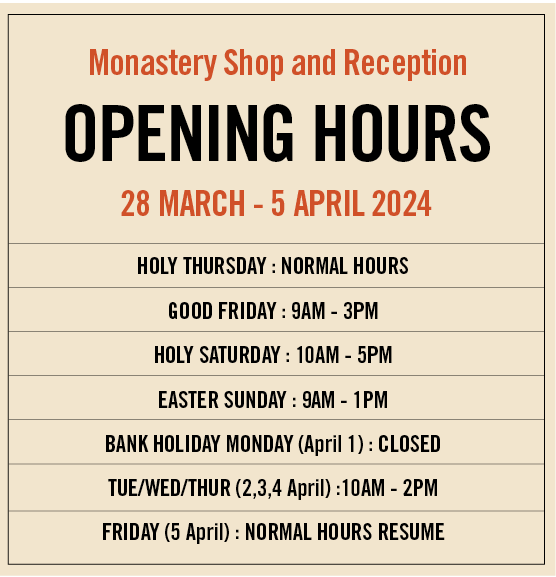
Monastery Shop and Reception Opening Times

Categories
Abbey | Latest News abbeynews

Holy Thursday – Homily

Abbot Brendan OSB

We have listened to the Book of Exodus. How each household must share the Passover lamb with unleavened bread and bitter herbs, taking into account what each can eat. The Last Supper, the memory of which we keep this evening, was a meal Jesus celebrated with his disciples during Passover.

Over time the Passover traditions of the Jewish people strayed a little from the regulations in the Book of Exodus and by the time of Jesus, well over one thousand years later, Passover could also refer to the weeklong celebration of Unleavened Bread with which it had merged.

The famous Roman historian Josephus tells us that over 250,000 lambs were slaughtered every year on the eve of Passover between 3pm and 5pm, some in the Temple and some in people’s homes. This is the same time we will celebrate our Liturgy of the Passion tomorrow afternoon. The time that Jesus died on the cross. The lambs used in the Temple were, like Jesus, born in Bethlehem. They were without blemish, specially reared in the hills surrounding Bethlehem and brought to the Jerusalem Temple for sacrifice. The blood of these slaughtered lambs was collected in bowls and some of it thrown against the altar. Two rods in the form of a cross skewered the lambs before they were prepared and eaten. St John in his Gospel wants us to understand that Jesus is our Paschal lamb. The Lamb of God.

On this night Jesus chose to digress from the normal ritual of the Passover week. He rose from the table and washed the feet of his disciples. He made the disciples ritually clean and brought them into communion with him. Then he fed them with himself. The bread was his body, the wine his blood.

Next he goes to the Garden of Gethsemane, which means ‘oil press’. Do we not remember here another garden, the Garden of Eden with its two trees, the tree of good and evil and the tree of life. Despite what almost everyone thinks, nowhere does it say in the Book of Genesis that Adam and Eve ate an apple. Genesis only mentions that they ate fruit and the ancient Jewish tradition was that this fruit was probably fig, because Adam and Eve afterwards sewed fig leaves together to make themselves clothes. This also helps us make sense of what Jesus said to the fig tree as he was on his way up to Jerusalem for the Passover, “may no one ever eat fruit from you again”.

If tradition says the fig was the tree of good and evil, it also says that the olive was the tree of life. Gethsemane is the oil press where the olive from the tree of life must be crushed. The healing power of the tree of life, holy Chrism, has to flow down upon us from the Paschal Lamb on the tree of the cross.

This blessed night, the gift of the Eucharist, the gift of healing oil, the washing of our feet, reveals in a beautiful way what St John teaches us in the Gospel: “Having loved his own who were in the world, he loved them to the end”.

Tomorrow, Christ our Paschal Lamb will be sacrificed. Tonight, he invites us to come home. He invites us to sit at his table with him to be washed and healed by his oil of love and feed on his body and blood.

Categories
Abbey | Latest News abbeynews

Talk: ‘The Loving Shepherd Who Enters Death’


Emmaus O’Herlihy OSB concludes our series of talks for Lent 2024 with ‘The Loving Shepherd Who Enters Death’ available to playback here: bit.ly/3PCmnuZ (audio-only: shorturl.at/hprJP)

Categories
Abbey | Latest News abbeynews

Transitus of St Benedict – Homily

Fr Abbot Brendan OSB 

This morning the monks at morning prayer listened to a sermon from St Aelred for today’s feast. It began like this, ‘Today is the Transitus of St Benedict and so I have to say a few words to you. This is particularly so, as you are so eager to listen.’ I hope that is also the case here? Today, 21 March, happens to be the traditional date for the spring equinox. As you probably know from your geography lessons, at the spring or vernal equinox, as it is called, the sun is directly over the equator making its way northwards. Astronomically speaking, it is the start of spring and summer. From now on the days will get much longer and the light grow ever brighter.

On this highly significant day of light, St Benedict passed from this life into glory in the year of our salvation 547. That is what we celebrate today. Today then we are remembering the day St Benedict died. Those of us who have lost relatives and friends will know how important it is to remember loved ones on their anniversary day. However, here the emphasis is different and we can learn a lot from it. The story of Benedict’s passing is told by Pope St Gregory the Great in his book, The Dialogues.

As Benedict was dying, his brother monks held him up, they carried him to the Eucharist. This is telling us that we as brothers and sisters are supposed to carry each other through life. At times we are all in need of this.

We are also told that after his death two monks saw a vision of a road leading from the monastery into heaven and this road had a carpet of light and was flanked by lamps. This is the road Benedict took when he went to heaven. The lamps are his good deeds in life and the shining carpet is charity, which covers all things.

It is also important for us to note that this account is told to us in the present tense. This passing into life is not an end, it is another stage on a journey. Both life and death are journeys and that journey is marked by the lamps of our good deeds and the carpet of love we leave as we travel this road.

Anyone who has lost a loved one will have little difficulty identifying with this vision and will also be able to take from this account great consolation that those we have loved and who have loved us, have passed along this road too on their journey. This is the message the Transitus of St Benedict leaves with us today, on this spring equinox, a day of light.

Categories
Abbey | Latest News abbeynews

Talk: ‘Unless the wheat grain dies… (John 12:20-33)’


Watch or listen to Simon Sleeman OSB’s talk for Lent 2024 given this weekend at Glenstal Abbey: bit.ly/3ID37tA

(Audio-only version: bit.ly/3TCNI2G)

Categories
Abbey | Latest News abbeynews

Homily – St Patrick (Lent Sunday 5)

Fr Cuthbert Brennan OSB

The great prophet Jeremiah walks into our lives this morning and he is one of those people I’d rather read about than live with. He must have been one incredibly tough truth teller, reminding God’s first Chosen People how they had violated the covenant with their Creator, not only because of their worship of other gods but because of the way they had oppressed the poor.

So love of God and neighbour! It sounds familiar doesn’t it? Jeremiah announces a second chance – a fresh covenant, not one with new content but one with a new geography. From now on, the heart not
stone tablets will be the place where God writes his covenant. The late Stacy Simpson, a Baptist minister, in an attempt to understand what a heart inscribed covenant might look like, offers this reflection entitled Branded by God She writes; The image of God writing on the heart of the people is a compelling one, it also has a frightening aspect to it. Think of a tattoo. Pain, indelibility, identity are the central aspects of what it means to be marked. If it didn’t involve pain, it wouldn’t be indelible; marks that don’t hurt are the ones that wash off. If it were not indelible, what it revealed about a person’s identity wouldn’t be so critical.

Maybe you remember your catechism classes as a child where we learned that baptism left an indelible mark on our souls. At baptism a covenant was inscribed on us, our very hearts were tattooed by God. On the very centre of our being, we are fired with love, that same love which called St Patrick back to this land with the gift of the gospel. That gospel which isn’t simply a story showing us a path to life; it’s an education in what things are worth dying for.

Unless a grain of wheat falls into the earth and dies, it remains a single
grain; but if it dies, it bears much fruit. From Jesus, we learn that divine power is the most subversive force in all of creation. Rather than crush opponents, God’s power undermines evil and the violence it perpetrates. As Mahatma Gandhi explained, “Love is the strongest force the world possesses, yet it is the humblest imaginable.”

Ultimately, the greatest leap of faith Christians are invited to take is to
believe in this entirely counterintuitive and countercultural idea that the
forces of humility, generous love, and tender, nonviolent creativity are the instruments of world change. This is Jesus’ message. He taught that falling into the ground and dying lead to ousting the ruler of this world.

Jesus was planted on Calvary, St Patrick was planted in Ireland, we were
planted deep in a baptismal pool and it is here at our liturgies that we
rehearse transformation, we learn to germinate, we practise dying so that our lives when we leave here, can give seed to justice and care, respect and dignity, love of neighbour equal to a love of God.

Jesus knew what he was living for. And he knew what he was dying for. He was the grain of wheat that died and produced much fruit. That fruit is us. That leaves only one question on this St Patrick’s Day – What are we dying for?

Categories
Abbey | Latest News abbeynews

Hymn for Saint Patrick


A hymn for Saint Patrick sung by the monks of Glenstal Abbey 🎶

Lá Fhéile Pádraig sona daoibh! ☘️

 
Categories
Abbey | Latest News abbeynews

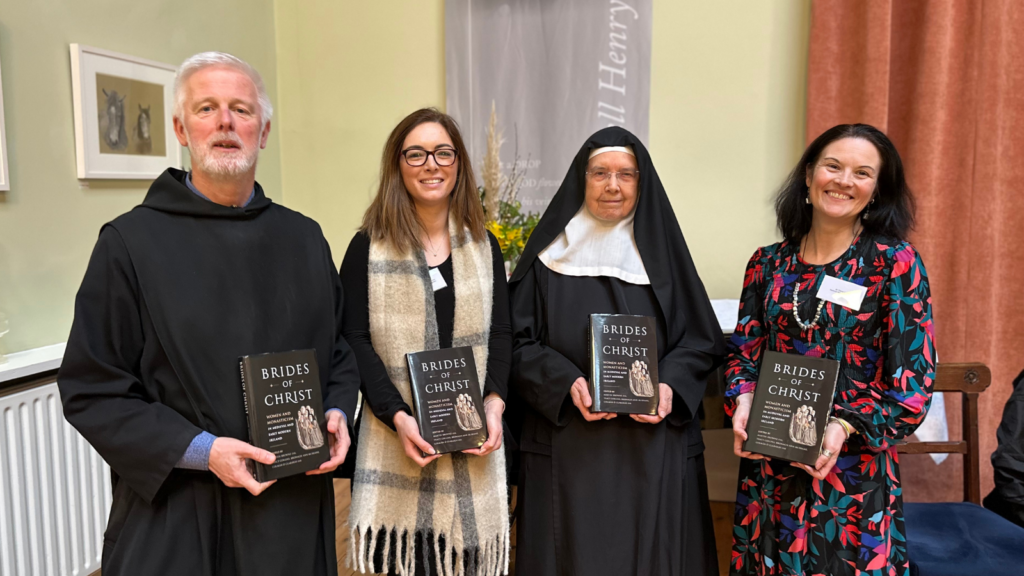
Launch of ‘Brides of Christ’ book

Dr Colmán Ó Clabaigh OSB pictured with Dr Bronagh Ann McShane, M. Máire Hickey OSB and Dr Tracy Collins.

On 6 March 2024, the Benedictine Community at Kylemore Abbey hosted a one-day symposium on the history of nuns and female monasticism, to mark the launch of Brides of Christ: Women and Monasticism in Medieval and Early Modern Ireland (Four Courts Press, 2023).

Organised in association with the University of Notre Dame Kylemore Abbey Global Centre, over 75 guests attended the programme, travelling from all parts of Ireland for this unique gathering.

Throughout the long history of Irish monasticism, the experience of women monastics has, until recently, been relatively sidelined. A desire to redress this inspired the decision to dedicate the fifth Glenstal History Conference in 2021 to exploring the various ways in which women responded to the monastic and ascetic vocation in medieval and early modern Ireland, with the publication Brides of Christ bringing together the contributions made at that conference. This work highlights the extraordinary Irish women who found creative and dynamic ways to pursue their calling as ‘Brides of Christ’ between the fifth and the seventeenth centuries, often in the face of tremendous difficulties and challenges.

Last week’s Symposium, entitled Keepers of the Sacred Flame, drew speakers from Ireland and the US, including Dr Tracy Collins of the National Monuments Service; Sr Faustina Greally of the Poor Clares in Galway, Dr Bronagh Ann McShane of Trinity College Dublin; Professor Amy Mulligan of the University of Notre Dame; Dr Colmán Ó Clabaigh OSB of Glenstal Abbey, and Professor Deirdre Raftery of University College Dublin.

Following the Symposium, M. Máire Hickey OSB, former abbess of Kylemore Abbey launched Brides of Christ: Women and Monasticism in Medieval and Early Modern Ireland. The book’s editors include Glenstal Abbey’s Br Colmán Ó Clabaigh OSB and Fr Martin Browne OSB.

To purchase a copy of the book please visit Glenstal’s online shop here.

Subscribe To Our Newsletter To Receive Updates

[hubspot type=form portal=6886884 id=9e1d6d0d-c51e-4e35-929d-3a916798de64]