

Categories
Abbey | Latest News abbeynews

HOMILY – FUNERAL MASS OF BR CIARAN FORBES OSB – 5TH JANUARY 2022

Fr Abbot Brendan Coffey OSB

Tadhg Eoin Mac Firbisig, was born on 19 August 1942 and grew up on Wellington Road, in Dublin with his family. He went to school in the nearby Gonzaga College and entered Glenstal on 6 September 1961 taking the name Br Ciarán. He made his monastic profession on 15 September 1963, over fifty-eight years ago. Whenever a new candidate enters the monastery, the superior asks him a series of questions and the answers are recorded in the entry logbook. Looking back over Ciarán’s answers, I had to smile to myself at the innocence of those days. Asked if he had ever been accused in the civil Courts? Ciarán replied, ‘Yes, for having no light on a bicycle.’ They were obviously very different times, a reminder of how the world can change over the course of one lifespan and a reminder too of Ciarán’s mischievous side, which never left him.

Anyone who knew Ciarán, knew that he was passionate about music. He listened to music all the time, he appreciated it, he derived peace and joy from it and he was able to hear the voice of God in his music. Mozart and Cecilia Bartoli were his favourites and the three of them spent many happy hours together.

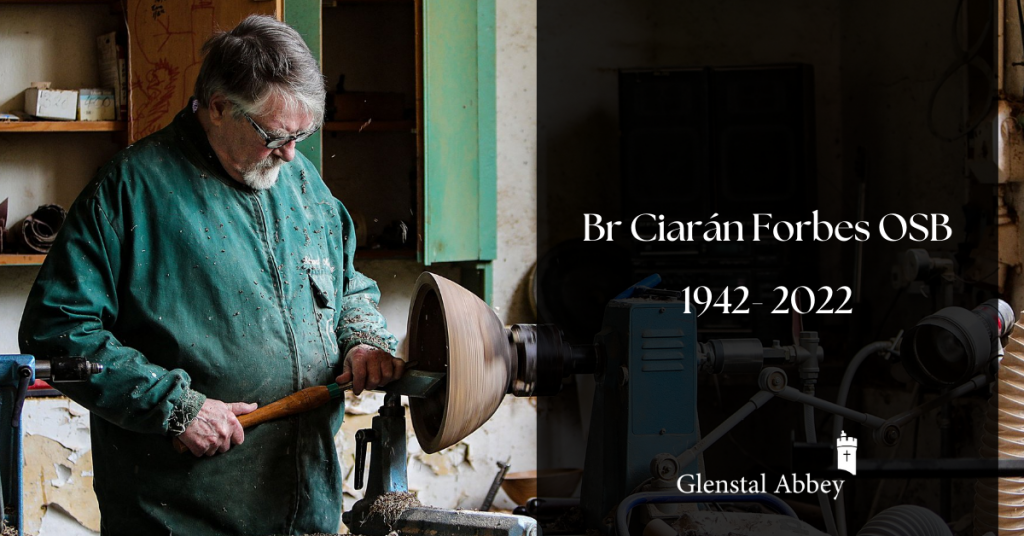
However, most people knew Br Ciarán because of his skill as a wood-turner and indeed, he possessed a rare talent. He had an eye for the perfect piece of wood, which he could turn into a real work of art, as light as a feather and smooth as silk. His skill as a wood-turner needs no elaboration from me; it is recognised and lauded near and far. His beautiful wooden bowls being given as gifts by heads of state to the great and the good.

In the music of Ciarán’s own life, we find many different scores. We find first and foremost a song of love and friendship. He had many friends, here in Murroe, where he knew almost everyone, and beyond. Ciarán possessed a big heart. In another score we find a song of wonder, a song of nature, and Ciarán who excelled as a master craftsman, could marvel like few can marvel, at the work of the Divine Artisan in the exquisite beauty of creation. Ciarán loved this place and these grounds and was most passionate about them. At other times, there was a song of loneliness and sadness written on the score of his life as he struggled for many years with health issues – and in more recent times decreased mobility was very difficult for him. He was in a lot of discomfort and at times, pain. He continued to soldier on bravely and rarely complained about his condition.

As the world welcomed in a New Year, Ciarán was welcomed into new life. Although we can name the day of his passing, only God knows the moment. Ciarán slipped gently into God’s arms, moving quietly from this life into a new life. It was certainly the way he would have wanted it, but difficult for those left behind. However, providence had arranged a visit with his family only a few days before, a visit he greatly enjoyed. On his return, he told everyone he met about his few days away and the Christening he attended.

It is important that we realise here today, that the music of Ciarán’s life hasn’t ended, rather there has been a change of key and this means that we have to learn to listen in a new way to hear it; we have to listen now with St Benedict’s ear of the heart. As every good musician knows, silence is the necessary space between the notes. That space, what most of us experience as emptiness, absence, or a void, is in reality the birthplace of the music. Ciarán’s great hero, Mozart tells us that “The music is not in the notes, but in the silence between.” It sets a rhythm, holds the energy, and gives music its life, power, and beauty. It is never just emptiness; not in music, not in life, not in death, and not on this day.

Today we stand in that space between the notes, a space that makes room for Ciarán’s presence in a new way when we gather around the altar, a space from which God is making all things new. The preface in our liturgy tells us as much when it says that, ‘life is changed, not ended’. Death is not the musical coda, the conclusion, to this song of life. This is what St John means when he tells us ‘where I am you may be also.’

Today, we pray for our brother, Ciarán. We ask God to grant him his mercy and to forgive all his sins. We ask him to grant Ciarán his peace and eternal rest with all the saints until that day when we all meet again in Christ.

Braon de dhrúcht na bhFlaitheas

’s deoch ó thobar na grás

go mbronnadh Dia ar a anam

agus ar ár nanam féin in uair ár mbáis.


Categories
Abbey | Latest News abbeynews

Br Ciarán Forbes OSB

CIARÁN FORBES OSB

MONK OF GLENSTAL

 Died, Saturday 1st January 2022

aged 79, in the 59th year of monastic profession

Tadhg Eoin Forbes (Mac Firbhisigh) was born on 19th August 1942. From a large family in Wellington Road in Dublin, he received his secondary education at the nearby Gonzaga College. After a short time working as an apprentice bank clerk, he entered Glenstal Abbey in 1961 and was given the name Ciaran, in honour of the great abbot of Clonmacnois. He professed simple vows in September 1963, and after philosophical studies in the monastery, in 1965 went to Belgium for theological studies at Sint-Andriesabdij, Zevenkerken, near Brugge, which was then a French-speaking community.

Br Ciarán later spoke of his three years in Belgium as an experience of awakening to the depth and beauty of music and literature, and his love for these arts was to be a constant throughout his life. In the monastery he served as First Chanter during a period when the community made several commercial recordings. Among classical composers his hero was Mozart, while his literary hero was the Danish writer Karen Blixen. He was an utterly devoted admirer of the performances of the contemporary Italian mezzo-soprano Cecilia Bartoli.

After his studies in Belgium, Br Ciarán taught Irish and French in the school, also serving as housemaster to the junior students. In 1970, two students introduced him to woodturning and he began experimenting on a lathe that they owned. The monastery eventually acquired its own lathe, and Br Ciarán went on to study the craft at the Kilkenny Design Workshop in Dublin and with a master craftsman in Devon, England. From the late 1970s, his prize-winning work was being exhibited and sold to great acclaim, both in Ireland and further afield. He was a founder member of the Irish Woodturners Guild, and went on to spend three years teaching the craft at the Letterfrack Furniture School in Connemara. As the years passed and his reputation grew, bowls by Br Ciarán were, on more than one occasion, presented by the Irish government as gifts to visiting dignitaries.

Throughout his latter years, Br Ciarán was a regular presence in the public areas of the monastery. Often accompanied by his beloved dog, Bede, he toured the grounds in an old golf buggy, offering a warm welcome to all whom he encountered. He maintained an extensive network of close friends in the local area. Having rung in the New Year with the community, he died peacefully in his sleep on 1st January 2022.

Eternal rest grant unto him, O Lord, and let perpetual light shine upon him.

 Reposing in Meehan’s Funeral Home, Newport, Co. Tipperary, from 2.00pm until 4.00pm on Tuesday 4th January. Funeral Mass in the abbey church on Wednesday 5th January at 12.10pm. Interment in the abbey cemetery will take place at a later date, following private cremation.

Categories
Abbey | Latest News abbeynews

HOMILY – 2ND SUNDAY AFTER CHRISTMAS – YEAR C

Fr. Lino Moreira

The author of today’s first reading, Ben-Sirach, believed that divine Wisdom had come down from the highest heavens, to dwell among the human race, when the God of Israel gave his people a Law according to which they could live. This was an entirely new theological insight, but it seemed to be borne out by Moses himself, who said to the people of Israel: I have taught you laws and customs, as the Lord my God commanded me. Keep them, put them into practice, for that is your wisdom and your understanding in the sight of the nations (Dt 4:6).

Alongside Ben-Sirach, other biblical authors have also regarded Wisdom almost as a distinct personality acting as God’s agent, not only in human history, but even in the very act of creation. For instance, in the book of Proverbs, Wisdom itself describes its own role, when God was creating the world, in the following terms: I was beside him as a master workman, delighting him day after day, ever at play in his presence (Pr 8:30).

Such imagery, however, is largely poetic, and it is only in the New Testament, namely in the Prologue to Saint John’s Gospel, that equality with God is eventually ascribed to Wisdom by transposing some of its defining features to the Logos, or divine Word.

In the beginning was the Word – says the evangelist – and the Word was with God, and the Word was God (Jn 1:1). And if the Word was thus co-equal with God, who else but the Word could have been at God’s side as a master workman when the world was being made? Indeed, all things came into being through him – the eternal Word – and without him not one thing came into being (Jn 1:3).

In the light of this revelation, God’s command in today’s first reading can also be taken as addressed to the divine Word: Make your dwelling in Jacob and in Israel receive your inheritance (Si 24:8) – said the Creator of all things. And such an unheard-of command met with a loving response, which the evangelist summarised as follows: the Word became flesh and lived among us, and we have seen his glory, the glory of a Father’s only son, full of grace and truth (Jn 1:14).

This is the astonishing mystery we are still celebrating with great joy. God’s only-begotten Son, the divine Logos, the light and life of the world, the fountain of Wisdom became one of our flesh and blood in the person of Jesus of Nazareth, born of the Virgin Mary. But the story was by no means an entirely happy one, as we have also heard: He was in the world, and the world came into being through him; yet the world did not know him (Jn 1:10) – in other words, did not love him. And St Paul also says, speaking of God’s Wisdom made manifest in Jesus Christ: None of the rulers of this world knew it, for if they had known it, they would not have crucified the Lord of glory (1 Co 2:8).

Who has ever heard of a more resounding defeat? And yet it was precisely by being so utterly rejected that the Son of God received Israel and all the other nations as his heritage. In fact, it was through his cross, through the mystery of his death and resurrection, that the Word incarnate gave to all who believed in his name the power to become children of God (Jn 1:10). And in this way the Church was born of every nation, of Jews and Gentiles alike, as a universal family of brothers and sisters of Jesus Christ.

So by confessing that Jesus is the Son of God and being baptised in his name, we were all born from above (cf. Jn 3:3.7), from God (cf. Jn 1:13). And we remember very well what our Redeemer said to Nicodemus: unless one is born of water and the Spirit, he cannot enter the kingdom of God. That which is born of the flesh is flesh, and that which is born of the Spirit is spirit (Jn 3:3.7).

At the beginning of a new year, then, we are called to renew our commitment to live more and more according to the Spirit, so that with hearts purified by love we may one day come to enjoy the riches of the glorious inheritance God has prepared for us among his saints (cf. Ep 1:4).

Categories
Abbey | Latest News abbeynews

SOLEMNITY OF MARY, THE MOTHER OF GOD – HOMILY

Fr. Martin Browne OSB

One of the things that critics of Christianity often point out is how divided, argumentative, and sometimes downright horrible Christians can be. Mahatma Gandhi is reputed to have said, ‘I like your Christ, I do not like your Christians. Your Christians are so unlike your Christ’. He had a point. Christians are always squabbling. Within the Catholic Church, the past year has seen much in-fighting, some of it truly vitriolic and nasty, over issues as diverse as climate change, papal authority and the pre-Vatican II Mass.

I’m not quite sure whether it’s a consoling sign or a depressing one – probably a bit of both – but it seems that it was ever thus. From the earliest days of the Church, for example, followers of Jesus disagreed and argued over the precise meaning of the mystery we have been celebrating for the past week: the mystery of God’s ‘Son, born of a woman, born under the law, in order to redeem those who were under the law’. How could Jesus be both fully God and fully human? Was the Son of God himself truly God also? Great Councils of the Church took place to hammer out answers to these questions and they weren’t always edifying spectacles. There’s even a legend that Saint Nicholas, whom we have come to know as Santa Claus, got so frustrated with the heretical views of the priest Arius about the nature of Christ in debates during the Council of Nicaea in 325 that he slapped him in the face! Christians arguing and letting themselves down by the way they treat each other is certainly not a new phenomenon…

Just over a hundred years later, in 431, another important Council took place, this time at Ephesus. Among other things, it reaffirmed what the Creed said about Jesus – that he was God from God and Light from Light. If follows that if Jesus is not only the Son of God, but is also himself God, then Mary is literally the ‘Mother of God’. The term used at Ephesus wasTheotokos: ‘God-bearer’, or ‘the one who gives birth to God’. Of all the titles given to Mary, and there are thousands, surely this must be the most beautiful and the most important. She is not just the mother of Jesus, or mother of the Christ, but is truly the Mother of God, because through her, the true God became true man.

‘Today a wonderful mystery is announced: natures are made new; God has become human: he remained that which he was and has assumed that which he was not.’

The titles of Theotokos and Mother of God are not just bouquets of honour to be flung in Mary’s direction; they are powerful proclamations of the Incarnation. To reflect in prayer on Mary as Mother of God is as much a meditation on who Jesus is as it is a meditation on who Mary is. Through the birth of Emmanuel from the Blessed Virgin Mary, the path to glory was opened up to humanity.

‘O wonderful exchange! The Creator of human nature took on a human body and was born of the Virgin. He became man without having a human father and has bestowed on us his divine nature.’

Today’s Gospel picks up where we left off at Christmas Midnight Mass. Having heard the angel’s astonishing message, the shepherds went to see for themselves ‘and found Mary and Joseph, and the child lying in the manger’.

‘In a corner stall of pilgrim strangers,

she falls and heaves, holding a tide of tears.

A red wire of pain feeds through every vein

until night unweaves and the child reaches dawn.

Outside each other now, she sees him first.

Flesh of her flesh, her dreamt son safe on earth.’

‘After eight days had passed, it was time to circumcise the child; and he was called Jesus, the name given by the angel before he was conceived in the womb.’ The last few lines of today’s Gospel reading seem almost like an afterthought, but they remind us firstly of his humanity and his parents’ obedience to the Law, but also of his divine and miraculous origins, foretold by the angel, who named him before he was conceived in Mary’s womb. He was named Jesus, because, as the angel told Joseph in another place, ‘he will save his people from their sins’.

Mary’s motherhood brings God fully into the complex, messy and beautiful reality of human existence – she who, as Gerard Manley Hopkins wrote:

‘Gave God’s infinity

Dwindled to infancy

Welcome in womb and breast,

Birth, milk, and all the rest’.

And all the rest…. Yes, God truly became one of us. He visited us like the dawn from on high, but he is no spirit or spectre, but is flesh of our flesh and blood of our blood. ‘Birth, milk and all the rest…’.

Mary, Joseph, the shepherds, the Magi and his apostles and disciples all knew Jesus in the flesh. We know him now by faith, in the proclamation of his word and the celebration of the sacraments. We too can be bearers of him… can bring him to birth in our lives… Our homes can be new Bethlehems or new Nazareths, where the Word made flesh is revealed to others by our love – if only, unlike the Christians criticised by Gandhi, we would live like Christ.

Let this be our resolution, our hope and our prayer for this New Year.

‘Of her flesh he took flesh:

He does take fresh and fresh,

Though much the mystery how,

Not flesh but spirit now

And makes, O marvellous!

New Nazareths in us,

Where she shall yet conceive

Him, morning, noon, and eve;

New Bethlems, and he born

There, evening, noon, and morn—

Bethlem or Nazareth,

Men here may draw like breath

More Christ and baffle death;

Who, born so, comes to be

New self and nobler me

In each one and each one

More makes, when all is done,

Both God’s and Mary’s Son.’

Categories
Abbey | Latest News abbeynews

FEAST OF THE HOLY FAMILY – HOMILY

Fr. Cuthbert Brennan

Only yesterday we encountered the all too familiar scene of Mary and Joseph in a stable in Bethlehem with the baby Jesus wrapped in swaddling clothes and lying in a manger. This morning the gospel forces us to move the baby out of the manger, out of Mary’s arms and into the world, to Jerusalem, where this gospel will end. Luke, the great storyteller gives us in these few sentences echoes of his entire Gospel. The place is Jerusalem, where the gospel begins and ends. The place is the Temple, where the gospel begins and ends. And maybe you heard some other familiar words and phrases –  Passover, three days and seeking Jesus in the wrong place, such words and images we will encounter again and again as we continue our pilgrimage through the liturgical year. All we have to do is read the entire nativity story in Luke to make the connection between the baby and the man, between the heart-warming sentiments of Bethlehem and heart-stirring story in Galilee and the heart-breaking passion in Jerusalem. All you have to do is read the story and you will begin to hear his claim on your life.

When Jesus spent three days in the Temple he found out that there was a higher claim on him than the claim of Mary and Joseph. For Jesus the real authority in his life is his heavenly Father, and his life’s work and obedience to the Father’s will, will lead him back to the Temple again, where he will claim his own authority and where this time the religious leaders will conspire to kill him.

The gospel this morning shows us that Jesus is moving out of the circle of his parents, Jesus had to break with the familiar in order to truly be himself. And as followers of Christ it is a move we too have to make at times – break with the familiar, break with our families, our homes, if we are to truly find ourselves.

And maybe you hear echoes of another story in Luke. The rich young man who came to Jesus and asked “What must I do to inherit eternal life?” Jesus’ response is to ask him to sell all he has and distribute it to the poor and come follow me. But when he heard this he became quiet sad for he was very rich. He was too at home in his wealth and couldn’t break with the familiar.

Jesus’ family got him to Jerusalem in the first place but his ministry calls a new family into being. A family not constituted by blood but by a free decision to become a disciple. This Feast of the Holy Family is an invitation to rethink the multiple families that enfold us. Particularly a family that shares one faith, one hope, one love through baptism, shares the same Holy Spirit as God’s free gift, shares the same body and blood through the Eucharist, shares the command of Christ, “Love one another as I have loved you.”

What sets Jesus’ family apart as holy, long before later Christians capitalised the “h” and painted halos on their heads is their commitment to the will of God. Joseph is characterised by Matthew as a just man, faithful in his relationship with God and Mary’s primary gift was that of a disciple. She listened to God’s word and did it. Such is the example set before every Christian, fidelity to relationships, to responsibility that stems from a covenant with God.

It’s easier to keep him in the manger, wrapped tightly in swaddling clothes. We like the familiar. But the story that the church puts before us this morning forces us to move with Jesus out of the manger, out of the loving and sheltering arms of his parents, into the world – a world that is filled with sin and death and great need, with powerful people who continue to oppose Jesus and with others who turn to him for life. Just as the story moves from Nazareth to Jerusalem, so we will have to move with Jesus on the long road to Jerusalem again, to the temple again on another Passover where he will upset the authorities and upset ultimately, all the powers and dominions of this world.

The twelve year old Jesus in the Temple makes us take his power – and his claim on us – seriously. With him we move out of the safety of the manger into adulthood, into maturity, as disciples of the one who called God “Father.” Like Mary we will keep these things in our hearts until we understand who he really is. And then we will know how great this gift truly is, this sacrifice of love that claims us as family and calls us to follow him, out in to the world, into demands and needs and confrontations; out into the world, away from this safe and familiar place, to the call that claims our own lives.


Categories
Abbey | Latest News abbeynews

CHRISTMAS DAY MASS – HOMILY

Fr. Christopher Dylon

Christmas in a time of Covid is still Christmas, strange though it may feel. In fact, when you think about it, the inconveniences, the anxieties, the discomfort of it all, connect us somewhat to the situation of Joseph and his heavily pregnant wife, for whom there was no room in the inn. What an introduction for the Son of God to the world of his creation! “He was in the world that had its being through him and the world did not know him. He came to his own domain and his people did not accept him.” What might have been expected to be a stupendously triumphal entry, was a non-event, unnoticed, unwanted.

But, His ways are not our ways. As the heavens are high above the earth, so are his ways above our ways; His thoughts above our thoughts; so the prophet, Isaiah, reminds us. For He is full of grace; he is all gift, in our regard.

Did you notice those words of the Opening Prayer, just now; “O God, who wonderfully created the dignity of human nature and still more wonderfully restored it, grant, we pray, that we may share in the divinity of Christ.”? Not content with the dignity of our human nature, we ask for more. This is the Christmas present which we ask from God.

What is it, exactly, that we are asking for? What does it mean, to “share in the divinity of Christ”? That we become God-like; that we become, in some way, similar to Christ, the Lord of the Universe, whom we believe to be the Second Person of the triune God? How has it come to this, that we should presume to consider such a possibility and, even, dare to ask for it?

The dignity of that human nature which God created in the beginning, seems, in some fashion, to have included this possibility, the possibility which we destroyed by sin. But the coming of God in Jesus Christ into our world, by assuming our human nature and being born of Mary, has restored that original possibility; and that is now made available to us by God’s grace, by God’s gift. The gifts we give one another, for Christmas, are a pale, but precious, reflection of this gift of God to us, that we should be His children, adopted and precious to Him, as Jesus Christ is precious to him. Is this not good News, even in these times of Covid?

Why this should be so, why God should so endow us, is sheer mystery; but it is the Good News which Christians celebrate, particularly, at this time of year, the news that God has become man, in Jesus, so that all men may become God; that is, all humankind, for “from his fulness we have all received, grace in return for grace”. 

But, of course, the gift has consequences and it makes demands of us, that we behave, as best we may, as Jesus Christ, that we become ever more like him; in a word, that our behaviour brings about God’s kingdom in our world, bringing about that peace on earth, of which the angels sang, in Bethlehem, and the justice that it implies.

The Covid miseries, which all humankind is experiencing, with all their attendant  difficulty, are of this existence only. The truth is, there is a larger picture; there is an infinitely greater reality ahead, for all of us. The manner with which we can embrace this truth and live with its consequences will be the measure of how far we will make God’s gift a reality in His world.

Happy Christmas, from all of us to all of you. 

Categories
Abbey | Latest News abbeynews

MIDNIGHT MASS – CHRISTMAS EVE 2021 – HOMILY

Fr. Abbot Brendan Coffey

C.S. Lewis wrote a Christmas essay about the fictional island of Niatirb – Britain spelled backwards, where every citizen is obliged to send to each of their friends and relations a square piece of card stamped with a picture. Finding cards from someone to whom they also have sent cards, they throw them away and give thanks that this labour is over for another year. Finding cards from someone to whom they have not sent, they beat their breasts and wail and utter curses against the sender; and, having sufficiently lamented their misfortune, they put on their boots again and go out into the fog and rain and buy a card for them also. Sound familiar? Is this really, what Christmas has become?

Nothing, however, says Christmas in this part of the world like Charles Dickens. He has shaped many of our Christmas traditions with his stories. These dominate the Christmas Season even today and first among them is undoubtedly the heart-warming tale, A Christmas Carol. From Tiny Tim to Ebenezer Scrooge, this story has captured our attention like no other.

Ebenezer Scrooge is a central protagonist in this tale, but who, or what, is an ebenezer? Did you know that the word “ebenezer” comes from the First Book of Samuel? The Philistines had stolen the Ark of the Covenant. The country was in disarray. It was then the people turned their hearts back to the Lord. Samuel set up a stone and named it “Ebenezer” meaning, “the Lord has helped us”.

An ebenezer is a memorial of God’s faithfulness and our repentance. The stone is a marker for transformation and conversion and this is exactly what Ebenezer Scrooge becomes in Dicken’s story. 

Gregory of Nazianzus tells us that instead of garlanding our porticoes and titillate our taste-buds, we should luxuriate in the word and in the law and narratives of God. So for a moment let us do just that.

When human history is complete and the last books are written, one of the saddest lines in all of that history will be this one: “there was no place for them in the inn”. How strange and how very sad that God simply doesn’t fit into our world and yet on this holy night his favour rests on each of us, on our communities and families and on all who suffer and feel afraid. Mary and Joseph, for whom there was no room, are the first to embrace the One who comes to give all of us our document of citizenship, for this night the Lord has truly come to help us. God has set up his own ebenezer.

Our gospel tells of a world thrown into turmoil for a census: but what Augustus and no one else realised was that this turmoil had the hand of God behind it. A virgin named Mary, betrothed to Joseph of the house of David, arrived in Bethlehem, the city of David for the census, “while they were there, the time came for her to have her child and she gave birth to a son, her firstborn.” It is all said so simply, just one sentence, and indeed that was how it seemed to everyone at the time too.

In Bethlehem, a small chink opens up for all who have lost their way, their land, their country and their dreams. Once in our world, a Stable had something in it that was bigger than our whole world. God could, had He pleased, have been incarnate in a man of great power. He chose instead to be incarnate in Jesus of Nazareth who wept at the grave of Lazarus and sweated blood in Gethsemane. The faith we proclaim tonight makes us see God present in all those situations where we think he is absent, for God has come to help us.

All of the trappings of this Christmas Season are only significant insofar as they are “ebenezers.” They are important because they mark a change and remind us of the change that is happening now and that is still to come; for I too am called to become an Ebenezer, “O Christian be aware of your nobility, it is God’s own nature that you share.”


Categories
Abbey | Latest News abbeynews

CHRISTMAS MASSES

Christmas Masses

Christmas Eve  11.20pm    Vigil & Midnight Mass

Christmas Day 10.00am    No Music

  12.00am    Sung Community Mass

Categories
Abbey | Latest News abbeynews

PSALM 110

As Christmas approaches we chant here Psalm 110 with the antiphon “Jerusalem, rejoice with great joy, for the Saviour will come to you, alleluia!”  📖🎼 

Categories
Abbey | Latest News abbeynews

Psalm 62

O God, you are my God, for you I long…” 🎶📖 

Subscribe To Our Newsletter To Receive Updates

[hubspot type=form portal=6886884 id=9e1d6d0d-c51e-4e35-929d-3a916798de64]