Categories
Abbey | Latest News Uncategorized

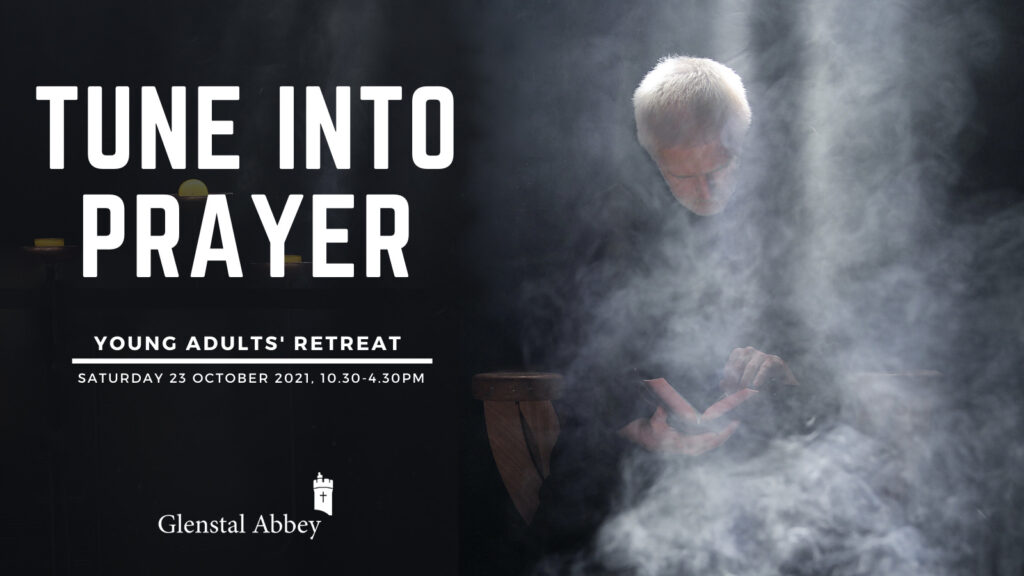
YOUNG ADULTS’ RETREAT

Young Adults’ Retreat


Young adults are invited to come away to Glenstal Abbey and tune into prayer during a day at the monastery. This retreat on Saturday 23rd October will include short talks from monks with time for prayer and visits to the famous Icon Chapel and our beautiful gardens. For more details or to register contact Fr Luke Macnamara OSB on luke@glenstal.com or call 086-2717937.


Programme

10am – Arrival & refreshments

10.30am – “Listening”

11am – “Praying with St. Benedict”

12.10pm – Mass

1pm – Lunch

2pm – “Praying with Icons”

2.30pm – Personal time

3.30pm – “Praying with the Scriptures”

4.10pm – “Remember and Keep”

4.20pm – Refreshments & depart


Suggested donation of €30

To register: luke@glenstal.com / 086-2717937

Categories
Uncategorized

Mindful Monk – Tony and Friends

Fr Simon OSB 5 Feb 2021

Dr. Tony Bates talks with Father Simon last year about his move from city to country and the animals he’s now gathered around him. An interesting insight into the healing power of nature 🌊⛰️🌳🌻

Categories
Uncategorized

Homily for the 4th Sunday of Ordinary Time

Sunday, Sunday, 31st January 2021
Fourth Sunday of Year (B)

Dt 18:15-20, 1 Cor 7:32-25, Mk 1:21-18

Today’s gospel has Jesus preaching in Capernaum in Galilee. This was a politically contested part of the world where the Jewish world met the Greek and Roman worlds and several of the major trade routes from Egypt to Babylon passed through the area too. So it’s a frontier area where identities clashed and political power caused considerable instability, and this is the town which Matthew calls Jesus’ city (Matt 9:1). There’s an amazing set of archaeological remains of a synagogue in Capernaum which shows influences from several cultures – Roman, Greek and Syrian elements – living alongside each other in a jumble that shows the pliability of the local people’s cultural world, and this is where Jesus preaches more than anywhere. And yet this city rejected him. They didn’t drive him out or threaten him; they just didn’t accept his message; they were just indifferent.

So how does today’s gospel fit into this scene? Hearing this story about the possessed man brings a shiver to some of us, and a wry smile for others. For some, it is the uncomfortable fringe of religion; an unsettling esoterism. Is this is where faith meets the eerie and the weird? For others, this is part of the historical dross that comes with Christianity having arisen before the modern psychiatry: it is just one more bit that needs to be dumped. For most people I suspect it’s just another thing that doesn’t seem important one way or the other: another bit of religion that just slips over us. But I think that this story has important things to say to us. The man possessed isn’t possessed by just one demon but by several. And I think if we’re honest we can all identify with that, we all have several demons. The idea of calling these demons out into the clear light of day, modern psychology tells us, will remove their power over the sufferer. Jesus has the authority to call these out and he also has the power to remove their power.  The work of identifying our own demons and bringing them to light simply and honestly is part of our life’s work just as the business of understanding this Christ of faith we have met and followed is a life’s work.

All around the world at the moment there are street protests from Washington to Moscow, Amsterdam to Tunis, from Santiago to Lagos and to Warsaw. People all around the world feel themselves out of step with their governments and societies in a way that doesn’t seem capable of being expressed through more conventional and less confrontational means of debate. It’s like a great bubbling up of discontent that had heretofore been kept under wraps. The lockdowns associated with the pandemic mean that we may have similar feelings of tectonic pressures shifting within us ourselves, and things bubble up that may surprise and upset us, not to mind in our societies and communities.  Joseph Biden the American president in his recent inauguration noted “Many centuries ago, Saint Augustine, a saint in my church, wrote that a people was a multitude defined by the common objects of their love, defined by the common objects of their love”. There’s a part of the Catholic identity that’s happy to be affirmed in such a public fashion on so large a stage, a bit like cheering for the Catholic greyhound in the derby. Be that as it may, St Augustine’s point and Mr Biden’s paraphrase is worth noting.  The bishop of Hippo noted “If one should say, ‘a people is the association of a multitude of rational beings united by a common agreement on the objects of their desire,’ then it follows that to observe the character of a people we must examine the objects of its love.” (St. Augustine, City of God 19.24) For Augustine there can be really only two loves: the love of self and the love of God. If one of those is a candidate for the common bond of our modern societies, it is not I fear perhaps the latter. But Biden to be fair to him is asking what does unite us, for the good reason that our ability to live together in peace seems so very fraught and strained. Our ability to share common lives and loves to bind our societies and communities seems imperiled. Biden answered that question suggesting opportunity, security, truth, respect and dignity were the core values that unite. Of course one speech isn’t going to unite a country but it’s a start. Analogously St Mark’s sees Jesus call up the rival contestatory spirits and expel so much of that which is contrary to the love God.

In a world as fractured as ours appears to be, the steady work of Christians has to involve opening ourselves to God’s power to transform and call out that which is contrary to his graceful love at work in us, and our Church. This is the work of a lifetime for sure. But it is also a work to which we can merely be indifferent like the people of Capernaum.Reading Pope Francis’s recent letter “Let Us Dream.” He writes that times of crisis reveal our hearts–how big, how small. Normal times are like a formal dinner. We can put on nice clothes. Hide our faces behind prepared expressions. Say the right things. The crisis lays us naked. Unprepared. The Pope says the general rule of a crisis is that you do not exit unchanged. The crisis will change you especially if you attempt to remain the same. So when we’re trying we are trying to figure out the pandemic and the political rersentments broiling across the world we should set ourselves the task of coming out better or we’ll find that without consciously willing it, we are much worse than we thought we were to begin with.

Categories
Uncategorized

Mindful Monk – Robin Red Breast

Father Simon heads back outdoors this week to talk to us about the Robin Red Breast, our companion in these dark days of winter:

Categories
Uncategorized

Homily for the 3rd Sunday of Ordinary Time (Word of God Sunday)

Homily – Third Sunday Year B

The evangelist Mark gives only very bare details of the calling of the first four
disciples, Peter and Andrew, James and John. There are lots of gaps in the story and we would like to know more. The gaps however allow each of us to
complete this story for ourselves. Without gaps, the story would be a dry
historical report. The Word of God which we celebrate today is not a one size
fits all – but is a Word addressed to each of us – for us to take up, reflect upon,
respond and make our own. No one can take our unique role in this dialogue –
the Word is addressed to everyone, and we are each invited to enter Jesus’ story.

The call of the first four disciples is puzzling at a number of levels. Why
does Jesus choose these four? We might expect that Jesus would call some
scribes who would be familiar with Scriptures and be better able to teach.
Instead, he calls four fishermen. Later in the Gospel, we learn just how little
suited they are to the task. James and John seek the best places in the kingdom, and the others become envious. They all squabble about who is the greatest.Peter is impulsive but also fearful. They all abandon Jesus, and Peter denies him. How can such an ill-equipped group respond to Jesus’ call to follow him?


Many might wonder how the fishermen could respond so enthusiastically to
Jesus’ call. The evangelist doesn’t fill in every detail, and we may presume that
the call to follow is not the first word spoken to the disciples. Just before the
account of the call there is a summary of Jesus’ general preaching which
presumably forms the context of the call of the disciples. Jesus first proclaims
the Good News of God: the time has come; the Kingdom of God has come
close. These are wonderful words. However, for the four fishermen who
recognise how far they are from God, these words are fearsome and
uncomfortable. They are unlikely to access the salvation associated with the
coming of the Kingdom. The News is Good for others but not for them.

Jesus acknowledges the situation of the fishermen when he calls on them to
repent and believe in the Good News. The invitation to repent signals that Jesus
knows that the fishermen are far from God. The invitation shows however that a
new direction is possible, that the fishermen might repent. The fishermen
themselves might be unsure. They know all too well their failings, how far they
are from God.


The word “repent” echoes in their minds. In the Scriptures they would recall
the trip of the well-known prophet Jonah to the city of Nineveh. Jonah didn’t
want to go to Nineveh, the capital city of the Assyrians who had ravaged much
of Israel and deported much of the population. The command of the Lord to
preach to the Ninevites and call on them to repent was inexplicable. The Lord
sent the prophet to the greatest of Israel’s enemies. Despite Jonah’s extreme
reluctance, the people of Nineveh responded and repented at the Lord’s
command and were saved. The Lord’s command “to repent” empowered those
furthest from him to return to him and be saved. The four fishermen take hope
from this word of Jesus – repent. Although aware of their continuing faults, the
way is now open to reconnect with God. Yes, they will make mistakes and fall
short, but Jesus’ invitation to repent allows them to get up again and walk the
road of salvation. This is how the fishermen can become followers of Jesus by
constantly being open to repentance and this is how we both individually and as
church can be true followers of Jesus. The Good News is Good for all. We all
stumble but we can through repentance walk the same road with Jesus to life
and salvation.

Categories
Uncategorized

Mindful Monk – Birds of a Feather

Ever the biology teacher, Father Simon shares some insight into the two different approaches to living bird life in this week’s Mindful Monk 🐦🌳 https://bit.ly/3sDYXZ6

Categories
Uncategorized

Homily for the 2nd Sunday of Ordinary Time

Check against delivery

JESUS TURNED AROUND AND SAW THEM FOLLOWING AND SAID WHAT DO YOU WANT?  THEY ANSWERED RABBI WHICH MEANS TEACHER, WHERE DO YOU LIVE? (JOHN 1.38)

This, we are told, is the Second Sunday in Ordinary Time.  The time seems extraordinary, for we are not at ease in the old dispensation. After all that has happened, are we really back where we started?  After all we have been through: The Silent night, when peaceful stillness lay over all, and night had run the half of her swift course, and when down from the heavens, from the royal throne leapt your all powerful Word.   For this is a Word that will not return until its mission is accomplished.   It is a Word that is a lot more powerful and transformative,  and a lot less destructive, than a large meteorite that comes at great speed and buries itself deep in the earth to vaporises explosively. This word is  gentle, for it is the Word by which the heavens and earth were made and are being made. It is the word of love,  beautiful, noble, generous, resourceful  and infinitely creative.

And John proclaimed Him, as we do later in Mass: Behold the Lamb of God, Behold Him who takes away the sins of the World.

Many rush towards Him, for no one has ever spoken as beautifully as He or with such authority.  Some come with specific favours in mind.  Others simply address Him as Rabbi, Master, thereby pledging themselves as His disciples.  To these He gives power to become Children of God.

If we too seek to enlist with Wisdom, the Great King, it might seem reasonable to enquire what are the terms and conditions and rewards for service.  We have heard of the phrase ‘taking the King’s shilling’.  So what would be in it for us?

Do we wish to see the World?

Wisdom is quicker to move than any motion, she is so pure she pervades and permeates all things.

How quick? What of the speed of light? Compared with light, she takes first place, for light must yield to night, but against Wisdom, evil cannot prevail.

Can we depend on promises given? – Wisdom, again we read in the Book of Wisdom, is beneficent, friendly to human beings, steadfast, dependable, unperturbed.

Do we wish to perform mighty deeds and great miracles? To give life and health, nourishment and happiness all over the world to billions?

If so, the sure way to do so is to become His disciples, to allow ourselves become Children of God and so rejoice in His great works as if they were our own, as by His grace they are. And may all our works be His that we may praise the Lord working within us and that we may live in His presence all the days of our life now and forever Amen.


Categories
Uncategorized

Mindful Monk – ‘Five a Day’ with Tony Bates

Looking after our mental health with five things everyday: curiosity, learning something new, connecting with others, doing something for others and exercising: https://bit.ly/3qmCaPI

Categories
Uncategorized

Homily for the Baptism of the Lord

The Baptism of the Lord Jan 2021  

I have a file marked Personal – it has my birth certificate, passport, academic qualifications, medical records, and strangely, details of my ‘Christening’. It took place on the ninth June 1951 when I was two months old.  . The church was 25, Kirschen Alle, Berlin, the Padre was Capt. Mahony R.A.  There were 24 guests plus godparents.  I was given my name. There is no account of the ceremony.  

Saint Mark gives us an account of Jesus’ baptism – we know the place was the river Jordan,  the baptiser’s was John and we know Jesus’s age.  That’s it – no guest list or godparents or new name. Instead we get an account of the ceremony; when John baptised Jesus, the spirit descended, like a dove and  the voice came of the Father declared “this is my Son”. The operations of the Trinity revealed. 

There is a seismic difference between Jesus’ baptism and the ‘definitive moment’ of my Christian life. No ‘voice from heaven’ is recorded but  I was baptised in the name of the Father, Son and Holy Spirit – the control centre of baptism. 

Can I ever grasp the power of this moment or do I remain largely unbaptised despite the ritual I un-knowningly went through?  Can I move from it being an abstract idea to something alive and active in my life?  It is easy to talk about sacraments, about how we should behave, but what about Christian life as lived.? 

I recognise that it takes is a life time to surrender and relax into the mystery that is the Trinity. 

A life time to recognise that we are invited into something extraordinary – into a world where God is supernaturally active, visibly and invisibly, both within and around us, beyond our capacity to notice or explain, control or manage – a world where the Holy Spirit is ‘formationally active’.  

Whether we recognise it or not – whether we let it lie dormant as a certificate in a file or decide to accept the invitation to become participants in the life of the Trinity, baptism redefines our life as God’s gift to be lived from within the life of God as three persons – one God.  But there is no coercion – there is just invitation. 

It has taken me a life time to glimpse the possibility of letting go of control, and allowing the Trinity of God to become my grounding identity – the control centre of my life – baptised as I was into the personal life of God, on the 9th of June 1951.   

Categories
Uncategorized

Mindful Monk – Curiosity

“What’s going to happen next? Where are the hints and nudges that life is providing for me now?” – Father Simon begins a new series of Mindful Monk reflections:

Subscribe To Our Newsletter To Receive Updates

[hubspot type=form portal=6886884 id=9e1d6d0d-c51e-4e35-929d-3a916798de64]