Categories
Abbey | Latest News abbeynews

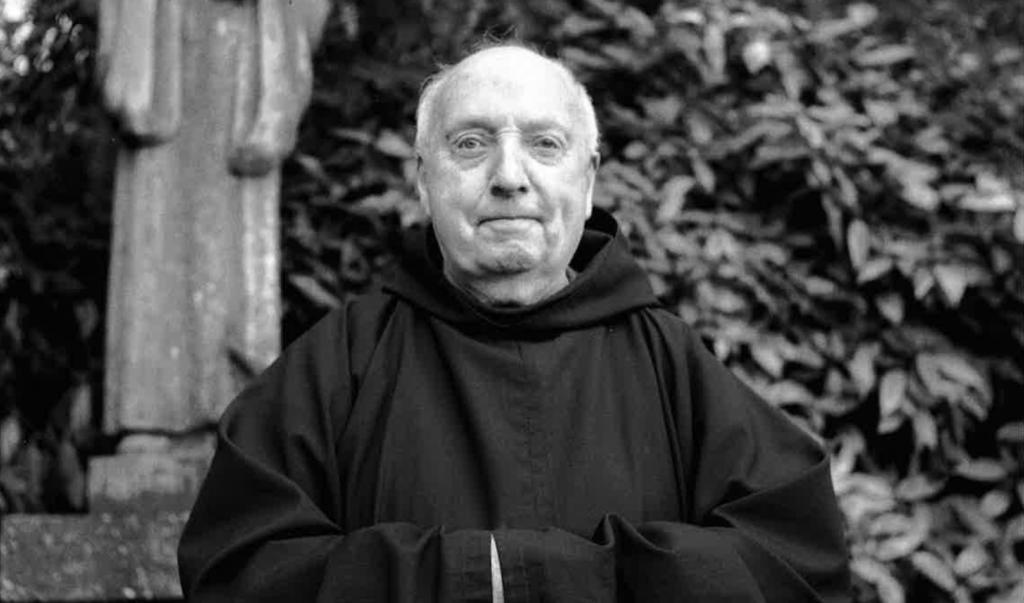
Michael O’Connor OSB

On Saturday 10th February, the feast of Saint Scholastica, the monastic community at Glenstal remembers Br Michael O’Connor OSB on the tenth anniversary of his death.

James (Seamus) John O’Connor was born in Dublin on 5th February 1927. His father died in 1928, leaving his wife to raise their daughter and three sons. After school with the Christian Brothers in Francis Street, close to St Patrick’s Cathedral, Seamus went to work in the White Swan Laundry which remained a reference-point for his whole life. Referred to Glenstal by the Augustinian friars in John’s Lane, Dublin, he entered the monastery on 5th May 1951, receiving the name Michael. He was professed on 10th May 1953.

For much of Brother Michael’s life in the monastery, he was the community tailor and in charge of the then linen-room, as well as assistant infirmarian. He also spent some years as kitchener. He is best remembered, however, for his gifts of hospitality and friendship. While these found ample expression during his long tenure as guestmaster, he also made many friends in the locality. An important aspect of his ministry was his care for the Boy Scouts who up to the 1980s held regular summer camps on the back avenue. This dedication was recognised by several honours from the Catholic Boy Scouts of Ireland and the so-called Baden Powell Scouts, before the merger of the two associations.

Unforgotten is Brother Michael’s exemplary and patient care of Father Thomas Scott and especially of Father Winoc Mertens, whom he attended day-and-night from the latter’s stroke in late 1970 until his death in July 1978.

Possessed of keen psychological insight, Brother Michael could sum up a person at a glance and instinctively know how to behave. This did not mean that he was in any way subservient or a flatterer, and he was more than capable of a well-honed, apposite, remark. He was never short of a word and had a bank of anecdotes, starting from his childhood in the Liberties in Dublin, through his time in what he called the ‘landry’, to the monastery and, in later years, his trips to Germany and beyond with his good friend Father Franz Behler. Brother Michael was always close to his family and was particularly proud of the achievements of his nephews and nieces.

In poor health for some time, he died in the Regional Hospital in Limerick on 10th February 2014. Having celebrated his Golden Jubilee with not a little pomp in 2003 and his Diamond Jubilee more soberly in 2018, he would have been disappointed that the huge crowds that would have undoubtedly attended his funeral were prevented from doing so by one of the worst hurricanes the country had seen for more than 70 years.

May he rest in peace.

Categories
Abbey | Latest News abbeynews

Homily – Sunday 5 – Year B

Fr Anthony Keane OSB

EVERYONE IS LOOKING FOR YOU.

In today’s gospel, from the first chapter of Mark, we find Jesus
welcomed and celebrated as the hope and delight of the peoples,, the
EXPECTATIO GENTIUM. For he teaches with authority, and among
his listeners the effect is one of welcome affirmation and liberation. It
is indeed no wonder that these wonders should occur. That nature
should be stilled and be thrilled at the presence of its Creator. That
everyone should be delighted at his summons to wholeness and
fullness of life. For he lovingly restores to us the perfection of the
divine image in which we are made, saying: ‘I say to you, you are
Gods, and all of you children of the Most High’. For those weighed
down by guilt for past sins, He is the Lamb who is proclaimed at the
sacrifice of the Mass: Behold the Lamb of God, behold Him who
takes away the sins of the world. He would share with us the ecstasy
of the Trinity and its creative power to share life and make it
complete.
All seems lovely and bright, but dark clouds begin to appear, first as
mere specks that then proceed to gather and ominously darken. This
happens because the leaders of the people regressively wish to stay
asleep and stay in power. It happens because the oppressed
regressively wish to regress into a quiet impersonal state of existence.
It happens too because the explosive force of Christ’s presence among
us needs to be contained and properly packed to have its full effect.
The terrifying opposition to Christ’s coming is itself part of the plan
and only serves to amplify its message.
Finally, Christ calls disciples. Are there among us some who would
choose the fullness of life which He so kindly offers?

Categories
Abbey | Latest News abbeynews

Presentation of the Lord

Fr Abbot Brendan OSB

The Temple in Jerusalem was a very busy place. A great many people were coming and going about their business. Priests and Levites were taking their turn to be on duty and many other devout people and pilgrims were scurrying about anxious to encounter the God of Israel. In all of their haste and business, none of them noticed Jesus. The child Jesus was like all the others, a first-born son, of simple unremarkable parents.

Only two elderly people, Simeon and Anna, were alert enough to notice him. Led by the Spirit they were able to find the fulfilment of their long awaited watchfulness. The prophetic attitude of these two elderly people contains the entire Old Covenant. When they saw him, they just knew! That is what is so remarkable. His light was visible to their well trained eyes.

Our feast today contains the fundamental symbol of light. This light comes from Christ, as in an icon, and shines upon Mary, Joseph, Simeon and Anna. We are asked to express this light as philokalia, love of Divine beauty, where our mind becomes absorbed in the awareness of God as a living presence. For this reason a lighted candle was entrusted to each one of us at our baptism.

This feast also contains prophecy as a gift of the Holy Spirit. In contemplating the Child Jesus, Simeon and Anna foresee his destiny of death and Resurrection for the salvation of all peoples and they proclaim this mystery as universal salvation. True prophecy is born of God, from friendship with him, from attentive listening to his word in the different circumstances of history.

Finally, this feast reveals to us the wisdom of Simeon and Anna. The wisdom of a life completely dedicated to the search for God’s Face, for his light, for his signs, for his will. This is a life of listening to the Word and living it.

The Holy Spirit illumines the Word with new light opening up new pathways for us to follow in our own lives as Christians. Do not be blind to this light. Do not let it pass you by in the hustle and bustle of ordinary life. Become wise like Simeon and Anna, attuned to the Word of God, so that when that Word approaches, you will just know.

This feast invites us to see the world in the light of Christ, to become a prophetic people rooted in the Word that gives us wisdom.

Categories
Abbey | Latest News abbeynews

Homily – Sunday 4 – Year B

Fr Henry O’Shea OSB

Despite the fashionable mockery heaped by many populists from the
right or left of the political spectrum on those they classify as so-called
experts, most of us are prepared to accept the authority of at least
some experts.

In many cases, we can immediately recognise some benefit to
ourselves. The knowledge or skill of, for example, a doctor or a
mechanic may be of use to us. In these situations, the knowledge the
other person possesses can be power – but in most cases we can choose
whether or not to avail ourselves of that knowledge or skill. More or
less consciously, we believe that in these cases our freedom, our space,
is not invaded.

Many of us, though, have difficulty with an authority which we know
or imagine to be claiming to have the right to tell us how to behave,
how to run our lives. Our experience of the abuse of such authority in
public life, in the Church, in school or even in our families, can make
us allergic to claims of such authority and its exercise. And so we are
entitled to ask, is there such a thing as legitimate authority?

In today’s gospel Jesus is recognised as one who speaks with authority.
Is his the authority of the technical expert? Is his an authority that
invades our space, that limits our freedom? Is his the authority of a

2

life-giving self-sacrifice or the self-seeking authority of the death-
dealer?

The scribes in to-day’s gospel are the officially accredited teachers of
the scriptures in the synagogue. Their knowledge is power – and they
know it and use it. Those who are surprised to hear Jesus preach as he
did in the synagogue immediately recognise the difference between
him and their usual teachers. Spontaneoulsy they grasp the difference
between professional peddlars and interpretors of an inherited, stale
and almost academic, tradition and a person who is speaking from
inside his own being. They immediately recognise the difference
between the dealers in death and the giver of life.

Jesus’s teaching flows out from who and what he was and is. Who and
what Jesus was then and still is now, is recognised and shouted out by
one of his listeners. A man possessed by an unclean spirit cries out– ‘I
know who you are – you are the holy one of God’. Jesus shows himself
to be a new way of knowing God a new way of talking about and
talking to God, a new way of living God.

Regardless of how we today might understand and describe what is
meant by an unclean spirit, the intuition and recognition displayed by
this spirit are not mistaken. The unclean spirit calls out, ‘what do you
want with us, Jesus of Nazareth? Have you come to destroy us?’. Jesus’

3

reply, ‘be quiet, come out of him’, destroys the death-dealing unclean
spirit and returns his life to the possessed man.

Up to the time of his crucifixion, Jesus, the life-giving teacher, will go
on to destroy many more dealers of death until with his resurrection
he destroys death itself. Every day, every moment, he offers us, he
challenges us, to choose between life – that is himself – and death –
that is slavery to the cynical, hopeless, despair of the unclean spirit.
When we choose life, his resurrection gives us the hope that the choice
is the right one. The holy one of God gives us the strength to live out
that right choice.

Categories
Abbey | Latest News abbeynews

Homily – Sunday 3 – Year B

Fr Luke Macnamara OSB

The Mass is a place of encounter. We, the baptised are called by the Holy Spirit to celebrate together the mystery of Jesus’ death and resurrection. At the Mass we encounter and listen to the Word of God which is a lamp for our feet and a light for our paths. This light is necessary as we so often find ourselves in dark places either due to our own actions, those of others, or sometimes by chance. The Word shines a light in our darkness that the dark cannot overcome.

The readings today provide an indication of the illuminating power of the Word of God in various situations. First up is Jonah who has been commanded to go to Nineveh and proclaim: “Forty more days and Nineveh will be destroyed”. Nineveh is the capital of Assyria, a nation that is foremost among Israel’s enemies. This wicked city is unlikely to respond to a Jewish prophet. Jonah didn’t want to go there but finally accepts the Lord’s command. He is fearful that what the Lord says will not happen, and that he and the Lord will be shamed. The people of the city from the greatest to the least repent, fast and pray, so that the Lord changes his mind. The physical city of Nineveh is not destroyed and so Jonah is in one sense proved right. However the wickedness of the city is no more, so in a more real sense, the preaching of God’s word has destroyed the old Nineveh and something new and wonderful emerges. Might this transforming word have something to say to us in Ireland? Might this word have something to say to us at Glenstal, monastery and school, that we might be transformed? Might we have the courage to recognise failings and be open to new possibilities?

St Paul relativises all human possessions and relationships. The kingdom is coming. Possessions and concern for status will only weigh us down. God is calling us his children to take our places in the Kingdom. God calls us for who we are, not for what we have. Today, there is a real need to reconnect with who we are and who God wants us to become. God’s word has been sown in our hearts and knows us better that we know ourselves. The Word knows our deepest desires for life and happiness and so is best placed to guide us. This is why St Benedict places so much emphasis on listening to the Word in his Rule – monks are to spend about a third of the waking hours of each day reading and listening. The Word of the Lord calls out daily to each of us but how often do we listen?

Jesus proclaims the Good News to the people of Galilee, a word that is also spoken to us: “The time has come and the kingdom of God is close at hand. Repent, and believe the Good News.” Now is the time, near is the kingdom, best is this Good News for us all. Much like the fishermen, Simon and Andrew, and James and John, we have doubts, personal failings and weaknesses, but God’s word works in and through us. We have only to take up the invitation, to let the word perform its surgery on our hardened hearts and so make them hearts for love. The unlikely transformation of Nineveh, the greatest of sin, and of the all too ordinary fishermen with their weaknesses, should encourage us.

We may be in dark places, we may have personal failings, but God’s word lightens the darkest places and strengthens the weakest parts of ourselves. Let us open our eyes to the divine light and listen to the voice of the Lord, whose Word is the best compass for navigating our personal journeys, who guides our hearts to choose the way of life and happiness and who ultimately will bring us to our true harbour, life with the Trinity in eternity.

Categories
Abbey | Latest News abbeynews

Meet the Monks – Fr Martin

In this special episode of Meet the Monks released for the Week of Prayer for Christian Unity, Fr Martin Browne OSB of Glenstal Abbey talks about his monastic life and his work at the Vatican’s Dicastery for Promoting Christian Unity.

Categories
Abbey | Latest News abbeynews

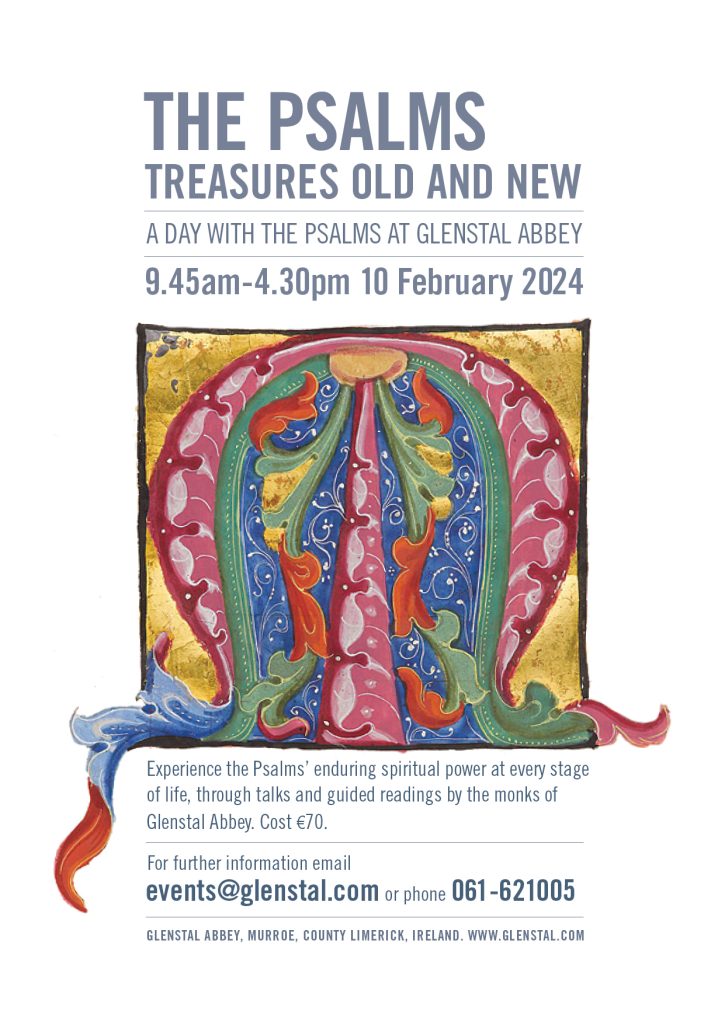
The Psalms: Treasures Old and New

On Saturday 10th February 2024, you have the chance to learn about the Psalms’ enduring spiritual power through talks and guided readings by the monks of Glenstal Abbey.

The monastic day is punctuated by the praying of the Psalms which, over time, are intended to penetrate every thought, word, and deed of the monk. During this day of talks, the monks will seek to share the treasures of the Psalms and to reveal their enduring spiritual nourishment for every stage of life.

Columba McCann OSB will explore some of the many ways in which the Psalms function in the liturgy, whilst Pádraig McIntyre OSB will share some personal readings of the Psalms. Starting with Columba of Iona, Colmán Ó Clabaigh OSB will explore how the Psalms shaped the spirituality, theology and art of medieval Irish Christians. Simon Sleeman OSB will explore the Psalms in dialogue with contemporary scholars.

  • 9.45am – Registration
  • 10am – ‘O God, we ponder your love within your temple: Psalms in the Liturgy’ with Columba McCann OSB
  • 10.45am – Morning Coffee
  • 11.05am – ‘The Psalms: My Prayer’ with Pádraig McIntyre OSB
  • 12.10pm – Mass
  • 1pm – Lunch
  • 2.15pm – ‘The Psalms in the Irish Tradition’ with Colmán Ó Clabaigh OSB
  • 3.30pm – ‘Praying with Open Eyes’ with Simon Sleeman OSB

Taking place Saturday 10th February 2024 from 9.45am to 4.30pm. Cost €70.

For more information and enquiries please contact events@glenstal.com or call 061 621005.

Categories
Abbey | Latest News abbeynews

Homily – Sunday 2 – Year B

Fr John O’Callaghan OSB

Today’s readings are about recognising good leaders. How does one identify a good leader? How does one find a good guide, an inspired guide, so as to make your life a success? The world is full of people, most obviously on the international stage, who want to be our leaders. Some of them could be disasters and to vote them into power might be the last exercise of your freedom. There might be people in your own vicinity who want to be local leaders, but are they the right ones, for your team, your class, your organisation? Today’s readings gives us a lesson in the biblical idea of recognising the right leader.

The first reading gives us an example with the boy Samuel. He himself was an answer to prayer (as his name in Hebrew indicates). In gratitude his mother dedicated him back to God to serve in the Temple at Shiloh. It was there, in the presence of the Lord, as we read, that he “grew up, [and] the Lord was with him”. We are told that he was entirely at the disposal of divine inspiration: ‘Speak Lord, your servant is listening’. And we are told a little further on that ‘the word of Samuel, was as the word of the Lord’ for all Israel. Much good come from this listening: for example Samuel was able to identify David as the future king of Israel, choosing him out of a confusing array of brothers. And it was from David’s line that the messiah was to come. The role of Samuel the prophet was to listen and communicate the will of God. Prophets in the Old Testament did not predict far off future events; no, they were voices who understood their present time from God’s point of view and therefore they could show the right way forward.

Thanks to another prophet, namely John the Baptist, Christ is pointed out in today’s gospel as the leader to follow. We are told that, like Samuel, John had been born in answer to prayer; that he “grew and became strong in spirit” that “among those born of women there was none greater than him”. He testified to the Jesus as Rabbi, teacher of the Jewish scriptures; as the long-awaited Messiah, fulfilling the religious traditions of Israel; and the ‘Lamb of God’, in other words the one who would reconcile all humanity with God by his death and resurrection. The Baptist, at the cost of his own life, testified to Christ as the greatest leader, the greatest guide of all time. And Christ would also fulfil the role of king, but of an everlasting kingdom. Today’s gospel reiterates the Baptist’s inspired testimony for us.

And what does our leader have to say to us? ‘Seek first of all the kingdom of God, then the rest will also be given you!” Such is the way to a successful and fruitful life! Christ is saying that there is an ordering of priorities in a successful life. If we exclude this first priority, seeking the good kingdom of God, then no matter how ambitious we are, no matter how many useful things we may do, somehow it will disintegrate in our hands. The technical achievements or our times are an obvious example. They make many things easier and better and so often are marvellous but they also bring us into new and dangerous territory, even to the possibility of annihilating ourselves. We could loose our way in trackless wastes if we abandon the direction and values of the kingdom of God. We are to use our talents for the good of God’s project with humanity. And each person has his or her special place on the team. With the help of lesser prophets, sometimes our friends, parents and the church, God guides us. Someone will say the right word to us, at the right time and in the right way, and that will lead us on to make our special, unique, irreplaceable, contribution to the building up of God’s everlasting kingdom.

Today’s gospel identifies for us our leader and he makes his voice heard even today. Like the young Samuel and the first disciples let us seek to hear and follow it.

Categories
Abbey | Latest News abbeynews

Homily – Baptism of the Lord

Fr Martin Browne OSB

On the first day of Christmas….. we didn’t sing at Mass about a partridge in a pear tree. Instead, Midnight Mass began with some lines from Psalm 2: ‘The Lord said to me, “You are my son; today I have begotten you.’  Today, as we bring our Christmas celebrations to a close with the feast of the Baptism of the Lord, we hear very similar words in the Gospel. Not from an oracle or prophet or preacher, but from the Lord God himself. ‘You are my Son, the Beloved; with you I am well pleased.’

It is almost as if our entire Christmas celebration is framed by these powerful and striking declarations of who this Jesus of Nazareth is. On Christmas Eve, we heard the words of a psalm, an inspired poetic song, honouring a king, which Christians have long heard as pointing towards Jesus, as we contemplated the birth of the infant Jesus. Today, we heard the voice, not of prophets or seers, but of God the Father himself, as the adult Jesus emerged from the waters of the Jordan. The words were the same: ‘You are my Son’.

Of course the line from Psalm 2 and the line from today’s Gospel were not exactly the same. The second half was different. On Christmas Eve we heard ‘today I have begotten you’, whereas today we heard ‘with you I am well pleased’. The first, like a man putting his name on a birth certificate – an acknowledgement of paternity; the second, like a man giving his son a major role in the family business – a seal of approval, and a kind of commissioning: ‘You are my Son, the Beloved; with you I am well pleased.’

To stretch the metaphor a little bit more, we could ask what was the ‘family business’ that the Father was entrusting to the Son? In a word: Salvation. We hear the word a lot in our worship and prayers, but despite that, it can feel a bit obscure or even slightly embarrassing to us today. But salvation is what the crib and the Baptism are about, and salvation is what the Cross and the empty tomb are about too. Salvation. Jesus – the Messiah, the Christ, the Anointed One – came to save us. Indeed the Holy Name itself can be translated as ‘the Lord saves’ or ‘the Lord is salvation’.

St Gregory of Nyssa expresses well why sinful humanity needed a Saviour: ‘Sick, our nature demanded to be healed; fallen, to be raised up; dead, to rise again. We had lost the possession of the good; it was necessary for it to be given back to us. Closed in the darkness, it was necessary to bring us the light; captives, we awaited a Saviour; prisoners, help; slaves, a liberator’. So that we might be healed, raised up, and rise again, and so that he might bring us light, a Saviour, help and liberation, Jesus came among us, sent by the Father. ‘It was in him, before the foundation of the world, that the Father chose us and predestined us to become adopted sons and daughters, for in him it pleased the Father to re-establish all things [LG 3].

The nativity scene depicted in our cribs invites us to adore. To savour and delight in the mystery of God-made-man, of God-with-us, and – with the Magi – to worship him. Still kneeling in wonder before this mystery, today’s feast begins to draw our attention from Bethlehem to Jerusalem, from the crib to the Cross. The only Son of God was born as a helpless baby in Bethlehem. At his Baptism in the Jordan, he began the public life that would lead to him dying, as the Suffering Servant, in Jerusalem. His mission begins with his Baptism.

St Mark tells us that John was ‘proclaiming a baptism of repentance for the forgiveness of sins. And people from the whole Judean countryside and all the people of Jerusalem were going out to him, and were baptized by him in the river Jordan, confessing their sins’. Having taken on human nature and been born in the flesh, now, at the beginning of his public life, Jesus undergoes an experience intended for sinners, but he had no sins to confess. Could God’s care for humanity be made any clearer? ‘He allows himself to be numbered among sinners; he is already “the Lamb of God, who takes away the sin of the world”. Already he is anticipating the “baptism” of his bloody death. Already he is coming to “fulfil all righteousness”, that is, he is submitting himself entirely to his Father’s will: out of love he consents to this baptism of death for the remission of our sins. The Father’s voice responds to the Son’s acceptance, proclaiming his entire delight in his Son. The Spirit whom Jesus possessed in fullness from his conception comes to “rest on him”. Jesus will be the source of the Spirit for all humanity. At his baptism “the heavens were opened”- the heavens that Adam’s sin had closed – and the waters were sanctified by the descent of Jesus and the Spirit, a prelude to the new creation’ [CCC 536].

We began today’s Mass by blessing and sprinkling water, in commemoration of our own baptism. We give thanks for that glorious moment when we were washed in the waters of new life and incorporated forever into the Body of Christ, our Head.  As we heard at the Christmas Vigil, we now share in God’s own nature. As a great early Christian writer teaches us: ‘Everything that happened to Christ lets us know that, after the bath of water, the Holy Spirit swoops down upon us from high heaven and that, adopted by the Father’s voice, we become sons and daughters of God.’

Surely, there has been no greater moment in our lives.  We give thanks for it. But let us give thanks too for the Baptism of the Lord, that moment when, after decades of hidden life with his family in Nazareth, he began the work he was sent to do. What the Magi recognised him to be – the Messiah – was now revealed to a larger audience by the waters of the river Jordan, and confirmed by the Father who sent him. ‘You are my Son, the Beloved; with you I am well pleased.’

‘O come, all you peoples, worship him!

Praise to you, Lord, for your glorious Epiphany which brings joy to us all!

The whole world has become radiant with the light of your manifestation!’

Categories
Abbey | Latest News abbeynews

Homily – Epiphany

Fr Abbot Brendan OSB

I know next to nothing about the world of social media. As far as I am concerned tiktok is what a clock does and Instagram is a new measurement of weight. However, I recently came across a new category of celebrity, which I found rather fascinating, the influencer. For those of you who are as ignorant as I am, an influencer is someone with a large number of followers on social media. Cristiano Ronaldo has 616 million followers and Selena Gomez 429 million! One post from an influencer promoting your latest brand of shampoo can be far more effective than ten highly expensive advertising campaigns. Long before the dawn of the internet, influencers were of a very different variety. The Magi were one such, and in the ancient land of Israel, their exotic and unexpected arrival was the talk of Jerusalem.

Epiphany is a Greek word and it literally means ‘to draw back the veil’. People are essentially curious and whether that curiosity is about the exotic Magi, or the twenty first century influencer, we want to know, everything!

Whenever you hear of epiphanies in the Gospel, it means that God is drawing back the veil that covers a great mystery and all of us can peer into this mystery.

This is what happened at Epiphany. What did the Magi see when the veil of God was drawn back? The child with Mary, his mother; yes, but they were also given to see beyond the obvious and into the mystery and they fell on their knees and Christian worship began. Adoration is the lesson of Epiphany; it is the most we can give, and to adore is to acknowledge. Have you ever noticed how depictions of the Magi tend to have one standing, one bowing and one kneeling? They are leading us into worship, into adoration and the gifts they presented tell us about the mystery revealed to them.

They offered him gold, a sign and symbol of kingship; and frankincense, the sign and symbol of the presence of God. The final gift was the perfumed oil, myrrh, used for his burial and this of course was the sign of his sacrifice that he would offer up his life for the redemption of the whole world. These gifts tell us about God, but they also represent those things that God wants us to give him.

Give to God your gold, that is to say, all that the world values and tells us to strive after, but let nothing and nobody take away your Christian dignity, for you are worth more than all the gold and jewels and earthly treasure in the world. In God’s eyes, everyone is an influencer.

Give to God your frankincense, that is to say, all those things that we make into gods in our life. “You shall have no gods before me”, says the Lord. So, this year, let us offer to God our idols, our mistaken priorities, our worldly but futile ambitions.

Finally, give him myrrh. The root meaning of the word myrrh is ‘bitter’, and it is a symbol of death and the grave. So give to God all that embitters you and all that leads to death, and even give to him your illnesses and sufferings. We are asked to surrender all things to God. No earthly influencer looks for these things, only Jesus said, “come to me all you who labour and are heavy burdened and I will give you rest.” How easily we can skip over those words, but imagine how they sound to people in Ukraine, or in Gaza right now. These are very serious words. This is all part of Epiphany.

When we have given all of these things to God then we too can kneel before him and truly worship, truly adore.

Subscribe To Our Newsletter To Receive Updates

[hubspot type=form portal=6886884 id=9e1d6d0d-c51e-4e35-929d-3a916798de64]