Categories
Abbey | Latest News abbeynews

Homily – 6th Sunday in Ordinary Time (Year A)

Fr Senan Furlong OSB

One of President JFK’s favourite sayings was: Do not remove a fence until you know why it was put up in the first place. The saying, attributed to G.K. Chesterton, has given rise to the principle known as “Chesterton’s fence”. It states that reforms should not be made until the reasoning behind the existing state of affairs is understood. In other words, when making great decisions we must understand the rationale behind previous decisions. If we don’t understand how we got
“here,” we run the risk of making things much worse. However, the image of a fence is ambiguous. Yes, a fence protects and establishes proper boundaries but it also excludes and shuts out, even privileging fear over welcome. Rightly does Robert Frost in his poem Mending
Wall ask himself the question:

Before I built a wall I’d ask to know
What I was walling in or walling out.

A much-revered concept of Rabbinic Judaism is making a fence around the Torah or God’s Law. Just as a fence around a yard or a house protects it, the Rabbis introduced safeguards to make sure God’s Law was kept in its fullness. After all the Law was given as God’s gift to his
people and so, they love it with all their heart. As today’s psalm sings: Teach me the demands of your statues and I will keep them to the end. Train me to observe your Law, to keep it with my heart.

In today’s gospel we see Jesus, like the rabbis, making a fence around God’s Law. Jesus insists that he has come not to abolish the Law or the prophets, “I have come not to abolish but to fulfil.” To fulfil the Law is to determine and carry out what God wants and so bring it to completion. It is to discover the deeper intentions of God. As God’s Son, Jesus is the one who can teach us what those intentions are. He can tell us for sure what is in accord with God’s will, with his loving desire for us. The heart of that desire is expressed in the favourite saying of St Matthew’s Gospel taken from the prophet Hosea: What I want is mercy, not sacrifice.

Jesus does not overturn the Law of Moses, nor does he set us free from the Law. He requires us to go beyond the Law by doing more than the Law requires. You have heard that it was said … but I say. The Law condemns murder: You shall not murder, but Jesus says: Do not be anger or resentful; do not speak with scorn and contempt; do not think of another person as mere low-life. This is the stuff of which murder is made, so fence it off by reconciliation. The Law condemns adultery: You shall not commit adultery, but Jesus says: Do not look on another person with lust. The problem begins with perception, so fence it off before one thing leads to another. The Law condemns false oaths: You shall not swear falsely, but carry out the vows you have made to the Lord, but Jesus says: mean what you say, say what you mean and do what you say. Make a fence to wall out untruth before you deceive yourself.

God in his wisdom has forged a covenant with us. It is a wisdom, as St Paul tells us, that God has predestined to be for our glory. He enfolds us in his extravagant love and he asks us to love every other creature with the same passion, the same consistency, the same faithfulness, the
same charity revealed in Jesus, who loved us unto death.

Today’s gospel challenges us to assess our fences and ask what we are walling in or walling out. Many, if not most, of our fences have to go once we know why they were put up in the first place. But Christ our Lord also asks to make fences around his Law so that we might choose
rightly, live justly and love peacefully.

Open my eyes that I may see
the wonders of your Law.

Categories
Abbey | Latest News abbeynews

Anselm Hurt OSB

The Abbot and monastic community announce that the death has occurred of Br Anselm Hurt OSB.

Funeral arrangements: Monday 13th February – reception of remains to monastery reception at 3.30pm followed by transfer to the Abbey Church and Vespers at 5pm. Tuesday 14th February – Funeral Mass followed by Burial at 11.30am.

Categories
Abbey | Latest News abbeynews

Book Launch

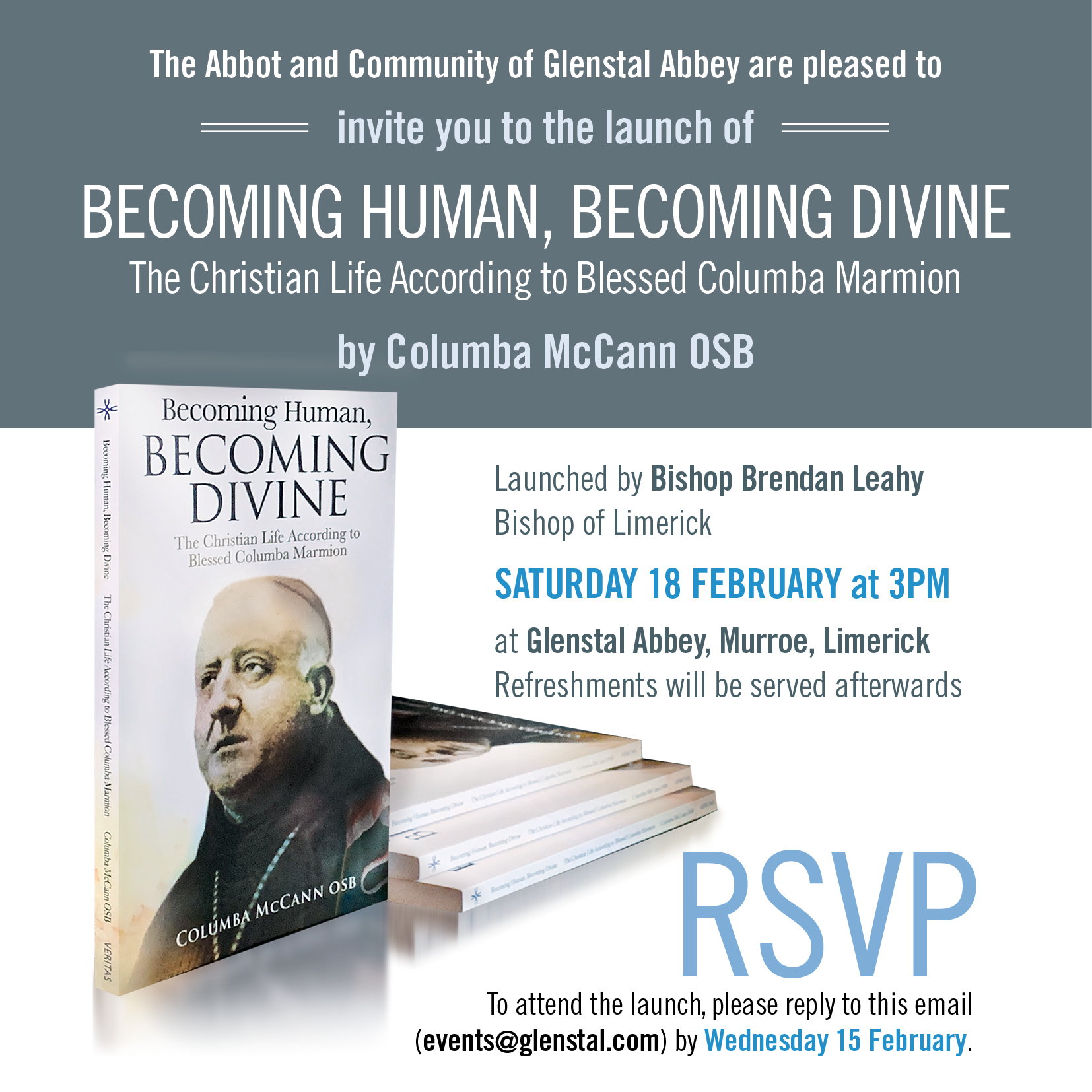
In this centenary year of the death of Blessed Columba Marmion, a new book has been written by Glenstal monk Fr Columba McCann OSB on the writings of Marmion and the wisdom which can be gleaned for living the Christian life.

‘Becoming Human, Becoming Divine’ will be launched by Bishop Brendan Leahy at Glenstal Abbey on Saturday 18th February at 3pm. Refreshments will be served afterwards.

The Abbot and monastic community at Glenstal Abbey invite you to attend the launch of Father Columba’s new book. To RSVP please email events@glenstal.com by Wednesday 15th February.

Categories
Abbey | Latest News abbeynews

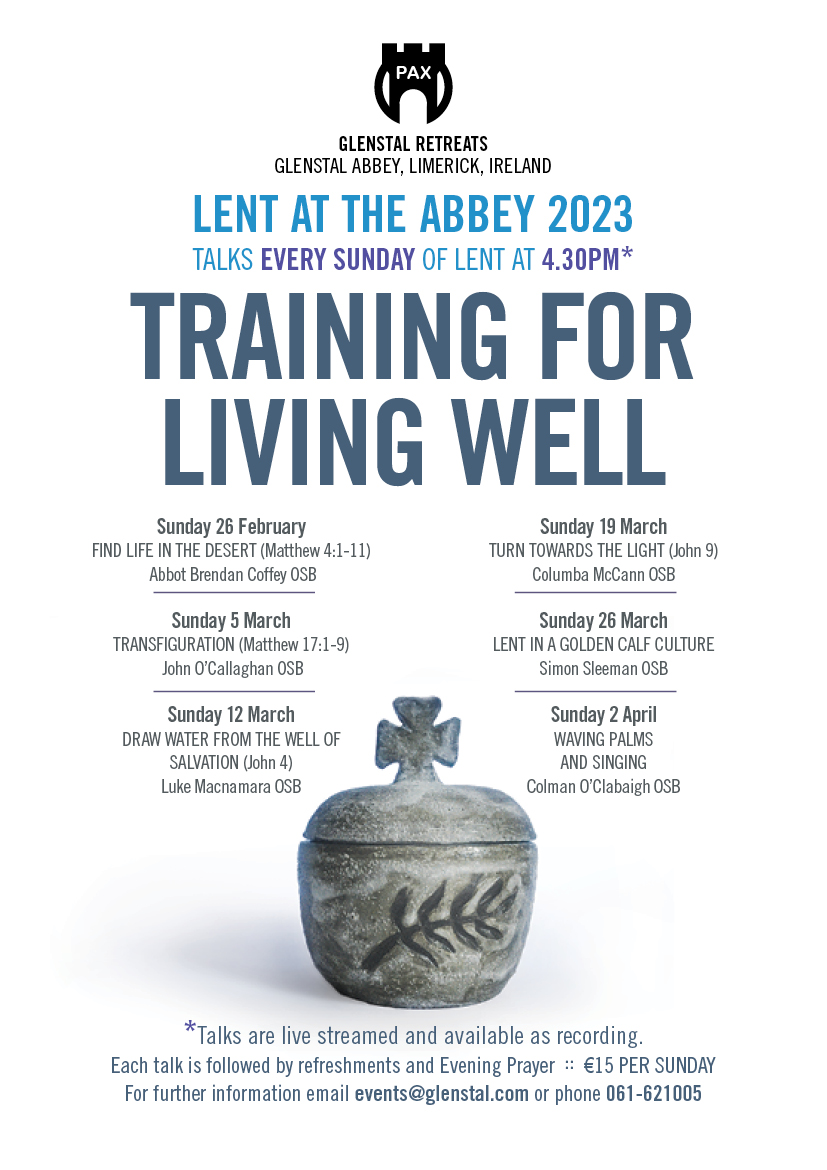
Lent at the Abbey 2023

Training for Living Well is our series of talks for Lent 2023. Journey through this season by tapping into the wisdom of the monastic community each Sunday at 4.30pm in the Monastery Library, beginning Sunday 26th February and concluding on Sunday 2nd April.

Talks include: ‘Find Life in the Desert’ with Abbot Brendan Coffey OSB; ‘Transfiguration’ with John O’Callaghan OSB; ‘Draw Water from the Well of Salvation’with Luke Macnamara OSB; ‘Turn Towards the Light’ with Columba McCann OSB; ‘Lent in a Golden Calf Culture’ with Simon Sleeman OSB and ‘Waving Palms and Singing’ with Colmán Ó Clabaigh OSB.

Refreshments will follow each talk with Vespers celebrated in the Abbey Church at 6pm. Suggested donation: €15 per Sunday.

Talks will be live streamed on the webcam here under the ‘Talks’ tab and made available on the monastery YouTube channel: www.youtube.com/glenstalabbeymonks

For further details contact events@glenstal.com or telephone 061 621005.

Categories
Abbey | Latest News abbeynews

Homily – 5th Sunday in Ordinary Time (Year A)

Fr Christopher Dillon OSB

Well, that is putting it to you, to all of us; and from every angle! Whether it is Isaiah, from eight hundred years before Christ, to Saints Paul and Matthew, only a few years after Christ, the message is the same; it is up to us to get it done, whatever is to be done. The title of Fr Columba’s new book, Becoming Divine, is the name of the game. The whole Christian project has been summed up as God becoming human in Jesus Christ, so that we humans, on being baptised into Christ, may become divine, co-heirs with Christ, as the text of the
Mass puts it. This, you might say, is the Christian perspective on what this whole business of human living is about, the very meaning of human life. And the programme is not complicated; it is very practical stuff, sharing our bread with the hungry, sheltering the homeless poor, clothing the naked.

We’ve all got much more than we need; and the St Vincent de Paul shop and the Oxfam shop are very happy to receive whatever we bring them. But there is also the personal and inter-personal stuff; we must do away with the clenched fist, the unkind word, the put-down, the mean trick, dishonesty and cheating. Because we are baptised into Christ, we are Christ, “members of his body”, as we say, and so we must behave as Christ; and, as such, we are to set the standard for the rest of the world; and that can get complicated, very complicated.
But, if we start with the simple things, the obvious things, we will grow into the larger, more difficult, tasks. St Benedict writes of the monastery as a school of the Lord’s service; and there is a very real way in which the boys’ school here shares in that characteristic; and in that regard, the staff here and the monastic community succeed in our work if the young people in our care learn to be Christ-like, just as we fail, if the boys do not learn.

But in all this, we are not on our own; for we have received the Holy Spirit of God, both in Baptism and in Confirmation, to guide us in our thinking and our doing. That is what the intimacy of Isaiah’s words mean, when he writes, “Cry, and the Lord will answer; call and he will say, “I am here.’” These are words which invite us to be constant in prayer; that is, ever to be aware of the Divine Presence and ever ready to respond to it.

We have heard all this before, so many times; and what difference has it
made? While it may seem that nothing we do is particularly significant, it is also true that we really do not know how our behaviour, good or bad, affects others. All we can be sure of is that it matters what we say and do and how we say and do it. It is our decision whether we make a difference for the worse or for the better; and decision time is every moment of every day.

Categories
Abbey | Latest News abbeynews

Homily – Presentation of the Lord

Abbot Brendan Coffey OSB

Today is the day when the end of winter is enough of a possibility that we can begin to anticipate spring. Joseph and Mary present the infant Jesus in the Temple. Hope arrives into the house of God. Simeon, for so long had held onto the promises of God foretold by the prophets and now he has lived to see that dream come true. He speaks those moving words, which are echoed in the Nunc Dimittis, a prayer recited down the centuries at the end of day: ‘Now Lord, let your servant depart in peace…’ Simeon is now ready; here is the light of the world, lying in this present moment in his arms.

But as Simeon lets go in a place of hope, he also speaks of Mary’s pain yet to come. One day it will be as if a sword is piercing her heart and soul. This is the painful reality of life on earth, but it is never a life without hope.

Anna too is a vessel of hope. We know very little about her, but what we do know is touching. She was only married for seven years before her husband died. She was a woman who knew about grief and loss and shattered dreams and her response was to spend her days worshipping in the temple, keeping her eyes fixed on God, praying in hope. In Anna too we see foreshadowed something of the grief and loss which Mary is yet to experience.

Then we come to Mary. We are given a beautiful insight into how Mary nurtured her hope by pondering all of these things in her heart. How important this is for all of us.

Like Simeon, Anna and Mary we are deeply aware of the pain and that great sense of loss people are experiencing in so many different ways around the world. We are conscious of those suffering as a result of war, economic hardship, injustice, abuse, poverty, hunger and loneliness. We need to be honest about our struggles and our weariness, even our own little personal struggles. We also need to ponder, to look back and to look forward, and so replenish the treasure of God within us.

Following Jesus is not always easy. Today, we let Simeon turn us in the direction of the cross, remembering that following Jesus is also about sacrifice and faithfulness in the face of suffering. This is why we bless candles, signs of the light of Christ in the world. We have need of such signs to get us through the darkness. Today is the day when the end of winter is enough of a possibility that we can begin to anticipate spring. Let that be our prayer as we journey through the seasons of the year and of our lives.

Categories
Abbey | Latest News abbeynews

Homily – 4th Sunday in Ordinary Time (Year A)

Fr Cuthbert Brennan OSB

Imagine with me for a moment the make-up of the crowd in today’s gospel. They are made up of the poor, the sick, the demon-possessed the socially excluded, those on the margins of society – those whom the Jewish world would not have called blessed. What Jesus tries to get across to the crowd is that the life he is about to describe – a life of blessing in God’s kingdom – is really and truly available to them. What is in common with all the beatitudes in Matthew’s gospel, is that every group called blessed is vulnerable in Jesus’ society. He turns on its head the Jewish notion of what it means to be blessed.

There are nine beatitudes and I want to read them again with you in groups of three. Let’s start with the first three. Blessed are the poor in spirit, blessed are those who mourn, blessed are the meek. Jesus is saying, Christianity begins with the desperate. Are you miserable? Is life not going as you planned? Here’s the good news, you’re right where the gospel takes root. Are you bored? , disillusioned with church? There’s a message here for you as well, “If you want to see what Christianity is really about then hang out with those who are hungry, those who are rejected by society, those whose spirit is crushed, because that’s where you will find Jesus”.

The next three beatitudes say, blessed are those who hunger and thirst for righteousness, blessed are the merciful, blessed are the pure in heart. What does it mean to hunger and thirst for righteousness? It is to, despite our shortcomings and failures, to be so focused on God and walking God’s ways and sharing God’s heart that God’s life becomes our daily sustenance.

Then there’s the merciful. This is the central beatitude of the nine. Jesus says to us treat others the way God treats you. Demonstrate to others the mercy you beg God for.

Next we come to blessed are the pure in heart. We’ve all had the experience of preparing our to-do lists, where we have to list what’s urgent and what’s important. Purity of heart for the Christian is ultimately knowing as a matter of habit which things are important. It allows you in a moment of crisis or despair, to see the one thing that no one is able to see, because you never stopped looking at it.

The last three beatitudes are about what happens to us when we follow the logic of Jesus’ life and teaching – when we embody the gospel.
Blessed are the peacemakers. To be a peacemaker we need to understand how the first group of beatitudes, how sin, and unfairness and suffering lead to conflicts and then we need to be disciplined in our practice of the next three beatitudes because peace making needs mercy, a healthy sense of perspective and of course needs God. How do you become a peacemaker? Ask yourself each morning, “What kind of presence am I going to be in the world today?”

Then we have the last two, blessed are those who are persecuted for
righteousness sake, blessed are you when people revile you and persecute you and utter all kinds of evil against you falsely on my account. Jesus is talking about those who love God so much that they don’t care who knows, how much it costs, how unpopular it makes them, how much it endangers their lives. To develop such a life requires commitment, disciplined practice and investment of your whole being.
There is a story told that on our deathbeds our life will flash before our eyes? Before you die, what life will flash before your eyes? Playing it safe doesn’t make it memorable. Jesus invites us to be vulnerable, to enter into the pathos and joy of the Christian life. The closer we get to the cross of Christ, the closer we get to resurrection. Because you see Jesus doesn’t just speak the gospel. He lives it. This is Jesus’ autobiography. The beatitudes are Jesus saying “This is who I am – this is how to be like me – this is how to be me, to be my body in the world.”

To be a Christian is to live the beatitudes. Sometimes our world and church can seem an inhospitable place for some of us. What the beatitudes encourage us to see, is that we ought to stand ready to invite absolutely anyone into the life of Christ. We should be careful of how we judge who is suitable to take up discipleship, who we called blessed. The distinctions we might take to be relevant, simply are not – gay or straight, tattooed or not, piercings or not, married or single, catholic, protestant, orthodox, Muslim, atheist. Everyone is invited to surrender their life today and walk into the fullness of life in God.

Blessed, blessed are you.

Categories
Abbey | Latest News abbeynews

50 years of monastic life for Br Timothy McGrath

Brother Timothy marks 50 years as a monk after swapping finance for poverty

This article by Donal O’Regan appeared in the Limerick Leader on 21st January 2023 and has been copied here with permission – www.limerickleader.ie

Brother Timothy McGrath recorded 50 years as a monk in Glenstal Abbey this month, which he describes as a “uniquely personal epiphany for me.” The Dublin native’s connection with Glenstal goes back to 1958 when he enrolled as a first-year student in the school. After leaving, he graduated in History and Economics at UCD, and, at the invitation of the then headmaster, Fr Celestine, returned to take up a teaching post in Glenstal Abbey School, where he remained on staff from 1967 until becoming a novice monk in 1971. Br Timothy was duly professed on January 6, 1973.

For the next 50 years he served in the community of Glenstal in many different roles – for almost 40 of those years in the sports, academic and admin departments. In 1993, at the behest of the then headmaster, Fr Simon Sleeman, he undertook the role of student career counsellor. “It was where I felt I was possible most effective and positively most fulfilled.” said Br Timothy.

In 2010, he decided to spread his wings after he was invited to a sister monastery in India for four to six weeks each year teaching and supporting fellow monks. “These were periods of great happiness and self-affirmation. I think I made 18 such visits between the years 2000 and 2019, initially in the company of the late Abbot Celestine, who was, and remains in every respect, my personal North Star, and continued after his death in 2019.However, these personal odysseys became too arduous for me and the local terrain too challenging. Respecting the realities of the impact of a series of cardiac surgeries and two hip replacements, it became obvious that these expeditions had to be brought to a close,” said Br Timothy. But the old adage, “When one door closes…” came true for him.

“I have now linked my long association with Poland to a recently established relationship with Ukraine. Just two years ago a visionary monastery of Benedictine monks and nuns combined was established near the Ukrainian city of Lviv. It is relatively close to the Polish border and, at the moment, is only an occasional target in the cross-hairs of the on-going Russian bombardments. This embryonic but ambitious monastic project has had quite a mesmerising effect on me. To date, I have been able to visit there once a year, but aspire to increase that ratio if possible.”

Br Timothy, who is closer to 80 than to 70, says he is “not quite ancient but I am elderly.”

“And, to deploy a sporting motif, about round eight of a 10 round boxing match! Thus, I have adopted a pivotal fragment of the Rule of Saint Benedict to guide me through this final quarter: the one when Benedict urges his monks to keep death before our eyes – daily. This I do – it is the most momentous advice I have ever received.”

Categories
Abbey | Latest News abbeynews

Homily – 3rd Sunday in Ordinary Time (Year A)

Fr Henry O’Shea OSB

Is our renown’d Dominion then so small
As not to hold a new inhabitant?
Or are her means so pitiably scant
As not to yield a livelihood to all?
Or are we lesser men and women,
foredoom’d to thrall?
Or so much better than the immigrant
That we should make our hearts as adamant
And guard against defilement with a wall?
Nay, but our land is large and rich enough
For us and ours and millions more …
…And Christian, owning all mankind as kin.
W. M. Mackeracher

Some of us, if we are eager followers of futuristic fantasy- or science-
fiction films or series in the media, may be familiar with names of exotic non- existent people or places – and we take these as part of the game. Most of us, though, when it comes to strange names in Scripture can, I think, be a little nonplussed. That is, when we do actually think about such names at all. Names such as Zebulun and Naphtali which are mentioned in today’s first reading from the Book of Isaiah and the Gospel of Matthew, are more likely to make us think of exotic soap or oils used in aromatherapy.

Today’s double mention of Zebulun and Naphtali is a typical example
of the attempt made throughout the Sunday liturgy to link the first reading – usually from the Old Testament – with the Gospel of the day. In many cases, the gospel reading says, either explicitly or implicitly, that what was foretold in the Old Testament has been fulfilled, brought to completion in the life, death and resurrection of Jesus.

For the authors of the Book of Isaiah, writing, scholars tell us from
anytime between the end of the sixth to the beginning of the second centuries BC, the phrase ‘lands of Zebulun and Naphtali’ was a kind of shorthand for all that was foreign and in particular, for those who had abandoned God’s covenant with or promises to his people Israel.

At every stage of history, people seem to need groups of outsiders. These outsiders help the insiders to define themselves. These outsiders may be as harmless as members of another football-team or may be a whole race of people seen as a threat and even turned into hate-figures.
Yet, in today’s first reading the writer is foretelling that the very lands
and peoples who epitomised the outsider will receive glory, will receive favour, from the Lord. Those who were written off and believed to be wandering in the darkness of ignorance, rejection and non-belonging will see a great light.

They will receive joy and their burdens will be lifted. Outsiders will receive favours that were regarded as the preserve, as the right, of the insiders. Insiders, in turn, will learn that they are not the only beautiful people. All are entitled to be entitled. It is part of the craft of archaeologists, historians and literary critics, to name only a few such professionals, constantly to discuss and argue about their discoveries – or what they believe to be discoveries. There are some who suggest that Jesus was from Zebulun – ‘can anything good come out of Nazareth’ – and was therefore, by definition, an outsider. So, when today’s gospel tells us that Jesus, prompted by the arrest of John the Baptist, went back to Galilee and settled on the borders of Zebulun and Napthali, we are being told that Jesus chose to be in the space or spaces between insiders and outsiders.

Matthew tell us specifically that Jesus’s choice is the fulfilment of Isaiah’s prophecy concerning the foreign and rejected, concerning the excluded and the rejecting. Jesus, literally going worlds beyond the confines of the geographical Zebulun and Naphtali – going well beyond all social, political, spiritual and intellectual Zebuluns and Naphtalis – this Jesus is the great light, unconfined and available to all. All are invited to be insiders. The land of the living is open to all.
Just one element of what being insiders might look like and, importantly, what it might demand of us, who are members of one another through our shared baptism, is illustrated in today’s second reading. St Paul tells the Corinthians and tells us, to stop our endless squabbling, our splitting of hairs and forming of opposing factions. It is appropriate that we should bear this in mind particularly on this Sunday in the middle of the week of prayer for Christian unity
St Paul tells us to stop making outsiders of others. The life, death and
resurrection of Jesus cannot be reduced to a political agenda, to a social
programme or to an excluding and comfortable blanket of religious certainty.

Jesus cannot be monopolised by or become the property of any group. Jesus cannot be manipulated, exploited by those who wish to indulge in ‘othering’ or culture-cancelling.

In today’s psalm we have already sung about the summons to allow our
hearts be expanded beyond these smallnesses:

The Lord is my light and my help;
whom shall I fear?
The Lord is the stronghold of my life;
before whom shall I shrink?
I am sure I shall see the Lord’s goodness
in the land of the living.
Hope in him, hold firm and take heart.
Hope in the Lord!

Categories
Abbey | Latest News abbeynews

PUNCHING HOLES IN THE WALL OF IGNORANCE WITH ECUMENISM

A feature by Chai Brady in The Irish Catholic on 19th January 2023 and copied with permission from www.irishcatholic.com

It’s hugely important to bridge the complicated relationship between Christian communities, Fr Martin Browne OSB tells Chai Brady in Rome…

Dialogue between the Christian Churches in Ireland is more important than ever as the population of different religious traditions continue to grow across the country, according to an Irish monk chosen by the Vatican to assist with ecumenism.

Benedictine monk Fr Martin Browne OSB was recently appointed to the Vatican’s Dicastery for Promoting Christian Unity with responsibility for the Church’s relationship with the worldwide Anglican Communion and the World Methodist Council.

Fr Browne, who is a monk of Glenstal Abbey in Co. Limerick, told the Irish Catholic ahead of the Week of Prayer for Christian Unity which runs from January 18-25 that the celebration must not become “safe and stale.”

It is not enough for Christians to come together just because it’s a date set in the calendar, Fr Browne said, “it’s important because you’re actually praying and we trust that God hears our prayers, and it also punches holes in that wall of ignorance and fear that can exist between people.”

“What may give something like the Week of Prayer a bit more impetus in Ireland now, because it can get a bit sort of safe and stale, no denying that, is the variety of expressions of Christianity that are present in Ireland now,” he said.

“The amount of new Pentecostal and African-led Churches, the huge increase – sadly because of the war in Ukraine – of Eastern Christians, both Orthodox and Eastern Catholic, all of this creates a whole new set of potential relationships, a whole new set of people who need to know more about open another, a whole new set of opportunities to learn from one another and be enriched.”

Due to the changing environment, acting and praying for Christian unity is not something to be done once and ticked off, Fr Browne insisted. “Apart from what might be happening in society, and the need for more credible Christian witness, the Christian make-up of Ireland now would have been unimaginable 20 years ago, so that work and adventure and fun of getting to know one another and having the courage to step out and meet one another, and to pray and witness to Christ together, is all the more urgent,” he said.

One a worldwide scale, the ecumenical work of the Vatican is complex. The Church has connections and relations with a huge variety of other Churches and Christian bodies around the world. The Vatican’s Dicastery for Promoting Christian Unity is organised in two sections, an eastern section and a western section.

In the Eastern section there are the Orthodox Churches, including the Oriental Orthodox Churches, many of which are very old such as the Coptic Orthodox Church, the Armenian Apostolic Church and the Assyrian Church of the East. The Vatican has a different kind of relationship with each group, sometimes there are simple conversations and sometimes there are very formal theological dialogues which have been in place for years.

In the Western section they dialogue with a plethora of Protestant Churches, including the Anglican Communion, the World Methodist Council, the World Communion of Reformed Churches, the Baptist World Alliance, the World Evangelical Alliance, the Salvation Army, the Quakers and some newer Pentecostal and independent non-denominational Churches.

Speaking of the different dialogues between the various Churches, Fr Browne said: “There’s a lot of very different kinds of relationships, a lot of different levels of similarity and dissimilarity depending on the Church and the history. Some are characterised by very complicated histories, mutual condemnation and so on.

“Particularly since Vatican II the effort has been to try and attend to all those relationships and work on them and see what progress can be made and that is done on several different fronts,” he said.

“Some of it is the ecumenism of life, just getting to know one another, or the ecumenism of love, learning to know a bit about one another, meeting one another, praying together. Some are also at a different level where we’re addressing really complicated theological questions.

“Some of the Churches that separated from the Catholic Church first, the Oriental Orthodox Churches, like the Assyrian Church in the East, did so over very serious disagreements on questions like the divinity and humanity of Christ and so on. In most of those cases, thanks to the dialogue, those disagreements have been overcome, or understood, or brought into new context and so there’s a considerable level of new agreement that has been reached.”

In the West, Fr Browne said the situation is a bit more complicated. Regarding his responsibilities, which are the Anglican Communion and the World Methodist Council, the dialogue began shortly after Vatican II in the late 1960s.

ARCIC (Anglican-Roman Catholic International Commission) are currently working on their final report on moral discernment in the Churches and how Churches reach decisions on moral issues, which Fr Browne describes as “a complex and hot topic.”

He said often when the issue of moral discernment is broached, people think it’s only about questions of sexuality, but it’s also about various issues, such as slavery. “Of course the Churches reached the same decision on that [slavery] as part of their discernment,” Fr Browne said, “But they’ll come to different conclusions on other issues. That’s what the dialogue is about, trying to understand how Churches have come to these decisions, what hope there is for convergence. Sometimes people think that theological dialogue sounds very ivory tower and remote but currently we’re looking at very concrete issues.”

Discussion

Asked about the discussion regarding the ordination of women to the priesthood and same-sex marriage, Fr Browne said they “certainly make agreement more difficult”, but the Vatican is not “in the business of breaking off relations”.

He gave the example of the Russian Orthodox Church, which the Church is still very actively engaged with despite major disagreements about their attitude to the war in Ukraine.

Even within the various Anglican Churches there is disagreement, which has led to “huge trauma”, Fr Browne said.

“The hot button issues in the West around women’s ordination and sexuality and so on, undoubtedly there are huge disagreements on some of these issues within the Churches. The Anglican Communion is experiencing huge trauma at the moment around that and there’s a danger of having some very serious division between its global south members and other more liberal Anglican provinces,” he said.

Speaking on the Catholic Church’s position, he said: “We’re unlikely to agree on something like the issues of women’s ordination or same sex marriage any time soon. The Catholic Church has a very firm position. On one level that makes it all the more pressing to do as much as possible together on things we do agree on. That we do bear witness to Christ together, that we don’t let our relationships be defined by what we disagree on.”

“It’s important we continue talking to one another, it’s important that we don’t let those differences define us, that we do continue to pray about them, but certainly with some of those things it’s hard to see how we could ever agree,” he continued. “Unity is God’s gift, it’s something that Jesus prayed for the night before he died so we’ve got to take that imperative very seriously and keep working at it no matter what the obstacles are even if it’s hard to see how we’ll be able to agree on certain things.”

Many of the ‘hot button’ issues came up in the synthesis of Ireland’s national synod. It was clear that there are some within the Church that feel the Church’s position should change on same-sex marriage and female ordination.

Fr Browne said this is one of the reasons some people found the synod difficult, as “everything is being spoken about”.

“We know that we can’t make our doctrine by referendum either, but it would be a strange synod if they were not talked about. If the whole idea of consulting the people of God is to get a sense of what the people of God think you’ve got to be willing to hear what the people of God think even if it isn’t exactly what the official positions of the Church would be,” he said.

“That’s one of the big challenges, and for some, one of the great fears of the next couple of years in the synodal process – where does it all lead? I don’t think anybody knows but we do trust that God is part of that process, it’s not just wait and see, it’s wait and see hopefully.”

A lot can be learned from the experiences of other Christian Churches, according to Fr Browne, who said the Anglican Communion is “suffering greatly around the issue of same-sex marriage.”

“Whereas some provinces have moved to celebrate same-sex marriages, to allow clergy to be in same-sex marriages… huge swathes of the Anglican Communion, particularly in what’s called the global south, see it as an absolute departure from the Biblical truth and they are struggling to know how they are going to continue to be part of the same communion. There are very strongly held positions on both sides and how that tension is resolved is just as big a problem for the Anglican Communion as it is for the relationships with other groups like us,” he said.

As the Catholic Church continues on its synodal journey, Fr Browne said it is important to look at what is happening in other Churches: what they resolve or don’t resolve and how they manage or don’t manage certain tensions.

He added: “I think that’s what this synodal process is probably about and that’s not tidy, it’s messy and it causes a lot of anxiety and in some places suspicion that there’s some strange agenda being played out whereas if we take it on its own terms, that it’s about listening to the people of God and ultimately trying to hear the voice of the Spirit of God, well then you just keep at it and see. I’m inclined to trust God when it comes to these things even if it looks a bit messy.

Ecumenical landscape

Speaking of the ecumenical landscape in Ireland, Fr Browne said there is a tendency to see it through the lens of Irish history, through political and reconciliation issues.

“When it comes to relationships between the Churches, certainly at a leadership level, they’re very good, and I think in most places certainly, in the parts of Ireland I know well, the relationships locally are very strong,” Fr Browne said.

“Again it has to be more than singing Christmas carols together but you do see in places around the country that there is practical cooperation.”

He said that sometimes in Ireland people don’t realise that the need for reconciliation has driven the Churches together because the reality of the need for a common witness is more clearly perceived than it might have been in a place where everything is simpler socially.

Week of Prayer for Christian Unity

However, Fr Browne believes that the Week for Prayer for Christian Unity needs a “kick-start” in Ireland.

“I think in some cases certainly the issue has ceased to be important to people,” he said. “Sometimes it can be that in places the relationships are so strong already and they’re doing things together anyway, they say why would we need to be doing something special for the week of prayer – but I wouldn’t stretch that point.

“In some cases I think it is that the energy has gone out of it and we need leaders to promote it more, to talk about it more and to encourage.”

He said the local events, even if they are not based off the formal materials sent out every year, can be beneficial and parishioners don’t need to depend on clergy to organise something.

“I think nowadays in most parishes and communities there are lots of different people involved in identifying priorities and planning events and certainly I would hope that people would re-tune into that,” he advised.

South Sudan

The Pope will soon be travelling on an ecumenical pilgrimage to South Sudan with Anglican Archbishop Justin Welby of Canterbury, head of the worldwide Anglican Communion, and Rev. Dr Iain Greenshields, moderator of the General Assembly of the Church of Scotland. The pilgrimage will take place from February 3-5 in the capital city of Juba.

For Fr Browne the trip is important for a plethora of reasons, one of which is the political turmoil and general instability in the country.

“The Presbyterian, Catholic and Anglican Churches are the main Christian groups in South Sudan so there’s a logic to the three of them going together. Over the years the Council of Churches in South Sudan was hugely instrumental in working for reconciliation in witnessing to unity together,” he said.

“This isn’t a manufactured intervention, it’s organic. They wanted to go for several years and then between the Pope’s illness and the pandemic it wasn’t possible. This has been long desired by the three Church leaders and it’s been long desired by the Church leaders in South Sudan. It is welcomed and desired by the political leaders in South Sudan too, they’ve recognised the importance of the Christian contribution to any progress that is being made in what is still a very volatile situation.”

Another “incalculable” positive is the ecumenical message it will send to the world, Fr Browne said, a message that is hugely important to all Christian Churches.


Subscribe To Our Newsletter To Receive Updates

[hubspot type=form portal=6886884 id=9e1d6d0d-c51e-4e35-929d-3a916798de64]