

Abbot Brendan
When I was growing up my family used to visit our relations in the lead up to Christmas every year. We would all pile into the car and head off together. My abiding memory of those journeys are road works. Clare County Council seemed to specialise in December road works. I remember thinking to myself, when this road is finally finished it will be just great. However, it was never finished. Once they repaired one section, another section needed attention. I mention this because John the Baptist was sent to prepare the way. Not a physical road, but a way nonetheless. Today is Gaudete Sunday, meaning rejoice and John the Baptist is the saint of joy – for even in his mother’s womb he leapt for joy. This joyous servant is the one who prepares the way; how does he do this?
John is a most unusual character. I’m not talking about his funny clothes, or the fact that he lived on a diet of locusts and wild honey, or that he was a spiritual road mender. He is unusual, even remarkable, for another reason. John didn’t mind taking second place. He had no problem giving up the limelight. He didn’t have a jealous bone in his body and that is so very unusual.
If we’re honest most of us do not appreciate competition, but John actually encouraged his disciples to leave him for Jesus. When people came, ready to honour John as the messiah, he set them straight. He insisted that he was not the star of the show, only a supporting actor. To use John’s own example, he was like the best man at a wedding. “My joy is now full (he said). He must increase and I must decrease.”
The Baptist was joyful because he was content to be who he was created to be – one who prepares the way. He calls us to conversion, to become who God created us to be. Most of us, at one time or another, battle a nagging sense inadequacy. We feel we are just not measuring up, mostly to expectations other people have set for us. We become preoccupied with ourselves, seeing others as competitors. Human history is full of tragic examples of this and in our own day we do not have to look very far before we find striking examples of this foolish pride. Even the ancient Greeks knew that hubris or pride was the root of tragedy. John the Baptist chose a different way and it is of him that it was said – a greater has not been seen!
Trying to measure up to the expectations of others is an exhausting enterprise. Freed from the blinding compulsion to dominate allows us to become the person God created, a masterpiece. Even in his prison cell John the Baptist was more interested in hearing about Jesus and what he was doing, than dwelling on his own situation, desperate as it was. What would happen if there were more people like John the Baptist in the world? What would become of the war in Ukraine if the desire to dominate evaporated? What would become of the housing crisis, poverty, global inequality? What would happen if I became more like this? What would happen if I were simply content to say, “He must increase and I must decrease”. What indeed! This is how to prepare the way for a better world. This is how to build a spiritual road, which will not need constant patching year on year because it is established on something, which is true. This is how to prepare the way for a real encounter with the Lord in the mystery of the Nativity. This is the invitation, what is your answer?
In the second in our Advent 2022 series of talks, Father Jarek speaks on ‘Advent of Christ: A Chance for Renewal’ in this recording.
An audio-only version can be listened to here.
Journey with us through Advent by joining us each Sunday of Advent at 4.30pm, in-person or online. More information here.
Fr Christopher Dillon OSB
This season of Advent in which we find ourselves has a prophetic character; and prophets are regularly anti-Establishment, insofar as they call the Establishment and its keepers to account for their ministry or the lack of it. During the past week, we have heard the prophet, Isaiah, excoriate the hypocrisy of the priests and those conducting the sacrificial ritual of the Temple worship, because it bears no relation to their everyday behaviour of corruption and greed.
Today, the same theme is continued under the aegis of the Baptist. When the representatives of the Jewish Establishment appear, in the persons of the Pharisees and Sadducees, John is quick to observe the discrepancy between their apparent readiness for penitential reform and their actual behaviour; “If you are repentant, produce the appropriate fruit, and do not presume to tell yourselves, ‘We have Abraham for our father’; that is, ‘We are members of the Chosen People’”.
We, here, might all say of ourselves, “We are Mass-going Catholics”. The Baptist responds, “So what?!” Our ploughing through the ritual of our prayers and services counts for nothing, unless our behaviour manifests the goodness, the holiness and the generosity of the Father.
But there is more, much more, to what the Baptist has to communicate to us; he has a profound sense of the unique transcendence of his divine cousin and of the relative littleness of us, mortal human beings. “I am not worthy to carry his sandals”, he says of himself; and of Jesus, “He will baptise you with the Holy Spirit and with fire.” What he meant by that, what he understood by that, is for the scholars to discuss; but it is clear that he appreciated the littleness of human achievement in the context of the grandeur of God and, by association, the insignificance of the Pharisee and Sadducee agenda. Incredible as it may sound to our ears, both Pharisee and Sadducee, whatever the difference in their theology, believed that the merits of Abraham before God were such as to guarantee the favour of God for every Jew, simply because he or she was a descendent of Abraham.
For all of us, here, today, the Baptist is calling us to take account of our real situation, to consider the meaning of our existence in the vastness of God’s creation. We, Christians, could be at risk of presuming too much on the merits of our Baptism; for our faith teaches us that God became human so that we humans might become God. “Not so fast!”, the Baptist interposes, “Show me the fruit of your Baptism”. Through the centuries, the history of the Church as the community of those who believe that Jesus has risen from the Dead, for all its sins and faults, has been uniquely characterised by its care of the poor and
the sick; just think how many religious orders have been founded for precisely that purpose, providing hands and feet to work God’s kindness among his people.
Working God’s kindness among his people, that is the meaning of our
existence; that is the fruit of our conversion, as we make our way through the maze of life, to realise the glorious goal for which God has created us, the goal for which God became a human being in Jesus of Nazareth. Only by this means, only by this work, does our attendance at Mass and our other religious practice have any value, any meaning. Advent is the time to consider these things.
Fr Columba McCann OSB
What’s happening in our world? Where are we heading? – with war, talk about nuclear weapons, global warming, dictatorships, or the next best thing? It’s hard to know exactly how it is all going to play out from day to day, and there can be surprises, both pleasant an unpleasant; but our Christian faith is that, in the end, literally the end, all will be well. Christ will come again. And when the Son of Man comes, all that oppresses and disfigures our human world will be finally swept away, like the story of Noah and the flood.
There is a lot that we would love to see swept away out of our world: hatred, war, talk of nuclear weapons, abuse of the weak by the strong, starvation, corruption, dishonesty. The hopes for a different kind of world have never died, the hopes for what the Bible calls ‘the new heavens and the new earth’, or ‘the kingdom of God’. The prophet Isaiah dreamed about such a world. He envisaged a time when people would no longer prepare for war, when weapons would be destroyed and their technology re-harnessed towards feeding the hungry. He foresaw people of all nations streaming towards the temple of Jerusalem in order to worship and learn the ways of God.
With the coming of Christ, with his death and resurrection, a new temple was built. That temple is Jesus himself. Millions of people have streamed to him, have learnt to walk in his ways, and in him have worshipped God. Countless people have been an oasis of peace in their own family, their own neighbourhood through their Christian faith. Men and women too many to number have literally fed the hungry in the name of Christ. The mountain of the temple of the Lord, Isaiah says, will tower about the mountains. What would it be like if the person of Christ were to tower over everything else in my life? If the person of Christ, the words of Christ, the power of Christ, the love of Christ were to tower over every other aspect of my life? ‘Prefer nothing whatsoever to Christ,’ St Benedict says. That’s why we are here. This is
what we yearn for deep down. And Advent is a time to make space for him. The amazing thing is that the kingdom of God is pouring out into the world right here where we gather. Whenever, wherever we gather for the Holy Eucharist we are standing in God’s throne room, gathered around the Lamb of God, once slain, who lives for ever. The wonder, the forgiveness, the unity, the adoration, the love into which we are invited can spill out into the world through us, if we receive it and treasure it above everything else. If things as simple as bread and
wine can become the living presence of Christ among us, it’s a promise of what could happen to the whole world.
The human world was always intended by God to be luminous with his presence. It will happen finally when Christ comes again, but it’s planted here among us now in the Mass. What happens under the radar here will finally come out into the open. And Christ’s coming will be felt either like the intrusion of a burglar, or the return well-loved master, depending on what each of us have been up to in the meantime. His advice is that we remain awake, alert. Whenever the Pope appears at a big event in the Vatican, like a papal audience for example, you will normally see some of the Swiss guards standing discreetly nearby. Maybe you’ve even been there yourself. I’m told that their uniforms were designed by Michelangelo. A bit like the guards at
Buckingham Palace, their outfits attract tourists and cameras and end up on postcards. But if you were to run forward from the crowd and try to get between one of those guards and the pope, I think you would meet far more than a colourful costume. You would come up against a professional who is calm but vigilant. You would be deflected in seconds. Being one of the guards to the pope must be an unusual and interesting job, but every Christian is called to a far more exalted post: we are to take our place before God, and direct our gaze calmly
and consistently towards Christ. And like good soldiers we can, with vigilant ease, deflect anything that gets between us and God. One might ask: What about working, doing the shopping, looking after family, putting food on the table? All of that is doing God’s work. Far from getting between us and God, these things unite us to him. But our privilege is to stand in God’s presence and keep our attention there, staying awake to something wonderful, like sentries in his throne room.
St Paul mentions the kinds of things we need to deflect, the things that do get between us and God: jealousy, wrangling, the kind of self-indulgence that is harmful to ourselves and others. So we need
to be calmly vigilant, our eyes open to what is around us and within us.
One day, as we watch, we shall see the Son of Man face to face, either at the end of our lives, or the end of the world, whichever comes first. As we move inevitably towards this meeting, we can prepare by allowing him already to tower over everything else, everyone else in our lives. We can enjoy the privilege of having our attention always towards the Son of God, and like a professional, calmly deflect anything that gets between us and him.
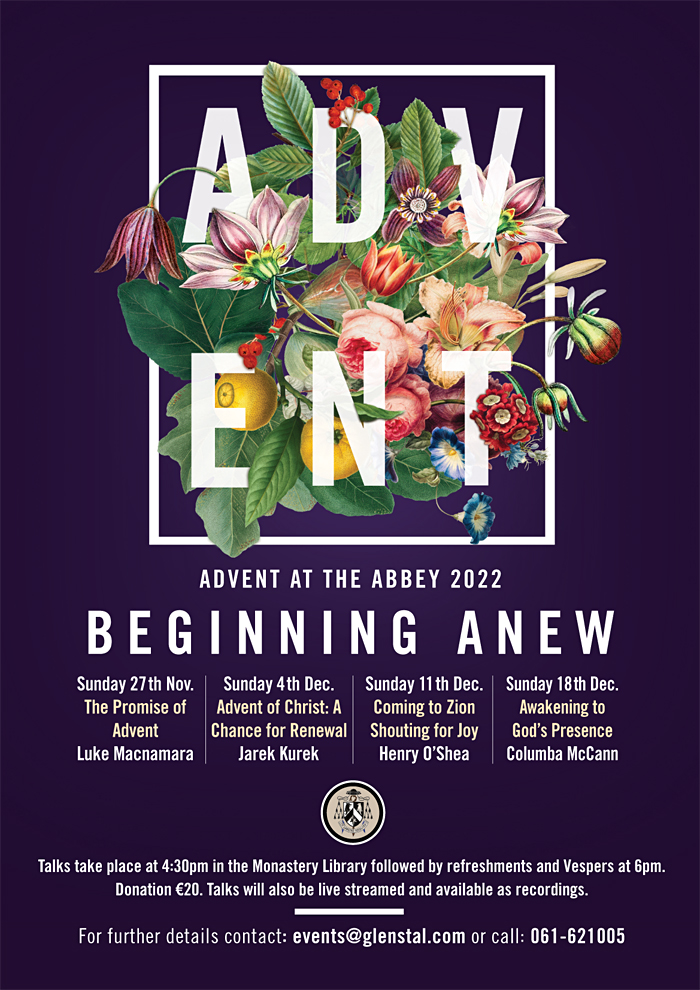
You are invited to journey with us throughout Advent in our series of Sunday afternoon ‘Beginning Anew’ talks.
The talks take place at 4.30pm in the Monastery Library and will be followed by refreshments with Vespers at 6pm. Suggested donation is 20 euros, and the talks will also be live streamed on our webcam (click the ‘Talks’ tab) and available as recordings later.
Speakers include:
For further details contact: events@glenstal.com or call 061-621005.
Fr Senan Furlong OSB
Tom Honeyman, a medical doctor and art connoisseur, was appointed Director of the Kelvingrove Art Gallery in Glascow in 1939. Thirteen years later, there was uproar when he purchased a religious painting for the gallery, paying £8,200 for it – a sum considered in 1952 to be an outrageous waste of hard-earned taxpayers’ money. The painting in
question was Christ of St John of the Cross. The artist was the Catalan surrealist, Salvador Dalí. Opinions and tastes change over time, and today the work is perhaps the most celebrated and reproduced religious painting of the 20th century. A poll conducted in 2006 ranked it Scotland’s favourite painting, and an offer of £80 million by the Spanish government was turned down.
Dalí based his painting on a pen and ink sketch of the crucified Christ by the 16th century Spanish mystic, St John of the Cross. The painting depicts Christ on the cross in a darkened sky floating over a tranquil dawn-lit bay complete with a boat and fishermen. What is unusual is the dramatically different interpretation that Dalí gave the crucified
Christ from the Spanish mystic. For St John of the Cross, the crucified Christ was a focus for compassion, a tortured and murdered man. Dalí aimed instead for an image of perfection and transcendence — there’s no blood, no nails, no crown of thorns. St John’s drawing is frenetic, a vision of the agonizing death on the cross. Dalí’s painting is serene,
a celebration of life and the triumph over death.
Today’s readings for the Solemnity of Christ the King present us with these two seemingly opposite views. The passage from the letter to the Colossians is a magnificent hymn of praise and thanksgiving to the Cosmic Christ. The battle has been won and a great exchange has been effected. God has delivered us from the power of darkness and transferred us to the kingdom of his beloved Son, who is the foundational unity holding all things in being. This is Dalí’s inspiring vision: Christ, ‘the nucleus of the atom’, the very unity of the universe.
It is ironic that on this day when we are called to reflect on the power and authority of our infinite God, the gospel passage takes us to the scene of the crucifixion. This form of punishment didn’t just kill a person. It dehumanised, degraded and debased. And here is our King, not ruling from a majestic throne but hanging from a cross, too weak to save himself from death. His crown is a crown of thorns. He has no armies at his command.
The only soldiers in attendance are his executioners. He is an appalling sight, without beauty or majesty, a thing despised and rejected. This is the vision contemplated by St John of the Cross. Can he who is mocked as ‘King of the Jews’ be the King of the Universe? Can the
apparent weakness of this dying man be the power of God giving new life to the world? Both St John of the Cross and Dalí have us view Christ and the cross directly from above. It is a heavenly perspective; it is that of God the Father, in the one case looking down on the sacrifice of his Son, in the other embracing and blessing everything beneath. Both breath the Resurrection. That doesn’t take away from the horror of Jesus giving himself up to death, but it does show that in this ultimate solidarity with humankind, God reveals himself as the God of love, who opens up hope and a future through the most negative side of history.
And what about us? Jesus hangs on the cross between two criminals. One mocks while the other owns his wrongdoing and looks to Jesus. In his powerlessness and pain, his eyes are opened and he sees right beside him the fount of mercy, forgiveness and redemption. “Jesus, remember me when you come into your kingdom.” His plea acknowledges that Jesus is King. He sees that salvation is to be with Jesus. On this Solemnity of Christ the King may we discover in this crucified, powerless, thorn-crowned King, the only person who can truly say, “Today, you will be with me in paradise.”
Fr Cuthbert Brennan OSB
If you came to mass this morning expecting to be uplifted by receiving some good news then you may have been disappointed as you listened to the readings. The prophet Malachi predicts days blazing like an oven, a divine fire and people reduced to stubble. Luke is not much cheerier, with Jesus announcing that nations will rise against nation, familial divisions, earthquakes, famines and plagues. On an individual
level, there is the promise of persecution, hatred and even death, though at the end of the gospel there is the perplexing line, ‘not a hair on your head will be destroyed.’
You could almost create a TikTok for the church from today’s readings;
Although you’ll be persecuted, imprisoned and put to death, your hair is going to look fabulous. Good news indeed. I don’t think you’ll get too many likes or followers with that message. These readings are not about a prediction of the future but rather they remind us of the precariousness of the present. Our world is not so stable and fixed as we might like to think it is. We have been travelling with Jesus to Jerusalem since June 26 th , the 13 th Sunday in Ordinary Time. Luke has been our guide and if you remember along the way we have encountered time and again great reversals, the last will be first, the first will be last, we heard that the kingdom of God is at hand, we encountered the foolishness of God in leaving everything to seek out
that which is lost. And to-day we arrive in Jerusalem and Jesus is offering us the vision of an ending and a new beginning, a vision of God’s kingdom and a different kind of temple where Jesus is the cornerstone. Jesus understands that every temple is a temporary structure, every system we create will collapse, every cause, every framework that we construct will fade away, will disappoint….. except his!!
The name we give to the genre of reading we are presented with today is called apocalyptic. While in the popular imagination apocalypse denotes widespread destruction or disaster, its original meaning is uncovering, unveiling in order to impart wisdom, meaning and especially hope to people. And that is that job of every Christian here. We are, in the words of St Paul this morning to the Thessalonians, to get to work. As the followers of Jesus we are to pull apart the veil, raise the curtain, shine a spotlight on every inhumanity to humanity, every act that diminishes human dignity, not only attacks with ballistic missiles and armed drones but on every slur that we make against
another. Do we build up or destroy people by our words and actions.
How well do we encourage one another, build each other up, co-create an environment where all can truly be themselves, and live in peace. What is the cost to my community, to the rest of the world and to the planet in maintaining my status quo? If there is good news in the gospel this morning, it is that if your world is not at peace at present, then it will not always be that way. God is not just in the creating and constructing business but in the deconstructing, dismantling business. God will bring an end to all of this – there will be a day when there
will not be a tomorrow.
What is it like to have God end something in your life? What is it like to experience a micro-apocalypse in our lives? God is there.
Maybe you have lost a loved one, lost your job, ended a relationship, and posted something you shouldn’t have had on social media and have been found out, posted some comments about others that are hurtful or simply untrue. What do we do in the face of such loss and grief, such inhumanity and insanity? We turn to the Spirit which resides in us individually and collectively and we stir that phoenix of hope to take wing so that God’s holy hope might surge within us. For with every ending there is a new beginning, we are offered a whole new life.
Jim Wallis, the founder of Sojourner, tells the story from some years ago of volunteering in a church homeless shelter around Christmas time. The church basement was decorated with banners, “Good news! Christ is born!” “Glory to God in the Highest” and so on. One of the
men who lived each day out on the streets looked around the room and asked, “What is the good news anyway?” Jim said there was a long pause; no one knew what to say. Finally someone spoke up from the back of the line, “The good news is that it doesn’t have to be like this.”
It doesn’t have to be this way.
On this World day for the poor, how might the millions of refugees and displaced hear this gospel. How about the 164,000 children who are living in poverty in this country? The world as it is, is not what God had in mind. The difference between bad news and good news that is gospel, depends on where you happen to be standing when you get the news.