Categories
Abbey | Latest News abbeynews

Homily – 32nd Sunday in Ordinary Time (Year C)

Fr Lino Moreira OSB

In Chapter VII of the Second Book of Maccabees we are told how a Jewish mother and her seven sons chose to face torture and death rather than transgress against the Law of Moses, which forbade them to eat pork. They showed such superhuman courage because they believed in the resurrection from the dead: “You dismiss us from this present life but the King of the Universe will raise us up to an everlasting renewal of life” (1 M 7:9) – said one of the young men to King Antiochus Epiphanes.

If we examine the contents of this belief, we will see that it embraces the whole of human nature, which is both spiritual and physical. One of the martyrs expresses the hope that his body will be restored in the following terms: “From Heaven I have received these limbs […] and from him I hope to receive them again (1 M 7:11).” Therefore it is the whole person that will be granted immortality, and because the body is not excluded, the relationship between those who loved each other in this world will also be revived. As the mother said to her youngest son, the last to be executed: “prove yourself worthy of your brothers and accept death, so that I may receive you back with them in the day of mercy (1 M 7:29).”

This theology of a bodily resurrection, so clearly formulated in the beginning of the second century before Christ, was rejected by the Sadducees. And according to Saint Luke, some of them tried to prove to Jesus that such a doctrine was utterly absurd by telling him the story of seven brothers who married the same woman in close succession. They asked: “In the resurrection, therefore, which one’s wife will
she be? (Lk 20:33).”

In his answer Jesus stresses the fact that the life of the age to come is by no means a mere continuation of the life in this world, which can only be perpetuated through propagation: “those who are considered worthy to attain to that age and the resurrection from the dead – he says – neither marry nor are given in marriage, for neither can they die anymore, since they are like angels, and are children of God, being children of the resurrection (Lk 20:35-36).”

This is a very clear statement that the laws of biology no longer apply to those who rise from their tombs, but at the same time we are to understand that not only their souls but also their bodies are clothed with immortality. Indeed, were it not so, eternity in God and with God would be anything but an interrelationship of persons, and Jesus’s assertion that those who rise from the dead are children of God (cf. Lk
20:35) would be no more than an empty metaphor.

Having made it clear that those whom God wakes from the sleep of death share the one bond of adoption as sons and daughters of the same God, Jesus goes on to say: “But that the dead are raised, even Moses showed, in the passage about the burning bush, where he calls the Lord the God of Abraham, and the God of Isaac, and the God of Jacob. Now he is not the God of the dead, but of the living” (Lk 37-
38).

For the Sadducees, who held only the written Law – that is to say, the first five books of the Bible – as authoritative, an argument based on story of the burning bush, which is told in the third and fourth chapters of the Book of Exodus, carried a very special weight. Jesus points out to his learned opponents that to say that Abraham, Isaac and Jacob are not fully alive is tantamount to denying that the Creator of the universe is the God of the living. And he concludes with a striking remark: “for all live to him” (Lk 37-38).

That means that to live is to live for God, and the opposite is death. In other words, it is only those who listen to the word of God and put it into practice that are truly alive in this world, and because they are known and loved by their Creator, they are granted immortality. We are invited, then, to listen to Jesus, the Word of God made flesh (cf. Jn 1:18), and to follow him wherever he goes. By doing so we will be living to the full even now, and in the age to come we will have our share in the happiness of the children of God.
Categories
Abbey | Latest News abbeynews

Funeral of Fr Placid

Abbot Brendan Coffey OSB

By any reckoning, Fr Placid lived an extraordinary life. Born, Michael Francis Augustine Murray, on 7 October 1918 in Lismore, County Waterford, just over a month before the end of World War I. Benedict XV was Pope, Ireland was in the aftermath of the 1916 Rising and Europe was in deep shock after the slaughter the World War had brought. It would be another nine years before Glenstal Priory was founded.

His lifespan covered that of nine Popes, five English monarchs, all nine Irish Presidents, nineteen US Presidents and two global pandemics. As a student in Rome he experienced first-hand the Second World War, eventually making his way home by flying boat to Foynes.

During his long life Fr Placid worked on scholarly and liturgical publications, was heavily involved in the Liturgical and Ecumenical Conferences here in Glenstal, was the first President of Societas Liturgica and all the while a faithful and constant presence in our monastic choir. Newman and his works always held special resonance for Fr Placid, and he generously shared his insights with others. He held many roles in this community, including that of superior, and over his long monastic life made many friendships with local people and visitors to the Abbey which endured to the end. Recently he celebrated his one hundredth and fourth birthday. I asked him what it was like to have reached this great age. He replied in his customary deadpan way, “I find there is very little peer pressure now.”

Every one of us must walk the full journey if we are to discover the meaning to our own life. The full journey for Fr Placid was very long indeed, but he persevered faithfully until the end and he would have been pleased about that. Now he will know the joy of those words from the gospel, “Happy the eyes that see what you see, for I tell you that many prophets and kings wanted to see what you see and never saw it; to hear what you hear, and never heard it.” We thank him for the example of great fidelity, which he has left us. His long life reached its completion on 31 of October in Millbrae Lodge Nursing Home, where he had lived for the last fourteen years! We thank the staff there for their care of Fr Placid.

Those of you who knew Fr Placid will know that he never did anything quickly. Everything was carefully thought through, every word he wrote pondered over. However, no matter where he was, or what he was doing, he would drop everything once he heard the signal for the Divine Office. He took his monastic life seriously and placed his trust in the suscipe he sang on the day of his profession. “Receive me, O Lord, according to your word, and I shall live; and let me not be confounded in my hope.”

It isn’t possible to sum up a life one hundred and four years long in these few short lines and anything I could say would only scratch the surface. Neither would Fr Placid want me to attempt such a task, he was always a very private person and would cringe at the thought. He would, I know, like to be remembered as a monk and a scholar and that is what he was. Today we celebrate St Malachy. His biographer, St Bernard of Clairvaux, says of Malachy that he was distinguished by his humility, obedience, modesty, and true diligence in his studies. It is fitting that we celebrate Fr Placid’s funeral on his feast, as he strove to do the same. We thank him for this example and we ask pardon for the times he failed.

Fr Placid would want prominent mention of John Henry Newman, his great mentor, at this liturgy and so I leave to Newman, the final word.

Go forth upon thy journey, Christian soul!

Go from this world! Go, in the Name of God

The Omnipotent Father, who created thee!

Go, in the Name of Jesus Christ, our Lord,

Son of the living God, who bled for thee!

Go, in the Name of the Holy Spirit, who

Hath been pour’d out on thee! Go, in the name

Of Angels and Archangels; in the name

Of Thrones and Dominations; in the name

Of Princedoms and of Powers; and in the name

Of Cherubim and Seraphim, go forth!

Go, in the name of Patriarchs and Prophets;

And of Apostles and Evangelists,

Of Martyrs and Confessors; in the name

Of holy Monks and Hermits; in the name

Of Holy Virgins; and all Saints of God,

Both men and women, go! Go on thy course;

And may thy place today be found in peace,

And may thy dwelling be the Holy Mount

Of Sion:—through the Same, through Christ, our

Lord.

Categories
Abbey | Latest News abbeynews

All Saints

Abbot Brendan Coffey OSB

As the seasons change and we move from autumn into winter the world of nature all around us begins to slow down. The days draw in, the leaves fall from the trees, the vegetation begins to die back and the temperatures start to fall. It’s entirely natural at such a moment of change for our thoughts to turn to the autumn and winter of our own days and reflect upon questions of life and death. The passing of Fr Placid last evening makes that even more vivid for us. Even before Christianity arrived on our shores our ancestors were asking these questions at this time of year, for the Lord God reveals his mystery in the world of nature if we are willing to open our eyes to see. This is a moment in the year when life and death touch and so it has always been a holy season.

At this time of year then we reflect on our beloved dead and on our ancestors in the faith, the saints in heaven whom we celebrate today. They are the throng of the heavenly host who are present with us in this place as we come to worship.

Is it not appropriate that so many saints are depicted in stained glass windows? For the saints are people who let the light of God’s Son shine through them. It doesn’t matter if they were a great Archbishop or Doctor, a civil rights leader, a mother, a missionary, an elderly nun in India, or one whose greatness is known to God alone. All of them share a common vision. The saints of God are among us and through them the light of Christ continues to shine.

All Saints Day beckons us to something beautiful. It reminds us of our great potential, the promise that lies within each of us. It is the promise that was fulfilled in the countless people we venerate this day, our models, our companions, our inspirations, our guides. They give us blessed hope, the peacemakers, the poor in spirit, the merciful, the pure in heart, those who mourn, the persecuted. Because they assure us again and again: no one is born a saint, but every one of us, by the grace of God, can become one.

The torrent of time is sweeping us all along, into the dark, into death. Every autumn turning to winter reminds us of it. But there is another stream and All Saints reminds us of this too. It is the stream flowing from Easter, from the pierced side of Christ, and, for all its apparent weakness, it is the stronger. The saints are those “who have washed their robes white again in the blood of the Lamb.” It was God who loved us first. A saint has realised this, loves him in return and becomes a living beatitude. The robe washed in the blood of the Lamb, is our humanity. Let us open then that tattered robe we are to the power of this love which has no end, so that we too can become people who let the light of God’s Son shine through us.


Categories
Abbey | Latest News abbeynews

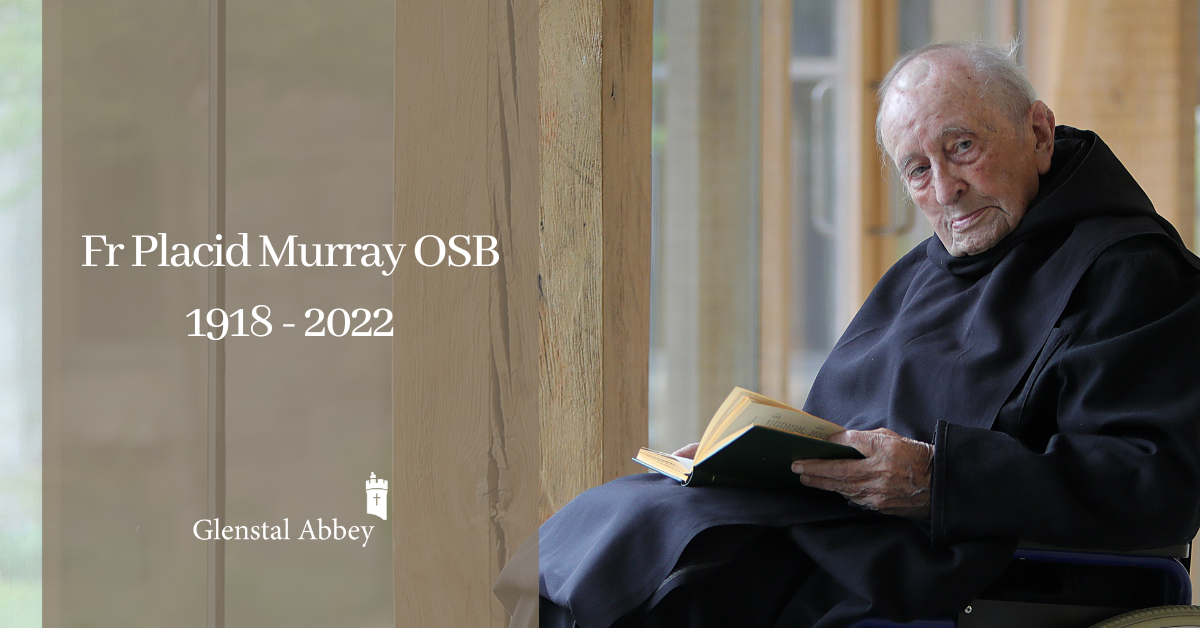
Obituary and Funeral Arrangements for Fr Placid Murray OSB

Placid Murray OSB

MONK OF GLENSTAL

died, Monday 31st October 2022

aged 104

Michael Murray was born in Lismore., Co. Waterford, on 7th October, 1918. After the early death of her husband, Mrs Murray moved with her young family to Dublin. Following school at Blackrock College, and on the recommendation of the headmaster of that school, Dr John Charles McQuaid CsSp, Michael Murray entered Glenstal on 2nd September, 1935, receiving the name Placid. He made simple profession on 6th January, 1937. Shortly after this, he was sent to Maredsous, where he studied philosophy and began to study theology. On the outbreak of the Second World War the community at Maredsous, along with Brother Placid, fled briefly to the south of France, returning to Belgium when that country surrendered to the invading German forces. Abbot Celestine Golenvaux, fearing danger to an Irish citizen in occupied Belgium, sent Brother Placid to Sant’Anselmo to complete his theological studies. It was during his time in Sant’Anselmo that Brother Placid developed his love for the works of John Henry Newman, a love that remained with him all of his life.

On the grounds of delicate health, Dom Placid was ordained priest ahead of his time, at the Abbey of Saint Scholastica at Subiaco on 20th December, 1941. He celebrated his First Mass in the nearby Sacro Speco church of Saint Benedict’s monastery. The disimproving military situation in Europe and the ambiguous status, in international eyes, of Ireland, still a member of the Commonwealth, but neutral, suggested that Dom Placid should return home. This he did by what he frequently described as an inconvenient train journey, up through Italy, across the south of France and the north of Spain to Portugal, where he boarded a flying boat from Lisbon. At the time, the route from Lisbon to Foynes was one of the main conduits for the infiltration of Allied spies into a belligerent Europe.

Returned home, he became assistant novice-master and taught religion and German in the Priory School for several years. Following the resignation of Dom Bernard O’Dea in 1952, Dom Placid became Glenstal’s second Conventual Prior. He held this position until Glenstal became an Abbey in 1957. During his time as Prior, Father Placid completed the abbey church and created the present monastic refectory by integrating several rooms on the ground floor of what is still called the Fathers’ Wing.

He developed a strong interest in the liturgy and was very involved in the setting up of Societas Liturgica and was its first President from 1967-1969, with the first of its cycle of biannual meetings taking place at Glenstal in 1969. He established the annual Liturgical Conference at Glenstal, which he continued to organise until it was discontinued in 1975.

Following the election of Abbot Joseph Dowdall, Father Placid had time to return to his research on Cardinal Newman. This resulted in the publication, in 1969, of Newman the Oratorian, Cardinal Newman’s Oratory Papers, for which Father Placid received a doctorate in theology from Sant’Anselmo. A consultor of ICEL, the International Commission for English in the Liturgy, established during the Second Vatican Council, Father Placid became involved in many projects for the translation of liturgical texts into English. In 1970, he was asked by the bishops of Ireland, Great Britain, and Australia, to chair the committee that translated the Liturgy of the Hours for use in these countries. The resulting breviary, in three volumes, remains the standard breviary for most non-American speakers of English. Father Placid’s final involvement with ICEL was as a consultor for the communion prayers of the revised Roman Missal of 2011. He was not happy with the official changes to his translations.

In the years before this last endeavour, he took great delight in mastering the use of the computer. This greatly aided his final major project on Cardinal Newman. This involved co-operation in a planned five-volume edition of the cardinal’s unpublished Anglican sermons delivered between the years 1824 and 1843. The great Newman scholar, Father Charles Dessain, of the Birmingham Oratory, had specifically asked shortly before his sudden death, that this task be entrusted to Father Placid. Volume 1 appeared in 1991 and Volume 3, the latter co-edited by Father Placid, was published in 2010.

During his final years in the monastery, Father Placid, while continuing to teach classes in the Novitiate and tutor boys from the school in German, helped in monastery reception and as a confessor.

Father Placid spent the last fourteen years of his long life in Millbrae Nursing Home in Newport, Co Tipperary. Up to shortly before his death, he had an active ministry in this facility. During these years, he came to the monastery for Mass and lunch every week and the celebration of his birthday became an annual event, up to his 104th birthday, which the community anticipated on 4th October of this year, 2022. He died peacefully after the First Vespers of All Saints, 2022.

Funeral Arrangements:

Reposing at monastery reception from 3.30pm on Wednesday 2nd November, with removal to the Abbey Church at 5pm followed by Vespers for the Dead.

Funeral Mass on Thursday 3rd November at 11.30am with burial afterwards in the monastic cemetery.

Eternal rest grant unto him, O Lord, and let perpetual light shine upon him. May he rest in peace. Amen

Categories
Abbey | Latest News abbeynews

Placid Murray RIP

It is with deep sadness that the monastic community announces the death of Fr Placid Murray OSB, at the age of 104.

Ar dheis Dé go raibh a anam dílis.

Categories
Abbey | Latest News abbeynews

Homily – 31st Sunday in Ordinary Time (Year C)

Abbot Brendan Coffey OSB

For most of us, Jericho is synonymous with the collapse of its famous walls – with trumpet blast and a great shout the walls came crashing down. But did you know that Jericho is very possibly the oldest city on earth? It is certainly the lowest city on earth, 846ft below sea level. Zacchaeus lived in this city of Jericho and this is the scene for our Gospel.

Before Jesus headed up to Jerusalem, 2,474ft above sea level, he turned towards the lowest place on earth, Jericho, and it was there, in the depths, that he found our friend Zacchaeus. He literally descended as far as it is possible to descend on earth to find him. As our First Reading from the Book of Wisdom tells us, “you are merciful to all, for you can do all things, and you overlook people’s sins, so that they may repent… you correct little by little those who trespass, and you remind and warn them of the things through which they sin, so that they may be freed from wickedness and put their trust in you, O Lord.”

Jericho was known as the ‘city of the palms’, because of the abundance of palm trees in the region and yet Zacchaeus ended up climbing a sycamore tree. This should not be confused with our European sycamore trees. Zacchaeus’ tree is a species of fig, a sycamore fig. Adam and Eve used the leaves of the fig tree to clothe their shame after the fall. Zacchaeus is clothed in this sycamore fig as he tries to catch a glimpse of Jesus. The sight is rather comical; this highly respected chief tax collector, somewhat vertically challenged, runs ahead of the crowd and gets himself, somehow, up into a sycamore fig from where he can see Jesus as he passes. He must have looked pretty ridiculous.

Zacchaeus was a local celebrity, he was rich, important, the chief tax collector no less. He was, we can assume, none too popular with his neighbours as a result. Then the unthinkable happens, Jesus speaks directly to Zacchaeus. He even calls him by name. Down he comes, probably with a thump, and the Gospel tells us that Zacchaeus was happy to welcome Jesus into his house. This is his salvation, the supreme moment in his life and everything changes.

From this, the lowest place on earth, Zacchaeus is raised up. But his neighbours are not one bit happy – they grumble. Perhaps they are jealous. Why is Jesus wasting his time with Zacchaeus of all people? However, that day Zacchaeus stood tall, perhaps for the very first time in his life, and the walls of Jericho fell a second time. He promises to make restitution for any wrong he has done and more, four times more! This is real conversion, not just words, actions as well.

Where is my Jericho? What lurks in the lowest part of my life? Where is my sycamore fig, the tree of shame, so I can climb it and be recognised by the Lord, called by name, my name! How do I bring down the walls of Jericho that surround my heart and mind? Opening my heart to conversion, generosity, restitution and right living. Opening my mind to understanding, justice, and right judgment. Seeing the world as it really is. Standing tall and speaking the truth in love.

Zacchaeus has a lot to teach us about real conversion, about courage, about standing up and speaking out at the right time. What would Zacchaeus say today if he lived in our world with its injustices, wars and brokenness? His words should be on my lips if I am to convert as he did, be happy to welcome the Lord into my house and bring crashing down the walls of Jericho.

Categories
Abbey | Latest News abbeynews

Psalm 83 chant

  ‘How lovely is your dwelling place, Lord God of Hosts!’ (Psalm 83:1)
Categories
Abbey | Latest News abbeynews

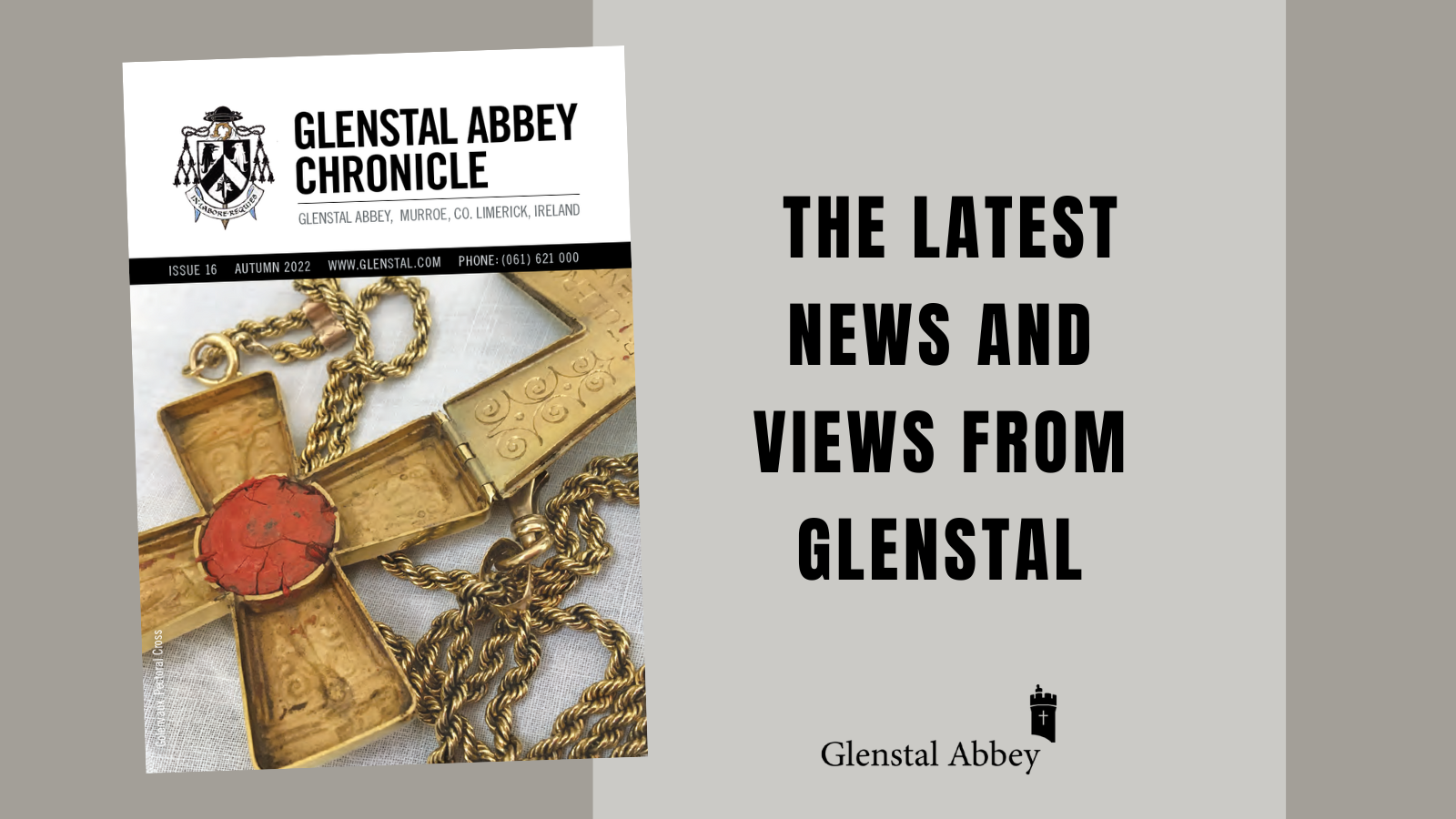
Autumn 2022 Chronicle

Our Autumn 2022 Chronicle contains the fascinating history of an almost century-old pectoral cross, an award from the government of Poland, tales from the holy city of Jerusalem, and much more. Read it here…

Categories
Abbey | Latest News abbeynews

Psalm 42 chant

‘Why are you cast down my soul? … hope in God, I will praise him still’ – Psalm 42 chanted by the monks of Glenstal and available for listening on our YouTube page.

Categories
Abbey | Latest News abbeynews

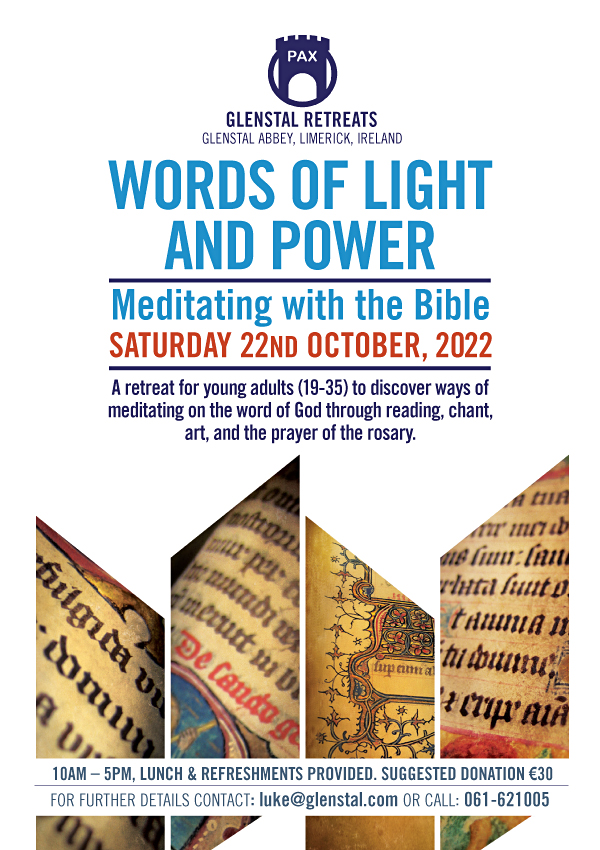
Words of Light and Power

Words of Light and Power is a retreat for Young Adults takes place on Saturday 22nd October from 10-5pm.

Participants will discover ways of meditating on the word of God through reading, chant, art, and the prayer of the rosary.

Talks include:

+ ‘Opening the Bible’ – Columba McCann
+ ‘Hearing the Word through Chant’ – Senan Furlong
+ ‘Seeing the Word through Monastic Art’ – Luke Macnamara
+ ‘Meditating with Mary’ – Jarek Kurek

Suggested donation €30, with refreshments and lunch provided.

To book please contact 061 621005 or luke@glenstal.com

Subscribe To Our Newsletter To Receive Updates

[hubspot type=form portal=6886884 id=9e1d6d0d-c51e-4e35-929d-3a916798de64]