
Categories
Abbey | Latest News abbeynews

Homily – 29th Sunday in Ordinary Time (Year C)

Fr William Fennelly OSB

In the readings today we are given some understanding of how our requests to God relate to time, our time and God’s time. In both the reading from Exodus and the Gospel passage from Luke we encounter urgent need. In the first reading the urgency is more obvious, for if there is not a speedy sorting out of the issues, then there’s going to be a defeat. Amalek has come to wage war against Israel, and Israel must defend itself then and there. To wait would simply allow them to be slaughtered. There’s also urgency in the widow’s plea for a just decision against her adversary. She does not seem to be able or willing to wait for the judge to take action in his time. She wants resolution now does all she can to get it.

But if they want resolution now, then both Moses and the widow cannot be passive onlookers. They have to be willing to play their part. Our actions, what we actually choose to do, show something of what our desires really are. If we want something badly enough we usually can muster up the necessary energy. In Moses’ case, he’s too exhausted to keep his hands up, so he uses not only his body, but also his intelligence by getting Aaron and Hur to support his hands when he is no longer able to keep them up. The widow, it would seem, also uses both body and mind. She figures out that her persistence will eventually get the better of the judge. And she is right.

When we ask God for things in prayer, we need to be involved, our bodies, our minds, our all. To ask God for something we desperately need makes clear that to do so in a lazy fashion risks treating God as a mere solver our problems, and so not letting Him be just Him. It may also show that our need is not really as great as we think it is. When we ask God for help, even though we put our needs in God’s hands, we show by our perseverance that we are truly engaged, our praying to God means above all not giving up, our active trust in God.

Yet in today’s readings there is another perspective on the relationship between our asking God for things and time, even if it is less obvious. As well as the perspective of our needs right now, there is the perspective, that is, seen from the perspective of eternity. We may think of this perspective, as how time is seen from God’s viewpoint. From the perspective of eternity all of our cares and concerns are seen in a much wider context.

We are reminded of this perspective in this Sunday’s Gospel where Christ speaks of final judgement, to judge the living and the dead, as we heard in the second reading. It is interesting that it’s after he speaks of the persistent widow that Christ then moves on to speak of the coming of the Son of Man, the great event of the end times, the establishment of an everlasting kingdom where the rule of God orders all things.

The widow comes across a bit like Mrs Doyle in the Fr Ted comedy badgering character to have a cup of tea, go on, go on, go on she repeats, go on give me me justice. Jesus tells this story, he says, so that we can pray continually and not lose heart. To pray is to raise the heart and the mind to God, that is to raise the heart and mind to our ultimate concern, our origin and our destiny. This is wearying because the daily round my wants and my disappointments is so much easier to
care about than who I am and where I am going. Is it any wonder we fall back in dismay. To have a goal oriented future vision of our destiny is to have an understanding of who we are, as not being fixed, but rather our true selves are in the act of becoming; becoming different, becoming better, becoming more than what we are right now. The stakes are as high as possible and this is what gives us the urgency of todays’ readings. To enter into this perspective, is not to ignore the issues that face us right now, but to see them in a new light. If we fail
in this, we should not be too hard on ourselves. The scriptures show us that the Lord never abandons us, not even in our greatest moments of doubt. To enter into the perspective of eternity is an invitation to enter into a deeper relationship with the God who ‘stepped out’ from eternity into the vulnerability of time and space in Jesus Christ. It is also to situate our problems into a bigger picture, a bigger picture that can be a great source of consolation, especially when our problems seem to be getting the upper hand. The perspective of eternity reminds us that these difficulties will not have the last word, that our lives are infinitely precious and that God is Lord of all of who we are and no part of us lies beyond his concern.
Categories
Abbey | Latest News abbeynews

Homily – 28th Sunday in Ordinary Time (Year C)

Fr Luke Macnamara OSB

Life throws many challenges at us. Whoever we are, and no matter how
nurturing and protective our parents might be, there will always be times when things don’t go according to plan. Growing up is not always easy.

The ten men probably had a bright future. Leprosy forced them to live apart and crushed their dreams. They hear about Jesus and hope that somehow he might be able to help. Keeping their distance, they cry out to him from afar, “Master, have mercy on us”. These are the very words we sung in Greek at the beginning of Mass, “Lord have mercy” and at the Lamb of God we will sing them again in Latin, “have mercy on us”. We too may have problems in our lives separating us from God, from parents, from families, and from making friends. We, like the ten in the Gospel cry out to the Lord: “Have mercy on us”.

By this, we invite the Lord to heal us. Calling for mercy is only one part of the dynamic of making us whole. Jesus sends the ten away to show themselves to the priests. The ten obey and as they went away they became free of their leprosy. Nine are delighted that all is well
and go on living their lives with their original hopes and dreams. One of the group, a Samaritan, recognises that he is healed and turns back giving praise to God for his healing and falling at Jesus’ feet gives him thanks. Again, the actions of this man will point to our actions at this Mass. The man returns to Jesus. This word “return” is the verb of repentance in the Old Testament. The prophets ask that the people return to the Lord their God. This is what the healed man has done. This is what we do at this Mass. We with all our failings call upon the Lord for mercy and once healed take up his invitation to return to
his loving embrace.

We asked and will ask for mercy. We praised God in the singing of the
Gloria (Glory to God in the Highest) and we will give him thanks in our offering of the Eucharist at the altar. Let us not be like the nine healed men who went on with their lives once all was well again. Let us not be satisfied with what the world deems success: wealth, prestige, great learning, beauty, fitness, etc. and miss out on a living relationship with God. Let us return to worship God through, with, and in Jesus at this altar and so share in the new life he offers.

Jesus gave a similar command to the ten and to the Samaritan – go on your way. For the ten this going led only to healing and living life as normal. For the Samaritan this second going in faith led to salvation. At the end of this Mass you will be sent on your way – go in peace. Do so in faith that you may live the full life that Jesus offers, one of Christian joy.

Categories
Abbey | Latest News abbeynews

Homily – 27th Sunday in Ordinary Time (Year C)

Fr Henry O’Shea OSB

Hab 1:2-3; 2:2-4. 2Tim 1:6-8.13-14. Lk 17:5-10

“It was the best of times, it was the worst of times,
it was the age of wisdom, it was the age of foolishness,
it was the epoch of belief, it was the epoch of incredulity,
it was the season of light, it was the season of darkness,
it was the spring of hope, it was the winter of despair.”
It is, I think, true to say that since humankind became
reflectively conscious of itself, people have always considered
themselves as living in the best and/or the worst of times.
Every era will be for some the best and for some the worst of
times. For all of us, it will, most likely, be a mixture of both.
We could be forgiven for thinking that in October 2022 we
are living in or approaching a worst of times. The catalogue of
calamities is endless. Ukraine, with the very real threat of
nuclear escalation. Covid, global warming, hurricanes and
famine. From the north to the south of the globe and within
societies, a widening gap between haves and have-nots. So,
what time are we living in?
Today’s three readings are about faith, about a patient hope
and a listening but also an a ctive love. But, what is faith? Is it
simply a wish-fulfilling whistling-in-the-dark, a coping
mechanism until our time runs out? Was Marx correct in
speaking of faith and religion as the opium of the people? And
then, nothing? ‘If that’s all there is, if that’s all there is..’
The Prophet Habbakuk in today’s first reading, surely speaks
for many of us when he howls, ‘How long, Lord, am I to cry
for help while you will not listen…why do you look on where
there is tyranny…?’ Is there any consolation for us in the
Lord’s reply to Habbakuk, ‘…this vision is for its own time
only, eager for its own fulfilment, it does not deceive…the
upright will live by their righteousness…?’ Fine, perhaps, if we
have that vision, even that righteousness, but how does this
help one to cope with, to make sense of, the here-and-now?
How does it help one to have hope for the future?

In the second reading, taken from the second letter of Paul to
Timothy, we are encouraged to fan into a flame the gift that
God has given us. We are told that this gift is not a spirit, not a
mind-set, of timidity but of power, or, better, of possibility in
the Holy Spirit. And also a spirit of love and self-control. Self-
control, not in a repressive sense, but rather as a vibrantly
aware focussing of spiritual energy. Further, we are encouraged
to be people of patient hope, bearing hardships for the sake of
the good news of the gospel, relying on the power of God. But,
might this not also be a coping-mechanism, a whistling-in-the-
dark on a personal and societal level until the time when time
runs out. And then what? ‘If that’s all there is, if that’s all there
is..’
At a first reading, today’s gospel can be a bit confusing. In
describing how a master treats his probably exhausted servant,
Jesus seems to be condoning a certain kind of arrogant attitude
of, a taking for granted of, entitlement. He seems even to be
agreeing that he who pays the piper calls the tune. But this is
not, I suggest, what the reading is about.
At the start of today’s passage, the apostles ask the Lord to
increase their faith. Jesus’ reply indicates that the apostles
haven’t even begun to grasp what faith is. Hence, the talk of
mustard-seeds, the smallest of seeds. Hence the colourful but
unlikely image of uprooting a tree and planting it in the ocean.
Here, Jesus is not interested in whether or not the servant is
justly or unjustly, or even simply inconsiderately, treated. His
message to the apostles and to us is that the beginning of faith
is an acknowledgment that we are servants, that we have done
and do only no more than our duty.
No more than our duty: this does not sound like a recipe for
a fun time. And for this very reason, faith, and along with it,
the Faith, are dismissed, ignored, ridiculed, abandoned,
unexamined, both on a personal and societal level. Does this
not sound familiar in our present society? If that’s all there is, if
that’s all there is..’
When in today’s gospel the apostles ask for an increase of
their faith, there is a hint that they are talking about some
quantifiable, measurable, commodity or skill. If one is the kind
of person who tries to control reality by science, logic and
numeration – all fine in their own place and within their own
limitations – or/and if one is the kind pf person who considers
everything to be a result of chance, of nature, red in tooth in
claw, faith in whatever form it takes, is far from the faith of
which Jesus is speaking and which St Paul tries to articulate.
Because faith is not a possession, quantifiable or not. Faith, as
a totally unmerited and gratuitous gift, a grace, from God, is
never definitively possessed, but constantly needs to be stirred
up, refreshed, renewed. This stirring up happens in the
circumstances, in the concrete realities of our lives and, as we
know too well in the trials, greater or smaller of our lives as well
as in its joys. But is this, too, just wishful thinking?
Christ is calling us to a certain dynamic, to a definite attitude
towards, or way of seeing things, and a way of living. We are
called to allow the deepest part of ourselves, the loving, all-
embracing part of ourselves to be flooded by him and to have
our way of seeing and thinking – but especially our way of
behaving – flooded by the life-affirming possibility that being
part of Christ promises and always does, if we let it, delivers. In
his Rule, St Benedict puts it very simply when he talks of
allowing our hearts to be expanded. Essential to this expansion
is our persevering acknowledgement that in response to this
great gift, we are servants of this great mystery and with it, of
one another.
This kind of brave, realistic, loving, serving faith, is not a
blinkered or gooey-eyed, sentimental, short-circuiting of reality.
It is, rather, a growing capacity to accept and even name every
reality. But this accepted, named and lived reality is a reality,
an event, that is not circumscribed not fenced in, not made
absurd, by death, but a reality open to the infinite possibility of
a life that conquers all deaths, that goes beyond all time, that
shatters the boundaries of time. An ever-flowering expansion of
our way of being.

And this is what we celebrate, trumpet, when we come together
around the tables of the Lord’s Word – the table of the
Scriptures – and of the table of the Sacrament of his body and
blood.
“It was the best of times, it was the worst of times…’
‘ O that today you would listen to his voice!
Harden not your hearts.’

Categories
Abbey | Latest News abbeynews

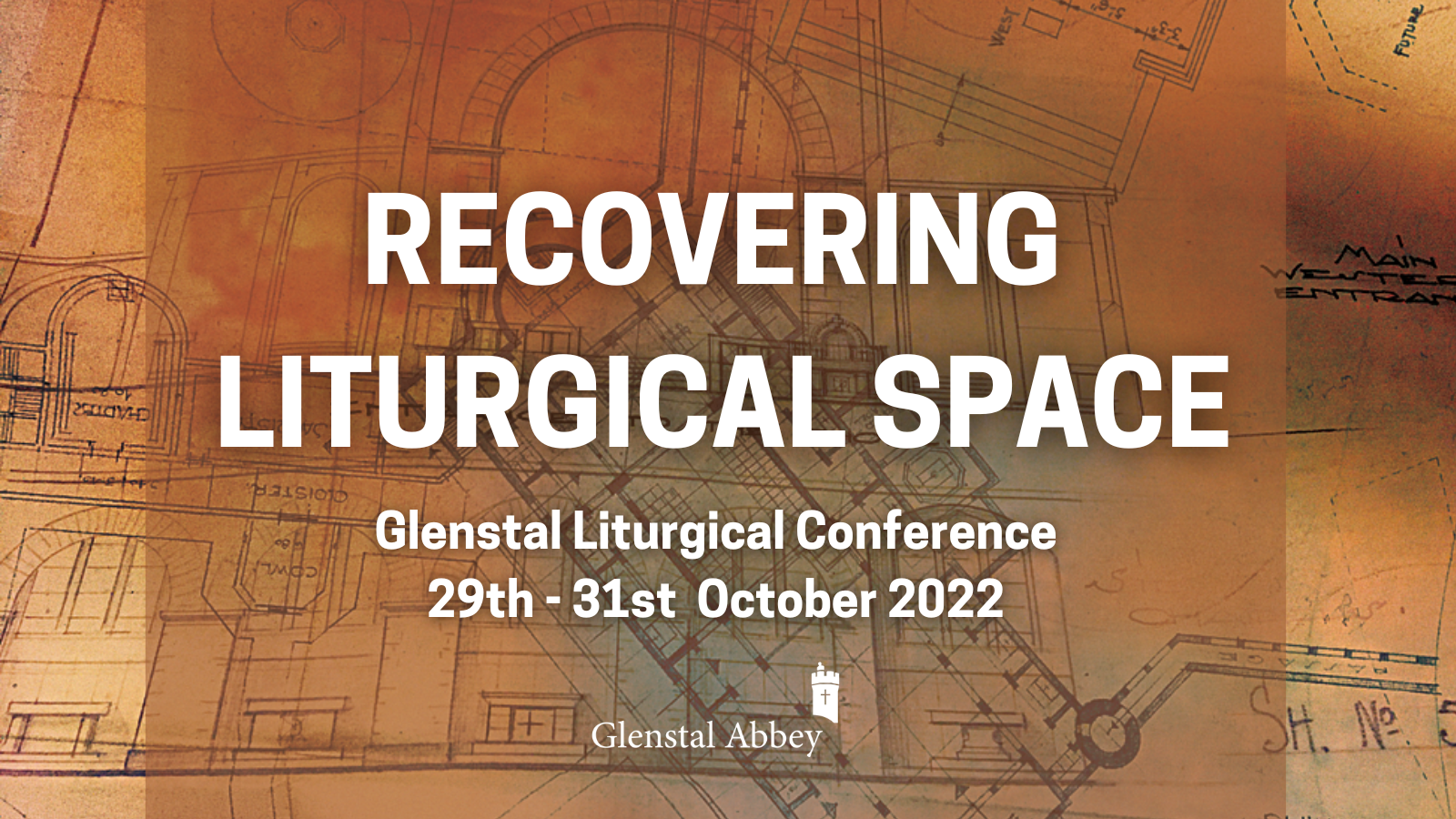
Liturgical Conference 2022

Glenstal Abbey is pleased to welcome you to our fourth Liturgical Conference, which will focus on our experience of worship within the liturgical space.

The conference takes place from Saturday 29th to Monday 31st October at Glenstal Abbey and features a range of contributors:

  • Abbot Brendan Coffey OSB – Abbot of Glenstal Abbey, studied theology in Rome and liturgy in Padua.
  • Johanna Wiese OSB – Prioress of Dinklage Abbey, Germany; architect specialising in Sacred Art and Architecture.
  • Luke Macnamara OSB – Monk of Glenstal Abbey, studied theology in Paris and Rome.
  • Emmaus O’Herlihy OSB – Monk of Glenstal Abbey, studied theology in Toronto.
  • Anna Gannon – Art historian at the University of Cambridge; her areas of specialism are the Anglo-Saxons at the time of their conversion to Christianity and their interactions with the neighbours on the British Isles, Continental Europe and beyond.
  • Henry O’Shea OSB – Monk of Glenstal Abbey, studied theology in Würzburg.
  • Jonathan Price – The Fred and Helen Lessing Chair of Ancient History at Tel Aviv University in Israel, specialising in Greek and Roman Historiography, Jewish history of the Roman Period and Epigraphy.
  • Robin Jensen – Patrick O’Brien Professor of Theology at Notre Dame University in the United States of America, specialising in the History of Christianity, Liturgical Studies, and Christianity and Judaism in Antiquity.
  • Columba McCann OSB – Monk of Glenstal Abbey, studied theology in Clonliffe and liturgy in Rome.
  • Jarek Kurek OSB – Monk of Glenstal Abbey, studied theology in Krakow and Oxford.
  • Dominik Jurczak OP – Dominican friar, professor of Theology at the Pontifical University ‘Angelicum’ and lecturer at the Pontifical Institute of Sacred Liturgy ‘Sant Anselmo’ in Rome, Assistant Editor of Ecclesia Orans.

Considering the different elements of the community’s experience when gathered together for the liturgy is something all the more relevant in light of the COVID-19 pandemic and ‘online worship.’ This will be a fascinating conference, filled with engaging speakers, panel discussions, liturgical art tours, prayer and time for interaction between participants, speakers and monks.

Single day: €95, full conference: €230 and student concessions are available. Bookings can be made by emailing: litcon@glenstal.org

When making your booking, please include all relevant details such as the number of days you wish to attend, special dietary requirements, etc. The cost is inclusive of all meals, talks and other activities. Accommodation is not available at the Abbey and must be booked separately, though we can assist with the names of some local hotels and B&B’s, if requested.

The full conference programme can be downloaded by clicking here.

Categories
Abbey | Latest News abbeynews

Words of Light and Power

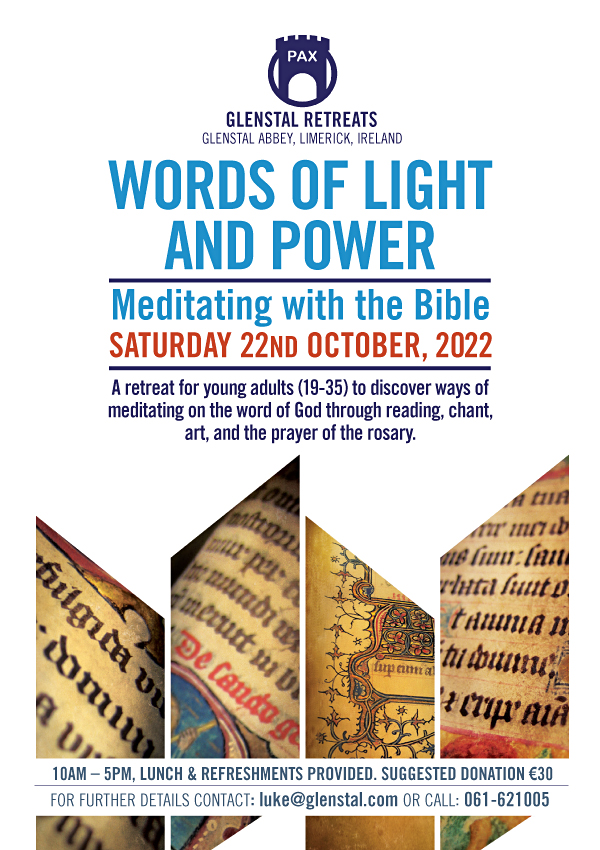
‘Words of Light and Power’ is a retreat for young adults (aged 19 – 35) taking place at Glenstal Abbey on Saturday 22nd October 2022 from 10am – 5pm.

Participants will discover ways of meditating on the Word of God through reading, chant, art and the prayer of the Rosary.

Contributions by monks of Glenstal include ‘Opening the Bible’ with Fr Columba McCann, ‘Hearing the Word through Chant’ with Fr Senan Furlong, ‘Seeing the Word through Monastic Art’ with Fr Luke Macnamara and ‘Meditating with Mary’ with Fr Jarek Kurek.

Refreshments and lunch are provided and the suggested donation is €30. To book please contact Fr Luke at 061 621005 or luke@glenstal.com

Categories
Abbey | Latest News abbeynews

Homily – 26th Sunday in Ordinary Time (Year C)

Fr Jarek Kurek OSB

The rich man in today’s gospel was, no doubt, in dire straits. So it doesn’t come as a big surprise that he looked up [to the heavens] and begged Abraham for seconds of relief from his agony, just to have his tongue cooled. This is very human indeed.

Any success? No. With his failed request came some feedback: you had too much comfort in your lifetime, that’s why you are experiencing torments now. He was paying dearly for carelessness in his earthly existence.

What happens next, however, is far more interesting. He forgets about himself and his pain and becomes concerned about his family. On their behalf, he calls for a miracle, as he doesn’t want them to experience the horrible torments he himself is experiencing.

But what does Abraham do? He doesn’t lose his composure, no emotions really. He calmly informs the petitioner: Nothing extraordinary will help your family unless they listen to Moses and the prophets.

Would it be too big a leap for me to make to say that this man, out of his torments, may also be begging on our behalf? He intervenes on our behalf because it is all too easy to start feeling comfortable in our lives, to have our spiritual attention loosened.

Abraham’s message is clear: ‘Listen to Moses and prophets’. ‘Listen to Moses and the prophets’ if there is to be any profound change in our spiritual life, if a metanoia is to take place ‘listen to Moses and the prophets’.

Now, no one will deny that the books of the Old Testament weren’t that well known, if at all, in the church over the centuries. The focus was always on the Gospels and all that had happened throughout the centuries before Jesus, remained virtually unknown.

Today Jesus points to Abraham making us turn towards the Old Testament. We need to take this seriously. To any Jew in the first century Abraham was like a father. That’s the way he is actually addressed by the rich man: father Abraham; look how highly he was thought of. Abraham held that same authority for Christian writers at the time. We monks also refer to Abraham in our prayers every morning and every evening.

So recognising Abraham’s authority, it is for us to follow his advice: ‘Listen to Moses and the prophets’, since it will give us a deeper understanding into why Jesus came to save his people Israel.

Abraham is a true model of faith. In him and with him we believers are blessed, asserts St. Paul. It will be, I have no doubt, a wellspring of blessings for anyone who decides to undertake this effort to become a friend of Moses and the prophets, anyone who desires to become familiar with the words that God spoke through those great men of old. The path is challenging, but the effort is worthwhile, believe me, as so many spiritual treasures are hidden in the pages of the Old Testament that give a different understanding of the New Testament.

May I say at the end: Blessed are they who truly listen to Moses and the prophets, blessed are they who truly listen to the words of God, amen.


Categories
Abbey | Latest News abbeynews

Psalm 119 ו‎ (VI) chant

  These words from Psalm 119, sung beautifully by Father Senan, remind us that true freedom comes in doing God’s will.
Categories
Abbey | Latest News abbeynews

Homily – 25th Sunday in Ordinary Time (Year C)

Fr Denis Hooper OSB

There is a lot of wheeling and dealing going on in today’s gospel. Quite a complex set of business transactions. Perhaps only Diego and his group young economists can make sense of it all for us. And amidst all the complexities of some pretty shady dealing Jesus finally gets his message out when he tells us in the last line of today’s gospel: “no servant can serve two masters”.

This is the best advice to give – not only to any young enteprenours and budding business executives. This is the very best of advice for all of us in the first reading from the prophet amos the lord says: “never will I forget a thing they have done”. In the second reading from st. paul to timothy we also heard: “this is good and pleasing to god who wills everyone to be saved”. Now, there is a thread of connection between these three readings. i wish to make this connection by telling you a true story from the second world war.

I recently read an account of the four Bielski brothers. “who” you may ask “are the Bielski brothers?” The Bielski brothers were polish Jews who fled to nearby forests after their parents and five other family members had been killed in a massacre in one of the polish ghettos in December 1941.

In the spring of 1942, together with 13 ghetto neighbours the Bielski brothers formed the nucleus of a group of jews who used the vast forests of present day Bellarus as their hiding place from an army that was constantly pursuing them.

Tuvia was the eldest brother and the leader of this small group who fled to the forest. He was very clear from the start that god had called him for one purpose and one purpose only: to welcome all Jews who came to join them: old and young; women and children. all Jews were welcome to the Bielski brother’s community in the forest.

Tuvia was a devout Jew and he believed from the start that god – his master – had entrusted him with the job of saving as many Jewish lives as possible. He was a relatively uneducated man who before the war lived an uneventful life as a shopkeeper until of course he was forced into the forest. Tuvia’s group was different to other partisan groups that were living in the same forest. The sole aim of the other partisan groups was to seek revenge and they wrecked death and havoc on the occupying army. But these other fighting partisans paid a huge price for their aggressiveness and many of them were killed as a result.

Tuvia was adamant that the purpose of his Jewish group was to save lives. After some time other Jews who escaped persecution in the ghettoes came to join Tuvia’s group in the forest. All were welcome and none turned away. By the end of the war the numbers filled to 1,400 Jews of all ages. They built a school, a hospital, a prayer house, a bakery, a clothes shop and more. They even had a Turkish bath house that opened a couple of times a week. Tuvia placed armed guards around the camp 24 hours a day.

On a number of occasions the Jewish community had to abandon their camp at very short notice because they had been discovered. They frequently practiced evacuations and within a very short time they were able to be gone further and further into the forests. They were never caught. They always escaped. This was a remarkable community of people and it was certainly not a perfect one. For instance, many of the younger Jews who were fit and able wanted to fight and seek revenge. Tuvia indeed let some of them join other fighting partisan groups. There are now over 15,000 Jews alive who are direct descendants of this group. And this number is growing.

A film “defiance” was made about Tuvia’s Jewish group. Daniel Craig played the part of Tuvia. It is an interesting film. Tuvia recognised that he couldn’t serve two masters. He is a wonderful example of a man who felt god calling him for one purpose alone – that of saving jewish lives. He absolutely refused to go on the offensive and seek revenge. He only allowed his group to defend with violence when they were threatened with violence. Tuvia Bielski chose god as his master. Remember our first reading today from Amos when the lord says: “never will I forget a thing they have done”. Remember St Paul’s reading: “god wills everyone to be saved” and as Jesus tells us in today’s gospel: “no servant can serve two masters”. Pretty good advice for all of us in a world that seems by the day to be getting more and more complex.

Categories
Abbey | Latest News abbeynews

Reception of New Novice 17 September 2022

Abbot Brendan OSB

Dear Gaelán in a few moments you will be clothed as a novice and I will ask you formally if you wish to join our community. The answer you will give is revealing; you will say, “I have come here seeking the mercy of God and your brotherhood.” What important things these are, the mercy of God and community life. It is so obvious one even wonders why we bother to spell it out.

However, the novitiate is all about paying attention to the obvious, the ordinary; learning the basics and coming to a new appreciation of their importance. God invites, we respond and God sustains us in this response.

I want to tell you a story about a Desert Father called Abba Joseph. He and some of the other monks went out into the desert for a time of retreat taking their novice with them. They pitched their tent and turned in for the night. During the night, Abba Joseph went and woke the novice and said to him, “Look up at the sky and tell me what you see and what it tells you?”

The novice answered, “I see millions of stars.” “Astronomically speaking – It tells me there are millions of galaxies and potentially billions of planets. “Horologically speaking – I deduce that the time is approximately a quarter past three in the morning. Theologically speaking – I can see evidence that God is all-powerful, and that we are small and insignificant. Meterologically speaking – I suspect that we shall have a beautiful day tomorrow.”

Abba Joseph was silent for a moment, and then said: “You have learned much, but you see nothing! Someone has stolen our tent!” It is a gift to learn how to see the obvious. The novitiate is about learning the alphabet of monastic life and receiving the tools you will need. It is about noticing things, listening for the voice of the Lord and entering into his peace. It is about learning how to live in this community, with this very imperfect group of people. It is about patience, it is about desire, it is about love and it is about God. It is about learning what it means to say that nothing is to be preferred to the love of Christ. It is an adventure. The Benedictine saint whose feast we celebrated today, Hildegard of Bingen, reminds us to, “take a good look at yourself. Inside, you’ve got heaven and earth, and all of creation. You’re a world—everything is hidden in you.”

To help you on this adventure you have chosen St Colmcille as your patron, in deference to the name of our monastery and to the one place this great saint loved Doire Cholm Cille. From now on, this is how you will be known. Under the protection of your new patron and with the help of Mary, Mother of God, may the Lord bring the good work he has begun in you to completion.

Categories
Abbey | Latest News abbeynews

Wedding of Cana study day

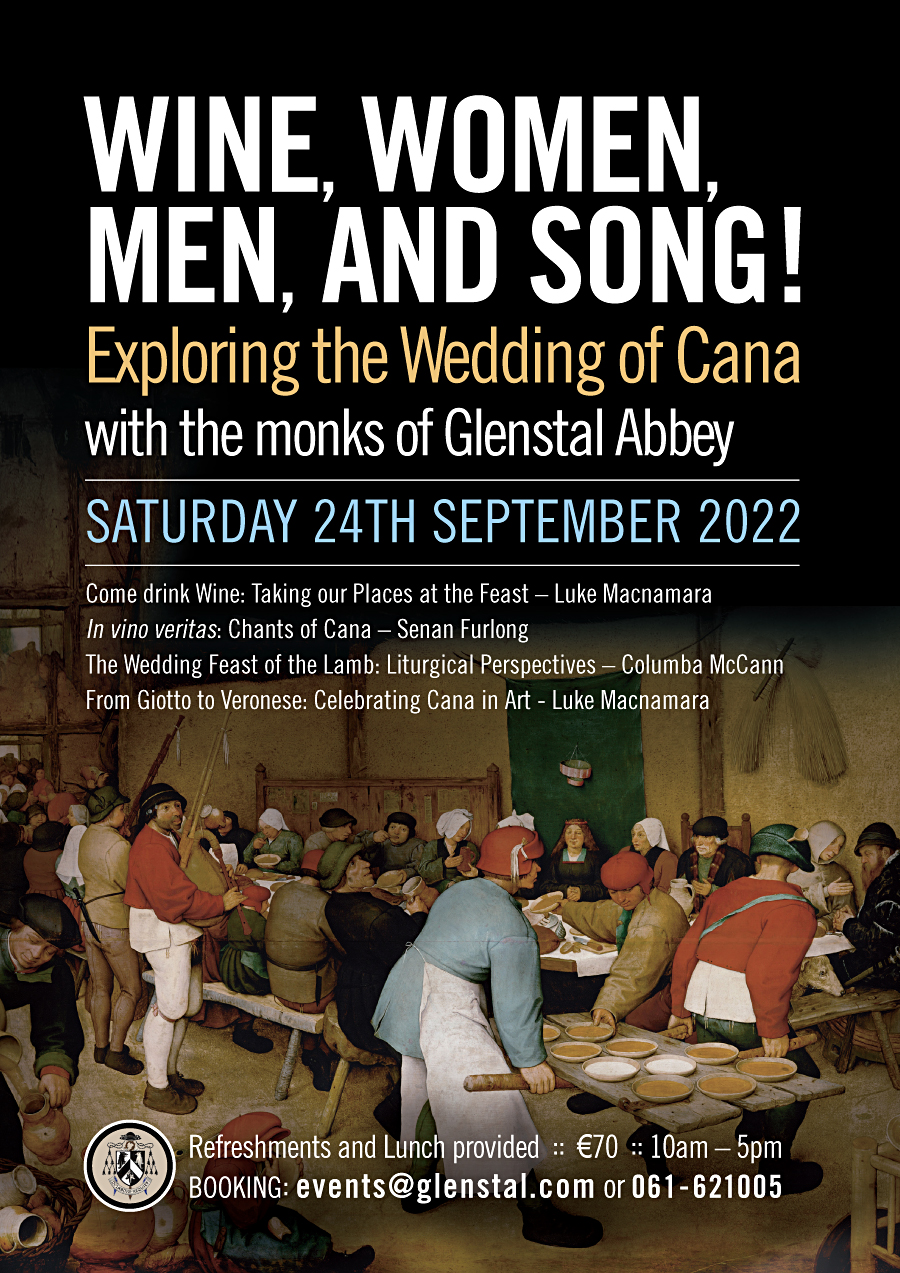
You are invited to the ‘Wine, Women, Men, and Song’ study day on the Gospel text of the Wedding of Cana. Join Fathers Senan, Columba and Luke to explore the Cana miracle through scripture, chant, liturgy, and art.

Talks include ‘Come drink Wine: Taking our Places at the Feast’ with Fr Luke, ‘In vino veritas: Chants of Cana’ with Fr Senan, ‘The Wedding Feast of the Lamb: Liturgical Perspectives’ with Fr Columba’ and ‘From Giotto to Veronese: Celebrating Cana in Art’ with Fr Luke.

Taking place at Glenstal Abbey on Saturday 24th September 2022 between 10am – 5pm, with refreshments and lunch provided. Donation: €70.

To book please email events@glenstal.com or telephone 061 621005.

Subscribe To Our Newsletter To Receive Updates

[hubspot type=form portal=6886884 id=9e1d6d0d-c51e-4e35-929d-3a916798de64]