

Categories
Abbey | Latest News abbeynews

Homily – 24th Sunday in Ordinary Time (Year C)

Fr Patrick Hederman OSB

The Prodigal Son

One thing we all have in common: we were born into a family of one kind or another. For some this was a blessing; for others the blessing was mixed; for many it was a disaster. Although we all have this one thing in common, it worked out differently in every case. Although you and I are family people, yours and mine were like chalk and cheese, tomahawks or SMGs. It depended on who our parents were or are, where we came in the family, how many of us there were, and above all what were they like? We choose our friends, as they say, but we’re stuck with Mum and Dad and the rest of them. No question of returned goods relief, no chance of an exchange or even a refund.

A French philosopher, Lachelier woke up one morning at the age of 26
saying to himself: ‘I realise today that I am the son of a man and a woman; that disappoints me; I thought I was a little more than that.’
Every family has sibling rivalry and inexplicable favouritism, real or
imagined. The Bible is full of it: Cain and Abel, Sarah and Hagar, Esau and Jacob, Daddy’s pet or Mummy’s boy, a black sheep and a blue-eyed wonder.

The feature film in this morning’s Gospel is a classic example: the
feckless spendthrift second son and the stalwart, steadfast, elder brother, always first in the class; never made a mistake in his life. And which one is Daddy’s favourite? You bet: the cheeky little waster who never did a day’s work in his life; who travelled the world hitting all the hot-spots, thinking of nothing and nobody except himself having the time of his life. Now we all know that there is great rejoicing in heaven when this idiot comes to his senses, picks himself up out of the pig-sty, dresses himself down and returns to his senses: three cheers for the Prodigal son!

But meanwhile, back on the ranch, what about me? Here I am, always
dependable, always loyal, always to hand. I stayed at home; I looked after the parents; I kept the family business going; I worked without reward or recognition, day and night, year in year out, come rain come shine. And what happens? The waster comes home, broke and bleary-eyed from debauch; poor little darling, worn out and exhausted from entertaining himself, on his last legs from living it up. And what do they do? Throw a party – invite all his well- wishers, his unbearable class-mates, his stockpile of girlfriends – a champagne barbecue to welcome him home.

What’s going to happen the next day? I’ll be up at dawn milking the
cows; he’ll be having breakfast in bed. Not a word of reproach, not a hint of disapproval: and don’t give me all that nonsense about how much I’m appreciated deep down, for my strong silent presence over the years, backbone of the family, my resolute reliability: I’m pissed off up to here; I’m riven with resentment; I’m ready to throttle him . . .
Now we can certainly see this point of view and I’m sure you can too:
but, unfortunately, it seems that at least one of the points of the parable is this: ‘Get over it baby, cop yourself on: if all your hard work, your duty-bound punctiliousness, your conscientious fulfilment of every tedious task that no one else will do; if all this has turned you into a bitter and resentful knit-picking judge of others, then all that so-called virtue is actually a toxic infection, paralysing not only you yourself but everyone else around you. So, get off the treadmill, unwind the whine machine, get yourself a life. The prodigal son is preferable to the po-faced perfectionist, the fault-finding sourpuss, the bellyaching grouch. So, shove that down your windpipe and ‘woke’ it, as they say these days!
Categories
Abbey | Latest News abbeynews

Homily – 23rd Sunday in Ordinary Time (Year C)

Fr John O’Callaghan OSB

‘We can hardly guess at what is on the earth, and what is at hand we find with labour’, as the first reading says. Many of us may be painfully aware of how hard knowledge is to acquire as new books pile high on our desks at the beginning of the school year. To learn another language, to understand mathematics or history, or how to run a business, can challenge the most capable of us. And life is more than books: learning the guitar, winning a game of chess or a rugby match, can show us the limits of our ability- to say nothing of trying to being friendly and courteous to all and to live together in peace! In all these challenges we recognise our limitations but today’s gospel puts everything into a wider perspective: Christ reminds us of another challenge in our testing world: ‘if anyone comes to me without hating his father, mother, spouse, children, … and his own life too, he/she cannot be my disciple.’

Let us be clear from the outset that by ‘hating’ Jesus couldn’t possibly mean despising another human being; he spent his whole life teaching us to ‘love our neighbour as ourselves’, to treat people as we would have them treat us, even our enemies. No, it was the Aramaic style of Christ’s speech to use superlatives instead of more nuanced comparatives to make his point; by ‘hating’ those closest to us he was saying ‘don’t prefer them to me’. The gospel is telling us not to prefer anything at all to being a disciple of Christ, not to take anything more seriously than going-to-God and making Him the centre of your life.
This applies to us today; He is saying that in all your hopes and ambitions for the coming year, be they for top grades in the Leaving Cert’, trophies on the games fields, or good times with friends, remember that there is more to your life than any of them, more than all of them put together.

And why? Because there is more to our lives than meets the eye! We are more than our marketable qualities, more than our reputations for winning or losing, more than what we can get out of other people. In our baptism we were all made members of the People of God, given a share in the divine life as His sons and daughters, destined for eternity. Our lives are sacred, because they have been made so by God. We have been made for him, the eternal God. Our importance and value cannot be reduced to achievements, reputation, or just ‘fun’ with a circle of friends. Instead our lives open onto eternity. To illustrate this Jesus takes what may be most dear to any of us, our special relationships, with family and friends, and teaches us that these relationships must always be second to our relationship with Him. That is saying a lot, as
anyone knows who has run into the love parents have for their children. It is what Paul was talking about in the second reading today: that Philemon should take back his runaway slave, Onesimus, with affection, rather than with punishment, because he is a fellow Christian. And Jesus teaches that even life itself is not worth extending forever, as an absolute value. He showed this by taking the road to Jerusalem, where was to die. He gave up his life on the cross for something better, so that we might share with him in the life of God.

Ultimately what we are talking about here are rival loves. We have every right to love learning, to love sport, to love people. But let us love them as Christians, knowing they are not absolutes, taking us over, ‘owning’ us. They are gifts and for a time. As we move from one home to another in the course of our life, from family, to school, to the world of work and elsewhere, let us remember that our destiny is greater than them all, our true homeland is in heaven. If we make of one of our passing homes the final end of our life that would be the final end of
us. So let us approach study with serenity, sport with honesty, and people with Christian respect, thanking God for all these blessings as we make our way to our heavenly homeland.

Categories
Abbey | Latest News abbeynews

Psalm 50 chant

The penitential Psalm 50, allegedly written by King David after his sin with Bathsheba, which the monks of Glenstal Abbey chant at Lauds on Friday of Week 1 📖🎶

Categories
Abbey | Latest News abbeynews

Homily – 22nd Sunday in Ordinary Time (Year C)

Fr William Fennelly OSB

Today’s gospel has always struck me as having a message that is somewhat odd. Be as humble as you can be in order to get a reward it seems to say. This is not really a teaching that fits in the management and self-improvement manuals of our times, which urge us to practice discipline to become bigger, faster, stronger, more successful and of course richer. The contrast with the teaching of today’s gospel is put pithily by St Bernard of Clairvaux who said that “Love is its own
payment, its own reward”. Christ gives the most profound teaching of this kind of love in the self-emptying love of the Cross where he holds absolutely nothing back. This powerful and almost excessive love is called kenosis in the tradition.

And the great French philosopher and mystic of the 1930’s Simone Weil was particularly drawn by it’s power. God in this version of the Christian event is wholly transcendent, wholly other and anything we say about him will be inadequate to the task. And yet this is not a remote God because it is in the absolute otherness that love gets its greatest power for her and she clung dearly to the church’s teaching in the Catechism that ‘Sustained by divine grace, we respond to God with the obedience of faith, which means the full surrender of ourselves to God and the acceptance of his truth insofar as it is guaranteed by the
One who is Truth itself.’ The phrase “full surrender” stuck with her and led her to pursue her goal with an austere singularity of purpose.

For this admirable and deeply intelligent woman her proof text was that Christ ‘emptied himself, taking the form of a slave.’ For her this is: suffering without consolation, which nevertheless doesn’t degrade the soul. In an essay ‘The Love of God and Affliction’, she writes, ‘at the very best, he who is branded by affliction will keep only half his soul.’ Affliction is her theodicy, her vindication of God in the face of evil and of course this was a question of considerable moment her as a Jew in the late 30’s and 40’s in France. The deeply troubling enigma that God
should have apparently given affliction the power to seize the very souls of the innocent and to take possession of them as their sovereign lord’ sits ill with most us today I suspect. Affliction for her she said is not merely the distance from God, but absence: ‘the soul ceases to love, God's absence becomes final.’ For God Himself to experience this absence, and to go on loving, to become the void
which is filled by God, is redemption. This really powerful and has something of Ignatius of Loyola’s prayer about it, “to give and not to count the cost to labour and to look for no reward”. And yes love should be without condition but to forsake conditions to this extent seems like a form of unhinged madness that’s compelling and perhaps just too far from our more mundane reality. And yet it does rings with a truth however much we might struggle with its demand. In mortals, to go on loving in affliction is inconceivable without grace, without
the gift of God’s love. The crucifixion is unique as a moment of self-gift without reserve which is totally unconditional: it is simply a pure gift of love. Rather than fleeing the messiness of human community, Christ’s self-emptying on the cross allows for the fullness of life to be realised. the purpose of individual life fulfilled in the resurrected body; communal life in the New Jerusalem. Christ’s sacrifice is also the model for an affirmative mysticism, a way of positive affirmation of God’s presence in Creation, from this perspective we deny ourselves in service of others. If the self-annihilation spoken of by Simone Weil turns our attention inwards, exalting the self, then if we turn our attention outwards, towards others, also reduces the focus on ourselves. Surrender, then, looks more like Christ washing the feet of his disciples. As it says in John’s gospel (13:12-14) “So if I, your Lord and Teacher, have washed your feet, you also ought to wash one
another’s feet. For I have set you an example, that you also should do as I have done to you”.

This spiritual tradition involves fewer fireworks and ecstasies. Rather than the ascent and descent of Weil’s theology, it moves outwards and inwards: mission, hospitality, prayer. ‘Ask and it shall be given to you, seek and you shall find’ (Matt 7:7). It encompasses the works of mercy, the hard work of forgiveness and reconciliation, the frustration and irritation of sticking with people we struggle to like. It is the Little Way of St Thérèse of Lisieux, devoting oneself to the ordinary business of loving other people and recognising the beauty and value in each of them. Rather than locking the mystic to God in an insular union, it
embeds her in a web of relationships and communities. Common life necessitates a mature understanding of one’s responsibility towards others, whereas self-annihilation makes personal responsibility much more difficult. It follows that a cataphatic mysticism would reject the hatred of the body common to the negative way I tried to describe at first, rather it works by recognising the body as a gift which enables us to live a common or shared life with all the risk it entails — eating, drinking, loving. Christ’s surrender on the cross is completed
with His resurrection and the promise of transformed, perfected, embodied life.

The promise of the new creation is not that risk will be averted, sadly that’s just not possible, but the promise that finally we will be able to see each other face to face. God reveals himself in the face of those around us. Our lives and how we live with each other really matter. This kingdom of God is coming will be shared by us all.

Categories
Abbey | Latest News abbeynews

Homily – 20th Sunday in Ordinary Time (Year C)

Fr Christopher Dillon OSB

Out of the clear blue sky, comes this bombshell of challenge from Jesus to those who were and are following him. What were they, what are we, to think?!

What has happened to that “peace on earth, to people of good will”, of which the angels in St Luke’s gospel sang? All is now division and implicit conflict, reminiscent of the subsequent prophecy of Simeon to Mary and Joseph, also in Luke’s gospel, when he said of Jesus, “This child is destined for the rising and falling of many in Israel…to be a sign that is rejected.”

In St Luke’s account of the Gospel, from which this passage is taken, Jesus is on the point of heading for Jerusalem, where he is to suffer his passion. It is the point of decision and crisis for him, when he will be rejected definitively by the Jewish authorities and by his own follower, Judas Iscariot.

We are being told, on this glorious summer’s day, that we too, every one of us, have to decide one way or the other; either we are for Jesus, as the Way, the Truth and the Life, or we are against him, in favour of accommodation with the spirit of the world and compromise with convenience at the expense of goodness and justice. And let’s face it, for centuries of its history, the Church compromised with and was compromised by its association with the powers that rule in civil society. A great part of the novelty of secularism for Christians, today, is the discovery that, all of a sudden, we are on our own. Civil society is not only not influenced by the Church; it is increasingly that the case that it opposes and rejects the Church.

In a manner which is relatively new for us, in our society, here in Ireland, the Church is having to begin again. It is an exciting time, but it is challenging. Increasingly, Christians among us are having to think as Christians, as opposed to being merely members of our society. We are very much at that point of decision, where the disciples found themselves, when Jesus was snatched away from them, and they had to decide whether or not they would stand against their religious establishment and start afresh on their own, with the spirit of Jesus  for guide; the stone rejected becoming their corner stone.

While we calculate our options, on the way to Jerusalem, along with Peter and the other disciples who will stand by and watch, if they don’t run away, Jesus, standing by his decision, is wrenched up on the gibbet of the cross, to hang from those nails and slowly suffocate. He does this, in order to bear definitive witness to Goodness and Truth, on  behalf of humankind, so that we, deciding to stand with him, may associate ourselves with his gift of himself to the Father of Goodness and Truth.

This has been the plan of Father, Son and Spirit, from the very beginning, to salvage humankind and all creation from the consequences of Adam’s sin and the Fall. And it is the Good News of Christianity that that plan has been accomplished,  by means of the life, death and resurrection of Jesus Christ. If we find this convincing, we must make the decision to go with it, whatever the ensuing division in our everyday life. But then, it is true that, for all the pain of division, there is ultimate peace in the decision for the life of Goodness and Truth which is uniquely in Jesus Christ. This is the peace that Christ leaves with us, that he gives us; not as the world gives peace. Is this, perhaps, the peace of which the angels were singing? So, how do you decide?

Categories
Abbey | Latest News abbeynews

Homily – 21st Sunday in Ordinary Time (Year C)

Fr Cuthbert Brennan OSB

What are we to make of the God we encounter in our readings this morning? Luke continues to present to us the God of the great reversal. The last shall be first the first shall be last. We are warned that close proximity to Jesus doesn’t guarantee us a seat at the banquet and is not to be equated with struggling to enter through the narrow door. Jesus seems to go beyond his inner circle when envisioning the vastness of God’s beloved – he goes so far as to clarify that a certain group who thought they could rely on their social connections and long-time friendship with Jesus would not make it through the narrow door, while hoards of others would be invited to recline at table.

Insiders become the outsiders and the outsiders become the insiders. It would seem that God is not fair.

Does not our baptismal cert give us priority boarding, our guarantee for access to the fast track corridor? We attend and participate, be it here physically or virtually via the webcam. However, Jesus this morning says Be careful, if you think you have a boarding pass, if you think you know who should get in and who shouldn’t, you might just have locked the door against yourself.

How many will be saved?

The better question is ‘How may I be included among the people of God? And the answer we are given is to strive to enter through the narrow door. Strive! There is effort required to enter through the narrow door and Jesus makes a point of saying that many will not be strong enough to accomplish it. In antiquity, the synagogue often had a large door where people of status would enter and a narrow door where people of lower status would enter and the use of such imagery by Jesus suggests a call to solidarity with those who enter through the narrow door, those who are on the margins of society.

The narrow door in the gospel this morning is not a thing: it is a person. Jesus is the true narrow door through whom we must pass. The irony in the revelation is that the narrow door can properly be understood, not only as the person of Jesus Christ, but more broadly, as the justice enacted in his name. It is based on what we do…..the justice that we enact. The author of the letter to the Hebrews calls our attention to this. We are to be trained in righteousness, and this is not always pleasant or easy. Many of us need to rid ourselves of selfishness and greed. Others of us need to cleanse our hearts of biases and discrimination.

For us today, as for the Lukan community, the struggle is for humility and solidarity with the marginalised in society. What our baptismal cert does give us is the responsibility of witnessing to the entire world, the glory and justice of God. We are called to reverse our attitudes and practices, avoid the large door, and struggle to enter through the narrow door with the people who need us to be with them. Who is that person for you today? Maybe it is a person of a different faith, or someone who holds a different political position from you. Maybe it is a person of a different racial identity or gender classification. Whoever that person is, they should be able to recognise God’s goodness in the way we live our lives and in the manner in which we interact with them. They are the living keys, which can pry open the narrow door that is often rusted shut by our own prejudice. We are to strive to enter through the narrow door. We are to be disciplined in gospel ways, disciplined to practice justice, to expand our narrow minds and hearts so that we might honour those whom society diminishes, casts aside and overlooks. They hold the key to our salvation, for when we open a door for them they in turn open the door of the just Christ for us.

God is not fair, but depending on where you are in the line that can be good news.

Categories
Abbey | Latest News abbeynews

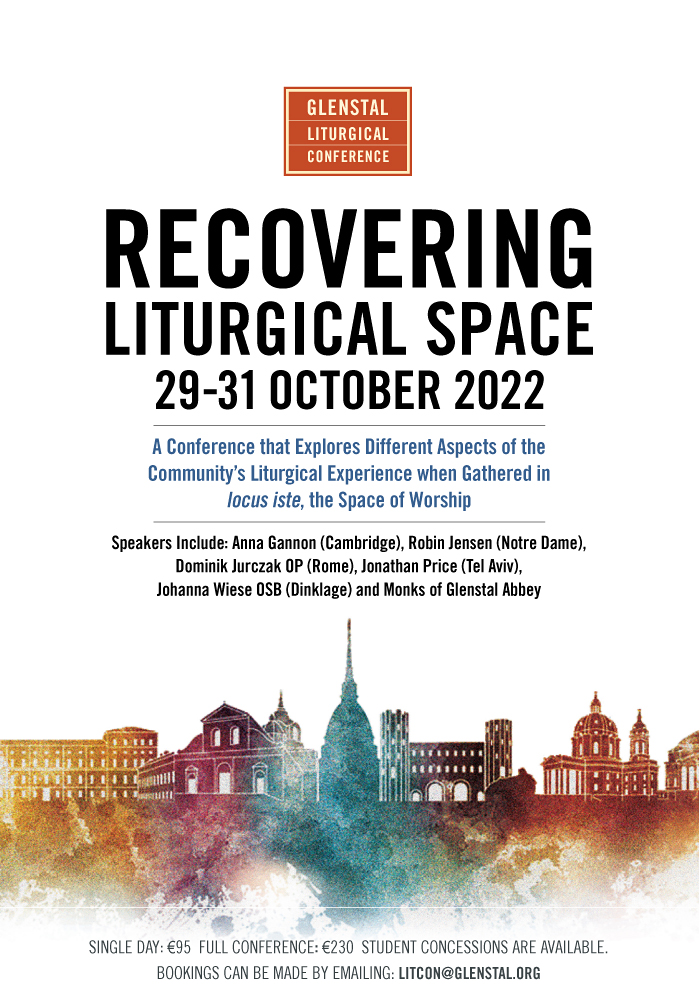
Liturgical Conference 2022

Glenstal Abbey’s Liturgical Conference is back and this year will consider the liturgical experience of the community when gathered in the place of worship.

This discussion is all the more relevant in light of the COVID-19 pandemic and the use of ‘online worship.’ The monastic community desires participants to engage directly with the conference speakers about this shared experience.

Those wishing to attend should contact us and include all relevant details such as the number of days they wish to attend, any special dietary requirements, etc. Accommodation is not available at Glenstal and must be booked separately, although we can assist with details of local hotels and B&Bs if requested.

More details, including those on conference speakers and their talks, are to follow.

When: Saturday 29th – Monday 31st October 2022.

Price: Single day €95 or Full Conference €230. Student concessions available.

Contact: litcon@glenstal.org

Download: Glenstal Liturgical Conference 2022 Poster

Categories
Abbey | Latest News abbeynews

Homily – 19th Sunday in Ordinary Time (Year C)

Fr. Luke Macnamara OSB

Wake up. Pay attention. Don’t let life pass you by. There is something wonderful in store for each of us today, but we need to awaken our senses to perceive and receive God’s gift. Séamus Heaney remembers how he captured a gifted moment in his life, one that might easily have passed him by, in his poem: “Had I not been awake, I would have missed it.”  For Heaney, the chimes of nature coalesced like a movement from a symphony awakening him to the wonder and possibility of life. This moment passed but was transforming and pivotal to his recovery from a stroke. The poem evokes not only the memory but that electrifying experience that sets him all a-patter. The poem was not a mere looking back to a historical episode of his life but about access to the energising force with which he henceforth continued to live his life.

Jesus’ words are a wake-up call: “See that you are dressed for action and have your lamps lit.” Too many of us slumber through life and miss God’s electrifying presence in our lives and all that he envisages for us. We too often settle for low voltages, when God has something much more ambitious in store for us. How might we overcome our severely limited vision of possibility and become open to the expansive outlook of God for us? The path of growth can be daunting but again Jesus points to some helpful ways in which we might become more open and less afraid of the great journeys God envisages for us.

The commandment of Jesus recalls the Exodus, when the Hebrews were to dress for action and have their lamps burning, ready to depart from the land of slavery in haste. This brief commandment evokes the whole Exodus experience, a daunting journey through the sea and desert and in the face of multiple dangers from the ravages of armies and nature. By dressing for action and lighting our lamps we prepare to take the great journey that God has planned for each of us. We do so in the knowledge that God has helped and delivered our ancestors of the Exodus against incredible odds. But if we examine our own personal stories, we will discover times when God has helped and delivered us in times of difficulty, perhaps the death of someone close, or a prolonged period of depression or addiction. Reflecting back, we begin to see how we never could have managed on our own without God’s help. Regular remembrance helps us to become attuned to how God works in our lives.

Remembrance is only the first step. It is good to give thanks for all that God has done for us in the past. The community of the book of Wisdom who remember the Exodus follow up the remembrance by singing hymns to God. Our giving thanks is a response to God’s work in our lives and joins us ever closer to him. Our active participation at the Eucharist is the climax of our act of giving thanks to God. We offer our whole selves through prayer, listening, responding, with Christ to the Father.

Finally, it is important to celebrate how God has worked for us in the past but also how he works for us here and now. The Hebrews in the desert had to prepare their own meal in haste before departing Egypt. Jesus promises that should we be ready when he comes, that he will gird himself and seat us at table and serve us. This he has done at the Last Supper where he washed our feet and gave us his body and blood. He invites us now to this banquet at his altar.

The Mass combines remembrance, thanksgiving, and celebration for our definitive deliverance from sin and death and through Jesus seals our union with God. May we prayerfully enter into this triple dynamic and become ever more aware of how God is present in our lives through the peaks and troughs, cognisant that the definitive Exodus, the victory over death and sin has been won for us. Let us be dressed for action with our lamps burning and so be ready to journey with God along the open path to life eternal.

Categories
Abbey | Latest News abbeynews

HOMILY- FEAST OF TRANSIGURATION – SOLEMN PROFESSION OF BR. JUSTIN ROBINSON – 6TH OF AUGUST 2022

-Fr. Abbot Brendan Coffey

Dear Justin, three years ago you came before this altar and made your simple profession in our community. Today, you are ready to take vows for life and we welcome you, definitively, into our community. You have chosen to take this step on the beautiful feast of the Transfiguration of the Lord, a feast so very dear to monks.

There are certain moments in life when we can see another person revealed to us in a depth, which we never saw before. Sometimes this happens in moments of crisis, or moments of great joy or sadness. For some reason we become pure of heart and we see the other in a different light. Although terribly inadequate, this experience can help us appreciate something of the apostles’ vision on that mountain. They saw Christ in glory at a moment when His total surrender to the will of the Father became revealed to them. Moses and Elijah stood beside him, the law and the prophets. Both are necessary in monastic life.

The three apostles are an important part of the scene as well. They wanted to remain there forever, as do we whenever something fills us with wonder, but this is no time for building tents. The tradition of the Church often sees in them the theological virtues. The faith of Peter, the rock, the hope of James, the martyr, and the love of John, the beloved. I commend these virtues to you today, Justin. Seen through the eyes of faith, hope and love the Transfiguration allows us to understand that saying which the Desert Fathers so often repeated. ‘The one who has seen his brother or sister has seen God.’ It is an imperfect community you join here today, and you need to understand the wisdom of this saying to prosper.

There is also another side to our protagonists. Moses had a dark secret; murder. He came across an Egyptian mistreating a Hebrew and killed him. The defining moment in Moses’ life comes at the burning bush. Here God reveals his name to Moses and, in a sense, transfigures him with hope for a better future for God’s people Israel. Filled with this hope he is ready to receive the Law.

You will recall that Elijah doubted God’s love and mercy, even after God had granted him his great victory over the prophets of Baal. He ran away because he was afraid of Jezebel, the queen. God managed to transfigure Elijah through this experience of desolation, renewing his faith. He is now a true prophet.

The three disciples aren’t much better. Peter, the impulsive one, the one who would end up denying his Master at the critical moment. The brothers James and John, who wanted to call down fire on the Samaritan women and children! Who tried to outmanoeuvre the other disciples, to get seats at the right and left of the Lord. Pentecost makes them apostles, filled with faith, hope and love.

In engaging with this gospel, we participate in our own transfiguration, our conversatio morum. Far from perfect, we too can change, convert and become the person God created me to be. For you Justin, that is a monk. Take St Paul’s words as your motto “I will sing with the spirit and I will sing with the mind” (1Cor 14:15). Mens concordet voci, as St Benedict says.

I leave to St Paul the final word, “When I was a child, I spoke as a child, I thought as a child, I reasoned as a child. When I became a man, I put aside the things of childhood, for now we see in a mirror, confusedly, but then we shall see face to face. Now I know only partially, then I shall know fully, just as I am fully known. Now faith, hope and love abide, the three of them, but the greatest of them is love.” (1Cor 13:11-13)


Categories
Abbey | Latest News abbeynews

HOMILY – RENEWAL OF VOWS – 5th OF AUGUST 2022

-Fr. Abbot Brendan Coffey OSB

On 7 July last, the Hellier Stradivarius was put up for auction at Christies with a starting price of £5.5 million. It failed to sell. This violin is described as “the finest inlaid violin ever made by… Stradivari”, who kept the instrument for 55 years, before he sold it in 1734 for £40 to Samuel Hellier.

If you think that’s extravagant then you need to hold onto your seat before I tell you that in 2014 the Macdonald Stradivarius, one of only eleven surviving violas crafted by the master, went on sale at Sotheby’s with a price tag of $45 million. Unsurprisingly, it also failed to sell!

Sadly, being so very valuable, these instruments often end up in display cases for safekeeping and are rarely played. If you have a Stradivarius and nobody to play it, it’s just a Stradivarius. Or is it even that? It’s nothing. In the wrong hands, even a Stradivarius can sound like a collection of alley cats screeching.

There is one school of thought, which says that a really good violin will, if not played for a few months, “go to sleep.” It’s difficult to say exactly what this means, but apparently its tone dies, it becomes “less bright” and, to the professional ear, “sounds sleepy.” If played again regularly and frequently for a few weeks it will gradually “wake up” and become its former self.

The Rule of St Benedict is like a finely tuned Stradivarius. It is priceless in its wisdom and the possibilities it offers, but without monks to live the life, it is nothing. In the wrong hands, it too can become like a bunch of screeching alley cats.

The Rule is meant to be lived and lived seriously by a monastic community. It is not something to be admired from a distance for its wisdom, moderation, creativity, understanding and longevity, as often happens. The Rule is nothing at all if there are no monks to bring it to life. It is not a relic of a distant golden age, it is not a reference work to sit on the shelf and gather dust, something to be consulted from time to time as the need arises. The rule is a living document, brought to life in the daily round of a monastic community. If it is not this, then it too will “go to sleep” and with it our monastic life! It is for this reason we read a portion of it together every single day.

So let us play the tune of our monastic life in this community with a rich, bright and powerful tone, bringing the Rule of Benedict to life in this place for the people of our own time as we now renew our monastic profession.

Subscribe To Our Newsletter To Receive Updates

[hubspot type=form portal=6886884 id=9e1d6d0d-c51e-4e35-929d-3a916798de64]