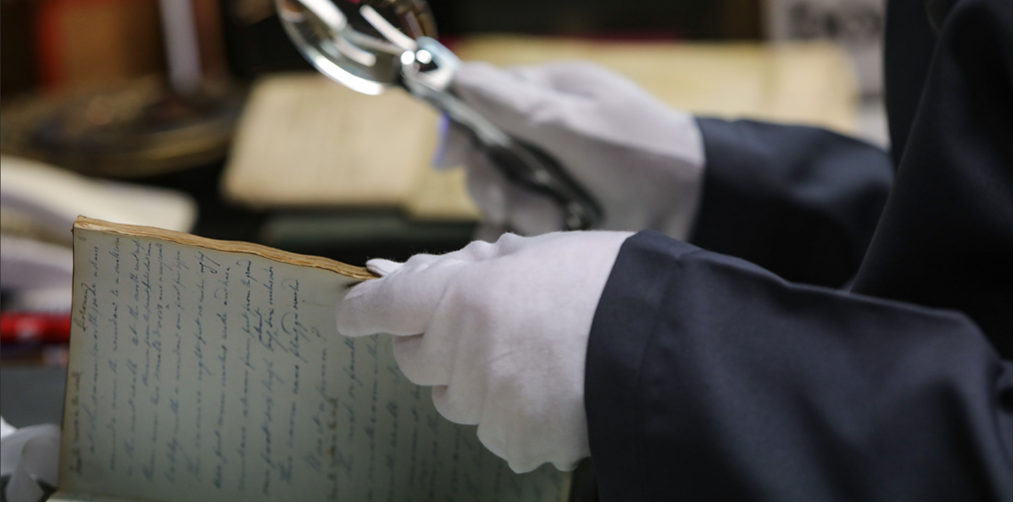



Extract from the Annals of Glenstal Priory for 18th and 19thDecember, 1927:
‘He [Father Superior, Dom Gérard François] came back [from Belgium] during the night before December 18th. The next day, it being a Sunday, the six members of the new foundation being assembled in Sir Charles Barrington’s former smoking-room, at the bottom of the main staircase, Dom Gérard declared that the Lord Abbot of Maredsous and the Lord Abbot President of the Belgian Congregation had delegated him to erect canonically the new priory. Consequently, the regular community-life was to start this afternoon.
From the next morning onwards, Matins were said in choir at 5.20 in the morning – one hour later than in Belgium. In that first community conference, Father Prior pointed out that our work was going to be a long an arduous one; and that we were not likely to reap ourselves the full fruit of the seeds we were sowing…’

CHRISTMAS LITURGY TIMES/OPENING HOURS
Wednesday 24th December (Christmas Eve)
6 pm – Vespers I
11.20 pm – Vigil followed by Midnight Mass
Thursday 25th December (Christmas Day)
8 am – Solemn Lauds
10 am – Morning Mass (no music)
12 noon – Solemn Conventual Mass
5 pm – Vespers II
Friday 26th December (Feast of Saint Stephen)
7 am – Matins and Lauds
12.10 pm – Mass
6 pm – Vespers
Saturday 27th December (Feast of Saint John the Apostle and Evangelist)
7 am – Matins and Lauds
12.10 pm – Mass
6 pm – Vespers I of the Holy Family
8.35 pm – Vigil
Sunday 28th December (Feast of the Holy Family)
7 am – Lauds
10 am – Mass
12.35 pm – Sext
6 pm – Vespers II
8.35 pm – Compline
Monday 29th December (5th Day in the Octave of Christmas)
7 am – Matins and Lauds
12.10 pm – Mass
6 pm – Vespers
8.35 pm – Compline
Tuesday 30th December (6th Day in the Octave of Christmas)
7 am – Matins and Lauds
12.10 pm – Mass
6 pm – Vespers
8.35 pm – Compline
Wednesday 31st December (7th Day in the Octave of Christmas/New Year’s Eve)
7 am – Matins and Lauds
12.10 pm – Mass
6 pm – Vespers
8.10 pm – Vigil
Thursday 1st January 2026 (Solemnity of Mary, Mother of God)
7 am – Lauds
12.10 pm – Mass
6 pm – Vespers
8.35 pm – Compline
The normal liturgical time resumes from Friday 2nd January 2026.
Confessions
A priest will be available on Christmas Eve from 2pm – 5pm in the Abbey Church.
Guesthouse
Closes on Sunday 21st December and reopens to guests on Monday 29th December.
Monastery Reception and Shop
The following are the opening hours of the reception and monastery shop from Monday 22nd December to New Year’s Day.
Monday 22nd – Wednesday 24th December: 10am – 2pm
25th, 26th, 27th, 28th December: CLOSED
Monday 29th – Wednesday 31st December: 11am – 4pm
Thursday 1st January: CLOSED
Friday 2nd January return to normal working hours of 9am – 5pm.

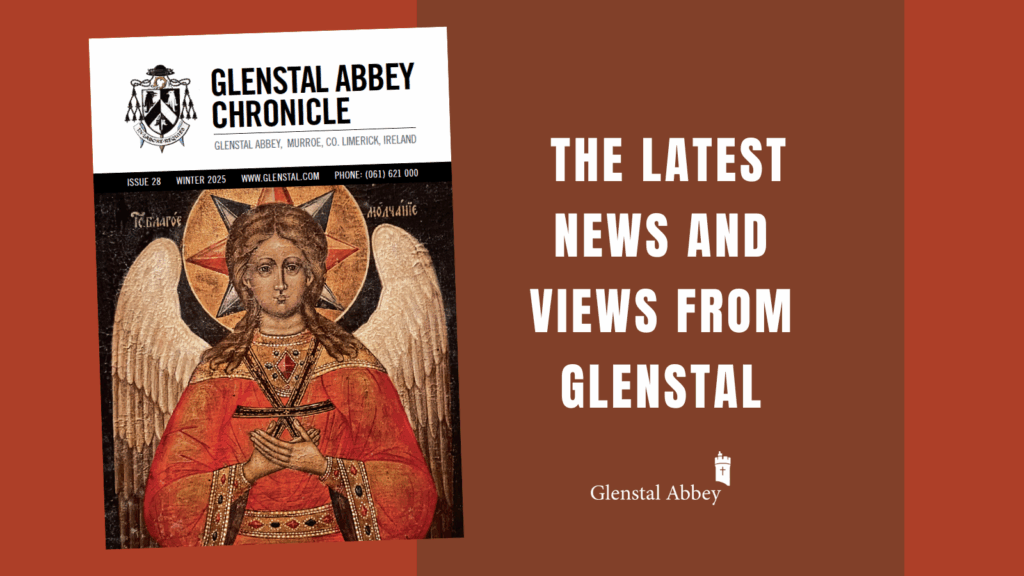
The Winter 2025 edition of the Glenstal Abbey Chronicle has been published, and is now available to read on the website here.


I have always liked – but for no morbid reason – the month of November, a month when the turning of the seasons mirrors the cycle of life and death. There is something about the days growing shorter and nature itself dying back into winter that connects in my being. For our Celtic forbears this was a liminal time, Samhain, when the veil between worlds became more transparent and the connectedness of both worlds became present. In all of this, nature herself calls us to remember those gone before us. The month is laced with ritual, beginning on All Hallows’ Eve, to the great interwoven feasts of All Saints on the 1st November and All Souls on the 2nd November, days of remembrance and remembering. These feasts, rooted in time and tradition, connect, celebrate and offer prayers for the departed as expressions of hope in the resurrection and eternal life.
The practice of commemorating the dead finds deep resonance in our Benedictine tradition. At the Abbey of Cluny in medieval France – one of the most influential monastic centres in Europe – the remembrance of the dead was woven into the very fabric of daily life. Founded in 910, Cluny became renowned for its spirituality, liturgy, learning, and architecture, but also for its spiritual concern for the souls of the departed. The Cluniac monks introduced the practice of offering regular Masses and prayers for the dead, formalising what would become the Feast of All Souls. This innovation spread throughout Christendom, shaping how generations of Christians would remember their ancestors and loved ones. This emphasis on remembrance was an act of profound faith in the communion of saints, a belief that we, the living, remain united with our dead in Christ through prayer and love. This in essence is what we remember during this month of November.
As in all parishes, this tradition finds quiet continuation here at the abbey in Glenstal. Woven through the monastic rhythm of prayer, reflection and work, is this thread of remembrance. Each day, at the conclusion of the various hours we pray ‘May the souls of the faithful departed through the mercy of God rest in peace’. In particular, at Midday Prayer on Sunday, we commemorate all our deceased brethren, relatives, friends, and benefactors as we chant;
‘With your holy ones, O Christ,
give rest to all your servants in a place of peace,
where there is neither pain nor sorrow but joy in everlasting life. Alleluia!’
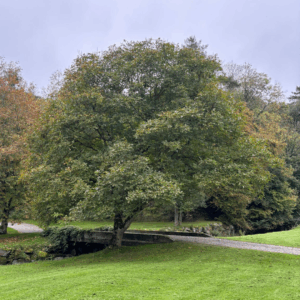
Rather than a place of desolation, the cemetery here becomes a witness to continuity; between life and death, between past and present, between earth and heaven. The autumnal dying light, the rustling leaves, and the scent of damp soil all seem to join in the liturgy of remembrance. In this setting, history breathes gently and memory is renewed through the quiet chant of the monks.
Thus, for a Christian, November’s commemoration is not nostalgia; it is an act of faith and love. To remember our dead, ‘those gone before us marked with the sign of faith’, is to affirm that life transcends mortality; that those gone before us remain part of us, part of our spiritual family, as one day will we for those left after us. Remembrance is a sacred bridge between them and us, between here and there, between time and eternity.
May their souls and the souls of all the faithful departed,
through the mercy of God rest in peace. Amen
Pádraig McIntyre OSB

Br Timothy McGrath OSB passed away peacefully aged 79 on Saturday 18th October 2025. He is mourned by his community, his family and a wide circle of friends and colleagues.
He made profession of vows as a monk of Glenstal Abbey on 6th July 1973 and his work of service was rich and varied: novice master, teacher in our Abbey School, rugby coach and career guidance counsellor to senior students.
Facing up to significant illness over the last ten years with courage and a zest for life, Br Timothy left us suddenly, yet aware that his health was precarious. He was particularly saddened by the death of his brother Leo only three weeks before his own.
Eternal rest, grant unto him, O Lord, and let perpetual light shine upon him. May he rest in peace.
Funeral arrangements: reposing at Glenstal Abbey from 3.30-5pm on Friday 24th October, followed by removal to the Abbey Church and celebration of the Office of the Dead. Funeral Mass at 11.30am on Saturday 25th October, followed by burial in the Abbey Cemetery.

The monastic community announces with sorrow the death of Br Timothy McGrath OSB, a monk of Glenstal Abbey since 1971.
May he rest in peace.

Over the years many people have desired to join us in prayer by using the books which monks use in the monastic choir.
We’re delighted that a limited number have been now been printed to enable friends of the monastery to unite their prayers with ours, particularly when praying with us via the webcam.
A book for Vespers (Ferial and Memorials) and Compline is now available, with books for the other hours to be printed soon.
Write to guestmaster@glenstal.com to find out how to order your copy!

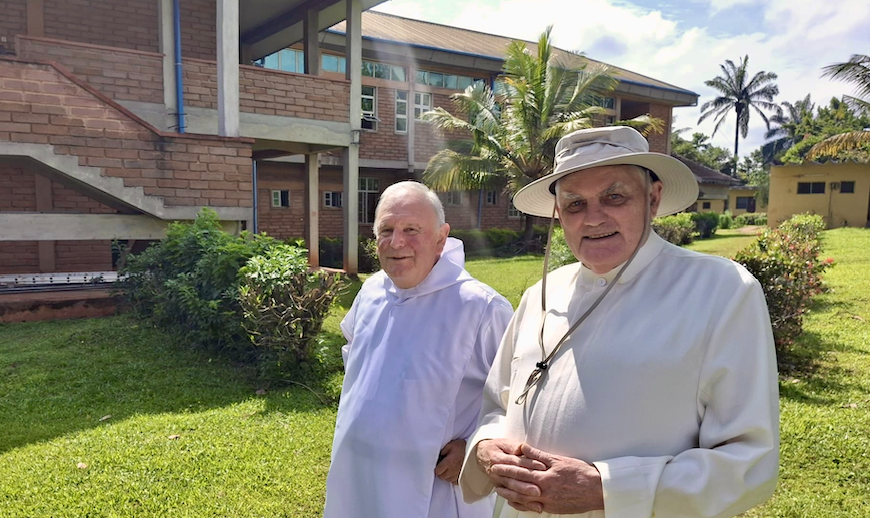
It would be inaccurate to say that the monks of Glenstal Abbey contributed to the establishment of our monastery in Nigeria, as if they were adding to something that already existed. In reality, they were the very foundation of monastic life at Saint Benedict’s Priory in Ewu-Esan in 1979. They did and were everything for us: erecting the first buildings, establishing plantations, recruiting and forming the initial community of monks, and raising the funds needed to feed, clothe, and train them.
They were monks of vastly different gifts and personalities. They were mystics, philosophers, teachers, scholars, preachers, linguists, musicians, farmers, builders, and much more. Those pioneering early monks were popular in the locality whenever they went out to celebrate Mass, something which was appreciated by the local faithful and non-Christians alike.
When the monastery’s turquoise blue Volkswagen Beetle hit the road, the villagers would run and thunder excitedly: “Father! Father! Father!” irrespective of the driver. The car’s identification with the monastery was enough to cause a great stir among the locals, particularly as “Father” would often stop to give a lift to as many people as could be accommodated inside, outside and on-top of the little car as it bounced its way along the village roads.
Those early monks were all past middle age, and would even be considered elderly by African standards… I recall a local priest cautioning me against joining the community as he believed “the monastic life is meant for old and frustrated people.” They were certainly older men, but they were not frustrated. They came with energy and the common purpose of planting the monastic life in Nigeria. We were blessed in the following years to be visited by generations of Glenstal monks who helped us with formation, classes, music, retreats, and so on. They brought a new dynamism to the community, and their creativity contributed positively to the monastery’s outlook.

Looking back, one feels we owe those pioneering monks from Glenstal Abbey so much, especially for their efforts to establish an African monastery for Africans, rather than a community built along European lines here. It must have been a life of great sacrifice for these men, but it is one of the reasons they became revered and loved by all. Upon arrival, they observed local conditions and decided to go into agricultural work. They planted palm oil trees and – like local farmers – cultivated the yam, cassava, maize, plantain and melon which constitutes the diet of ordinary people, along with other vegetables and fruits like pawpaw, pineapple, bananas and oranges.
These Irishmen were used to potatoes and plenty of meat and fish, but soon they grew accustomed to eating mostly mashed yam and rice, with very tiny pieces of fish and meat during lunch on set days in the week. It was very obvious that they chose to identify with the local people, especially those at the margins of society. They soon began to resemble particularly impoverished Africans!

People didn’t see them as far off, distant, or unapproachable. Imagine the scene: many times a local woman would go into labour in the village, and her husband would run to the monastery in the middle of the night to call for help. One of the monks would appear, take out the famed turquoise blue Beetle and rush them to the hospital in the next town. It was run by Irish sisters, and the bill would be settled by the monks.
They lived simply, often precariously, and always close to the margins. They adopted what they could of African culture, and avoided imposing European ways onto the brothers. They guarded against the tribalism which is often common in African communities made up of members from different tribes, giving us today a strong community which is diverse yet unified.
These men were deeply convinced of their monastic calling, and they taught by their example of prayer, work, study and the common life. If the monastery were to fail today, it would be on our own heads and not on those of the Glenstal monks who made such a great sacrifice to create and hand over to us all that we have now. They laid the foundations in such a way that we, as native Africans, could shape the monastery with our own identity and culture. Abbot Augustine O’Sullivan would often remind us: “When the time comes, you Africans will decide for yourselves.”

Today we are a community of over fifty monks from fifteen different Nigerian tribes, along with one Togolese confrère. The monastery’s layout resembles a traditional African village, with small residential blocks housing six monks each and a central building where the entire community gathers. The monastery’s architecture, liturgy and economic ventures all have an African feel to them. We seek to live a style of monastic life that is very much akin to the people and culture of this region, and a spirituality that the people of the place find no difficulty in identifying with and supporting.
There is a deliberate attempt to live a simple and pure monastic life, composed of the pillars of prayer, work and study in community. We rise each day at 3.30am with the beating of the Ekwe drum, before the day gets underway with a round of Vigils, time for personal prayer, and the celebration of Lauds and Mass from 5.30am. Between our daily work assignments we meet again in the church for communal prayer another four times during the course of the day, and retire to our cells sometime after 8pm. Our timetable is intense, as is the daily heat and humidity. There is time also for recreation and sports, and rarely is a brother absent from liturgy, table, work or community time.
During working hours monks can be found in the guesthouse or the herbal medicine centre, or at work in the bakery, candle factory or gift shop. We also run a farm of birds, pigs, goats, sheep and cattle, and have a palm oil plantation, vegetable garden and orchard.
The international press often reports on religious intolerance and violence by Islamic extremists in Nigeria, and we sometimes receive anxious calls and emails asking about our safety. While we have faced a few negative encounters with outsiders from other regions in the country, such incidents have been rare. Our monastery is located in Muslim territory, though the numbers of people following Islam, Christianity or Traditional African Religion are roughly the same. We have excellent relations with the local ruler and we find the Muslims here are very friendly.

At Ewu, all three religions interact and there is no real tension as it’s not unusual to find practitioners of all three among the members of a single family. The monastery plays a significant role as a common meeting ground for the followers of different religions. Here there is no segregation, no discrimination. When it is the time for their prayers, some of the Muslim workers simply create a space for themselves, do the ablutions and follow their prayer rituals. All of our workers, irrespective of the religion, attend Mass on major solemnities and join in the entertainment afterwards. The relationship between the monks and the people in neighbouring villages is very good.
During this World Mission Month, when the Church prays for and supports missionaries around the globe, I find myself reflecting on what the Irish monks brought to Ewu — and what we, in turn, might offer back to Glenstal Abbey and the Irish Church. Glenstal made many sacrifices to bring this foundation to birth and nurture it to maturity. If our motherhouse were to ask for help, we would not see it as repayment but as fulfilling our duty to a parent. In African culture, caring for one’s elders is a source of pride. Thus Saint Benedict’s Priory at Ewu will always remain open and grateful to Glenstal Abbey, remembering our founders and all who followed them in support of our growth.
We are both communities of individuals with names and stories, not faceless numbers. Ewu has a duty to keep our bond with Glenstal alive and fresh through regular communication and visits. We are also finding ways to honour the memory of each Irish monk who came to Ewu; the comprehensive list is quite long!
Every year, Saint Patrick’s Day is celebrated as a solemnity at Ewu. On this great feast we give thanks to God for the Irish monks who came here, for our very existence through them, and for the entire Glenstal community. When I visit the motherhouse in Ireland, I never fail to go to the cemetery to pray for those who now sleep there, asking for their intercession so that the brilliant torch which Glenstal Abbey has handed on to us may never cease to burn brightly.
Peter Eghwrudjakpor OSB is superior of Saint Benedict’s Priory at Ewu-Esan in Edo State, Nigeria.