

Categories
Abbey | Latest News abbeynews

Reverence in the face of mystery

Last month we had a conference on Jungian psychology at Glenstal Abbey. I spoke to the fifty strong group and was surprised to get a question on bees at the end of my talk, which was about Projection in Jungian psychology. The person asking the question confessed to being a beekeeper, and she wanted to know what I had learned from my fifty years working with the bees at Glenstal.

I was surprised by her question. My response surprised me. I said I no longer thought of myself a beekeeper – that this was somehow a misnomer. Yes, I have bees but ‘no’ I am not  ‘beekeeping’.  This term suggests a kind of ownership or possession of the bees with which I no longer feel comfortable.

The term belies the wider issue of how we live and relate to the world of creation, of which we are a part. We speak of ‘nature’ and the ‘environment’ and of ‘going out into nature’ as if it were object ‘out there’, at a distance – as if we could live outside creation. This is not only wrong, but crazy thinking and leads to all sorts of abuse of the very world of which we are an integral part. If it is ‘out there’ we can do what we like with it, spend our lives tormenting it into doing whatever we want. ‘Nature’ is hitting back. Bees are in peril.

I told my questioner that I am searching for a new term to describe my relationship with bees – ‘tending them,’ ‘minding them’  but above all getting away from the idea that I own them or am keeping them or even managing them. I told her the most appropriate gesture for me in the apiary is to take a step back and see the mystery before me.  I need to recover my ‘right size’, my appropriate stance before the bees in my hives.

I admitted that it had taken me until I was almost fifty to ‘see’ a bee. Until that moment, I viewed bees functionally – bee colonies were for production. I wasn’t quite as crass as that but I didn’t see them. I never marvelled at their magnificence. My aggressive, utilitarian approach dulled my perception and allowed me free reign to interfere, manipulate, and disrupt the bees. I was managing them using every management technique, every new beekeeping tip I could glean from magazines, journals and books.

Then one day everything changed. I ‘saw’ a bee. It landed at one of my hives, its pollen basket packed with golden, yellow pollen. It had only just made the alighting board weighed down as it was with its heavy load of life giving protein. There it was – a bee. Astonished at my discovery, I stared while the bee recovered enough strength to go inside the hive and hand over its load. The bee was too exhausted to mind my intrusive gawking. It was as if scales fell from my eyes. That moment taught me about the ‘tyranny of our conceptual frameworks’ – taught me that I needed to shatter the perceptual framework through which I viewed the world and start again and begin looking at the bees with loving rather than greedy eyes.

As I look back now on that, ‘moment of innocence’, seeing a bee for the first time, I recognise it as a ‘moment of reverence’ before the mystery. Living on this planet for 50 million years longer than we have, how can we be threatening their very existence?  It woke me up to the destructive power of an irreverent mind-set and  how it infects my relationship with the world in which I live.

We need to recover our organ of reverence before the wonders of creation – take a step back and look with astonishment at what is happening in and around us. This is not asking people to be naive but to recognise that our relationship with creation is dangerously out of joint – it threatens our very existence and that of the bees. We need to recover a stance that will allow us and the bees to survive on this beautiful and mysterious planet.

James Freeman Clark, an Easterner who traveled to the Western United States of America in the nineteenth century, wrote in his book on Self-Culture, ‘when I lived in the West, there came a phrenologist to the town, and examining the heads of all the clergymen in the place, found us all deficient in the organ of reverence. More than that, we all admitted that the fact was so, that we were not, any of us, especially gifted, with natural piety or love of worship. Then he said, ‘You have all  mistaken your calling. You ought not to be ministers.’[1]

I might add, ought not to be ‘beekeepers’ either.

Simon Sleeman OSB


[1] James Freeman Clark in Van Wyck Brooks, The Flowering of New England (New York: Modern Library, 1936), 268.

Categories
Abbey | Latest News abbeynews

Remembering Bernard O’Dea OSB

We remember at this time Father Bernard O’Dea OSB – the first Irishman to enter the monastic community at Glenstal Abbey – whose 25th anniversary takes place later this month.

Born in Inagh, County Clare, on 3rd October 1909, Gerald O’Dea went to school at St Flannan’s College in Ennis. He briefly attended the Patrician Brothers’ School in Mountrath, County Laois.

Matriculated in 1928, he trained as a pharmacist and worked as an apprentice in Dublin. Having been advised and introduced by an Augustinian spiritual director, he entered Glenstal Abbey on 19th June 1932, receiving the name Bernard. He made profession on 1st October 1933, the first monastic profession in Glenstal. The following day, he went to our motherhouse of Maredsous Abbey in Belgium for further formation and studies.

Following the study of philosophy there from 1933 to 1935, he studied theology at the Congregation’s scholasticate in the monastery of Mont César in Louvain from 1935 to 1938. He made solemn profession at Glenstal on 1st October 1936. Returning definitively to Glenstal, he was ordained priest in Thurles on 12th June 1938. While finishing his theological studies here, he was appointed Subprior and Guestmaster.

When travel to and from Europe became possible once more after the Second World War, Glenstal Abbey’s founding abbot, Dom Celestine Golenvaux, visited the monastery for the month of October 1945. On 8th December of that year Father Bernard was appointed prior of what was still a dependent foundation. On 6th February 1948, the monastery achieved independence as a Conventual Priory and Father Bernard was appointed Conventual Prior. He held this office until forced by ill health to resign on 1st August 1951.

During Father Bernard’s term as Prior, many initiatives were taken. On 9th October 1948, a university hostel was opened at Balnagowan, a house in Palmerston Park in Dublin. A year later, a good tillage-farm with a substantial house at Ballyvoreen – some five miles from Glenstal – was acquired from the brother of Archbishop Harty. Always interested in horses, Father Bernard encouraged riding in the school and there are photographs of him giving an exhibition of show-jumping on one of the playing-fields. He once said, “give me a horse and I’ll live for ever.” However, when he fell from a horse near the back lodge in his late eighties, community sympathy was limited!

A major decision taken was to build a monastic church, as the temporary chapel of 1932 was proving increasingly inadequate. Dom Sebastian Braun of Maredsous was appointed architect. Father Gregory Barry, an accountant and former Spiritan priest, was appointed director of fundraising. The estimated cost at the time was £75.000.oo –  about €3.6 million in today’s money. In the impoverished Ireland of the period, the only possibility of financing such a major undertaking was to supplement local endeavours, such as a Silver Circle, with foreign assistance. The main focus was on the United States. From February to September 1951, Father Bernard and Father Gregory made a successful tour of that country, exploiting Father Bernard’s network of County Clare exiles, many of them priests. From this period, Father Bernard’s admiration and reverence for the United States, already strong, remained undimmed. He returned to Glenstal for the laying of the foundation-stone on 14th October 1951. This occasion marked the emergence of the monastery into wider public awareness. The foundation-stone was laid by Archbishop Kinnane of Cashel and the ceremony was attended by the President of Ireland, Mr. Seán T. O’Kelly.

Following his resignation as Prior, Father Bernard took a long holiday on medical advice. In the archives there is a photograph of him skiing in Switzerland. The photograph does not tell the whole story as one such descent ended in a broken leg!

On his return to Ireland, Father Bernard assumed the running of Balnagowan and continued an expanded ministry as a retreat-giver in Ireland and abroad which he maintained until late in life. For a short period, he resumed the role of Guestmaster.

As time went on, he suffered progressively from SAD (Seasonal Affective Disorder) which made it difficult for him to support the Irish winter. In the early 1980s he spent two years with the developing foundation in Nigeria in Ewu-Isan. On his return, he began to spend extended winter-periods in Florida, being hosted by his network of Irish priest-friends. Increasing frailty eventually made such sojourns impossible but Father Bernard was helped somewhat by the purchase of a full-spectrum sun-lamp.

Despite indifferent health, he maintained his huge network of friends and a vast correspondence. He was a great believer in what he believed to be the values of the 1916 Rising, and of the superiority of Irish country culture of neighbourliness and self-help as exemplified in the Muintir na Tíre movement, founded in 1937 by his life-long friend, Canon John Hayes of Bansha, County Tipperary. To the end, he remained an inveterate ‘tracer’, that is, a tracer of family lineage. Once successfully identified, the traced would be told. “I have you now,” he would say.

His last years were punctuated by frequent stays in hospital. It was not until the final days of his life that he began to accept that he was not going to recover from the cancer that had been diagnosed. He spent his last ten days in Milford Hospice, continuing to receive friends and well-wishers. Father Andrew Nugent stayed with him round the clock and was present when he finally died in the early morning of 23rd May 2000.

May he rest in peace.

Categories
Abbey | Latest News abbeynews

Pope Francis

At the conclusion of the recent Universal Synod in October 2024, Pope Francis quoted Madeleine Delbrêl in saying that “there are places where the Spirit blows, but there is one Spirit who blows in every place.”

As we mourn the passing of Pope Francis we thank God for the particular way in which he himself was a bearer of the Holy Spirit, giving voice to the cry of the poor, to the cry of the earth, calling us to solidarity across nations and cultures, championing the rights of migrants and calling the Church back to the synodal dynamics of her springtime.

He encouraged each of us to play our part, no matter how small.  For Pope Francis, “small is not a handicap; it’s a resource.”

May he rest in the peace of Christ, and may the Holy Spirit continue to guide us on our pilgrim way.

Abbot Columba McCann OSB

Categories
Abbey | Latest News abbeynews

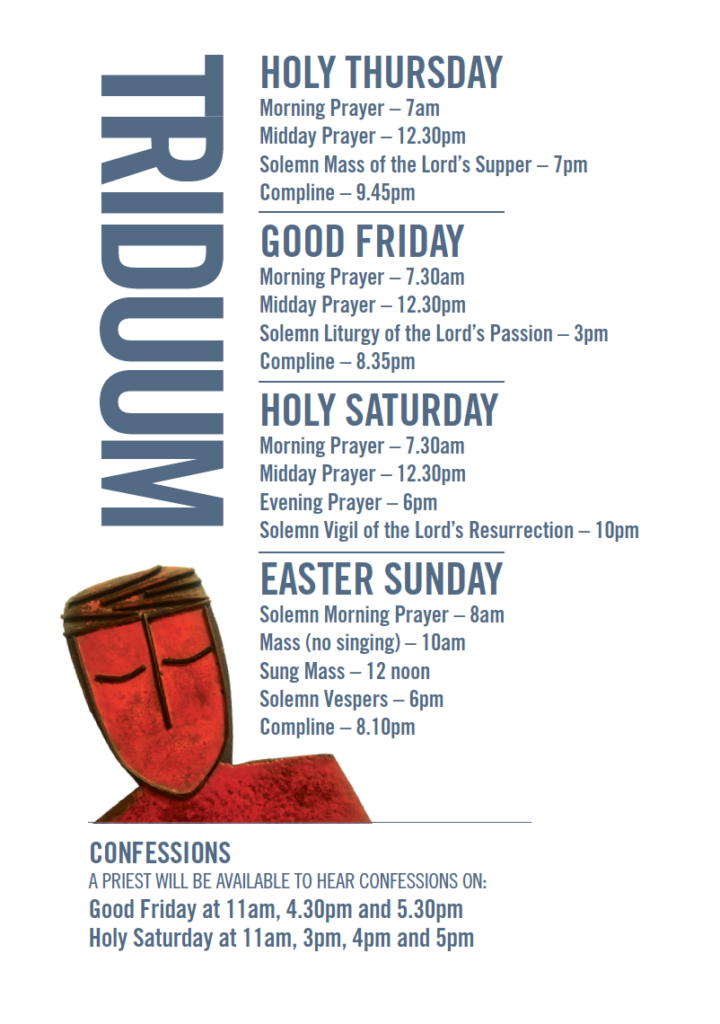
Liturgical timetable for Holy Week/Octave of Easter

Please note the following changes to the liturgical timetable during Holy Week and the Octave of Easter:

Holy Thursday

Morning Prayer: 7am

Midday Prayer: 12.30pm

Solemn Mass of the Lord’s Supper: 7pm

Compline: 9.45pm

Good Friday

Morning Prayer: 7.30am

Midday Prayer: 12.30pm

Solemn Liturgy of the Lord’s Passion: 3pm

Compline: 8.35pm

Holy Saturday

Morning Prayer: 7.30am

Midday Prayer: 12.30pm

Evening Prayer: 6pm

Solemn Vigil of the Lord’s Resurrection: 10pm

Easter Sunday

Solemn Morning Prayer: 8am

Mass (no singing): 10am

Sung Mass: 12 noon

Solemn Vespers: 6pm

Compline: 8.10pm

+ A monk will be available to hear Confessions in the Abbey Church on Good Friday at 11am, 4.30pm and 5.30pm, and on Holy Saturday at 11am, 3pm, 4pm and 5pm.

+ Lauds (Morning Prayer) will take place at 7am from Easter Monday to Sunday 27th April.

+ There will be no Compline (Night Prayer) in the Abbey Church on Easter Monday.

+ The usual liturgical timetable will resume on Sunday 27th April.

+ The guesthouse will be closed from Wednesday 16th April to Friday 25th April.

+ The opening hours of the Monastery Reception and Shop will be as follows:

Holy Thursday: 9am-5pm

Good Friday: 9am-3pm

Holy Saturday: 10am-5pm

Easter Sunday: 9am-1pm

Easter Monday: Closed

Tuesday/Wednesday/Thursday of Easter Week: 10am-2pm

Friday of Easter Week: 11:30-5pm

Saturday of Easter Week: 9:30am-5pm

Categories
Abbey | Latest News abbeynews

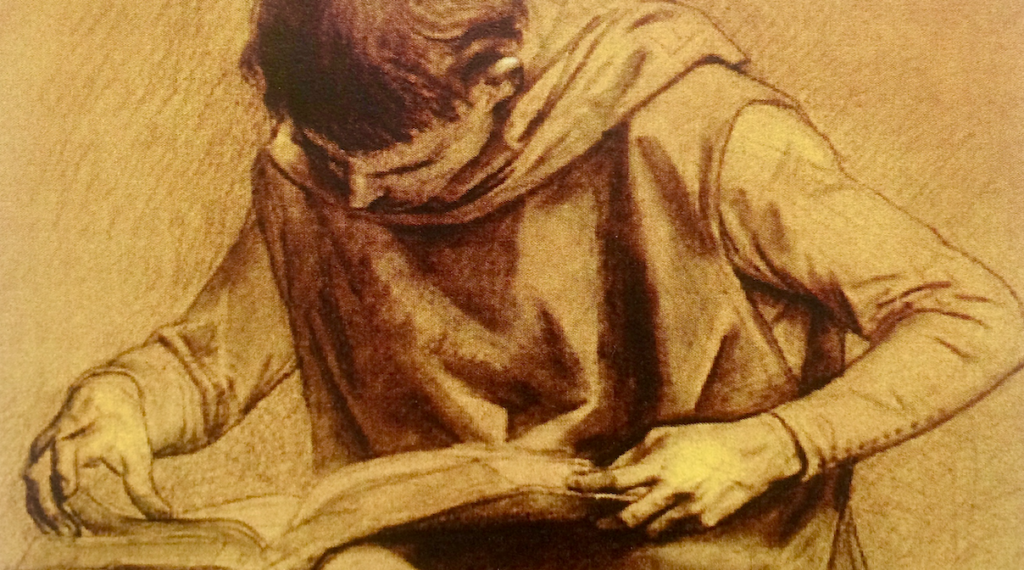
‘Once you learn to read, you will be forever free’

The above quotation from Frederick Douglass, the nineteenth century American slave turned abolitionist, testifies to the pleasure and value of reading. For Douglass it was patently true; the ability to decipher words on a page was key to his release and future success as a social reformer. However reading can yield deeper levels of freedom than that.

One can read for pure pleasure. Who has not stopped and savoured the first lines of some works of fiction! ‘It is a truth universally acknowledged, that a single man in possession of a good fortune must be in want of a wife.’ (‘Pride and Prejudice’ by Jane Austen.) And the whole of Emily Bronte’s ‘Wuthering Heights’ has given aesthetic pleasure to generations of readers. The same can be said of ‘The Grapes of Wrath’ (by Steinbeck),All the Light We Cannot See’ (by Anthony Doerr) and countless other novels. With them a reader thus ‘lives a thousand lives before he dies ….. [whilst] the man who never reads lives only one.’  Such ‘great reads’ introduce one to something deeper than aesthetics, they bring one to another place where one encounters other people and other predicaments. In time one learns to read a novel vertically as well as horizontally, and to understand literature not just as story but to value it for its ‘eternal freight’. This requires being open to literature as a study in depth of human nature from which we are enriched, rather than dismissing it as fanciful and to be replaced by a textbook of biology. But to read literature many of us require a teacher, either a formal one or an informal one and friend.

EXULTATION is the going

Of an inland soul to sea,—

Past the houses, past the headlands,

Into deep eternity!


Bred as we, among the mountains,

Can the sailor understand

The divine intoxication

Of the first league out from land? [1]

However for all the pleasure and companionship literature gives, and the voice it gives to man’s ultimate concerns, it is insufficient in responding to our search for meaning. The Bible indeed can be read for its literary quality alone: the Book of Esther for its epic plot, Second Isaiah and the Psalms for the beauty of their language, Sirac and Proverbs for their critical thinking, but to the believer these texts have another dimension; they resonate with something ‘other’, from beyond the horizon of everyday experience. These books have a character which is both human and divine. But while the reading the Bible is full of promise it is not easy to plumb its depths. At the most basic level the Jewish Rabbi, for example, does not see the Bible a narrative whole, in contrast to the Christian view. For him it is not a story of disaster in the Garden of Eden leading on to ultimate rescue, but a cryptic text (where no detail is unimportant) that offers guidance for life. For Christians it is a collection of books that does form a single whole and is unified by the New Testament.  In this it testifies to Jesus as the Messiah and Son of God. To recognise this, and much more, one is best off when accompanied by a guide who can reveal its depth of meaning.

Christian tradition from earliest times has guided readers on four possible levels of meaning in scripture: first is the literal interpretation or what the author meant. This may not always be obvious as we run the risk of reading elements of our own cultural mindset into that of ancient times. As Origen said, taking the text on face value, as some people do, can be a sign of stupidity. (Whoever heard a snake speaking in Hebrew, as related in Genesis 3!). A second level of meaning is ethical; make the comparison between the Law of Moses and the teaching of Jesus from the Sermon on the Mount! A third level of scripture, termed ‘allegorical’, consists in taking people, places and things of scripture as pointing to realities on a higher plane in a symbolic world. The story of the good Samaritan has been read as representing Christ’s mission of salvation to all humanity. And finally, ‘anagogical’ interpretation detects mystical signs of the after life in biblical events and statements. In each level of interpretation Jesus Christ is shown to be the fulfliment of the Old Testament. A most ironic of all biblical passages is when Jesus, in the synagogue on the sabbath, having read from the scroll of Isaiah announces that “this text is being fulfilled today  even while you are listening.” (Lk 4:16-22).

Monks have long approached the biblical literature along these lines though under the rubric of ‘Meditatio – Contemplatio – Oratio’. It is known as ‘Lectio Divina’. What could be better than to ruminate on the inspired scriptures so as to extract its divine essence, infused as it is through human words! For this kind of literature we may need a pedagogue! There are very many. Scripture commentaries come in varied user-friendly editions. Cf. footnotes for a few. [2]

Benedictine monks, at least during the season of Lent, ‘each receive a book from the library which they shall read through consecutively’. [3] If you too need guidance and encouragement in reading the Bible it may help to use a commentary or join a guided-reading group. It may set you on your path to freedom as a child of God, forever!

John O’Callaghan OSB


[1] Emily Dickinson

[2] ‘A History of the Bible’, by John Barton; Penguin Books 2020; ‘Jesus of Nazareth’ by Pope Benedict; Bloomsbury 2007; ‘The People’s Bible Commentary’ published by the Bible Reading Fellowship, Oxford;  ‘Letter of HH Pope Francis on the Role of Literature in Formation’ ..

[3] Rule of Benedict; Chapter 48

Categories
Abbey | Latest News abbeynews

Lessons from the forest

We celebrate the forests of the world for their many gifts: hydrological services, timber, shelter and food. But perhaps their greatest gifts to human kind are magnificence, splendour and wisdom.

Of all the animals of the earth, we – though we have to say it ourselves – are the most elegant, well balanced and upright. Among the plants, our elder brothers the trees may make a similar claim. It is therefore natural for us to feel a co-naturality with the trees, a certain haptic exhilaration at their height as they prayerfully stand tall and extend their limbs to the heavens. A man born blind when first he saw exclaimed: “I see men like trees walking.”

Trees manifest fidelity, constancy, endurance, and a generously creative response to adversity. In the press of competition they adapt, or, if all else fails,  give way in a spirit of advaita or non-duality, as if saying to their all too near neighbour: “it is all the one; whether you live or I live, the forest survives.” And so saying, give as nourishment of their very bodies for their friends.

Their fidelity is manifest at this time of year when the coming of Spring is only a vague rumour, completely unsupported  and even denied by swirling cold winds, frosts and snows… Yet they know its coming is as certain as the dawn and faithfully, with rising sap and swelling buds, prepare to welcome it.

Their constancy in an uncertain world is delightfully reassuring. Touch wood! Oak is always oak even after years of neglect and being ignored. “Like the stars when called by name, answering ‘Here we are!’” (Baruch 3:34).

Terrible predictions of terrors to come are all about us. Nature is all poisoned and destroyed. Nature will survive but with terrifying carelessness will cut off those who misbehave and poison the poisonous. The ever-moving present is like a tsunami crashing through time. We are like dolphins playing in the wave. We can do little to alter its course, but we can exult in its speed and power.

Let the sea and all within it thunder. Let us, with the trees of the wood, rejoice at the on-going revelation of the symphony of creation, at the coming of the Lord, for He comes to rule the earth. With justice He will rule the world, He will judge the peoples with truth!

Anthony Keane OSB

Categories
Abbey | Latest News abbeynews

Lent as a time for unclogging the ecosystem

We live in a time when the whole world is beginning to understand that our lives will have to be ‘at all times Lenten in character’ if we are to survive as a planet. There is a climate crisis which could destroy our world and a purification of the ecosystem is required, something like the traditional way of unclogging our spiritual ecosystem by prayer, fasting and almsgiving.

Since large-scale industrialization began around a century and a half ago, the levels of greenhouse gases have increased so that there is now an asphyxiating glut of greenhouse gases accumulating in the atmosphere. Our oversupply of such emissions is creating a hole in the delicate mantilla which presently shades us from the sun, and we are wrecking the greenhouse which allows us to survive. We have become ‘oilaholics’ and the disease is contagious. Our addiction threatens to destroy the roof over our heads, so a programme of ecological transformation is needed fast.

Our spiritual ecosystem was routinely purified by prayer, fasting and almsgiving. These were the three-pronged approaches to Lent. Prayer puts us in touch with the ultimate source of divine energy in our lives, the Holy Spirit, breathing in our hearts; fasting allowed us to cut down on external energy consumption, to concentrate on being rather than having. It’s different for each one of us, and should mean giving up whatever is debilitating and switching to the alternative energy which will raise us from the dead.

Almsgiving provides an outlet for this newly sourced energy, allowing it to radiate into the atmosphere around us. Almsgiving is being generous as God is generous. And if you are guilt-ridden or spendthrift; if your weakness is not being able to say no to anyone, then your godlike generosity is to develop the backbone which can resist those grasping tentacles, cut off the prying tendrils and tell the creepy-crawlies to get lost. Lent is a time for getting rid of at least some of the crazy-makers in your life, those whom you allow to enslave you, importune you, take you for granted, bully you. Those who push you around, keep you under their thumb, act as travel agent for your guilt trips. Resurrection is not about being feak and weeble, an inexhaustible wimp, a pushover when it comes to those looking for a hand-out.

Too often the emphasis has been on mortification as an end in itself. Or it has come across as a rejection of the body, of the passions, of the sap of life, as if these were antipathetic to true Christian living. Asceticism is not a punitive discipline but rather like learning how to play a musical instrument or training ourselves in a worthwhile craft. It should not be miserable exercise of the will over a reluctant and frightened part of myself. Lent is about doing to death, mortifying, at least some of the things that prevent us from being. It is about renouncing at least one thing that weighs me down, holds me back and prevents me from rising from the dead. It is not a macho manifesto of the mind over the body. Christianity is not about self-conquest, it is about self-surrender. Surrender of the total person, body and soul, to the guidance of the Spirit.

Lent is the runway towards Easter, preparation for the fullest kind of life: its sign is joy, its source is love. It should make us more ready, more fit, more willing, more in shape, to rise with Christ from the tomb at Eastertide to be alive with him forever. As the poet Rilke says, ‘we shall have been marvellously prepared for divine relationship.’ In the end, this divine connection must surely transform us and our connection to one another and the world around.

Mark Patrick Hederman OSB

Categories
Abbey | Latest News abbeynews

Remembering Father Columba Breen

This week the monastic community remembers Father Columba Breen OSB on the 25th anniversary of his death.

Born in Dublin on 18th October 1917, Frederick Thomas McDonagh Breen attended the Christian Brothers School in Marino, Dublin, and St Flannan’s College in Ennis before entering the Dublin Archdiocesan Seminary in Clonliffe College.

While there, he read classics and philosophy in University College Dublin, graduating Bachelor of Arts in 1938. Following a year of theology at the Lateran University in Rome, during which time he became familiar with Benedictines at Sant’Anselmo, he entered Glenstal on 22nd October 1939.

After a shortened postulancy, he entered the novitiate on 14th January 1940, receiving the name Columba. He made profession on 18th February 1941 and was ordained priest on 18th December 1945. Recovering from an illness, he spent the months of February to September of 1946 convalescing in our motherhouse of Maredsous Abbey in Belgium.

Father Columba taught French, Irish and religion in the school and, already devoted to the study of Scripture, taught this discipline in the monastery. In September 1948 he became Headmaster, a post he held until 1953.  In 1957 he went to the École Biblique in Jerusalem, obtaining a Diploma in Biblical Studies in 1959. At that time, the Dominican-run institute was at the height of its influence and Father Columba made many friends and future contacts there, the most important for him being Père Pierre Benoit OP. It was from this time, too, that his interest in yoga stemmed, encouraged by Père Jean-Marie Déchanet OSB of the then Abbey of Saint-André in Bruges, now Sint-Andriesabdij. From that time, too, came his habit of singing the psalms in Hebrew while striding about a rain-soaked Glenstal Abbey!

Father Columba spent the years 1960 to 1961 in Ealing Abbey while pursuing an extra-mural diploma-course in English Literature at London University. Returned to Glenstal, Father Columba taught Scripture to novices and juniors, was frequently invited to lecture in seminaries and had an active ministry as lecturer and retreat-giver to religious sisters. He was acutely aware of the sisters’ need for proper theological formation and did what he could to promote this, often against opposition from bishops and/or from religious superiors.

He was Master of Novices for several years until 1972, when he fulfilled a long-held dream and went to the Cameroons to begin the long process of making a Benedictine foundation in Nigeria, which was recovering from civil war. During his time in the Cameroons, he taught Scripture in the Swiss Benedictine foundation on Mont Fébé, just outside the capital Yaoundé. Finally, in 1975, after tireless lobbying of a Nigerian Government very suspicious of Irish priests but not knowing what monks were, it was possible to open the foundation at Eke, near Enugu, in the former Biafra. Over the year 1978 to 1979 the foundation gradually moved further northwest out of Igbo territory, to Ewu-Isan, some distance from Benin City. Father Columba served as Superior in both Eke and Ewu from 1976 to 1982. In that year he was replaced as Superior by Abbot Augustine O’Sullivan, but continued his ministries in teaching, formation and retreat-giving until his final return to Glenstal in 1996.

Back in Ireland, Father Columba was able to pursue one of his first loves, the Irish language, attending summer-schools and even Irish-dancing classes. In addition, he wrote articles and book-reviews for Irish religious periodicals, especially for Doctrine and Life, and gave lectures on Scripture and spirituality to seminarians and religious. A major work, Feed from the Tree of Life: Homilies for the Weekday Masses, appeared eight months after his death.

Father Columba died suddenly while waiting in the statio for Mass on 6th February 2000. May he rest in peace.

Categories
Abbey | Latest News abbeynews

Expectation turning to salvation

The Feast of the Presentation has been named in various ways and has had a diversity of religious associations in Christian history. The date on which it falls, February 2nd, has also non-religious – even pagan – associations, as it coincides with the Celtic feast of Imbolc.

It is called the ‘Presentation of the Lord’ because on that day the Church recalls the episode in the life of Jesus when Joseph and Mary came to the Temple to present him to the priests, and through them to God, as their first-born son in accordance with the Jewish law listed in Leviticus 12 and Exodus 13. The rite was to be carried out forty days after the child’s birth, so the church commemorates it forty days after December 25th, and the reason for that interval is given in Leviticus: the mother was ritually unclean for a week after the birth and then her blood had to be purified. The Feast was also known as The Purification of Mary before the liturgical reforms of the Second Vatican Council (1962-65), and a private ceremony called the ‘churching’ of women thirty days after they gave birth was almost universal.

In Exodus, another aspect of the rite is explained: it commemorates the liberation of the Hebrews on the night of the first Passover, when the first-born of the Egyptians were slain but those of the Hebrews saved. Ever afterwards, their first-born male was considered to belong to the Lord and had to be redeemed, or bought back from God, so the offering of sacrifice by the priest had a double purpose of purification and votive offering. Leviticus laid down that a lamb be offered or two turtle doves or pigeons, if the couple could not afford a lamb. Luke’s Gospel says that Joseph and Mary were in this category.

People sometimes ask what their circumstances were, and the Gospels tell us little beyond the fact that Joseph was a carpenter. That would have meant catering for the needs of a rural subsistence economy, making such items as yokes for animals, parts for ploughs – probably a reasonable living, but stretched to meet payment of the Roman taxes. They had not gone to live in Nazareth at the time of the Presentation and the visit of the magi bearing gifts occurred after that. What became of the gifts during their flight into Egypt, for example, we simply do not know…

They did ‘everything the law required’, and the account in Luke’s Gospel adds their encounter with Simeon, who emerges in the story at this point, but is otherwise unknown. He is described as ‘an upright and devout man’ (Lk 2:26). No doubt to the surprise of the parents – he was not the priest whose role it was to do so – he took the child into his arms and declared that he could now depart this life because he had seen the salvation God had promised, describing Jesus as ‘a light for revelation to the Gentiles and for glory to your people Israel’ (2:29). This reference to light is the origin of the practice of blessing candles as part of the liturgy of the Feast, and of the name Candlemas Day.

The two parts of Simeon’s testimony are significant: Jesus as saviour of the world, but also the final liberator of Israel, the long-expected Messiah. He blessed the child and then prophesied that Jesus would meet much opposition, and Mary too would suffer. This could imply that, as a humble person, the challenge of her calling to be the mother of the Messiah would bring great hardship.

Anna, who was always in the Temple, ‘came by just at that moment.’ She is described as a prophetess, a role ascribed to only a few women in the Old Testament, so her testimony has added significance. She embodied the religious aspirations of the people and saw Jesus as the one who was to come and achieve the final liberation of Israel, a destiny shrouded in mystery.

The Presentation of the Lord, grounded in Old Testament ritual, marked a decisive stage in the transition from Israel’s expectations to the universal salvation Christ would achieve by his life, death and resurrection.

Fintan Lyons OSB

Categories
Abbey | Latest News abbeynews

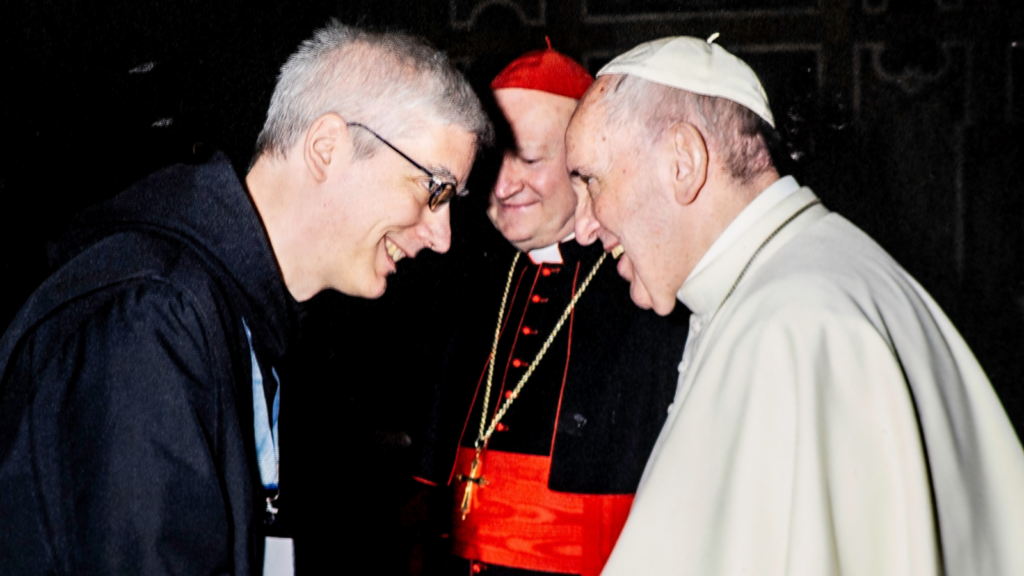
“What unites Christians is infinitely more significant than what divides us” – Martin Browne OSB talks to the Anglican Communion Office on Christian Unity

During the month of January, Christians around the world unite their prayers together during the Week of Prayer for Christian Unity (18-25 January). Whilst this week is a particularly graced time of seeking unity among Christians, it is a year-round undertaking. Glenstal Abbey’s Father Martin Browne OSB of the Vatican’s Dicastery for Promoting Christian Unity talks here to the Anglican Communion Office about this task:

Can you tell us more about the work of the Dicastery? How would you summarise its purpose?

‘Dicastery for Promoting Christian Unity’ is a long name, and includes a word that is unfamiliar to many, but its meaning is very simple. It is the office in Rome responsible for ecumenism – the quest for unity among Christians. That involves promoting ecumenism and ecumenical initiatives within the Catholic Church, but it also involves engaging in dialogue and cooperation with Christians of other traditions. For example, among the Dicastery’s many relationships, we have two separate commissions working with the Anglican Communion – the Anglican-Roman Catholic International Commission (ARCIC), which has been engaged in formal theological dialogue since the 1960s, and the International Anglican-Roman Catholic Commission for Unity and Mission (IARCCUM), which promotes practical cooperation between bishops of our two communions.

Why is the Week of Prayer for Christian Unity so important in the life of the Church?

In short, because Jesus prayed for it and Christians need to take him seriously! Dialogue and cooperation nurture unity, but ultimately, Christian Unity is God’s gift, and we need to pray for it. Of course, we should pray for this gift throughout the year, but a dedicated Week of Prayer is graced time each year to pray about Christian Unity with particular intensity. The fact that the prayers and reflections come from a different part of the world each year, but are used by Christians in all parts of the globe, is itself a powerful expression and foretaste of the unity for which we pray.

What does it mean to work for Christian Unity? Why do you feel called to this ministry?

One of the fundamental vocations of the Church is to bear witness to and share the Good News of Jesus Christ. To be a Christian, regardless of one’s particular tradition, is to be evangelical – in the sense of being one who believes in and shares the Gospel. Christian disunity is a countersign. It weakens our capacity to be credible witnesses in the world. How can we expect unbelievers to take Christianity seriously if Christians are marked by division and discord? It is as simple as that. The conviction that what unites Christians is infinitely more significant than what divides us has been central to my own believing and belonging for many years. To find even small ways of experiencing and expressing that unity felt like a key part of my vocation even before I found my way to monastic life and ordination. That I now find myself working full-time in Rome on this quest is an extraordinary privilege.

What excites you about the work of IARCCUM?

IARCCUM is unique! It recognises that while Catholics and Anglicans have not been able to establish a full communion relationship, over half a century of dialogue and walking together has caused them to discover how deep – though still incomplete – is the communion we already share. It challenges our two communions to take practical steps to manifest that communion in the way we minister alongside one another. It invites bishops from our two communions to take the lead in bearing witness to that relationship.

In practical terms, IARCCUM has organised two joint pilgrimages for bishops in the last ten years. I was closely involved in the pilgrimage of January 2024. It gathered over 50 bishops, in pairs, Anglican and Roman Catholic, from throughout the world for a week of walking, talking and praying together, first in Rome and then in Canterbury. During the Vespers at the Basilica of St Paul outside the Walls marking the end of the Week of Prayer for Christian Unity, the Pope and the Archbishop of Canterbury jointly commissioned the bishops to “together bear witness to the hope that does not deceive and the unity for which our Saviour prayed” and to “be for the world a foretaste of the reconciling of all Christians in the unity of the one and only Church of Christ”. It was an immensely moving experience. Their evident respect and affection for one another as co-workers for the Kingdom, along with their impromptu sharing in the ministry of preaching, made the words of commissioning that they spoke to the gathered bishops all the more powerful. It can be done!

What encouragements would you give to Anglicans who are seeking to strengthen church unity and encourage ecumenism in their contexts?

I call to mind some words from Pope Francis when he welcomed the participants in the Anglican Communion Primates’ Meeting to Rome last May. “The Lord calls each of us to be a builder of unity and, even if we are not yet one, our imperfect communion must not prevent us from walking together.” He went on to quote from Pope John Paul II’s great encyclical on Christian Unity, Ut Unum Sint, saying that relations between Christians “presuppose and from now on call for every possible form of practical cooperation at all levels: pastoral, cultural and social, as well as that of witnessing to the Gospel message”. The Pope underlined his belief that our differences do not diminish the importance of the things that unite us. I have a sense that this could be an important intuition for relationships within the Anglican Communion as well as for relationships between Anglicans and other Christians. Pope Francis also reiterated a statement he made with Archbishop Justin in 2016, saying that our differences “cannot prevent us from recognizing one another as brothers and sisters in Christ by reason of our common baptism”.

– Lambeth Conference, “What unites Christians is infinitely more significant than what divides us” – Reverend Martin Browne on Christian Unity,” 16 January 2025, https://shorturl.at/0p7mB.

Subscribe To Our Newsletter To Receive Updates

[hubspot type=form portal=6886884 id=9e1d6d0d-c51e-4e35-929d-3a916798de64]