

You can be passionate about politics, you can be passionate about poetry, you can be passionate about sport; the one adjective can be used of quite different activities. But when you use the noun from which it is derived, complications arise. Passion ultimately comes from the Latin word ‘to suffer’ and when capitalised it is used particularly in relation to Christ’s life. In Christian history, ‘passion’ often referred to morally objectionable emotions causing the Christian to struggle or even suffer to avoid sin; this was because it was used in early monasticism to translate the Greek term for such undesirable inner drives.
In recent centuries usage by some writers rescued the word from that implication by using it for many different emotions, some morally objectionable, some not (the philosopher Descartes listed forty, good and bad). Making passion mean whatever one wanted introduced the likelihood of it being deprived of its original connection with suffering. It’s true, of course, that you may suffer because of politics but you are less likely to suffer because of poetry, unless you are a very sensitive soul.
They being sensitive souls is why the adjective passionate is so appropriate to the three saints who are commemorated by the church in October; they are Francis of Assisi on the 4th, Carlo Acutis on the 12th and Teresa of Ávila on the 15th.
Francis was a man of contrasts and paradox, a fit subject for his biographer, G. K. Chesterton, who said of him that while he was passionately fond of poetry he was distrustful of books. He found poetry of course in the book of nature and hymns in the singing of the birds, and if he had been passionate about his youthful plumage, he passionately embraced lady poverty. Above all of course he was passionate about Christ in his Passion, to such an extent that the Five Wounds were imprinted on his body, thereby initiating a great popular devotion, while he disappeared from view and the location of his burial was for long a secret until in the end it became public in Assisi.
Saint Carlo Acutis, the fifteen-year old boy from Monza in northern Italy canonised in September 2025, is also buried in Assisi, wearing, appropriately, the simple jeans he wore in life, since his shrine is in the church marking the place where St Francis divested himself of his fine clothes as an act of renunciation of his worldly life. Carlo did not have to renounce his earlier life, having been devoted to the practice of the faith from his earliest childhood and it has been a cause for comment that a teenager could be considered one who reached the level of sanctity necessary for canonisation.
It can’t be known to what extent he shared the usual turbulent passions of his schoolmates, calcio and everything else, but he had deep traditional faith and passionate devotion to the presence of Christ in the Eucharist, and he used his passion for computers in his campaign to spread faith in Christ among his own generation. Suffering became part of his life with the diagnosis of very aggressive leukaemia, but he regarded it as little compared with what so many others suffered, and continued without complaint his life of prayer seeking union with Christ and knowing that it would soon be complete. What had been a private life became a public story soon after his death. Two well attested miracles brought the heavenly world to the attention of a society little prepared for such a disruption of agnosticism.
The life of Teresa of Ávila was one where faith provided the culture and monastic life the context for the inhabitants of that delightful walled town not far from Madrid. But the walls enclosed two contrasting passionate lifestyles; one was that of a people devoted to commerce, the other a declared intention to seek God rather than economic success. Unfortunately, the values of the first lifestyle had a way of influencing the second as the Carmelite sisters received visits and gifts from their wealthy families, but there was general acceptance that this was the realistic way for convent life to be lived in what was becoming the modern world. Teresa accepted this situation, and could hardly do otherwise because of frequent bouts of ill-health, but it was perhaps the incident when she was thought to be dead and was about to be buried that, on her resumption of convent life, made her aware that if nothing changed, the frequent breaches of the enclosure would lead her ‘straight to hell’.
Her conversion to a new life brought remarkable results. Her prayer life transformed her into a mystic. Mysticism had been a major type of spirituality in Christianity since the beginning, but in late sixteenth-century Spain it acquired a new warmth in Teresa’s version of the Latin temperament, passionate in her love for God, and passionate too in a her dealings with what seemed both internal and external temptations by the devil. She learned to laugh at a little dark creature she saw sitting beside her gnashing his teeth, but she suffered greatly when in the heights of mystical union her heart was transverberated by a sword, an event famously depicted by Bernini’s sculpture.
Many biographies fail to mention her levitations, despite the fact that on occasion they were witnessed by visitors (and, tellingly, imitated by a charlatan, a nun who concealed stilts in her habit). Such occurrences would be met with incredulity by the sane majority today, because whatever faith persists is rarely enlivened by passion.
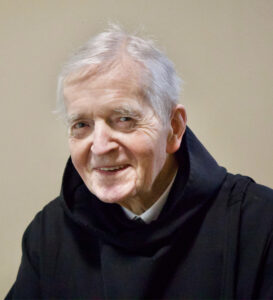 Daniel Kevin O Sé – known as Kevin to his family – was born in Cork on 3rd July 1940. Following school at Presentation Brothers College, he read Irish and German at University College Cork, graduating B.A. in 1961, Higher Diploma in Education 1962 and M.A. in 1970. A love and mastery of Irish and German language and literature was to remain with him all his life.