
Fr Columba McCann OSB
What’s happening in our world? Where are we heading? – with war, talk about nuclear weapons, global warming, dictatorships, or the next best thing? It’s hard to know exactly how it is all going to play out from day to day, and there can be surprises, both pleasant an unpleasant; but our Christian faith is that, in the end, literally the end, all will be well. Christ will come again. And when the Son of Man comes, all that oppresses and disfigures our human world will be finally swept away, like the story of Noah and the flood.
There is a lot that we would love to see swept away out of our world: hatred, war, talk of nuclear weapons, abuse of the weak by the strong, starvation, corruption, dishonesty. The hopes for a different kind of world have never died, the hopes for what the Bible calls ‘the new heavens and the new earth’, or ‘the kingdom of God’. The prophet Isaiah dreamed about such a world. He envisaged a time when people would no longer prepare for war, when weapons would be destroyed and their technology re-harnessed towards feeding the hungry. He foresaw people of all nations streaming towards the temple of Jerusalem in order to worship and learn the ways of God.
With the coming of Christ, with his death and resurrection, a new temple was built. That temple is Jesus himself. Millions of people have streamed to him, have learnt to walk in his ways, and in him have worshipped God. Countless people have been an oasis of peace in their own family, their own neighbourhood through their Christian faith. Men and women too many to number have literally fed the hungry in the name of Christ. The mountain of the temple of the Lord, Isaiah says, will tower about the mountains. What would it be like if the person of Christ were to tower over everything else in my life? If the person of Christ, the words of Christ, the power of Christ, the love of Christ were to tower over every other aspect of my life? ‘Prefer nothing whatsoever to Christ,’ St Benedict says. That’s why we are here. This is
what we yearn for deep down. And Advent is a time to make space for him. The amazing thing is that the kingdom of God is pouring out into the world right here where we gather. Whenever, wherever we gather for the Holy Eucharist we are standing in God’s throne room, gathered around the Lamb of God, once slain, who lives for ever. The wonder, the forgiveness, the unity, the adoration, the love into which we are invited can spill out into the world through us, if we receive it and treasure it above everything else. If things as simple as bread and
wine can become the living presence of Christ among us, it’s a promise of what could happen to the whole world.
The human world was always intended by God to be luminous with his presence. It will happen finally when Christ comes again, but it’s planted here among us now in the Mass. What happens under the radar here will finally come out into the open. And Christ’s coming will be felt either like the intrusion of a burglar, or the return well-loved master, depending on what each of us have been up to in the meantime. His advice is that we remain awake, alert. Whenever the Pope appears at a big event in the Vatican, like a papal audience for example, you will normally see some of the Swiss guards standing discreetly nearby. Maybe you’ve even been there yourself. I’m told that their uniforms were designed by Michelangelo. A bit like the guards at
Buckingham Palace, their outfits attract tourists and cameras and end up on postcards. But if you were to run forward from the crowd and try to get between one of those guards and the pope, I think you would meet far more than a colourful costume. You would come up against a professional who is calm but vigilant. You would be deflected in seconds. Being one of the guards to the pope must be an unusual and interesting job, but every Christian is called to a far more exalted post: we are to take our place before God, and direct our gaze calmly
and consistently towards Christ. And like good soldiers we can, with vigilant ease, deflect anything that gets between us and God. One might ask: What about working, doing the shopping, looking after family, putting food on the table? All of that is doing God’s work. Far from getting between us and God, these things unite us to him. But our privilege is to stand in God’s presence and keep our attention there, staying awake to something wonderful, like sentries in his throne room.
St Paul mentions the kinds of things we need to deflect, the things that do get between us and God: jealousy, wrangling, the kind of self-indulgence that is harmful to ourselves and others. So we need
to be calmly vigilant, our eyes open to what is around us and within us.
One day, as we watch, we shall see the Son of Man face to face, either at the end of our lives, or the end of the world, whichever comes first. As we move inevitably towards this meeting, we can prepare by allowing him already to tower over everything else, everyone else in our lives. We can enjoy the privilege of having our attention always towards the Son of God, and like a professional, calmly deflect anything that gets between us and him.

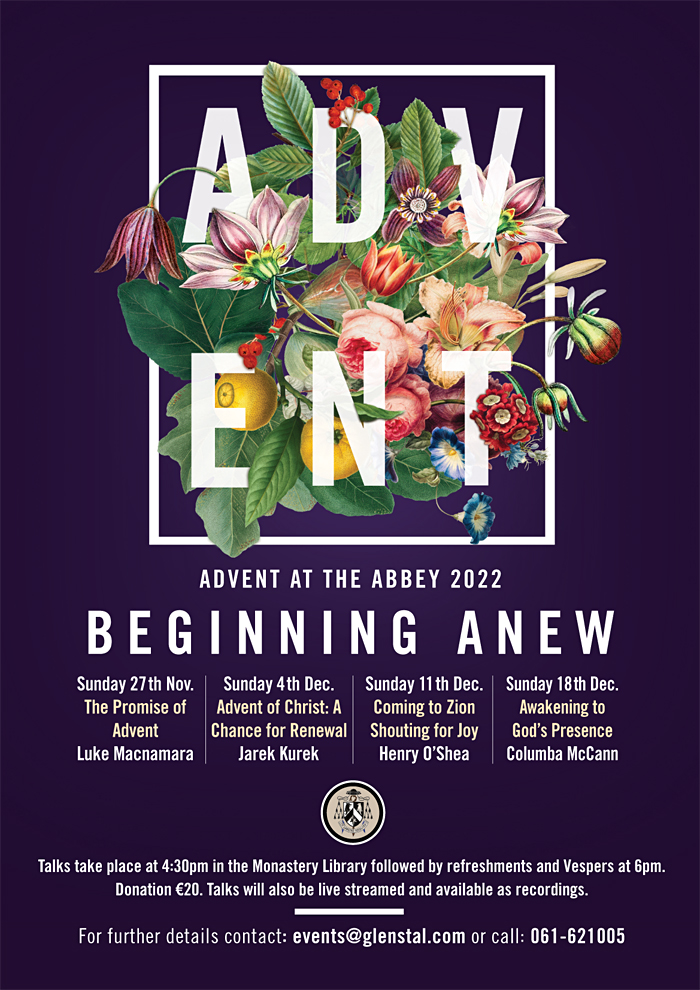
You are invited to journey with us throughout Advent in our series of Sunday afternoon ‘Beginning Anew’ talks.
The talks take place at 4.30pm in the Monastery Library and will be followed by refreshments with Vespers at 6pm. Suggested donation is 20 euros, and the talks will also be live streamed on our webcam (click the ‘Talks’ tab) and available as recordings later.
Speakers include:
For further details contact: events@glenstal.com or call 061-621005.
Fr Senan Furlong OSB
Tom Honeyman, a medical doctor and art connoisseur, was appointed Director of the Kelvingrove Art Gallery in Glascow in 1939. Thirteen years later, there was uproar when he purchased a religious painting for the gallery, paying £8,200 for it – a sum considered in 1952 to be an outrageous waste of hard-earned taxpayers’ money. The painting in
question was Christ of St John of the Cross. The artist was the Catalan surrealist, Salvador Dalí. Opinions and tastes change over time, and today the work is perhaps the most celebrated and reproduced religious painting of the 20th century. A poll conducted in 2006 ranked it Scotland’s favourite painting, and an offer of £80 million by the Spanish government was turned down.
Dalí based his painting on a pen and ink sketch of the crucified Christ by the 16th century Spanish mystic, St John of the Cross. The painting depicts Christ on the cross in a darkened sky floating over a tranquil dawn-lit bay complete with a boat and fishermen. What is unusual is the dramatically different interpretation that Dalí gave the crucified
Christ from the Spanish mystic. For St John of the Cross, the crucified Christ was a focus for compassion, a tortured and murdered man. Dalí aimed instead for an image of perfection and transcendence — there’s no blood, no nails, no crown of thorns. St John’s drawing is frenetic, a vision of the agonizing death on the cross. Dalí’s painting is serene,
a celebration of life and the triumph over death.
Today’s readings for the Solemnity of Christ the King present us with these two seemingly opposite views. The passage from the letter to the Colossians is a magnificent hymn of praise and thanksgiving to the Cosmic Christ. The battle has been won and a great exchange has been effected. God has delivered us from the power of darkness and transferred us to the kingdom of his beloved Son, who is the foundational unity holding all things in being. This is Dalí’s inspiring vision: Christ, ‘the nucleus of the atom’, the very unity of the universe.
It is ironic that on this day when we are called to reflect on the power and authority of our infinite God, the gospel passage takes us to the scene of the crucifixion. This form of punishment didn’t just kill a person. It dehumanised, degraded and debased. And here is our King, not ruling from a majestic throne but hanging from a cross, too weak to save himself from death. His crown is a crown of thorns. He has no armies at his command.
The only soldiers in attendance are his executioners. He is an appalling sight, without beauty or majesty, a thing despised and rejected. This is the vision contemplated by St John of the Cross. Can he who is mocked as ‘King of the Jews’ be the King of the Universe? Can the
apparent weakness of this dying man be the power of God giving new life to the world? Both St John of the Cross and Dalí have us view Christ and the cross directly from above. It is a heavenly perspective; it is that of God the Father, in the one case looking down on the sacrifice of his Son, in the other embracing and blessing everything beneath. Both breath the Resurrection. That doesn’t take away from the horror of Jesus giving himself up to death, but it does show that in this ultimate solidarity with humankind, God reveals himself as the God of love, who opens up hope and a future through the most negative side of history.
And what about us? Jesus hangs on the cross between two criminals. One mocks while the other owns his wrongdoing and looks to Jesus. In his powerlessness and pain, his eyes are opened and he sees right beside him the fount of mercy, forgiveness and redemption. “Jesus, remember me when you come into your kingdom.” His plea acknowledges that Jesus is King. He sees that salvation is to be with Jesus. On this Solemnity of Christ the King may we discover in this crucified, powerless, thorn-crowned King, the only person who can truly say, “Today, you will be with me in paradise.”
Fr Cuthbert Brennan OSB
If you came to mass this morning expecting to be uplifted by receiving some good news then you may have been disappointed as you listened to the readings. The prophet Malachi predicts days blazing like an oven, a divine fire and people reduced to stubble. Luke is not much cheerier, with Jesus announcing that nations will rise against nation, familial divisions, earthquakes, famines and plagues. On an individual
level, there is the promise of persecution, hatred and even death, though at the end of the gospel there is the perplexing line, ‘not a hair on your head will be destroyed.’
You could almost create a TikTok for the church from today’s readings;
Although you’ll be persecuted, imprisoned and put to death, your hair is going to look fabulous. Good news indeed. I don’t think you’ll get too many likes or followers with that message. These readings are not about a prediction of the future but rather they remind us of the precariousness of the present. Our world is not so stable and fixed as we might like to think it is. We have been travelling with Jesus to Jerusalem since June 26 th , the 13 th Sunday in Ordinary Time. Luke has been our guide and if you remember along the way we have encountered time and again great reversals, the last will be first, the first will be last, we heard that the kingdom of God is at hand, we encountered the foolishness of God in leaving everything to seek out
that which is lost. And to-day we arrive in Jerusalem and Jesus is offering us the vision of an ending and a new beginning, a vision of God’s kingdom and a different kind of temple where Jesus is the cornerstone. Jesus understands that every temple is a temporary structure, every system we create will collapse, every cause, every framework that we construct will fade away, will disappoint….. except his!!
The name we give to the genre of reading we are presented with today is called apocalyptic. While in the popular imagination apocalypse denotes widespread destruction or disaster, its original meaning is uncovering, unveiling in order to impart wisdom, meaning and especially hope to people. And that is that job of every Christian here. We are, in the words of St Paul this morning to the Thessalonians, to get to work. As the followers of Jesus we are to pull apart the veil, raise the curtain, shine a spotlight on every inhumanity to humanity, every act that diminishes human dignity, not only attacks with ballistic missiles and armed drones but on every slur that we make against
another. Do we build up or destroy people by our words and actions.
How well do we encourage one another, build each other up, co-create an environment where all can truly be themselves, and live in peace. What is the cost to my community, to the rest of the world and to the planet in maintaining my status quo? If there is good news in the gospel this morning, it is that if your world is not at peace at present, then it will not always be that way. God is not just in the creating and constructing business but in the deconstructing, dismantling business. God will bring an end to all of this – there will be a day when there
will not be a tomorrow.
What is it like to have God end something in your life? What is it like to experience a micro-apocalypse in our lives? God is there.
Maybe you have lost a loved one, lost your job, ended a relationship, and posted something you shouldn’t have had on social media and have been found out, posted some comments about others that are hurtful or simply untrue. What do we do in the face of such loss and grief, such inhumanity and insanity? We turn to the Spirit which resides in us individually and collectively and we stir that phoenix of hope to take wing so that God’s holy hope might surge within us. For with every ending there is a new beginning, we are offered a whole new life.
Jim Wallis, the founder of Sojourner, tells the story from some years ago of volunteering in a church homeless shelter around Christmas time. The church basement was decorated with banners, “Good news! Christ is born!” “Glory to God in the Highest” and so on. One of the
men who lived each day out on the streets looked around the room and asked, “What is the good news anyway?” Jim said there was a long pause; no one knew what to say. Finally someone spoke up from the back of the line, “The good news is that it doesn’t have to be like this.”
It doesn’t have to be this way.
On this World day for the poor, how might the millions of refugees and displaced hear this gospel. How about the 164,000 children who are living in poverty in this country? The world as it is, is not what God had in mind. The difference between bad news and good news that is gospel, depends on where you happen to be standing when you get the news.
Fr Lino Moreira OSB
In Chapter VII of the Second Book of Maccabees we are told how a Jewish mother and her seven sons chose to face torture and death rather than transgress against the Law of Moses, which forbade them to eat pork. They showed such superhuman courage because they believed in the resurrection from the dead: “You dismiss us from this present life but the King of the Universe will raise us up to an everlasting renewal of life” (1 M 7:9) – said one of the young men to King Antiochus Epiphanes.
If we examine the contents of this belief, we will see that it embraces the whole of human nature, which is both spiritual and physical. One of the martyrs expresses the hope that his body will be restored in the following terms: “From Heaven I have received these limbs […] and from him I hope to receive them again (1 M 7:11).” Therefore it is the whole person that will be granted immortality, and because the body is not excluded, the relationship between those who loved each other in this world will also be revived. As the mother said to her youngest son, the last to be executed: “prove yourself worthy of your brothers and accept death, so that I may receive you back with them in the day of mercy (1 M 7:29).”
This theology of a bodily resurrection, so clearly formulated in the beginning of the second century before Christ, was rejected by the Sadducees. And according to Saint Luke, some of them tried to prove to Jesus that such a doctrine was utterly absurd by telling him the story of seven brothers who married the same woman in close succession. They asked: “In the resurrection, therefore, which one’s wife will
she be? (Lk 20:33).”
In his answer Jesus stresses the fact that the life of the age to come is by no means a mere continuation of the life in this world, which can only be perpetuated through propagation: “those who are considered worthy to attain to that age and the resurrection from the dead – he says – neither marry nor are given in marriage, for neither can they die anymore, since they are like angels, and are children of God, being children of the resurrection (Lk 20:35-36).”
This is a very clear statement that the laws of biology no longer apply to those who rise from their tombs, but at the same time we are to understand that not only their souls but also their bodies are clothed with immortality. Indeed, were it not so, eternity in God and with God would be anything but an interrelationship of persons, and Jesus’s assertion that those who rise from the dead are children of God (cf. Lk
20:35) would be no more than an empty metaphor.
Having made it clear that those whom God wakes from the sleep of death share the one bond of adoption as sons and daughters of the same God, Jesus goes on to say: “But that the dead are raised, even Moses showed, in the passage about the burning bush, where he calls the Lord the God of Abraham, and the God of Isaac, and the God of Jacob. Now he is not the God of the dead, but of the living” (Lk 37-
38).
For the Sadducees, who held only the written Law – that is to say, the first five books of the Bible – as authoritative, an argument based on story of the burning bush, which is told in the third and fourth chapters of the Book of Exodus, carried a very special weight. Jesus points out to his learned opponents that to say that Abraham, Isaac and Jacob are not fully alive is tantamount to denying that the Creator of the universe is the God of the living. And he concludes with a striking remark: “for all live to him” (Lk 37-38).
That means that to live is to live for God, and the opposite is death. In other words, it is only those who listen to the word of God and put it into practice that are truly alive in this world, and because they are known and loved by their Creator, they are granted immortality. We are invited, then, to listen to Jesus, the Word of God made flesh (cf. Jn 1:18), and to follow him wherever he goes. By doing so we will be living to the full even now, and in the age to come we will have our share in the happiness of the children of God.
Abbot Brendan Coffey OSB
By any reckoning, Fr Placid lived an extraordinary life. Born, Michael Francis Augustine Murray, on 7 October 1918 in Lismore, County Waterford, just over a month before the end of World War I. Benedict XV was Pope, Ireland was in the aftermath of the 1916 Rising and Europe was in deep shock after the slaughter the World War had brought. It would be another nine years before Glenstal Priory was founded.
His lifespan covered that of nine Popes, five English monarchs, all nine Irish Presidents, nineteen US Presidents and two global pandemics. As a student in Rome he experienced first-hand the Second World War, eventually making his way home by flying boat to Foynes.
During his long life Fr Placid worked on scholarly and liturgical publications, was heavily involved in the Liturgical and Ecumenical Conferences here in Glenstal, was the first President of Societas Liturgica and all the while a faithful and constant presence in our monastic choir. Newman and his works always held special resonance for Fr Placid, and he generously shared his insights with others. He held many roles in this community, including that of superior, and over his long monastic life made many friendships with local people and visitors to the Abbey which endured to the end. Recently he celebrated his one hundredth and fourth birthday. I asked him what it was like to have reached this great age. He replied in his customary deadpan way, “I find there is very little peer pressure now.”
Every one of us must walk the full journey if we are to discover the meaning to our own life. The full journey for Fr Placid was very long indeed, but he persevered faithfully until the end and he would have been pleased about that. Now he will know the joy of those words from the gospel, “Happy the eyes that see what you see, for I tell you that many prophets and kings wanted to see what you see and never saw it; to hear what you hear, and never heard it.” We thank him for the example of great fidelity, which he has left us. His long life reached its completion on 31 of October in Millbrae Lodge Nursing Home, where he had lived for the last fourteen years! We thank the staff there for their care of Fr Placid.
Those of you who knew Fr Placid will know that he never did anything quickly. Everything was carefully thought through, every word he wrote pondered over. However, no matter where he was, or what he was doing, he would drop everything once he heard the signal for the Divine Office. He took his monastic life seriously and placed his trust in the suscipe he sang on the day of his profession. “Receive me, O Lord, according to your word, and I shall live; and let me not be confounded in my hope.”
It isn’t possible to sum up a life one hundred and four years long in these few short lines and anything I could say would only scratch the surface. Neither would Fr Placid want me to attempt such a task, he was always a very private person and would cringe at the thought. He would, I know, like to be remembered as a monk and a scholar and that is what he was. Today we celebrate St Malachy. His biographer, St Bernard of Clairvaux, says of Malachy that he was distinguished by his humility, obedience, modesty, and true diligence in his studies. It is fitting that we celebrate Fr Placid’s funeral on his feast, as he strove to do the same. We thank him for this example and we ask pardon for the times he failed.
Fr Placid would want prominent mention of John Henry Newman, his great mentor, at this liturgy and so I leave to Newman, the final word.
Go forth upon thy journey, Christian soul!
Go from this world! Go, in the Name of God
The Omnipotent Father, who created thee!
Go, in the Name of Jesus Christ, our Lord,
Son of the living God, who bled for thee!
Go, in the Name of the Holy Spirit, who
Hath been pour’d out on thee! Go, in the name
Of Angels and Archangels; in the name
Of Thrones and Dominations; in the name
Of Princedoms and of Powers; and in the name
Of Cherubim and Seraphim, go forth!
Go, in the name of Patriarchs and Prophets;
And of Apostles and Evangelists,
Of Martyrs and Confessors; in the name
Of holy Monks and Hermits; in the name
Of Holy Virgins; and all Saints of God,
Both men and women, go! Go on thy course;
And may thy place today be found in peace,
And may thy dwelling be the Holy Mount
Of Sion:—through the Same, through Christ, our
Lord.