
Categories
Abbey | Latest News abbeynews

Homily – Second Sunday of Easter – Year C

Fr. Luke Macnamara: Whenever the Risen Lord appears to the disciples, he greets them in the same way: “Peace be with you.” The Risen Lord continues to offer his peace to us today. He does so at this Mass. After the Our Father we will hear his words: – “Peace I leave you, my peace I give you”. This peace is not the absence of war or strife, it is something much more. Wherever we are in the world, in whatever situation we may be, however difficult, the Lord with hands outstretched offers us his peace. We may have lost a beloved spouse, broken up with a girlfriend, lost a dear friend, developed a severe illness or be under threat of violence – the Lord’s peace reaches beyond the surface into our deepest selves, so that we be truly at peace. 

The Lord doesn’t force his peace upon us. We can be reluctant to believe, we can have doubts and fears about exposing ourselves to the Lord’s touch. When the Lord appears to Thomas he asks him: “Give me your hand”. The hand represents our action in the world – so much of what we do involves our hands. It is only when they don’t work through illness or handicap that we come to realise how much our hands allow us to do. To give one’s hand to another implies a relationship of trust and much more. The clearest example is in marriage – “to give your hand in marriage” is more than a handshake – it is a giving up of one’s autonomy to share life with another. That sharing will involve moments of love and joy but also heartache and pain. However where there is true sharing, there is a deeper peace that sustains through the hard times. 

There is something of this dynamic in the Lord’s invitation to Thomas to give him his hand. Thomas must trust even if that hand is to be placed in a tangled wound. The Lord shares the glory of his resurrection with Thomas but also the pain of his passion. Thomas by giving his hand replicates the Lord’s journey through the passion and death to the resurrection and life. By giving his hand to the Lord, he receives the Risen Lord’s gifts of peace and forgiveness. The Lord invites us to do the same, to trust and open our hands to him, that he may fill us with peace and forgiveness. The Lord invites us to open our hands to one another to share his peace and forgiveness. There is great power in a chain of open hands – we will share something of that power at the sign of peace. May we truly then go in peace at the end of Mass and bring that peace to all those we meet.


Luke Macnamara OSB

Categories
Abbey | Latest News abbeynews

Homily – Easter Sunday – Year C

Fr. Lion Moreira: We have just heard Saint John’s account of how the tomb of Jesus was found empty. This is the story of a spiritual race, where the disciple whom Jesus loved was the first to cross the finish line. He saw and believed (Jn 20:8), and it was a while before Mary Magdalene, Peter and the other disciples reached that point. Let us briefly examine the successive stages of this race, which, in a sense, is also our own.

First upon the scene was Mary Magdalene. When she got to the tomb, she saw that the stone covering its entrance had been removed (cf. Jn 20:1). Relying solely on the testimony of her senses, she jumped to the wrong conclusion: ‘They have taken the Lord out of the tomb,’ she cried, ‘and we do not know where they have laid him’ (Jn 20:2). 

On hearing this, Peter and the other disciple set out at once. The two were running together, says the Evangelist, but the other disciple outran Peter and reached the tomb first (Jn 20:4). What is the significance of this? Why was Peter following (cf. Jn 20:6) the beloved disciple, and not the other way round? There seems to be a connection here to an earlier incident, when Jesus was brought before Caiaphas. On that occasion, both Peter and the other disciple were following their Master (cf. Jn 18:15), but Peter denied being one of Jesus’ disciples (cf. Jn 18:17). Now, on the way to the empty tomb, Peter was being led by the one who had never turned away, so that he too might run the path of discipleship without wavering.

At the entrance to the tomb, the beloved disciple stepped aside and let his companion go in before him. Then Simon Peter saw the linen wrappings lying there, and the cloth that had been on Jesus’ head, not lying with the linen wrappings but rolled up in a place by itself (Jn 20:6-7). At this point, Peter understood that he was looking at signs with a special significance. First, he realised that the neat positioning of the linen wrappings and the facecloth showed that the body had not been stolen. Then, he began to recall what Jesus had said and done. Perhaps the first thing that crossed his mind was the response Jesus had given to the Jewish authorities just before the Feast of Passover: ‘Destroy this temple, and in three days I will raise it up’ (Jn 2:19). It is written in Saint John’s Gospel that Jesus was speaking of his own body and his resurrection from the dead (cf. Jn 2:21). But this could well have been Peter’s original interpretation – a truth that began to dawn on him when he stood inside the empty tomb.

While Simon Peter was still reflecting, the other disciple also entered the tomb. He saw and believed (Jn 20:8). His was the gaze of someone who had already pieced it all together and now fully realised that God had fulfilled his plan to save humankind by raising Jesus from the dead. He understood this with his mind, believed it with his heart, and was ready to proclaim it with his lips.

In this episode from Saint John’s Gospel, there is a marked contrast between Mary Magdalene on one side, and Peter and the beloved disciple on the other: Mary appears alone in the dark of night, unable to see beyond the evidence of her senses, while the other two are shown running together on the path of discipleship – an action that leads to faith in the resurrection of Jesus. The story, however, does not end there. Mary follows closely behind Simon Peter and the other disciple, and when she reaches the tomb again, the risen Lord reveals himself to her, making her the first herald of his resurrection.

The conclusion is easily drawn: at times, we may feel lost in the darkness of this world, where we are told there is no scientific evidence that anyone has ever risen from the dead. But if we persevere in following Jesus together with his other disciples, as members of his Church, the risen Lord himself will open our minds to recognise the signs of his living presence – so that we can sing and proclaim with joy: Christ has risen, alleluia!


Categories
Abbey | Latest News abbeynews

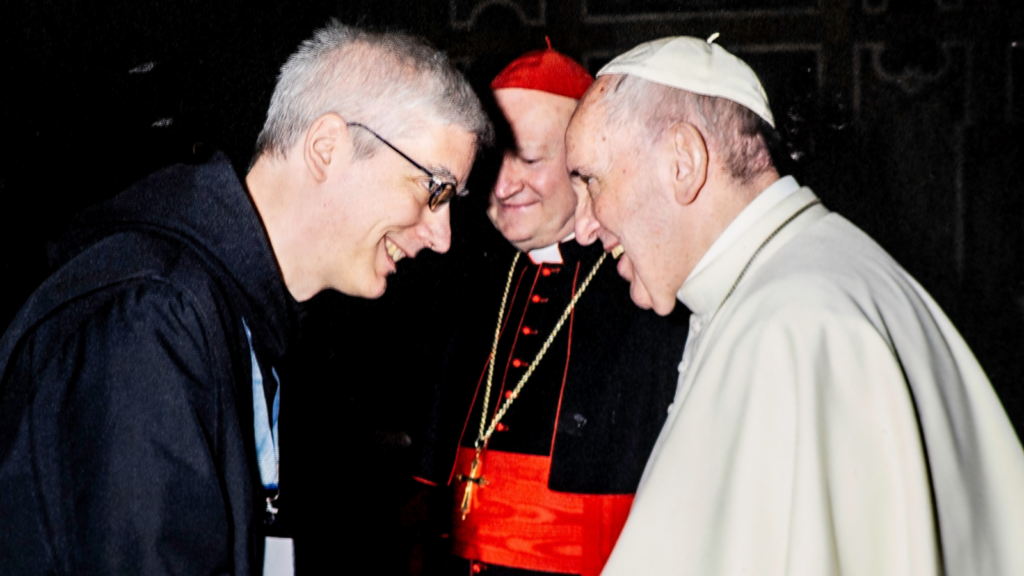
Pope Francis

At the conclusion of the recent Universal Synod in October 2024, Pope Francis quoted Madeleine Delbrêl in saying that “there are places where the Spirit blows, but there is one Spirit who blows in every place.”

As we mourn the passing of Pope Francis we thank God for the particular way in which he himself was a bearer of the Holy Spirit, giving voice to the cry of the poor, to the cry of the earth, calling us to solidarity across nations and cultures, championing the rights of migrants and calling the Church back to the synodal dynamics of her springtime.

He encouraged each of us to play our part, no matter how small.  For Pope Francis, “small is not a handicap; it’s a resource.”

May he rest in the peace of Christ, and may the Holy Spirit continue to guide us on our pilgrim way.

Abbot Columba McCann OSB

Categories
Abbey | Latest News abbeynews

Homily – 5th Sunday of Lent – Year C

Abbot Christopher Dillon: There is a great deal happening in this scene of the woman who has been caught in the act. At the same time, one wonders what had become of her partner. She cannot have been alone and they are each as guilty as the other; indeed, the Law which the priests and the Pharisees are quoting prescribes that the man should be stoned before the woman. Whatever about that, the point here, of course, is that Jesus is being put to the test on the horns of a dilemma. The Law is clear: the woman must be stoned. On the other hand, Jesus is beloved by the crowd for his reputation for mercy. Which is it to be? The righteous indignation, even the vindictiveness, of the accusers is palpable, as they press Jesus for his response, while he writes or doodles with his finger on the ground, avoiding their gaze and probably gathering his thoughts. But when he stands up, the simple expression of his conclusion both challenges and rebuts their judgmentalism, “Let the one among you who is without sin cast the first stone.” His response is as brilliant in its simplicity as in its justice. He does not minimise the gravity of the crime or question the justice of the sentence, but he reveals the unworthiness of the woman’s accusers and their own sinfulness rendering them incompetent to raise a hand against her. Among those present, Jesus alone is competent in his sinlessness to lift a stone against her, which he forbears to do. Instead, Jesus invites the woman to make a new beginning, leaving the past behind, to go and sin no more.

Is not this what Jesus is doing for all of us, as he embarks on the final stretch of his mission among us and embraces his passion in these coming weeks? The first reading from Isaiah has God leading us on a new Exodus inclining us to thanksgiving rather than complaining. Then St Paul speaks of straining forward to faith in Christ instead of striving for perfection by his own efforts. 

In this woman who has sinned and indeed in her sinning partner, Jesus is urging us to go and sin no more. For the Lord wishes not the death of sinners but that we be converted and live. God’s justice and mercy are infinite, but somehow his mercy outweighs his justice. We should study his example and learn from it to apply it in our own lives. The goal of all God’s action in Jesus is that we have life and have it to the full. Is that not what God is working towards by means of the passion of Jesus in the astonishing phenomenon of the resurrection? 

We have much to reflect on with that woman and with her we have much for which to be forever grateful.

Categories
Abbey | Latest News abbeynews

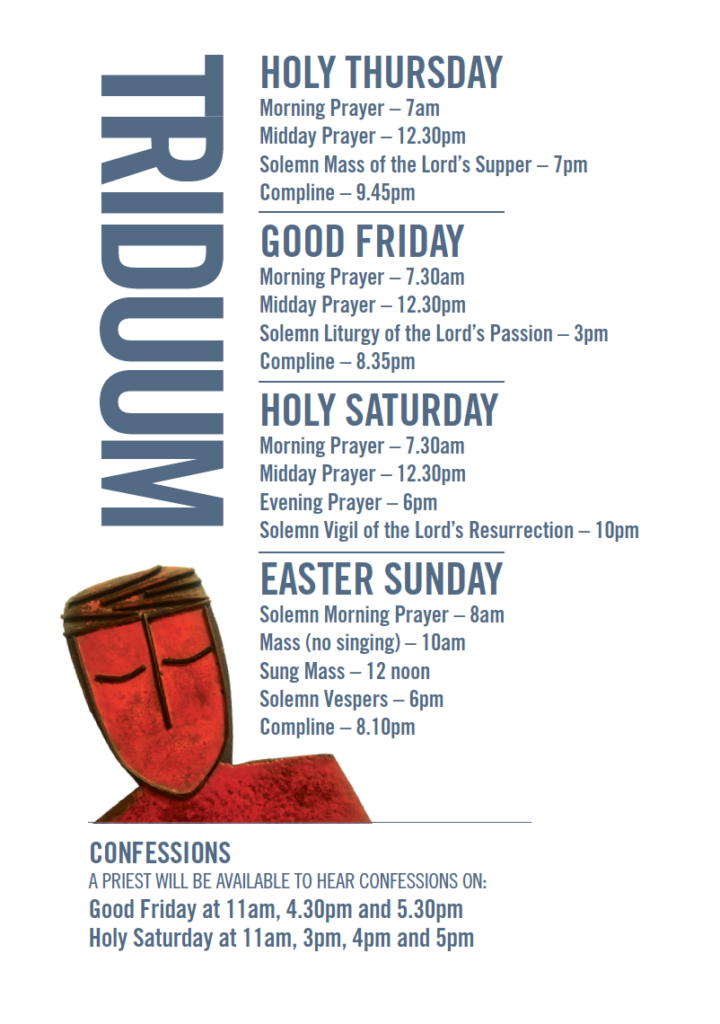
Liturgical timetable for Holy Week/Octave of Easter

Please note the following changes to the liturgical timetable during Holy Week and the Octave of Easter:

Holy Thursday

Morning Prayer: 7am

Midday Prayer: 12.30pm

Solemn Mass of the Lord’s Supper: 7pm

Compline: 9.45pm

Good Friday

Morning Prayer: 7.30am

Midday Prayer: 12.30pm

Solemn Liturgy of the Lord’s Passion: 3pm

Compline: 8.35pm

Holy Saturday

Morning Prayer: 7.30am

Midday Prayer: 12.30pm

Evening Prayer: 6pm

Solemn Vigil of the Lord’s Resurrection: 10pm

Easter Sunday

Solemn Morning Prayer: 8am

Mass (no singing): 10am

Sung Mass: 12 noon

Solemn Vespers: 6pm

Compline: 8.10pm

+ A monk will be available to hear Confessions in the Abbey Church on Good Friday at 11am, 4.30pm and 5.30pm, and on Holy Saturday at 11am, 3pm, 4pm and 5pm.

+ Lauds (Morning Prayer) will take place at 7am from Easter Monday to Sunday 27th April.

+ There will be no Compline (Night Prayer) in the Abbey Church on Easter Monday.

+ The usual liturgical timetable will resume on Sunday 27th April.

+ The guesthouse will be closed from Wednesday 16th April to Friday 25th April.

+ The opening hours of the Monastery Reception and Shop will be as follows:

Holy Thursday: 9am-5pm

Good Friday: 9am-3pm

Holy Saturday: 10am-5pm

Easter Sunday: 9am-1pm

Easter Monday: Closed

Tuesday/Wednesday/Thursday of Easter Week: 10am-2pm

Friday of Easter Week: 11:30-5pm

Saturday of Easter Week: 9:30am-5pm

Categories
Abbey | Latest News abbeynews

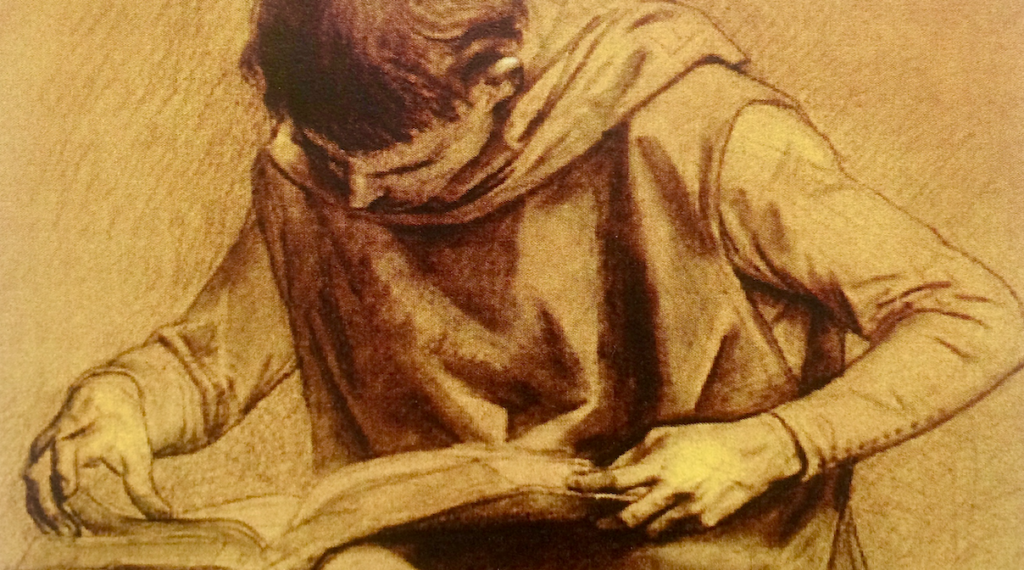
‘Once you learn to read, you will be forever free’

The above quotation from Frederick Douglass, the nineteenth century American slave turned abolitionist, testifies to the pleasure and value of reading. For Douglass it was patently true; the ability to decipher words on a page was key to his release and future success as a social reformer. However reading can yield deeper levels of freedom than that.

One can read for pure pleasure. Who has not stopped and savoured the first lines of some works of fiction! ‘It is a truth universally acknowledged, that a single man in possession of a good fortune must be in want of a wife.’ (‘Pride and Prejudice’ by Jane Austen.) And the whole of Emily Bronte’s ‘Wuthering Heights’ has given aesthetic pleasure to generations of readers. The same can be said of ‘The Grapes of Wrath’ (by Steinbeck),All the Light We Cannot See’ (by Anthony Doerr) and countless other novels. With them a reader thus ‘lives a thousand lives before he dies ….. [whilst] the man who never reads lives only one.’  Such ‘great reads’ introduce one to something deeper than aesthetics, they bring one to another place where one encounters other people and other predicaments. In time one learns to read a novel vertically as well as horizontally, and to understand literature not just as story but to value it for its ‘eternal freight’. This requires being open to literature as a study in depth of human nature from which we are enriched, rather than dismissing it as fanciful and to be replaced by a textbook of biology. But to read literature many of us require a teacher, either a formal one or an informal one and friend.

EXULTATION is the going

Of an inland soul to sea,—

Past the houses, past the headlands,

Into deep eternity!


Bred as we, among the mountains,

Can the sailor understand

The divine intoxication

Of the first league out from land? [1]

However for all the pleasure and companionship literature gives, and the voice it gives to man’s ultimate concerns, it is insufficient in responding to our search for meaning. The Bible indeed can be read for its literary quality alone: the Book of Esther for its epic plot, Second Isaiah and the Psalms for the beauty of their language, Sirac and Proverbs for their critical thinking, but to the believer these texts have another dimension; they resonate with something ‘other’, from beyond the horizon of everyday experience. These books have a character which is both human and divine. But while the reading the Bible is full of promise it is not easy to plumb its depths. At the most basic level the Jewish Rabbi, for example, does not see the Bible a narrative whole, in contrast to the Christian view. For him it is not a story of disaster in the Garden of Eden leading on to ultimate rescue, but a cryptic text (where no detail is unimportant) that offers guidance for life. For Christians it is a collection of books that does form a single whole and is unified by the New Testament.  In this it testifies to Jesus as the Messiah and Son of God. To recognise this, and much more, one is best off when accompanied by a guide who can reveal its depth of meaning.

Christian tradition from earliest times has guided readers on four possible levels of meaning in scripture: first is the literal interpretation or what the author meant. This may not always be obvious as we run the risk of reading elements of our own cultural mindset into that of ancient times. As Origen said, taking the text on face value, as some people do, can be a sign of stupidity. (Whoever heard a snake speaking in Hebrew, as related in Genesis 3!). A second level of meaning is ethical; make the comparison between the Law of Moses and the teaching of Jesus from the Sermon on the Mount! A third level of scripture, termed ‘allegorical’, consists in taking people, places and things of scripture as pointing to realities on a higher plane in a symbolic world. The story of the good Samaritan has been read as representing Christ’s mission of salvation to all humanity. And finally, ‘anagogical’ interpretation detects mystical signs of the after life in biblical events and statements. In each level of interpretation Jesus Christ is shown to be the fulfliment of the Old Testament. A most ironic of all biblical passages is when Jesus, in the synagogue on the sabbath, having read from the scroll of Isaiah announces that “this text is being fulfilled today  even while you are listening.” (Lk 4:16-22).

Monks have long approached the biblical literature along these lines though under the rubric of ‘Meditatio – Contemplatio – Oratio’. It is known as ‘Lectio Divina’. What could be better than to ruminate on the inspired scriptures so as to extract its divine essence, infused as it is through human words! For this kind of literature we may need a pedagogue! There are very many. Scripture commentaries come in varied user-friendly editions. Cf. footnotes for a few. [2]

Benedictine monks, at least during the season of Lent, ‘each receive a book from the library which they shall read through consecutively’. [3] If you too need guidance and encouragement in reading the Bible it may help to use a commentary or join a guided-reading group. It may set you on your path to freedom as a child of God, forever!

John O’Callaghan OSB


[1] Emily Dickinson

[2] ‘A History of the Bible’, by John Barton; Penguin Books 2020; ‘Jesus of Nazareth’ by Pope Benedict; Bloomsbury 2007; ‘The People’s Bible Commentary’ published by the Bible Reading Fellowship, Oxford;  ‘Letter of HH Pope Francis on the Role of Literature in Formation’ ..

[3] Rule of Benedict; Chapter 48

Categories
Abbey | Latest News abbeynews

Homily – Fourth Sunday of Lent – Year C

Fr.Luke Macnamara: Life is far from perfect in our lives, year groups, families, community. We make mistakes in our relationships, with God, with others, and with ourselves. Embarrassment and shame can stop us from mending relationships. We can live alongside rather than beside one another. This is not being fully alive but only a half existence. 

The Gospel story reflects this reality. It speaks of a dysfunctional family – where relationships are messy: the wayward younger son (Junior), the resentful older son (Senior). As the story progresses, Junior and Senior no longer regard themselves as sons. Junior hopes to be treated as a hired servant. Senior regards himself as having worked as a slave for his father. While both Junior and Senior are physically alive, they think of themselves as slaves and not as sons. They live apart from their father.

When Junior returns home, he is greeted by the Father who runs out to him, welcomes him with a kiss, gives him his finest robe, a signet ring and sandals, indicating his status as a son in the family. The feast is held to celebrate because as the Father’s says: “This son of mine was dead and has come back to life, he was lost and now is found.” How can this be? How can the Father overlook Junior’s many faults? Is Junior looking for some nice clothes and a full belly? How pure are his motives? The Father asks none of these questions – he simply embraces his lost son.

Although assured of the Father’s welcome, how can we take this difficult road back to the Father? Jesus has taken this road before us and for us. He has become lost and found for us, he has died and risen for us, that we might have fullness of life. Through the power of Christ’s death and resurrection, we are reconciled with God. Let no feelings of inadequacy come between us and the offer of Christ’s powerful reconciliation which leads to fullness of life, now, and in the world to come. Those joined to Christ become a new creation. Let us use these last three weeks of Lent to join ourselves close to Christ, to be reconciled to God, each other and ourselves, that we may receive his Easter gifts of peace, love, and life.


Categories
Abbey | Latest News abbeynews

Homily – Third Sunday of Lent – Readings for Year A

Abbot  Columba Mc Cann: Here’s a thought I came across on the internet a few days ago:  “One day you are going to meet someone in your life, that is going to change everything. They are going to change the way you think about the world, the way you view yourself, and the way you look at everyone else around you.”

Certainly for the woman at the well, to meet Jesus was a life-changing event. Here she is, going to collect water at the well in the middle of the day.  This Jewish stranger probably realises that something is wrong.  The heat of midday is not the time for trudging around carrying water; the women do that in the evening.  Does he realise that she is something of an outcast in her own village?  He seems to speak in riddles, promising her living water that will well up to eternal life.  What on earth does he mean?  By the end of the story we might have a clue.  

In the full story, which we don’t hear today, Jesus gently probes the question of her family life, and it turns out that she has been divorced four times, and the man she is now living with is not her husband.  Her life has not gone according to plan.  She has been rejected multiple times.  It’s not surprising that she has given up on marriage.  She has broken the rules, rules which Jesus himself underlined elsewhere about fidelity in marriage, even to the consternation of his disciples.  She has broken principles that Jesus himself believes are important.

But look at his response:  not a word of blame or condemnation.  It appears that he knows her through and through.  He knows what it is like to be her. Far from condemning her, he starts to speak about himself.  He reveals that he in fact is the long-awaited Messiah.  In St John’s gospel, the first person to whom Jesus reveals his identity in this way is this adulterous Samaritan woman.  He sees all that has gone wrong but, as Messiah, he loves her.  This is the living water that lasts for ever.  It’s his love.  Another name for this is the Holy Spirit.

St Paul speaks eloquently of it:  Neither death nor life, no angel, no prince, nothing that exists, nothing still to come, not any power, or height, or depth, or any created thing can come between us and the love of God made visible in Christ Jesus Our Lord.

For this woman the fact that she is a Samaritan and he a Jew, supposed to be sworn enemies over the centuries, will not get in the way of that love; the fact that her family life is way off the normal bounds of morality will not get in the way of that love; if anything it draws his love closer.  Many men have rejected her.  Jesus doesn’t.  His love is like living water, and nothing will get in the way of it, including societal norms.

What might it be like for any of us to be in touch with that love and living from it?  We could draw on a beautiful poetic image from the Old Testament;  it’s like a tree planted near the water’s edge, that thrusts its roots down to where it is always moist.   This tree has no worries when the weather gets hot and dry, with the soil dusty and barren; it is continually watered deep down, and will bear fruit in due course.  

The last book of the Bible, again writing in poetic terms, sees this flow of love, this river of life, flowing from the throne of God for all eternity, with amazing trees planted on either side, bearing fruit every single month, and with leaves that are healing and medicinal. 

I suggest that all of us thirst for something like that.  We don’t need to wait until the next life to begin to experience it. As we come to the altar table today already we can open our hands, open our mouths and say, like the Samaritan woman, ‘Sir, please give me this living water.’ And he will not refuse anyone who comes to him.

Categories
Abbey | Latest News abbeynews

Homily for Saint Patrick’s Day

Fr. Fintan LyonsMany years ago in a north Co. Dublin fairly rural parish, the attendance at Mass one St Patrick’s Day was noticeably reduced, and was commented on by parishioners –  in a village anything different tended to be noticed. We realised soon enough that it was because some had gone off early to the parade in Dublin city, with consequences for our local observance of a religious feast – a low mass in Latin with some Patrician hymns in Irish, and little else to honour our Patron Saint.  As one with pastoral responsibility, I wondered what effects this development could have on parish life; the new black and white televised parade was opening a wider world to us, one where the religious ethos would have to find its place.

It seemed a bit sudden, but the fact was that early 1960s Ireland was struggling to build up its economy, so a parade with colourful floats and an emphasis on industry had become prominent –  compared certainly with the Free State’s observance of the day less than three decades earlier –  a military parade, bands playing Patrician hymns, and ending with Mass in Latin, attended by government ministers. 

Change the scene to today’s Ireland and the Saint Patrick’s Day Festival now shaped by the mid-nineties government official plan ‘to project, internationally, an accurate image of Ireland as a creative, professional and sophisticated country with wide appeal.’   

How do faithful members of the little flock – no longer the great people, honour our patron saint in a mixed Christian and secular society, where for many the word Saint may not have meaning, traditional moral norms are disregarded and the state scrambles to deal with ever-multiplying social problems? A country of diverse ethnicities, a prominent consumer culture, social media influencers affecting attitudes and behaviours? And  a society where icons are esteemed and imitated.

We can learn this, at least, from the way society functions: the importance of icons. Champions in so many sports, big names in music and films, in endurance feats, are hero-worshipped, inspiring, and imitated by, the young and young adults, and rightly so.

Today, St Patrick, so many centuries after his time, could be an icon, as he actually became, several centuries after his death, when so much was written about him and devotion spread in Ireland and western Europe. 

He  had been called by God to build up the church in Ireland; we can call on him to re-build the church in our day. It’s just that he needs to become known accurately as the hero he was, a person worthy of being an icon for today’s generation, whether Gen Z or Alpha or whatever people are. 

Authenticity has an appeal for a generation aware that some who seemed icons have turned out to be very flawed, a generation that has learned not to be naïve, and values authenticity. And authenticity is what is found in Patrick’s honest, humble account of himself in his autobiographical Confession, self-deprecating, yet a revealing account of a spiritual champion.

It’s a short work, the length of one chapter of a typical modern novel. Part of its charm for those who believe is the great number of allusions rather than direct quotations from Scripture that have a pleasing resonance for anyone reasonably familiar with Scripture. For others, at least quite an amazing story. For someone reared in the West of Ireland, one of the comparisons or similes he uses has a particular and deeply spiritual resonance. 

I have a clear childhood memory of fields with stones lying on the muddy ground from cattle crowding against loose-stone walls. One sentence in paragraph 12 of the Confession sums up Patrick’s humility, his calling and his spiritual greatness: 

‘I know for certain, that I was like a stone lying  … in the mire. Then he who is powerful came and in his mercy pulled me out, and lifted me up and placed me on the very top of the wall.’

He continues with a sentence that could sum up his entire story:

‘That is why I must shout aloud in return to the Lord for such great good deeds of his, here and now and forever, which the human mind cannot measure.’

For people today, and especially the young, who find faith and a commitment to be followers of Christ, a step too far, knowing the story of Patrick can make him their icon. May it be so. He says early in his story that as a youth he ignored God and his commandments. But in the hardship, the loneliness, of captivity he came to himself and began to look to God for help. ‘There  I sought him, and there I found him’. There can be a lot of loneliness, a lack of meaning in a way of life of the young today that does not satisfy.

Patrick went through all that and found that God came to his rescue. Towards the end of his life, he prayed that some would come across his writing and learn from him,’ a sinner and unlearned’, how great God’s gift to him had been. Those who come across his story today can also learn how great God’s gift can be to those who are open to receive it.  

Categories
Abbey | Latest News abbeynews

Lessons from the forest

We celebrate the forests of the world for their many gifts: hydrological services, timber, shelter and food. But perhaps their greatest gifts to human kind are magnificence, splendour and wisdom.

Of all the animals of the earth, we – though we have to say it ourselves – are the most elegant, well balanced and upright. Among the plants, our elder brothers the trees may make a similar claim. It is therefore natural for us to feel a co-naturality with the trees, a certain haptic exhilaration at their height as they prayerfully stand tall and extend their limbs to the heavens. A man born blind when first he saw exclaimed: “I see men like trees walking.”

Trees manifest fidelity, constancy, endurance, and a generously creative response to adversity. In the press of competition they adapt, or, if all else fails,  give way in a spirit of advaita or non-duality, as if saying to their all too near neighbour: “it is all the one; whether you live or I live, the forest survives.” And so saying, give as nourishment of their very bodies for their friends.

Their fidelity is manifest at this time of year when the coming of Spring is only a vague rumour, completely unsupported  and even denied by swirling cold winds, frosts and snows… Yet they know its coming is as certain as the dawn and faithfully, with rising sap and swelling buds, prepare to welcome it.

Their constancy in an uncertain world is delightfully reassuring. Touch wood! Oak is always oak even after years of neglect and being ignored. “Like the stars when called by name, answering ‘Here we are!’” (Baruch 3:34).

Terrible predictions of terrors to come are all about us. Nature is all poisoned and destroyed. Nature will survive but with terrifying carelessness will cut off those who misbehave and poison the poisonous. The ever-moving present is like a tsunami crashing through time. We are like dolphins playing in the wave. We can do little to alter its course, but we can exult in its speed and power.

Let the sea and all within it thunder. Let us, with the trees of the wood, rejoice at the on-going revelation of the symphony of creation, at the coming of the Lord, for He comes to rule the earth. With justice He will rule the world, He will judge the peoples with truth!

Anthony Keane OSB

Subscribe To Our Newsletter To Receive Updates

[hubspot type=form portal=6886884 id=9e1d6d0d-c51e-4e35-929d-3a916798de64]