
Categories
Abbey | Latest News abbeynews

Homily – Pentecost 2025 – Year C

Fr. Mark Patrick Hederman: Today is red letter day. The Holy Spirit is moving through the airwaves. You could be the person needed for a next move in plans for the universe. Each of us has been fitted with a connecting link inside our identikit. It is important to take time to look around inside yourself and find the switch; Especially if you are making life-changing decisions or sitting important exams; The help-line is there if you are humble enough to use it.

There are two ways of living in this world: on your own or in the company of those who made us. The word ‘company’ comes from the Latin ‘cum pane’ meaning ‘with bread’ – Panis Angelicus – we who eat the bread of life together are companions. Companions with the Father, the Son, and the Holy Spirit. Companions with all those who have left us and who make up the company of the saints in heaven. They are all around us here this morning, we only have to reach out and touch them with our love.

The Holy Spirit is our Sat-Nav on this journey through life. The signals are often silent and always discrete. We have to listen carefully and stay awake. There is no attempt to force us or to impose. The invitation is private, privy sealed and personal. There is total respect for your free will and mine. It is always your choice, my choice. So, my advice is this: plug in; turn on; and do what you’re told. That, for me, is the recipe for happy, exciting, and meaningful life. 

‘Today, if you should hear this voice – harden not your heart.’

Categories
Abbey | Latest News abbeynews

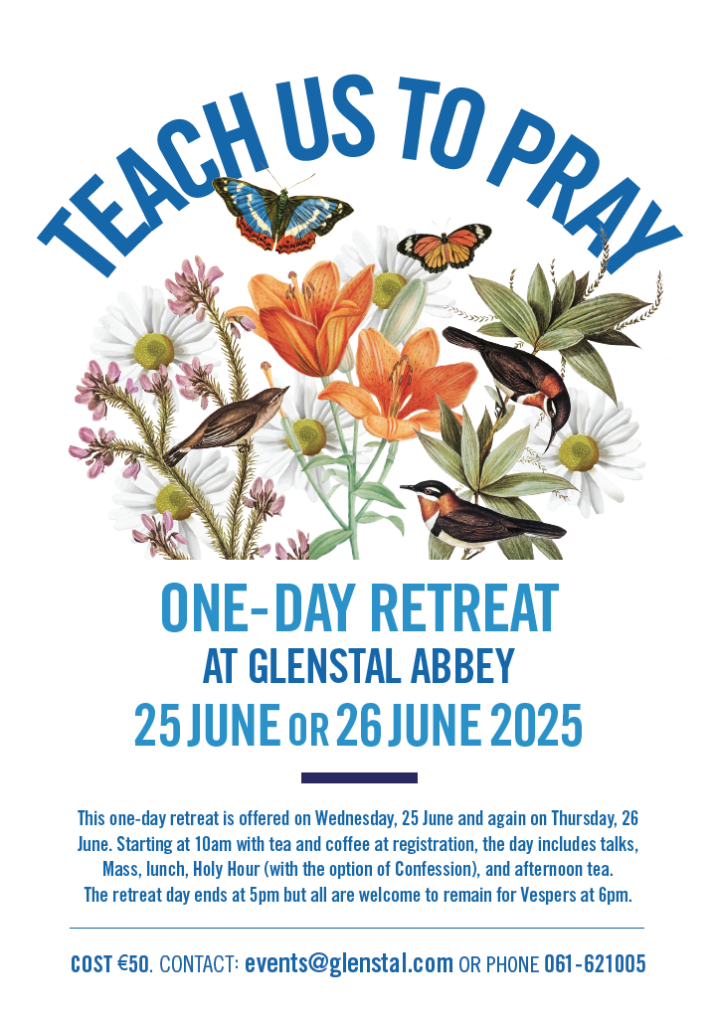
Summer retreat

The annual Summer Retreat will take place on Wednesday 25th and Thursday 26th June, and we invite you to join us!

This day-long retreat gives an opportunity for prayer, reflection and renewal in the midst of the busy summer season and has been a feature of the Glenstal calendar for many decades. The theme of this year’s retreat is ‘Teach Us to Pray’ and the retreat talks will be given by members of the monastic community.

Please email events@glenstal.com or telephone 061 621005 for more information.
Categories
Abbey | Latest News abbeynews

Seeing with the eyes of Christ

The late Pope’s extended stays in hospital produced some inspiring reflections on the amazing things that take place in hospitals. Saint Benedict’s instruction to ‘Listen carefully and attend with the ear of your heart’ prompted me to reflect upon my own hospital experiences, as after retiring I decided to join the chaplaincy department of our local hospital.

My training to be a lay chaplain began in the autumn of 2019, and I soon started a role which involved bringing Holy Communion to a ‘captive audience’ of appreciative Catholic patients, something which proved to be an easy yet very rewarding task.

Not long after beginning my rounds, however, the COVID-19 pandemic put a stop to all visits to the hospital. Nevertheless, I was one of the first volunteers to report back for duty in August 2021, though a major change had been introduced: we were each allocated to a ward, and only one, in order to contain the outbreak of any possible infections.

I was assigned to the ward for Acute Medicine, but panic soon set in… how would I manage to connect and engage with people unknown, who were in pain, worried, facing stark choices, who perhaps had no religion or could even be quite hostile? I took a deep breath and ‘sought the eyes of Christ’, a sentence I had heard often enough at Glenstal Abbey. I have not looked back.

My volunteering now takes place each Wednesday morning, and I wear a purple lanyard which reads CHAPLAINCY with a Saint Benedict’s Medal and pin with the Dove of the Holy Spirit attached. By now I am well-known to the staff on the ward, who count on me to help with difficult patients, and who sometimes need a good word and a hug themselves. My visits are a ‘light touch’ –  I simply try to be a witness to the love of Christ through my discreet presence and service. Although in reality not many people are religious, they do all appreciate being ‘seen’, and are receptive to a smile and a chat. Many patients don’t have visitors and are glad to tell me about themselves (or, more often than not, their dog…), while others truly welcome the chance to pray together, something I treasure, particularly with Muslim patients.

There are people living with dementia who need patience and help. On occasion I have been told painful family secrets, a way to make peace with a troubled past.  Other times it has been sharing the pain with someone losing a limb to diabetes. Most people are frightened of what the diagnosis will mean for their future. Sometimes I have accompanied patients over many weeks, and seen them deteriorate and die: interacting with their grieving families adds another dimension. As the late Pope Francis is reported to have said: “a hospital is a place where human beings remove their masks and show themselves as they truly are, in their purest essence.”

At the end of each shift, we write-up notes on each of the patients we have seen before chaplains and volunteers gather together in the hospital chapel. There is a brief service in which we pray for our patients, nurses and doctors – and for each other. Some days are so tiring and emotionally overwhelming, but I remember Who is helping me to carry the yoke of caring, the importance of mission and of bearing witness to our Faith as Christ’s apostles. All this work is a huge privilege and a blessing, and I’m so grateful to have this opportunity for service and witness at the hospital.

Anna Gannon is an Oblate of Glenstal Abbey and Fellow Emerita of St Edmund’s College at the University of Cambridge.

Categories
Abbey | Latest News abbeynews

The Glenstal Prayerbook

Just published! Get your hands on a copy of The Glenstal Prayerbook right here: shorturl.at/jYZkj

Categories
Abbey | Latest News abbeynews

Homily – 6th Sunday of Easter – Year C

Fr. Simon Sleeman: A friend gave me some advice when I told him I was preaching at the Parents Day Mass. ‘Good luck with that’ he said….’I know you have a great message, a message of peace, of freedom and living without fear but, but your congregation will  have other things on their minds… BBQ’s and bacon, sunshine and showers, music and sports, prizes and awards. Here’s what you do.’ Make your introduction concise, the ending abrupt with nothing in between.” So here goes…

We are here on assignment. The Christian assignment is not about getting more, it is not about doing more or even knowing more.It is about ‘becoming more’. Bearing fruit. Fruit that will last. Growing up into the full stature of Christ.

‘Becoming more’ is not getting bigger – Pliny the elder said that the Romans when they couldn’t make a building beautiful, made it bigger. ‘Becoming more’ is not bulking up with steroids or weights.  It is not even becoming nicer… ‘Becoming more’ is, ‘growth in the sense of the other’ – be that other my neighbour, or my God. Space for the other.

Before your mind takes you down the rabbit hole of ‘do-it-yourself becoming’, or asking yourself, ‘how can I get this done with ‘just one click’?  know that this growth is the work of the Holy Spirit of God, the Divine Artist who teaches you everything – an almost impossible proposition to hear, convinced as we are, that we can self-engineer anything we want or desire.

Our assignment is to cultivate that delicate instinct that responds to the slightest movement of God’s Holy Spirit in our lives leading us to life… and then hold onto your hats.

Categories
Abbey | Latest News abbeynews

Homily – 5th Sunday of Easter – Year C

Fr. Anthony Keane: In today’s gospel, which gives us the farewell discourses of Jesus,  dearest brothers and sisters, we are confronted with the mysteries of Life and Death. There is the horror of betrayal  even by one who shared his table – Jesus was deeply disturbed and declared:  ‘one of you is going to betray me’, and there are the chilling words of the text: As soon as Judas had taken the piece of bread he went out.  It was night.

Lest we be too afraid, we also read:  and light shines in the darkness of that night, and the darkness could not overpower it.  And of divine Wisdom:  compared with light she takes first place for light must yield to night, but against Wisdom evil cannot prevail.Despite the murderous threat of the Jewish establishment and the weighty Roman Empire, to which is added the treachery from among one’s own,  despite all of this horror,  Jesus says:‘Now has the Son of man been glorified’                                          

– Glorified because the life of the Giver of Life has been confronted, existentially threatened and, thereby,  gloriously revealed in all its power of  love  which overcomes death itself.

And in this power, ever ancient and ever new, we receive a new commandment:  Love one another.  This comes naturally, supernaturally,  to us when we see the wonders that God works.   For,  Wisdom, unchanging,  renews the world, and generation after generation, passing into holy souls, makes them into God’s friends and prophets.                           

Categories
Abbey | Latest News abbeynews

Homily – Third Sunday of Easter – Year C

Fr. Mark Patrick Hederman: It is interesting how the liturgy provides readings for special occasions. Next Wednesday the conclave begins to elect a new Pope. The Gospel this morning is about St Peter, the one chosen by Jesus to head up his team of disciples, to be the rock on which Christianity is founded. It would have been difficult to choose a less likely candidate. ‘I will never leave you, I am ready to die for you, you can definitely count on me!’ His oaths of loyalty are a penny a dozen: all blow and no go!

 Jesus is patiently realistic: ‘Before the cock crows tomorrow morning, he tells his over zealous disciple, ‘you will have denied me three times.’

There are only two scenes in the New Testament where a burning charcoal fire provides the setting. Here on the beach, after the miraculous catch of fish, where Jesus is waiting to meet both Peter and ourselves. The last time we sat warming ourselves beside a charcoal fire ‘A servant girl saw us, looked closely at us and said, “This person was a follower of Jesus.” And we all stood up with Peter and denied it. “Woman, we said, “I don’t know him; I know nothing about him.”  A little later someone said, “You must be one of them.”

And about an hour later another insisted, “This guy was certainly with him, his accent betrays him.” And Peter, like the rest of us, began to curse and swear saying “I don’t know what you’re talking about!”  And as he said it, a cock crowed. The charcoal fire kept burning and Jesus turned and looked at us straight in the eye. And Peter remembered the words he had spoken to him: “Before the cock crows, you will have disowned me three times.”  And Peter went outside and wept bitterly.

Here, today, in front of a similar charcoal fire, Jesus asks Peter three times ‘do you love me’ and Peter is offended by his asking him three times. But both Jesus and the charcoal fire are making a point. If you deny me three times, you must tell me three times that you love me. Not like Judas who hanged himself after his terrible betrayal, we are invited to say how sorry we are and that, in spite of everything, our weakness, our cowardice, our treachery, we really do love him. The charcoal fire is yet one more symbol of God’s burning love, it stands like the paschal candle here as a reminder that whatever we do, however we fail, we must never give up on God’s love for us. 

On Wednesday next, 133 cardinals will assemble in conclave to vote for the next pope, a new Peter. 108 of these electors [that is 80%) were appointed cardinals by Pope Francis. Was he shortening the odds or, maybe, increasing the oddballs? No one can say who will eventually be chosen. In Italy it is forbidden by law to place bets on the result. If you want to cash in, you have to access international aps such as Ladbrokes or Paddy Power. It would be foolish to predict. All we do know is that, by the end of next week, someone will have become a household name, an international celebrity and that person, whoever they may be, no matter how incompetent, how pathetic, how foolish they may have been in the past; that person will receive from that moment on, the guidance and the courage they need to do whatever the Holy Spirit has arranged for them to do. Such a process will have happened seven times during my lifetime and in each case I have to take my hat off to the Holy Spirit because, for the most part, they have been a credit to him or her, certainly in comparison with other internationally elected leaders during that time span. 

And why is this so? Because that fire of love is still burning on the beach by the waters of the Sea of Galilee.   Our God is a blazing fire; the Trinity is iron, coal and burning heat; the axis of the universe; what makes each of us and all of us complete. The three sang with one voice from the heart of the fire: blessed be God, alleluia.

Categories
Abbey | Latest News abbeynews

Latest edition of the Abbey Chronicle

We’re pleased to share the latest edition of the Glenstal Abbey Chronicle, which may be viewed here.

Categories
Abbey | Latest News abbeynews

Reverence in the face of mystery

Last month we had a conference on Jungian psychology at Glenstal Abbey. I spoke to the fifty strong group and was surprised to get a question on bees at the end of my talk, which was about Projection in Jungian psychology. The person asking the question confessed to being a beekeeper, and she wanted to know what I had learned from my fifty years working with the bees at Glenstal.

I was surprised by her question. My response surprised me. I said I no longer thought of myself a beekeeper – that this was somehow a misnomer. Yes, I have bees but ‘no’ I am not  ‘beekeeping’.  This term suggests a kind of ownership or possession of the bees with which I no longer feel comfortable.

The term belies the wider issue of how we live and relate to the world of creation, of which we are a part. We speak of ‘nature’ and the ‘environment’ and of ‘going out into nature’ as if it were object ‘out there’, at a distance – as if we could live outside creation. This is not only wrong, but crazy thinking and leads to all sorts of abuse of the very world of which we are an integral part. If it is ‘out there’ we can do what we like with it, spend our lives tormenting it into doing whatever we want. ‘Nature’ is hitting back. Bees are in peril.

I told my questioner that I am searching for a new term to describe my relationship with bees – ‘tending them,’ ‘minding them’  but above all getting away from the idea that I own them or am keeping them or even managing them. I told her the most appropriate gesture for me in the apiary is to take a step back and see the mystery before me.  I need to recover my ‘right size’, my appropriate stance before the bees in my hives.

I admitted that it had taken me until I was almost fifty to ‘see’ a bee. Until that moment, I viewed bees functionally – bee colonies were for production. I wasn’t quite as crass as that but I didn’t see them. I never marvelled at their magnificence. My aggressive, utilitarian approach dulled my perception and allowed me free reign to interfere, manipulate, and disrupt the bees. I was managing them using every management technique, every new beekeeping tip I could glean from magazines, journals and books.

Then one day everything changed. I ‘saw’ a bee. It landed at one of my hives, its pollen basket packed with golden, yellow pollen. It had only just made the alighting board weighed down as it was with its heavy load of life giving protein. There it was – a bee. Astonished at my discovery, I stared while the bee recovered enough strength to go inside the hive and hand over its load. The bee was too exhausted to mind my intrusive gawking. It was as if scales fell from my eyes. That moment taught me about the ‘tyranny of our conceptual frameworks’ – taught me that I needed to shatter the perceptual framework through which I viewed the world and start again and begin looking at the bees with loving rather than greedy eyes.

As I look back now on that, ‘moment of innocence’, seeing a bee for the first time, I recognise it as a ‘moment of reverence’ before the mystery. Living on this planet for 50 million years longer than we have, how can we be threatening their very existence?  It woke me up to the destructive power of an irreverent mind-set and  how it infects my relationship with the world in which I live.

We need to recover our organ of reverence before the wonders of creation – take a step back and look with astonishment at what is happening in and around us. This is not asking people to be naive but to recognise that our relationship with creation is dangerously out of joint – it threatens our very existence and that of the bees. We need to recover a stance that will allow us and the bees to survive on this beautiful and mysterious planet.

James Freeman Clark, an Easterner who traveled to the Western United States of America in the nineteenth century, wrote in his book on Self-Culture, ‘when I lived in the West, there came a phrenologist to the town, and examining the heads of all the clergymen in the place, found us all deficient in the organ of reverence. More than that, we all admitted that the fact was so, that we were not, any of us, especially gifted, with natural piety or love of worship. Then he said, ‘You have all  mistaken your calling. You ought not to be ministers.’[1]

I might add, ought not to be ‘beekeepers’ either.

Simon Sleeman OSB


[1] James Freeman Clark in Van Wyck Brooks, The Flowering of New England (New York: Modern Library, 1936), 268.

Categories
Abbey | Latest News abbeynews

Remembering Bernard O’Dea OSB

We remember at this time Father Bernard O’Dea OSB – the first Irishman to enter the monastic community at Glenstal Abbey – whose 25th anniversary takes place later this month.

Born in Inagh, County Clare, on 3rd October 1909, Gerald O’Dea went to school at St Flannan’s College in Ennis. He briefly attended the Patrician Brothers’ School in Mountrath, County Laois.

Matriculated in 1928, he trained as a pharmacist and worked as an apprentice in Dublin. Having been advised and introduced by an Augustinian spiritual director, he entered Glenstal Abbey on 19th June 1932, receiving the name Bernard. He made profession on 1st October 1933, the first monastic profession in Glenstal. The following day, he went to our motherhouse of Maredsous Abbey in Belgium for further formation and studies.

Following the study of philosophy there from 1933 to 1935, he studied theology at the Congregation’s scholasticate in the monastery of Mont César in Louvain from 1935 to 1938. He made solemn profession at Glenstal on 1st October 1936. Returning definitively to Glenstal, he was ordained priest in Thurles on 12th June 1938. While finishing his theological studies here, he was appointed Subprior and Guestmaster.

When travel to and from Europe became possible once more after the Second World War, Glenstal Abbey’s founding abbot, Dom Celestine Golenvaux, visited the monastery for the month of October 1945. On 8th December of that year Father Bernard was appointed prior of what was still a dependent foundation. On 6th February 1948, the monastery achieved independence as a Conventual Priory and Father Bernard was appointed Conventual Prior. He held this office until forced by ill health to resign on 1st August 1951.

During Father Bernard’s term as Prior, many initiatives were taken. On 9th October 1948, a university hostel was opened at Balnagowan, a house in Palmerston Park in Dublin. A year later, a good tillage-farm with a substantial house at Ballyvoreen – some five miles from Glenstal – was acquired from the brother of Archbishop Harty. Always interested in horses, Father Bernard encouraged riding in the school and there are photographs of him giving an exhibition of show-jumping on one of the playing-fields. He once said, “give me a horse and I’ll live for ever.” However, when he fell from a horse near the back lodge in his late eighties, community sympathy was limited!

A major decision taken was to build a monastic church, as the temporary chapel of 1932 was proving increasingly inadequate. Dom Sebastian Braun of Maredsous was appointed architect. Father Gregory Barry, an accountant and former Spiritan priest, was appointed director of fundraising. The estimated cost at the time was £75.000.oo –  about €3.6 million in today’s money. In the impoverished Ireland of the period, the only possibility of financing such a major undertaking was to supplement local endeavours, such as a Silver Circle, with foreign assistance. The main focus was on the United States. From February to September 1951, Father Bernard and Father Gregory made a successful tour of that country, exploiting Father Bernard’s network of County Clare exiles, many of them priests. From this period, Father Bernard’s admiration and reverence for the United States, already strong, remained undimmed. He returned to Glenstal for the laying of the foundation-stone on 14th October 1951. This occasion marked the emergence of the monastery into wider public awareness. The foundation-stone was laid by Archbishop Kinnane of Cashel and the ceremony was attended by the President of Ireland, Mr. Seán T. O’Kelly.

Following his resignation as Prior, Father Bernard took a long holiday on medical advice. In the archives there is a photograph of him skiing in Switzerland. The photograph does not tell the whole story as one such descent ended in a broken leg!

On his return to Ireland, Father Bernard assumed the running of Balnagowan and continued an expanded ministry as a retreat-giver in Ireland and abroad which he maintained until late in life. For a short period, he resumed the role of Guestmaster.

As time went on, he suffered progressively from SAD (Seasonal Affective Disorder) which made it difficult for him to support the Irish winter. In the early 1980s he spent two years with the developing foundation in Nigeria in Ewu-Isan. On his return, he began to spend extended winter-periods in Florida, being hosted by his network of Irish priest-friends. Increasing frailty eventually made such sojourns impossible but Father Bernard was helped somewhat by the purchase of a full-spectrum sun-lamp.

Despite indifferent health, he maintained his huge network of friends and a vast correspondence. He was a great believer in what he believed to be the values of the 1916 Rising, and of the superiority of Irish country culture of neighbourliness and self-help as exemplified in the Muintir na Tíre movement, founded in 1937 by his life-long friend, Canon John Hayes of Bansha, County Tipperary. To the end, he remained an inveterate ‘tracer’, that is, a tracer of family lineage. Once successfully identified, the traced would be told. “I have you now,” he would say.

His last years were punctuated by frequent stays in hospital. It was not until the final days of his life that he began to accept that he was not going to recover from the cancer that had been diagnosed. He spent his last ten days in Milford Hospice, continuing to receive friends and well-wishers. Father Andrew Nugent stayed with him round the clock and was present when he finally died in the early morning of 23rd May 2000.

May he rest in peace.

Subscribe To Our Newsletter To Receive Updates

[hubspot type=form portal=6886884 id=9e1d6d0d-c51e-4e35-929d-3a916798de64]