
Categories
Abbey | Latest News abbeynews

Meeting the Climate Challenge

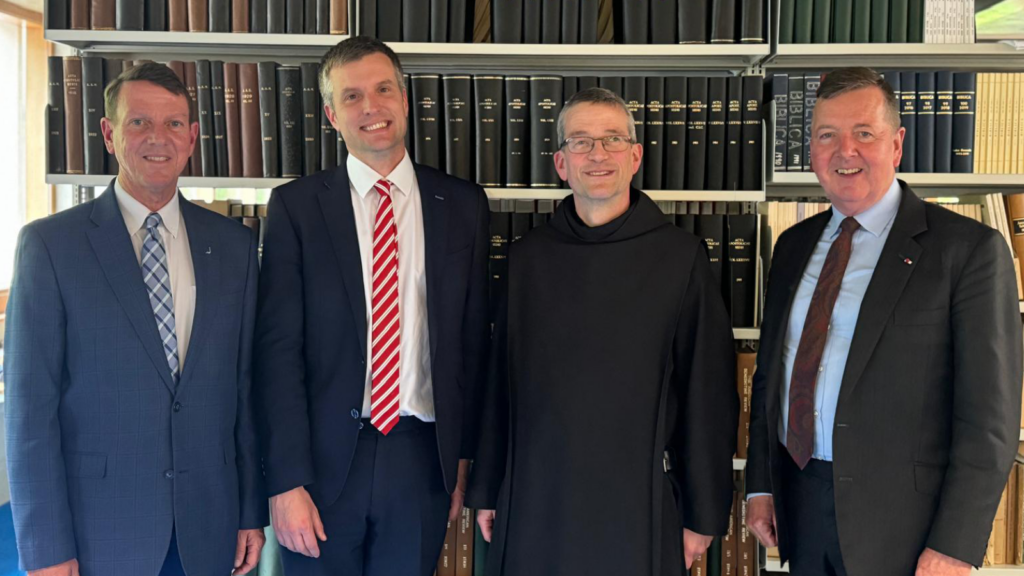
L to R: Tobias Winright, Edward Burke, Luke Macnamara OSB and Mark Mellett.

The monks of Glenstal Abbey were pleased to host a conference titled ‘Resetting the Clock on Climate Change’ on Saturday 18th May 2024 which brought together speakers, guests and representatives from church, academic, military and non-governmental spheres.

The conference’s keynote speaker was Admiral Mark Mellett, former Chief of the Irish Defence Forces. Mark spoke about the importance of the oceans, the story of evolution, our place in and with creation and the challenges of climate change. He concluded by suggesting ways we might meet these challenges through new technologies and outlined the characteristics required for leadership to drive the change needed.

Edward Burke, Professor of the History of War at University College Dublin and an Old Boy of Glenstal Abbey School gave a broad sociopolitical analysis of the climate crisis by outlining its stark challenges, including the security challenges posed by competition for resources and responses to ever increasing natural disasters.

Tobias Winright, Professor of Moral Theology at Saint Patrick’s College Maynooth, gave a reflection on non-violence and just war theories in the church and how these might assist in shaping responses to the climate crisis.

Br Cólman Ó Clabaigh OSB chaired a Q&A session to conclude the day’s proceedings. All three speakers spoke of how climate change disproportionately affects the poor and a question by an attendee asked if the proposed remedies mostly affected the poor – there was general agreement that this was the case and that public policy needs to reflect the needs of the poor when crafting responses.

The conference aimed to facilitate discussion on the issue of climate change and create a space where solutions might be explored together. Monasteries have long been concerned with the natural environment, and most recently the monastic and school communities at Glenstal have worked on a range of projects to reduce our carbon footprint and take steps to care for our common home in response to Pope Francis’ encyclical Laudato Si’. Indeed, earlier this year the monks welcomed the planting of 2,500 native Irish trees on a small plot of the Abbey grounds, part of a much wider project to plant 100 million trees across the country.

The monks of Glenstal Abbey give thanks to God for the gift of creation – a gift so wonderfully on display in the place which we are privileged to call our home – and pray that the challenges of climate change might be met in a timely and effective manner. Our hosting of the conference underlines our commitment to responding to the climate crisis and gives the monastic community new energy as we play our part in the response through the co-operation of one another, of our visitors, guests, students and co-workers.

Saint John Paul II once spoke of how in contemplating “with wonder the universe in all its grandeur and beauty, we must praise the whole Trinity.” May our contemplation of God’s marvellous handiwork lead us to praise Him, and prompt us to care for his gift to us!

Categories
Abbey | Latest News abbeynews

Homily – Pentecost

Abbot Brendan osb

On the evening of 14 November 1940, bombs rained down on the city of Coventry for eleven hours. After the raid, Coventry Cathedral and much of the medieval city had been reduced to ruins. It lost hundreds of shops, public buildings and 43,000 homes; 554 people were killed. The raid was so bad that a new word was coined; to be coventried, meaning to be decimated. In February 1945, and partly in retaliation, bombs were dropped on Dresden, one of the world’s most beautiful cities, for three days. A firestorm developed, killing up to 25,000 people, and six and a half kms2 of the city centre was obliterated.

Today, Dresden and Coventry are twinned cities, but the ruins of Coventry Cathedral are still visible. A new cathedral stands beside the old, but the old remains as a reminder of the senseless destruction and loss of life of which we are capable when madness takes hold. These cathedrals, new and old, side by side, have become symbols of peace and reconciliation.

Eighty four years later and our world is still disfigured by war and violence. People of good will desire to make common cause in the search for a worldwide community of fraternity and understanding under God. Peace is not just the absence of war, like a cathedral, it has to be constructed, patiently and with unshakeable faith.

What does all this have to do with Pentecost and your Confirmation? Everything. The cathedral of peace is built of many small stones. Each one of us has to become a stone in that beautiful edifice. Mistrust and division begin in human hearts. The Acts of the Apostles tells us, “There were devout people living in Jerusalem from every nation under heaven.” Each heard the apostles preaching in their own language. They communicated and understanding was the result. Love, joy, peace, patience, kindness, goodness, faithfulness, gentleness and self-control. These are not just qualities that sound nice in a list, they are necessary if humanity is to survive. They are the fruits of the Spirit. Wisdom, understanding, counsel, fortitude, knowledge, piety, and fear of the Lord, the Spirit’s seven gifts; wise people of integrity are what we need today.

Wherever the strong exploit the weak; wherever the rich take advantage of the poor; wherever great powers seek to dominate and to impose ideologies, there the work of making peace is undone; there the cathedral of peace is again destroyed.

“When the Advocate comes, whom I shall send to you from the Father, the Spirit of truth who issues from the Father, he will be my witness. And you too will be witnesses”. The ruins of the old cathedral constantly remind our society of its capacity to destroy. You are the stones building up the new edifice. You can see from our castle restoration works outside just how difficult it is to replace a broken stone. Be strong, firm and clear. Know for what you stand and why. Know that you are not alone, the Holy Spirit is with you and together we are many. This is the Church, whose birthday we recall with the coming of the Spirit. Find your voice and use it.


Categories
Abbey | Latest News abbeynews

Homily – Ascension of the Lord

Fr Luke Macnamara osb

Some time ago, when on a train, I sat opposite a young woman. She was giving a final farewell through the window to her boyfriend on the platform. As the train pulled away she kept her eyes on him, stretching and squinting until he eventually faded from view. At that precise moment she rested back in her seat and closed her eyes for a good five minutes. She wanted to treasure and savour the memory. When she opened her eyes, she smiled broadly – happy to engage again with the world. Although her boyfriend was no longer present, she was fully conscious of his love for her.

How must the disciples have felt when the Lord was taken up into heaven? They were looking all the time that Jesus was being taken up into heaven and even after he has disappeared from view. Two angels direct their gaze back to earth with the promise that Jesus will return. The angels’ words confirm that their longing will be satisfied – Jesus will be with them again.

The disciples had grown accustomed to Jesus’ physical presence among
them. As we all know when we lose someone dear to us, a spouse or child, a grandparent, parent, or sibling, or a close friend, it is very hard to adjust to their absence. The more we love someone, the more we miss them. The special love shared between Jesus and the disciples must have made his absence all the harder. However, love has a way of bridging the gap.

Jesus, before his ascension, in his final instructions to his disciples sends them out to proclaim the Good News. As a caring parent gives instruction to a child when starting school, university, or perhaps a first job, so Jesus gives instruction to his disciples. Those who believe are to be baptised. Believers will be recognised as they will speak and act with the same power with which Jesus spoke and acted when he was with them.

Jesus reassures the disciples that they do not go out alone but that, wherever they go, he the Lord will be working with them and in them. The Lord is no longer a companion on the road as he was on the way to Emmaus. Through belief and baptism, Jesus is in and with each disciple every moment of every day. The relationship with Jesus is not broken by his ascension. It becomes closer than we could possibly imagine. We need not worry about the booming message of the train station loudspeaker “mind the gap.” Jesus’ love for us bridges every gap. Through faith and baptism Jesus’ love for us finds its full flourishing. The words of St Patrick’s prayer, on the wall in in his chapel on your left, are fulfilled – Críost liom, Críost romham, Críost i mo dhiaidh, Críost ionam, Críost fúm, Críost os mo chionn – Christ with me, Christ before me, Christ behind me, Christ in me, Christ beneath me, Christ above me.

The words of the Lord in this Gospel are taken up in the final words that conclude the Mass: “Go out and proclaim the Good News.” We leave not only with this task but also equipped with the power of Christ to complete it. In a world so in need of the Gospel, may that power come to expression in our lives.

May this Good News find a home through us in our families, communities, the newly arrived immigrants, and in the people whose lives have been torn apart by war in Gaza and Ukraine. Go out and proclaim the Good News.

Categories
Abbey | Latest News abbeynews

Homily – Easter Sunday 6 – Year B

Fr Columba McCann osb

One day Jesus was in the temple at Jerusalem and noticed people putting money into the collection box. The rich put in plenty, but they were giving their leftovers. Then a poor widow put in a few cents. It was all she had to live on. It’s a good image of Jesus himself. At the Last Supper Jesus gave his disciples everything he had to give. There, on the table, was his life poured out for them, something which would come to completion the next day on the cross. He was loving them as the Father loved him. He loves us as the Father loves him, and invites us to the same table.

It is easy to forget about that kind of love, partly because it’s so big we can’t even get our minds around it. And sometimes we just forget about it. That is why Jesus says: remain in my love. Don’t get distracted from it; look for signs of it everywhere; bring your mind back to it whenever you get a bit of free mental space. We receive this love in every Eucharist; but it is good to savour the taste of it the rest of the time, especially in moments of prayer.

Nobody talks about the weather the way the Irish do, and when there are even just a day or two of sunshine we go crazy. We are out there in our shorts and t-shirts, working in the garden, walking the beach, having a drink outside the pub instead of inside, having barbecues. We bask in the sun.

Jesus invites us to bask in his love, a love which has no clouds, no sunset. He wants us to do this so that his joy will be in us. He wants us to experience the joy he gets from the Father’s love. Part of his formula is that we love one another has he has loved us. It’s easy to love someone when they give you what you want, or when they love in return. But let’s be honest: loving as Jesus loves is a tall order. It seems just too much. I don’t want to have to give up my little comforts and pleasures and convenience for someone else; I don’t want to let go of my desire for revenge when I fell hurt or put down; I really do want to have the last word when someone disagrees with me. I’ve got a problem with love. And only God can fix that. God is love.

The only way I can love like Jesus is if his love is in me. Which brings us back to his original invitation: remain in my love. Make your home in me as I make mine in you. The more we allow ourselves to receive from Jesus the more we have to give to others.

Categories
Abbey | Latest News abbeynews

Homily – Easter Sunday 5 – Year B

Fr Patrick Hederman OSB

Our Lord, Jesus Christ, when he came on earth used images to explain what he was trying to do for us. These images were taken from the day to day lives of the people with whom he lived. ‘I am the bread of life’ he said; ‘I am the door;’ ‘I am the shepherd;’ ‘I am the gateway.’ If he were here with us today, he might have used more up-to-date imagery to make us understand what is happening.

Instead of ‘I am the vine and you are the branches’ [John 15:5] he might have said: ‘I am the fibre optic splicer.’ Fiber optic splicing is one of the new professions in the telecommunications industry. You join two fibre optic cables together to create a continuous path for data transmission. The cable has at least two flexible fibres with a glass core
through which light signals can be sent. The Splicer makes a permanent connection between cables which allows each one of us to connect into the main branch. This is how we receive digital cable TV on our lap-tops, for instance. It comes through a network of high-speed fibre-optic cables.

Three weeks from today, on the 19 th May, is Pentecost Sunday, the day we welcome the Holy Spirit into our high speed networks. This completes the fibre optic connection between each one of us and the great power station that is the hub of the universe. We can either plug into this system or we can carry on paddling our own canoes. The choice at every stage of the connection is ours.

The second reading this morning gives us a clue: ‘Let us not love with
words or speech but with actions and in truth’ [1 John 3:18]. Let us be down-to-earth and practical as we prepare ourselves for our transfer to broadband. You don’t have to know how it works to find out that it works: just turn it on and benefit from your cable television. ‘We know’ Saint John tells us later on in this same letter, ‘that God lives in us because of the Spirit which God has given us’ [1 John, 3:24]. We all have that Spirit within us, that eternal source of God’s energy and power. All we have to do is activate that presence, by splicing the
fibre optic cables.

St Benedict tells us how to do this in the Prologue to his Rule: ‘whatever good work you undertake, ask him with most instant prayer to bring it to perfection.’ Whatever you do, whatever you say, whatever you hope for, stop for a moment and ask the Holy Spirit to help you. Instantissima oratione is the secret formula of Saint Benedict. Instantissima in Latin is the same word we use for ‘instant coffee’ or ‘instant soup.’ It is instant prayer. You can do it anywhere, at any time, in a couple of seconds; as long as it takes to say ‘I love you, help me.’
And it’s a question of getting into the habit, of going down into yourself and touching base. If someone asks you a question, instead of replying immediately, automatically, ask the Spirit to tell you what to say. The Holy Spirit is the finger of God, the extension of God’s right hand. The Holy Spirit is the Digitus Dei, digital divinity, The Holy Spirit is your ATM, your automated teller machine –telling you whatever you are meant to do; whatever you are meant to say.

If you allow the Holy Spirit to guide you there will be magic in your life ahead. You only have to learn to interpret the coded messages sent your way. These can happen through coincidences which can so easily be shrugged off or overlooked. Other times it is an impulse, sent your way: talk to this person, take down that book, walk in this direction, go into that church now. When we obey, we find that it leads to the unforeseen. The meaning of a particular hunch is often at the other side of our obeying it, of our doing what we are told. I have found that this instantissima oratio is particularly useful when doing examinations. Before even reading the question paper, make sure that the cables are connected and then continue working on evergreen energy.

Try it for yourselves when the Holy Spirit comes.

Categories
Abbey | Latest News abbeynews

Abbot Brendan Coffey’s sermon at Trinity College Dublin

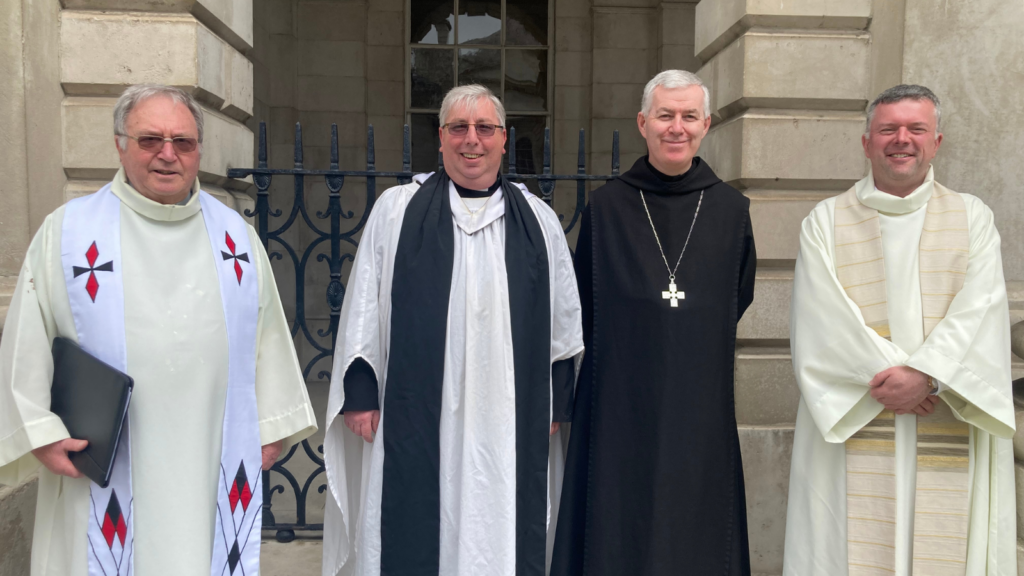
Left to Right: Fr Peter Sexton SJ, Rev Stephen Brunn, Abbot Brendan Coffey OSB, Fr Alan O’Sullivan OP.

Abbot Brendan Coffey OSB was invited to deliver the sermon at this year’s Service of Commemoration and Thanksgiving at Trinity College Dublin on the occasion of Trinity Monday 2024.

Trinity Monday has long been a special day in the life of the College as its Honorary Fellows, Fellows and Scholars are announced by the Provost in a ceremony referring back to the foundation of the College in 1592.

After the announcement on the steps of the Public Theatre, the Service of Commemoration and Thanksgiving takes place in the College Chapel and is followed by the Trinity Monday Memorial Discourse in the Graduates Memorial Building.


Abbot Brendan preached as follows:

(Check Against Delivery)

Trinity College is a famous place of learning, education and tradition. If you ask anyone in Ireland they will know this. If you mention Trinity College to someone here or abroad, they will also tell you that this is where you go to look at the Book of Kells.

Books, learning and education go together. Wars have been fought over books; they are valuable things. In our digital age we can easily forget that. While some books became works of art and are absolutely exquisite, most were primarily books: storing information, learning and wisdom. In the past books were comparatively rare and people only wrote things down if what they had to say was worth writing down. Perhaps we could learn something from that today, starting with my sermon.

Reading a book is one thing, understanding what you read is another. Jesus was handed the scroll of the prophet Isaiah and he found the place where it is written “The spirit of the Lord is upon me.” He explained that today this text has been fulfilled in your hearing. Well, that put the cat among the pigeons. They were astonished, outraged actually. They even tried to throw him off a cliff. I don’t think that happens very often after a lecture today? The people of Nazareth reacted like this because he said something that challenged their certainties. He didn’t just repeat the same old, same old, he said something completely new and unexpected. Nobody fell asleep during that sermon.

I am a Benedictine monk and I belong to a monastic tradition going back to the sixth century. Monastics and particularly Benedictine monastics, love books. We are hoarders. You should see the rooms of some of my confrères. Monks have always been like this, they kept everything, especially books; even books they couldn’t read or understand, in the hope that one day someone would come along and help them understand.

These people were open and they didn’t see knowledge as something dangerous or threatening. They didn’t necessarily believe and accept everything that came their way either, as some people seem to do today on social media, they exercised their critical faculties and their discretion. They did, however, value knowledge and believed that all forms of knowledge helped reveal the creator of all things. And so St Anselm could say fides quarens intellectum, faith seeking understanding.

It was monastics like this who were responsible for the Book of Kells, the Lindisfarne Gospels and the many manuscripts emanating from centres on the continent. These enlightened people valued learning and left us an invaluable legacy. Of course not everyone back then had such an open mind, but there were enough people who had.

Somewhere down the centuries things changed. We became fearful, like the people of Nazareth. Anything that might seem to threaten our narrow world of certainties was pushed off the cliff. Be that Galileo or Oscar Romero. Today, I am sad to say that this attitude is still alive and well. We might have exchanged one set of certainties for another, but very little has really changed. Anyone who challenges the perceived orthodoxy is immediately taken to the edge of the cliff.

How can we learn if we continue like this? Irrational fear lies behind our recent spate of attacks, violence, arson, and xenophobia. In other countries too we see similar patterns, even in the land of the free and home of the brave. This is why true education, learning and knowledge are essential today. Not a knowledge which is closed in its own discipline, but one which is open to all disciplines.

Winston Churchill once said, “Show me a young Conservative and I’ll show you someone with no heart. Show me an old Liberal and I’ll show you someone with no brains.” Life should teach us lessons, however, we do not need to fear everything and everyone.

Permit me one example from our monastic past. Hermann of Reichenau, or HermanusContractus, was a fascinating individual. His parents Count Wolverad II and Hiltrud were of a noble family from Upper Swabia. His noble birth probably saved his life as a child, together with the fact that he had very loving parents. He was born 18 July 1013 and died on 24 September 1054. He was extremely disabled from childhood, having only limited movement and limited ability to speak. He had a special chair made for him and he was carried around everywhere in it.

At the age of seven, he was placed in the Benedictine Abbey of Reichenau by his parents who could no longer look after him. After he died he was buried with his mother, because he believed it was she who saved his life as a child. To their eternal credit the monks of Reichenau took him in and looked after him. The island of Richenau was the artistic and literary centre of south-west Germany during this period. This island became Hermann’s entire world. The famous Benedictine Abbey which had been founded there in 724, played an important role in scholarship, since it was a centre where manuscripts were copied.

Hermann was an extraordinary individual who studied under the famous Abbot Berno (about 978-1048) in Richenau. Hermann decided to become a monk in 1043, later, and somewhat amazingly, he was elected Abbot of the Monastery after the death of Abbot Berno on 7 June 1048, at the age of 35. He was Abbot for the last 6 years of his life. Despite his disabilities, being confined to a chair and hardly able to speak, he was a key figure in the transmission of Arabic mathematics, astronomy and scientific instruments from Arabic sources into central Europe. He composed works on history, music theory, mathematics, and astronomy, as well as many hymns. He was the first to make the lunar calendar of the Middle-Ages work, a huge scientific discovery that really changed people’s lives for the better.

There are two things, apart from the obvious, that I greatly admire about Hermann. Firstly, very few people have ever heard of him despite his many claims to fame. He was obviously not interested in the limelight, and, secondly, he lived a very full and by all accounts contented life. He wrote most of his hymns later in life after he went blind, as if he hadn’t a sufficient number of difficulties to contend with.

This is what can happen when enough people keep an open mind. When we are willing to listen to an unexpected teacher in the synagogue in Nazareth. When we engage with the stranger among us and learn new things. When we don’t judge a book by its cover, or a person by the colour of their skin, physical abilities, race, creed or nation.

Let us remember that there were indeed many widows in Israel in Elijah’s day and yet he was sent by God to a Sidonian town to the widow of Zarephath. There were many lepers in Elisha’s day, but it was Naaman the Syrian who was healed. Can we not learn from this and overcome our fear? This is a true education.

– Abbot Brendan Coffey OSB, 22.4.24

Categories
Abbey | Latest News abbeynews

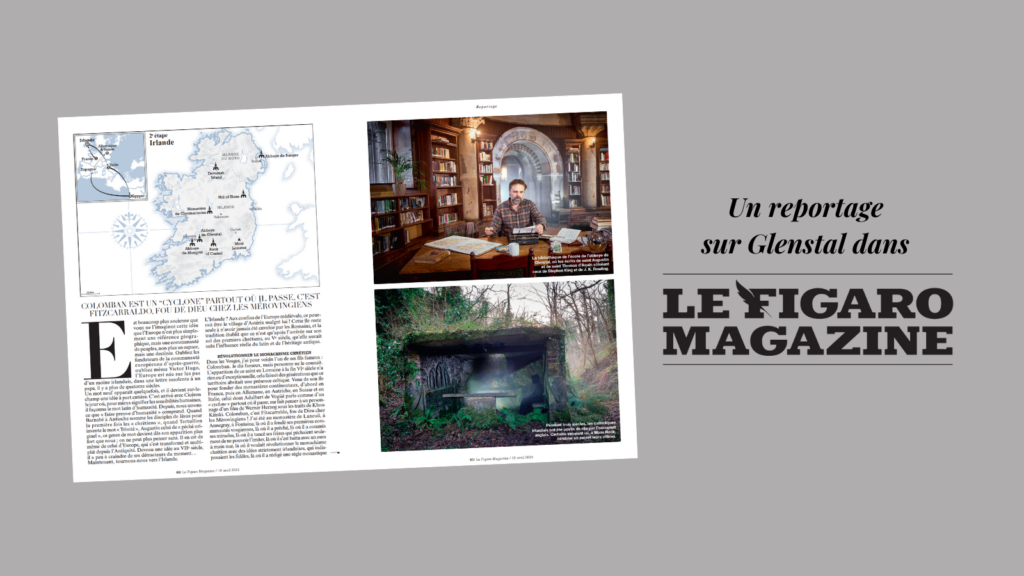
Reportage sur Glenstal dans Le Figaro Magazine

Nous sommes très heureux de partager avec nos amis francophones un article sur l’abbaye et l’école de Glenstal tiré du Figaro Magazine du week-end dernier. Avec l’autorisation de Romain Sardou (auteur) et Emanuele Sorcelletti (photographe) dans Le Figaro Magazine, 19 avril 2024, 58-67:

Categories
Abbey | Latest News abbeynews

Homily – Easter Sunday 4 – Year B

Fr Christopher Dillon OSB

A shepherd in Palestine or anywhere in the Middle East manages his sheep very differently from what you might expect of a shepherd in this country. We think of shepherds as driving their sheep, but the Palestinian leads his. He walks ahead of them to guide them to safety and good grazing, keeping an eye out for dogs and wolves and ready to take them on, should they attack. That is the point of the image which Jesus uses of the Good Shepherd. He sees his task as being out there ahead of us, to keep us safe. And not only that; he says, “I lay down my life for my sheep”.

All three readings today talk about God saving us. St Peter in the first reading says of Jesus’ name, “Of all the names in the world given to people, this is the only one by which we can be saved.” St John puts it more mysteriously in the Second Reading, when he says, “all we know is that when the future is revealed, we shall be like him”, that is to say, we shall be like God.

“And what”, you might ask, “do we need to be saved from?” Well, look around you: climate change, wars in Ukraine and Israel, migrants fleeing catastrophes of one kind or another, threats to democracy and sane government, social problems ranging from housing to health services, to say nothing of famine and drought around the world, the mental stress of addiction and loneliness.

There is so much from which people, including us here, need to be saved, to be rescued. And these readings represent the voice of God saying to us, “I love you. You are my children. I will not fail you. I will lay down my life for you.” The Easter story tells us that God, in Jesus Christ, has done just that; he has laid down his life for us, has laid down his life for us and taken it up again. He has taken it up again in such a way that we too can rise to new life after our own death. That is the saving, the rescue that he is speaking about. He is inviting us to put our trust and our hope in his love for us.

That is what our Christian faith is about, believing in God’s love for us. When all else fails, as it will, his love for us is absolute and unconditional. The question for every one of us is, “Do you trust his love?” At the very least, like the father of the sick child whom he brought to Jesus for healing, we can say, “Lord, I believe. Help my unbelief.”

Categories
abbeynews Chronicle

Reception of relics of Polish martyrs

Fr Jarek Kurek OSB, a monk of Glenstal Abbey and a chaplain to the local Polish community, invites you to the welcome of the relics of the blessed martyrs Zbigniew Strzałkowski and Michal Tomaszek at the Church of Saint Joseph and Saint Brigid in Thurles, Co. Tipperary, at 1pm on Sunday 21st April.
 
Fathers Strzałkowski and Tomaszek were Polish Conventual Franciscans martyred in Peru in 1991. The young friars were known for their dedicated pastoral work in the far-flung villages of the Andes mountains, and for their heroic decision to continue their mission despite the threats made against their lives.

Archbishop Kieran O’Reilly of the Archdiocese of Cashel and Emly will welcome the relics during the 1pm Mass and will be joined by Abbot Brendan Coffey OSB of Glenstal Abbey and Maciej Wojcik, First Secretary and Consul of the Republic of Poland in Ireland.

Father Jarek said: “the Polish community have been generously welcomed by the people of Ireland to their land and workplaces over the past two decades.
 
We now wish to share and promote the veneration of these heroic Polish martyrs with our Irish brothers and sisters, hoping that many spiritual benefits might be brought to this island through the intercession of the blessed martyrs Zbigniew Strzałkowski and Michal Tomaszek.”
Categories
Abbey | Latest News abbeynews

Homily – Easter Sunday 3 – Year B

Fr William Fennelly OSB

‘The disciples told their story’, Saint Luke tells us, about what had just happened on the road to Emmaus and about how, at the breaking of bread, they finally recognised that their new companion was Jesus, their Lord. you can almost feel the buzz. You can hear the urgency in their voices telling what they’d seen. And they were so consumed with the business of telling the others, that Jesus comes again and interrupts them mid-flow.

Telling stories about Jesus, sharing news of God’s wonderful works, and witnessing to the Risen Lord remains a vital task for 21st-century disciples as it was two thousand years ago. It’s how the faith was spread, often at great sacrifice and risk, and how it has been handed down through countless generations the world over. In this sharing of the Good News of Jesus Christ, no detail is more important than the Resurrection, not least because, as Jesus says, it fulfils the scriptures.

So, how good are we at engaging in and performing this key resoinsibilty? Have you, for example, radiated some of that same joy of the early disciples as they basked in the light of the Risen Lord? Have you greeted people with the traditional Easter greetings like ‘Christ is risen! Alleluia!’? When was the last time you spoke with friends about an encounter with Jesus like the Emmaus disciples? How many of us see his Holy Spirit as an animating force in our lives? Did you, this Easter, choose the Easter bunny and Easter eggs over the cross? These are searching questions to ask of ourselves.

The Korean German writer, Byung Chul Han, says that  Homo sapiens have degenerated into “phono sapiens”. Storytelling used to bind us together around the campfire; it connected us to our past and helped us imagine hopeful futures. The digital screen has replaced that fire, making us individuals that perform fictitious versions of ourselves to unseen peers, tailoring our looks, lives and opinions to get our story liked. “This smart form of domination constantly asks us to communicate our opinions, needs and preferences, to tell our lives, to post, share and like messages”. Han argues that in a fog of instant information, commodified data, and selfie updates, our ability to tell our stories has degenerated. He surely has a point and the effects of this decline really affect the christian community’s efforts to share its story and encourage each other in the faith. My story seems to be hard to connect to our story as christians.

One issue is ignorance of the story itself. You can’t speak about what you do not know about. ‘Ignorance of Scripture is ignorance of Christ’, it is said. Reading scripture and spending time in prayer are humble and faithful slow works of a lifetime, part and parcel of being a disciple.

Another obstacle is of course our sin. Our credibility as storytellers, as sharers of the Gospel, depends on the way we live our lives. People are rightly reluctant to accept the word of a hypocrite, one who says they know Jesus but doesn’t keep his commandments, as the Second Reading put it. Actually, I think few have the brass-neck for such double standards and so the result of sin is not that the Gospel is shared by sinners and is disbelieved, but that it isn’t shared at all for fear of being labelled a hypocrite or judged ourselves. Of course, not one of us is perfect and so failing to proclaim the Lord because of our own shortcomings is a complex but real state of affairs. Happily, there’s a remedy and one that is found in the very thing we seek to proclaim.

When we sin and we all do, we can confess and repent, as St Peter said in the first Reading. We repent knowing of the Lord’s victory over sin and death, confident of his forgiveness for all. As forgiven and redeemed people we can testify to others that we need not be trapped by our faults and vices in an endless cycle of guilt. Moreover, when we seek to avoid sinning, we hold to the ideal of being a genuinely good person on our horizon so that, ‘God’s love can come to perfection’ in us. Only by living God’s love will the Good News be seen for what it is: authentic; compelling; and transformative.

Jesus tells the disciples, as he tells us, in no uncertain terms ‘you are witnesses to this’. So let’s tell his story! Tell his story in your story! And tell the stories well, because salvation depends upon this vital task.

Subscribe To Our Newsletter To Receive Updates

[hubspot type=form portal=6886884 id=9e1d6d0d-c51e-4e35-929d-3a916798de64]